

Outsourcing recruitment services is the strategic delegation of hiring responsibilities to external specialists, enabling businesses to hire faster, access better talent, and reduce costs. For small to medium-sized businesses (SMEs) across Australia and New Zealand, this approach, formally known as recruitment process outsourcing (RPO), addresses a persistent challenge: filling roles quickly without blowing the budget. The rising complexity of hiring due to skills evolution and hybrid work models makes internal scaling costly and ineffective for many SMEs. Outsourcing gives you access to specialist networks, proven processes, and measurable cost savings from day one.
Why outsource recruitment services: the efficiency and cost case
The single strongest argument for outsourcing your hiring process is speed. Companies can achieve up to a 40% reduction in time-to-hire by partnering with specialised recruitment providers. That matters because top talent is typically off the market within 10 days.

Slow hiring does not just mean a vacant desk. It means lost productivity, overworked existing staff, and the real risk that your preferred candidate accepts another offer. When your internal team is already stretched, every extra day a role sits open costs you.
The financial case is equally strong. Effective recruitment outsourcing can improve ROI by 15–40% through streamlined processes, reduced time-to-fill, and lower attrition costs. That improvement comes not just from filling roles faster, but from filling them with people who stay.
Specialised recruitment partnerships also reduce agency spend by 30–60% by replacing transactional, high-fee methods with structured talent pipelines. For an SME paying a traditional agency 15–20% of a salary, that saving is significant.
| Metric | Typical outcome |
|---|---|
| Time-to-hire reduction | Up to 40% faster than internal hiring |
| ROI improvement | 15–40% through reduced attrition and faster fills |
| Agency spend reduction | 30–60% by moving to structured outsourcing |
| Talent availability window | Top candidates off market within 10 days |
RPO providers also use AI-driven sourcing, analytics, and automated scheduling to shorten hiring cycles considerably more than traditional in-house methods. For an SME without a dedicated HR technology stack, this is a genuine competitive advantage.
What are the benefits of specialised recruitment consultants?
Specialised recruitment consultants focus on specific industries or role types, and that focus produces better hires. Specialised recruiters have deeper access to passive candidates, those not actively job seeking but open to the right opportunity, producing higher quality hires than generalists can achieve.
General recruiters cast a wide net. Specialised consultants work within a defined talent community. They know who the strong performers are, which companies are restructuring, and which candidates are quietly open to a move. That intelligence does not appear on any job board.
The practical benefits of working with specialised recruitment consultants include:
- Access to passive candidates who are not visible through standard advertising
- Deeper role assessment based on genuine industry knowledge, not just keyword matching
- Faster shortlisting because the consultant already knows the talent pool
- Lower cost-per-hire over time through reduced re-hiring cycles
- Higher retention rates because candidates are matched on culture and capability, not just credentials
- Reduced hiring mismatches through deep evaluation capabilities that go beyond surface-level screening
Specialised recruiters maintain active engagement within their niches. They assess candidates’ suitability beyond resumes, which directly reduces the costly mismatches that force businesses back into the hiring cycle within 12 months.
Pro Tip: When evaluating a specialised recruiter, ask them to name three current trends affecting your industry’s talent market. A genuine specialist answers without hesitation. A generalist gives you a vague response about “skills shortages.” That one question tells you everything.
When should SMEs outsource recruitment versus build internal capability?
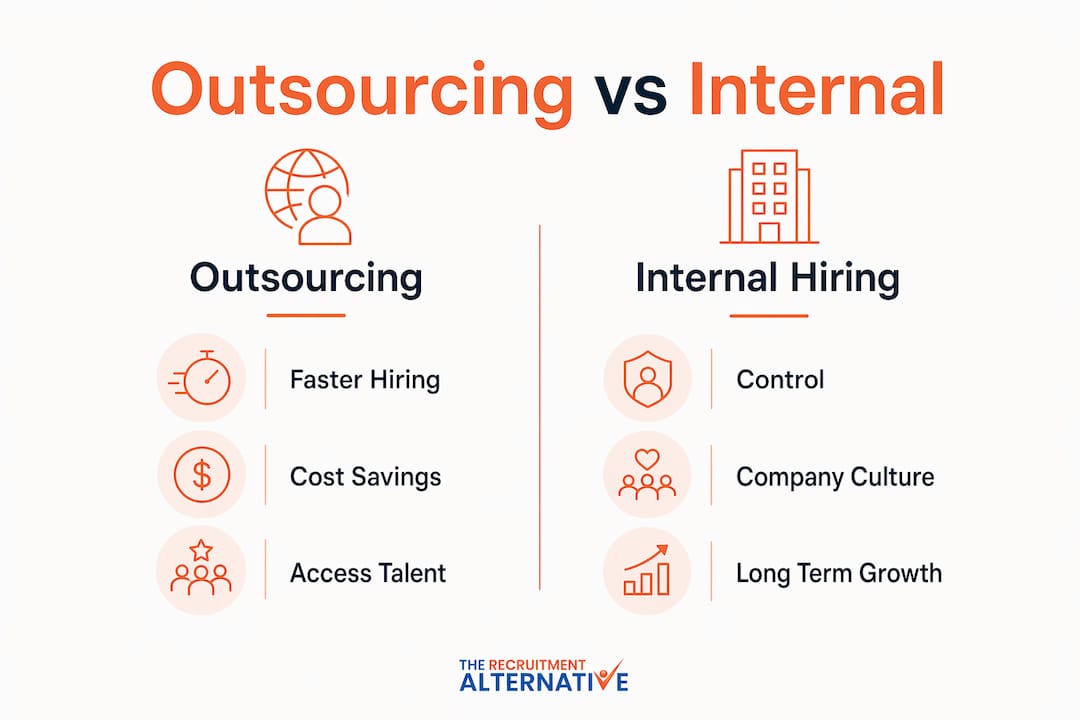
The decision to outsource is not always straightforward. Outsourcing works best in specific circumstances, and understanding those circumstances saves you from spending money where it will not deliver results.
Recruitment outsourcing should be engaged when hiring volume exceeds internal capacity, roles remain unfilled beyond 10–15 days, or specialised skills are needed that your internal team cannot reliably source. These are the conditions where an external partner adds clear, measurable value.
The clearest indicators that outsourcing is the right call:
- Your internal HR team is managing more open roles than they can handle without quality dropping.
- A critical or specialised role has been advertised for two or more weeks without a strong shortlist.
- You are hiring for a function outside your core business, such as technology, finance, or engineering, where your team lacks sector knowledge.
- You are experiencing a volume spike, such as a new contract win or rapid expansion, that your current capacity cannot absorb.
- You have had two or more bad hires in the same role within 18 months, suggesting a process or sourcing problem.
That said, outsourcing alone does not fix broken internal HR functions. Outsourcing should complement internal capability building, not replace it. If your onboarding is poor, your job descriptions are vague, or your hiring managers are inconsistent, an external recruiter will still struggle to deliver lasting results.
Businesses often wait too long to outsource. Engaging external support early, when capacity limits are first reached or roles become difficult to fill, increases recruitment success. Waiting until a role has been vacant for two months means you are already behind.
Pro Tip: Treat outsourcing as a capacity solution, not a cure for internal dysfunction. Fix your recruitment process fundamentals first. Then outsource to scale what already works.
How to select the right recruitment outsourcing partner
Choosing the wrong outsourcing partner costs more than doing nothing. The right partner understands your business, your culture, and the specific talent market you operate in.
Candidate market intelligence often remains with the recruitment provider. Successful partnerships include regular knowledge transfer to the client, so your business retains insight into the talent market even after the engagement ends. Ask any prospective partner how they handle this before you sign anything.
Use this checklist when evaluating a recruitment outsourcing partner:
- Do they have demonstrated experience in your industry or role type?
- Can they show evidence of passive candidate access, not just job board responses?
- Do they offer a clear knowledge transfer process so market intelligence stays with you?
- Is their pricing model transparent, with no hidden fees or percentage-of-salary surprises?
- Do they take time to understand your culture and team dynamics before presenting candidates?
- Can they provide references from businesses of a similar size and sector?
Different outsourcing models suit different needs. A flat-fee model, like the one offered by The Recruitment Alternative, gives you cost certainty regardless of the salary level of the role. A retained model suits executive or highly specialised searches where the recruiter invests significant time upfront. A contingency model means you only pay on placement, but it often results in lower recruiter commitment and higher volume, lower quality shortlists.
| Model | Best suited for | Cost structure | Key risk |
|---|---|---|---|
| Flat fee | SMEs, volume hiring, most permanent roles | Fixed price per placement | None if provider is reputable |
| Retained | Executive and senior leadership roles | Upfront fee plus completion payment | Higher cost, longer timeline |
| Contingency | Low-priority or easily filled roles | Fee on successful placement only | Recruiter prioritises easier roles |
The Recruitment Alternative operates on a flat-fee model across a broad range of industries, including sales, administration, finance, engineering, healthcare, and technology. That structure removes the financial risk of percentage-based fees and makes effective recruitment for SMEs genuinely accessible.
Key takeaways
Outsourcing recruitment services delivers measurable gains in speed, cost, and hire quality when applied to the right roles at the right time.
| Point | Details |
|---|---|
| Speed advantage | Outsourcing can reduce time-to-hire by up to 40%, critical when top talent exits the market within 10 days. |
| Cost reduction | Structured outsourcing reduces agency spend by 30–60% and improves ROI by 15–40% through lower attrition. |
| Specialised access | Specialised consultants reach passive candidates and reduce hiring mismatches through deep industry knowledge. |
| Know when to outsource | Engage external support when volume spikes, roles stay unfilled beyond 10–15 days, or niche skills are needed. |
| Choose the right model | Flat-fee models offer cost certainty for SMEs; retained models suit senior roles; contingency carries quality risks. |
Outsourcing recruitment in Australian SMEs: what I have actually seen work
The businesses I see get the most out of outsourcing are not the ones who hand everything over and walk away. They are the ones who treat their recruitment partner as an extension of their team.
The most common mistake I observe is treating outsourcing as a quick fix for a hiring problem that is actually a business problem. If your employer brand is weak, your interview process is inconsistent, or your offer stage takes three weeks, no external recruiter can fully compensate for that. The best outcomes happen when the internal foundation is solid and outsourcing adds capacity and specialist reach on top of it.
What I find genuinely underappreciated is the value of passive candidate access. Most SME owners think recruitment means advertising a role and waiting. Specialised consultants are already in conversation with candidates who will never apply to a job ad. That is where the real competitive advantage sits, particularly for technical, sales, and leadership roles where the best people are rarely looking.
The flat-fee model has changed the economics of outsourcing for smaller businesses. Historically, a $90,000 salary hire through a traditional agency cost $13,500 to $18,000 in fees. That figure made outsourcing feel out of reach for many SMEs. Fixed-price recruitment removes that barrier entirely and makes it rational to outsource even mid-level roles that previously would have been handled internally, often poorly.
My honest advice: do not wait until a role is critical and urgent before engaging an outsourcing partner. Build the relationship when the pressure is lower. You will get better results, better pricing, and a partner who actually understands your business before the stakes are high.
— Josh Townsend
Affordable recruitment outsourcing for Australian and New Zealand SMEs
The Recruitment Alternative was built specifically to give SMEs access to professional, specialised recruitment without the percentage-based fees that make traditional agencies expensive.
Whether you are filling a single administration role or hiring across multiple functions, The Recruitment Alternative’s flat-fee recruitment model gives you cost certainty and quality candidates without the financial risk. The agency recruits across sales, management, finance, engineering, healthcare, technology, and more, throughout Australia and New Zealand. For SMEs ready to hire smarter, The Recruitment Alternative’s small business recruitment services are a practical, proven starting point.
FAQ
What does outsourcing recruitment services mean?
Outsourcing recruitment services, formally called recruitment process outsourcing (RPO), means delegating some or all of your hiring responsibilities to an external specialist. The provider manages sourcing, screening, and shortlisting on your behalf.
How much can outsourcing recruitment reduce hiring costs?
Structured outsourcing reduces agency spend by 30–60% compared to traditional transactional hiring methods. Flat-fee models offer the greatest cost certainty for SMEs.
What types of roles are best suited to outsourced recruiting?
Outsourced recruiting works well for specialised roles, volume hiring, and positions that have remained unfilled beyond 10–15 days. Senior leadership, technical, and niche roles benefit most from specialised consultant networks.
Does outsourcing recruitment work for small businesses?
Outsourcing works well for small businesses, particularly when using a flat-fee provider like The Recruitment Alternative. It gives smaller teams access to professional sourcing and passive candidate networks without the overhead of an internal HR function.
What should I ask a recruitment outsourcing partner before engaging them?
Ask about their experience in your industry, how they access passive candidates, and how they transfer market intelligence back to your business. Pricing transparency and cultural fit are equally important evaluation criteria.

