

An ongoing recruitment partnership is defined as a long-term, strategic collaboration where a recruitment firm becomes a continuous extension of a business’s hiring function, rather than a one-off service provider. Unlike transactional recruitment, where you engage an agency role by role, a sustained recruitment relationship operates across multiple years under a shared understanding of your organisation’s culture, goals, and talent needs. The result is a talent pipeline that runs continuously, not just when a vacancy appears. For Australian and New Zealand business owners asking what is ongoing recruitment partnership, the short answer is this: it is the difference between reactive hiring and planned, consistent talent acquisition. The Recruitment Alternative works with businesses across Australia on exactly this model, combining flat-fee pricing with deep organisational knowledge built over time.
What is an ongoing recruitment partnership and how does it work?
An ongoing recruitment partnership is a multi-year or annual agreement between a business and a recruitment firm, structured around continuous engagement rather than isolated search mandates. The recruitment firm functions as an embedded part of your hiring process, not a vendor you call in emergencies. This model is sometimes called a retained recruitment partnership or a preferred supplier arrangement, though the defining feature is continuity of engagement, not the contract label.
The practical difference from transactional recruitment is significant. With a one-off agency engagement, the recruiter starts from scratch each time: learning your business, building a shortlist, and moving on once the role is filled. With an ongoing arrangement, the recruiter already knows your team dynamics, your leadership style, and the cultural traits that predict success in your organisation. That institutional knowledge compounds over time and produces better hires with less effort on your part.

Recruitment collaborations of this kind also shift the cost model. Rather than paying a percentage of salary per placement, many ongoing partnerships operate on a predictable flat-fee structure that covers a defined volume of roles across a set period. That predictability makes workforce budgeting far more manageable for growing businesses.
How do recruitment partnerships reduce time-to-hire?
Established recruitment partnerships reduce time-to-hire by bypassing the cold-start problem that slows every transactional engagement. A recruiter who already holds a pre-screened candidate pipeline for your industry and role types does not need to rebuild that pipeline from zero each time you have a vacancy. Standard recruitment cycles for specialised roles typically run 30–60 days. An ongoing partner with an active pipeline can compress that significantly.
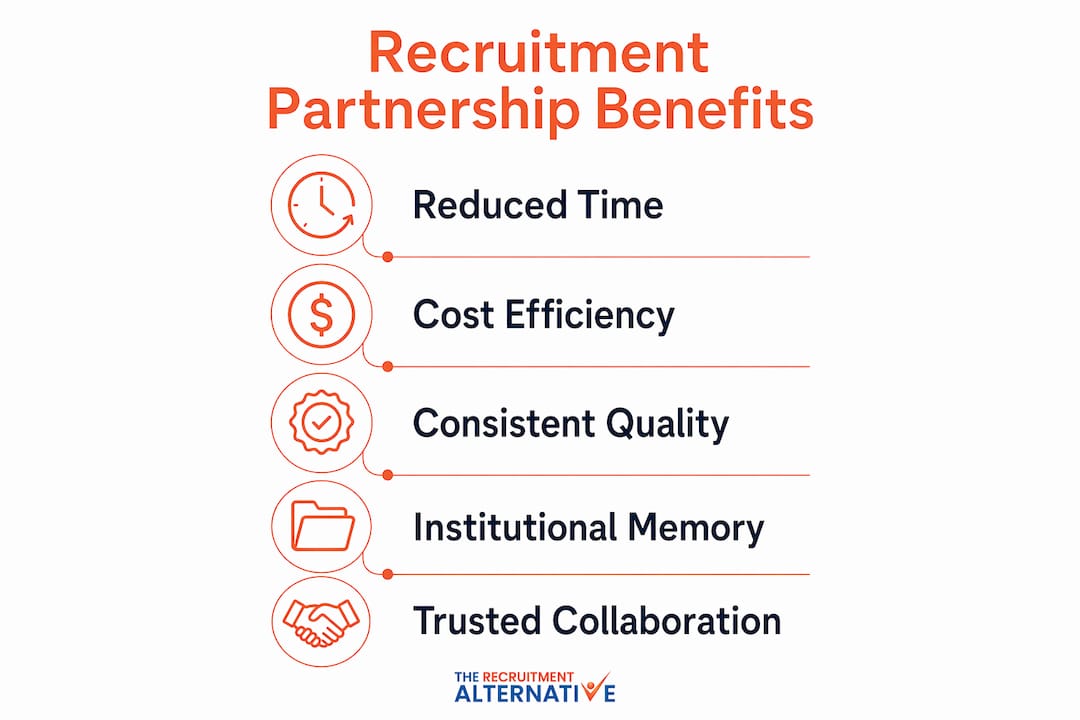
The efficiency gains extend beyond speed. When a recruiter understands your organisation deeply, the quality of shortlisted candidates improves. Fewer rounds of interviews are needed because the recruiter filters more accurately from the start. That means less time pulled from your leadership team and a faster path to a confirmed hire.
Key efficiency advantages of ongoing recruitment strategies include:
- Pre-built candidate pipelines for your industry and role types, reducing sourcing time from weeks to days.
- Niche database access that in-house teams rarely maintain, particularly for technical, executive, or specialist roles.
- Faster brief turnaround because the recruiter already understands your requirements without lengthy onboarding each time.
- Reduced interview rounds due to better initial screening aligned to your culture and performance benchmarks.
- Consistent communication with candidates, protecting your employer brand throughout the process.
Recruiting partners also manage sourcing, screening, scheduling, and candidate communications on your behalf. That frees your internal team to focus on running the business rather than managing a hiring process.
How to establish a recruitment partnership that lasts
Forming a durable recruitment partnership requires more than signing an agreement. The foundation is a thorough kick-off phase where the recruiter invests time learning your organisation before any search begins.
-
Conduct a detailed kick-off meeting. The recruiter should ask about team dynamics, leadership style, past hiring mistakes, and the cultural traits that have predicted success or failure in your business. A good recruiter goes well beyond the job description. They want to understand your organisational red flags as much as your ideal candidate profile.
-
Define the scope and capacity upfront. Agree on the number of roles covered, the timeframe, and the fee structure before work begins. Annual or multi-year agreements with a defined recruiting capacity give both parties clarity and prevent scope disputes later.
-
Start with a proof-of-concept phase. Most businesses assume exclusivity is required from the outset, but successful partnerships often begin with a limited commitment covering one or two roles. This trial phase lets you assess the recruiter’s communication style, candidate quality, and responsiveness before scaling the arrangement.
-
Build in feedback loops. After each placement, review what worked and what did not. Post-placement reviews are the mechanism through which a recruitment partner improves over time. Without structured feedback, the partnership stagnates.
-
Assess cultural alignment with your recruiter. The recruiter represents your brand to every candidate they speak with. Their professionalism, communication style, and values need to reflect well on your business. Assess this during the proof-of-concept phase, not after you have committed to a full-year agreement.
Pro Tip: Ask your recruiter to walk you through a recent placement where the candidate did not work out. How they handled that situation tells you more about their partnership capability than any success story will.
Benefits of recruitment partnerships beyond filling roles
The most underrated benefit of an ongoing recruitment collaboration is institutional memory. A recruiter who has placed five people in your business over two years knows which candidate profiles succeeded and which did not. Tracking why placements succeed or fail enables continuous refinement of screening criteria, leading to higher right-first-time placement rates over time.
This institutional knowledge also feeds into workforce planning. A recruitment partner who understands your growth trajectory can anticipate hiring needs before they become urgent. Continuous talent pipeline development enables more confident planning around future skill requirements, team expansions, and succession gaps.
The benefits extend to employer branding as well. Candidates who interact with a consistent, professional recruiter over multiple touchpoints form a positive impression of your organisation, even when they are not selected. That consistency is difficult to achieve with transactional agencies who may represent dozens of competing clients simultaneously.
“Corporate leaders should regard recruiting as an integral part of human capital planning rather than reactive transactions to build long-term organisational resilience.” — JRG Partners
Ongoing partnerships also protect against rushed hiring decisions. When you have a trusted recruiter engaged continuously, you are less likely to make a poor hire under pressure because the pipeline is already warm. That risk reduction has a direct financial value, given the well-documented cost of replacing a failed hire.
Ongoing partnerships vs. traditional recruitment methods
Understanding where ongoing partnerships outperform other models helps you decide whether the arrangement suits your business. The comparison below covers the most relevant factors for Australian and New Zealand business owners.
| Factor | Ongoing recruitment partnership | Transactional agency | Internal recruitment |
|---|---|---|---|
| Cost structure | Flat-fee or defined capacity agreement | Percentage of salary per placement | Fixed internal salary costs |
| Time-to-hire | Reduced through existing pipelines | Slower due to cold-start each role | Variable, often slow for specialist roles |
| Institutional knowledge | Builds over time with each placement | Resets with each new engagement | Held internally but limited by team capacity |
| Candidate retention | Higher due to culture-fit focus | Variable, depends on brief quality | Variable |
| Employer brand consistency | High, consistent candidate experience | Low, recruiter changes frequently | Moderate |
| Strategic workforce planning | Supported through continuous engagement | Not included | Possible but resource-intensive |
Ongoing partnerships deliver the most value for businesses that hire regularly across multiple roles or departments. They also suit organisations going through growth phases where hiring needs are frequent but not always predictable. For businesses that hire once every two years, a transactional model may be more cost-effective. The decision comes down to hiring volume, role complexity, and how much your business values continuity in the candidate experience.
Outsourcing recruitment functions through a partnership model also integrates well with existing HR teams. The recruiter handles sourcing and screening while your HR team manages onboarding and culture integration. That division of labour works cleanly when roles and responsibilities are defined from the start.
Key takeaways
An ongoing recruitment partnership delivers compounding value over time. The longer the engagement, the sharper the recruiter’s understanding of your business and the better the hiring outcomes.
| Point | Details |
|---|---|
| Definition of the model | An ongoing partnership is a long-term agreement where a recruiter becomes embedded in your hiring process across multiple roles and years. |
| Time-to-hire advantage | Pre-built pipelines and deep role knowledge reduce standard 30–60 day cycles for specialised roles. |
| Kick-off phase matters | A thorough initial briefing on culture, leadership style, and past hiring mistakes sets the quality of every future placement. |
| Institutional memory compounds | Each placement adds to the recruiter’s understanding, improving right-first-time rates over the life of the partnership. |
| Start small, scale up | Proof-of-concept phases reduce commitment risk and let both parties assess fit before signing annual agreements. |
Why I think most businesses underestimate recruitment partnerships
I have seen businesses treat recruitment as a cost to minimise rather than a capability to build. That mindset produces exactly the outcome you would expect: reactive hiring, high turnover, and a revolving door of agency contacts who never really understand the business.
The businesses that get the most from an ongoing recruitment partnership are the ones that treat the recruiter as a genuine stakeholder in their growth. They share organisational context openly, give honest feedback after every placement, and involve the recruiter in workforce planning conversations, not just vacancy briefs. That level of engagement feels like extra work at first. Over time, it pays back significantly in hiring speed, candidate quality, and reduced turnover.
The exclusivity question trips up a lot of business owners. They assume they need to commit fully before they can see results. The smarter approach is a proof-of-concept phase covering one or two roles. That gives you real evidence of the recruiter’s capability without locking in a long-term commitment prematurely. If the relationship works, scaling it is straightforward. If it does not, you have not overcommitted.
The other mistake I see regularly is underusing the recruiter’s market knowledge. A good recruitment partner knows what candidates in your sector are being offered elsewhere, which skills are becoming scarce, and where your compensation benchmarks sit relative to the market. That intelligence is available to you at no extra cost if you ask for it. Most business owners never do.
Recruitment is not a transaction you complete. It is a capability you build. The businesses that treat it that way consistently outperform those that do not, particularly when the labour market tightens and every good candidate has multiple offers on the table.
— Josh Townsend
How The Recruitment Alternative supports ongoing hiring needs
The Recruitment Alternative works with businesses across Australia and New Zealand that need a reliable, consistent recruitment partner without the unpredictable costs of percentage-based agency fees.
The Recruitment Alternative’s flat-fee recruitment model means you know exactly what you are paying before a search begins, regardless of the salary level of the role. That predictability suits businesses building ongoing recruitment arrangements across multiple roles and departments. The team recruits across sales, management, administration, finance, engineering, healthcare, technology, and executive leadership, making it practical to run a single partnership across your entire hiring programme. If you are ready to move from reactive hiring to a planned, continuous approach, contact The Recruitment Alternative to discuss an arrangement that fits your business.
FAQ
What is an ongoing recruitment partnership?
An ongoing recruitment partnership is a long-term, structured arrangement where a recruitment firm operates as a continuous extension of a business’s hiring function across multiple roles and years. It differs from transactional recruitment by building institutional knowledge and a sustained talent pipeline over time.
How does an ongoing recruitment partnership reduce time-to-hire?
Recruitment partners with pre-built candidate pipelines and deep knowledge of your role requirements can bypass the standard 30–60 day sourcing cycle for specialised positions. Faster shortlisting and fewer interview rounds are the direct result.
Do I need to commit exclusively to one recruiter?
Exclusivity is not required from the outset. Successful ongoing partnerships often begin with a proof-of-concept phase covering one or two roles before scaling to a broader annual agreement.
What industries benefit most from ongoing recruitment partnerships?
Businesses hiring regularly across technical, specialist, or leadership roles gain the most from this model, including those in engineering, technology, healthcare, finance, and executive management.
How is an ongoing partnership different from a retained search?
A retained search is typically a single, high-priority executive search paid in instalments. An ongoing recruitment partnership covers multiple roles over an extended period under a continuous engagement model, building organisational knowledge with each placement.

