

Affordable recruitment for small business is defined as hiring permanent staff through fixed-cost or low-overhead methods that avoid traditional agency commission fees. The industry term for the leading alternative is flat-fee recruitment, where a fixed price replaces the standard 15–25% of first-year salary charged by commission-based agencies. For a small business owner in Australia or New Zealand, that distinction is significant. Direct hiring costs already range from $800 to $3,500 per hire before agency fees are added. Choosing the right recruitment model from the start is one of the most direct ways to protect your cash flow and still hire well.
What are the main costs involved in recruitment for small businesses?
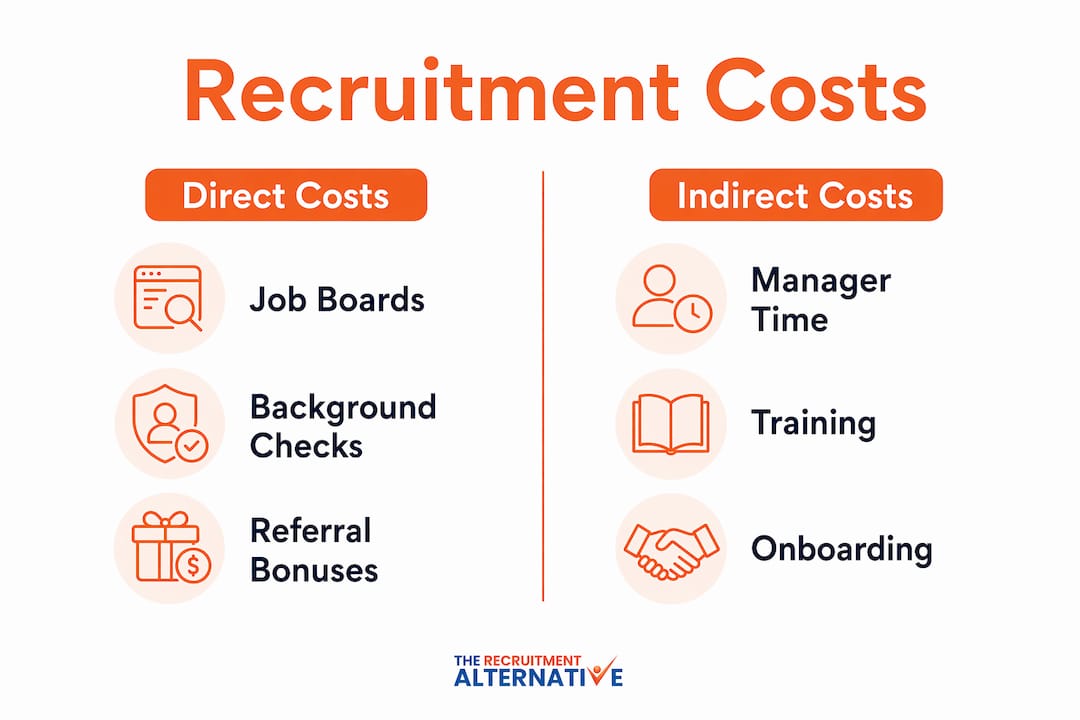
Recruitment costs fall into two categories: direct and indirect. Most small business owners track the direct costs but miss the indirect ones entirely, and that gap is where budgets blow out.
Direct costs include job board advertising, background checks, skills assessments, and any referral bonuses paid to existing staff. These are visible line items you can plan for. Indirect costs are harder to see but just as real. Founder and manager time typically runs 15–25 hours per hire, covering job brief preparation, screening, interviewing, and offer negotiation. Vacancy costs, meaning lost productivity while the role sits empty, can exceed $1,000 per month depending on the function.

The full picture matters even more when you factor in the first year of employment. For a $50,000 salary role, the true first-year cost including taxes, superannuation, equipment, and onboarding sits between $65,000 and $74,000. Running that calculation before you hire prevents cash flow surprises.
| Cost category | Typical amount (AUD) |
|---|---|
| Job board advertising | $300–$800 per role |
| Background and reference checks | $100–$300 per candidate |
| Founder/manager time (15–25 hours) | $1,500–$3,000 per hire |
| Vacancy productivity loss | $1,000+ per month |
| Onboarding and training | $500–$2,000 per hire |
| Traditional agency fee (15–25% of salary) | $7,500–$20,000+ per hire |
| Flat-fee recruitment | $2,000–$4,000 per hire |
The table above shows why the recruitment model you choose matters as much as any other hiring decision. A traditional agency fee on a $60,000 role can reach $15,000. A flat-fee model for the same role typically costs a fraction of that.
How do different recruitment methods affect hiring costs?
The recruitment method you choose sets the cost ceiling for every hire. Four main approaches exist for small businesses: traditional agencies, flat-fee agencies, direct hiring, and employee referrals.
Traditional agencies charge a percentage of the placed candidate’s first-year salary, typically 15–25%. The service is full-service and hands-off for the employer, but the cost is high. For roles above $60,000, fees regularly exceed $10,000 per placement.
Flat-fee recruitment agencies like The Recruitment Alternative charge a fixed price regardless of salary level. The low-cost recruitment model delivers the same sourcing, screening, and shortlisting process at a predictable cost. This model suits small businesses hiring across multiple roles or salary bands.
Direct hiring means advertising on job boards, screening applicants, and managing the process internally. It lowers direct spend but increases the time burden on founders and managers significantly.
Employee referrals are the most cost-effective channel available. Referral hires cost 50–70% less than other methods and stay 25–45% longer. Referral bonuses typically range from $500 to $2,000 and are paid after 90 days, making them a low-risk investment.
Pros and cons of each method:
- Traditional agency: Full service, fast access to passive candidates, but high cost and limited transparency on fees.
- Flat-fee agency: Predictable cost, professional process, quality candidates, and significant savings over commission models.
- Direct hiring: Lowest direct spend, but high time cost and risk of a poor-quality shortlist without recruitment expertise.
- Employee referrals: Lowest total cost and best retention outcomes, but limited reach and not suitable for all roles.
Pro Tip: Combine referrals for junior and mid-level roles with a flat-fee agency for specialist or senior positions. This split approach keeps average cost per hire low across your whole hiring programme.
What strategies can small businesses use to reduce recruitment expenses?
Reducing recruitment costs without lowering hire quality requires changes to both process and sourcing. The biggest gains come from three areas: interview structure, referral programmes, and onboarding.
Limit interview stages to three
Every extra interview stage beyond three reduces offer acceptance rates by 11% and increases time-to-fill by 4–7 days. Fewer stages mean faster decisions, lower manager time costs, and better candidate experience. Standardise your questions and use a scoring rubric so each stage has a clear purpose.
Build a referral programme
A structured referral programme is one of the fastest ways to reduce sourcing costs. Set a bonus of $500 to $2,000 paid at the 90-day mark. Communicate the programme clearly to all staff and refresh it each time a new vacancy opens. Referral hires arrive pre-screened by someone who knows your culture, which reduces early turnover risk.
Use automation for screening and scheduling
Applicant tracking systems and AI screening tools reduce manual workload and speed up the hiring process. Tools that automate interview scheduling alone save several hours per hire. The time saving translates directly to lower indirect costs, particularly for founders managing recruitment alongside other responsibilities.
Fix onboarding before chasing cheaper job boards
One failed hire within 60–90 days costs between $15,000 and $50,000 when you account for lost productivity, re-advertising, and re-hiring time. That figure dwarfs the cost of any job board or agency fee. A structured 90-day onboarding plan with clear milestones and regular check-ins is the single highest-return investment in your recruitment process.
Negotiate agency fees with usage data
Auditing and renegotiating agency fees based on your own hiring volume can reduce costs by 3–5%. If you hire regularly, consistent volume gives you leverage. Bring your placement history to the conversation and ask for a volume discount or a fixed-fee arrangement.
What are the practical steps for implementing affordable hiring solutions?
A clear process prevents budget overruns and keeps hiring quality consistent. The steps below apply to any small business in Australia or New Zealand starting to formalise their recruitment approach.
- Set a recruitment budget. Calculate direct costs (advertising, checks, referral bonuses) and indirect costs (manager time, vacancy loss). Use the cost table from the earlier section as a starting point.
- Choose your recruitment model. Decide whether each role suits direct hiring, a referral, or a flat-fee agency. Senior and specialist roles typically justify agency support. Junior and operational roles often suit direct or referral hiring.
- Create a referral programme. Set the bonus amount, define the eligibility period (90 days is standard), and communicate it to all staff before the role is advertised.
- Limit interview stages to three. Write standardised questions for each stage and use a scoring sheet. This reduces time-to-fill and improves consistency across hiring managers.
- Automate repetitive tasks. Use an applicant tracking system to manage applications, automate acknowledgement emails, and schedule interviews. Free or low-cost ATS options exist for businesses hiring fewer than 20 roles per year.
- Build a 90-day onboarding plan. Map out week-by-week milestones, assign a buddy or mentor, and schedule formal check-ins at 30, 60, and 90 days.
- Track three KPIs. Measure time-to-fill, cost per hire, and 90-day retention rate. These three numbers tell you whether your recruitment process is working or where it needs attention.
Pro Tip: Review your recruitment process at the end of each financial year. Compare cost per hire and 90-day retention across different roles and channels. The data will show you exactly where to invest and where to cut.
How do you evaluate affordable recruitment partners in Australia and New Zealand?
Choosing a recruitment partner is a business decision, not just a procurement exercise. The wrong choice costs more than doing nothing.
The most important criterion is fee transparency. A genuine flat-fee provider publishes a fixed price per placement with no percentage uplift based on salary. If a provider’s pricing changes based on the role’s salary, it is a commission model with a different label. Ask for the full fee schedule in writing before signing anything.
The second criterion is industry coverage. A generalist agency that recruits across multiple sectors gives you flexibility as your business grows. Specialist agencies can be valuable for niche technical roles, but they typically charge higher fees and have narrower candidate pools.
The third criterion is local market knowledge. Recruitment conditions in Sydney, Melbourne, Auckland, and Brisbane differ meaningfully. A provider with active operations in your market will have a more relevant candidate pipeline and better insight into local salary benchmarks.
| Recruitment model | Fee structure | Transparency | Best suited for |
|---|---|---|---|
| Commission-based agency | 15–25% of salary | Low | Large businesses with high-margin roles |
| Flat-fee agency | Fixed price per placement | High | Small businesses, multiple hires |
| Direct hiring | Advertising costs only | High | High-volume, lower-skill roles |
| Employee referral programme | Bonus ($500–$2,000) | High | Culture-fit and retention-focused hires |
Regulatory considerations also apply. In Australia, recruitment agencies must hold a valid labour hire licence in states where it is required, including Queensland, Victoria, South Australia, and the Australian Capital Territory. In New Zealand, the Employment Relations Act 2000 governs the obligations of labour hire arrangements. Confirm compliance before engaging any provider.
Key takeaways
Flat-fee recruitment is the most cost-effective model for small businesses in Australia and New Zealand, delivering professional hiring at a fraction of traditional agency costs.
| Point | Details |
|---|---|
| True cost of a hire | Total hiring costs including indirect expenses reach $3,000–$8,000 per hire before agency fees. |
| Referrals cut costs sharply | Referral hires cost 50–70% less and stay 25–45% longer than candidates from other channels. |
| Limit interview stages | Keeping interviews to three stages reduces time-to-fill and improves offer acceptance rates. |
| Onboarding drives ROI | A failed hire within 90 days costs $15,000–$50,000, making onboarding the highest-return investment. |
| Flat-fee beats commission | Fixed-price recruitment removes salary-linked fee escalation and delivers predictable hiring costs. |
Why onboarding is the most underrated cost lever in small business hiring
Most small business owners I speak with focus their cost-reduction efforts on the front end of recruitment: cheaper job boards, shorter agency contracts, faster screening. That instinct is understandable. The fees are visible and the savings feel immediate.
The real money, though, is at the back end. A hire who leaves within 90 days does not just cost you the recruitment fee again. It costs you the lost productivity during the vacancy, the manager time spent re-hiring, the onboarding investment you cannot recover, and the morale impact on the team left behind. The true cost of a failed hire sits between $15,000 and $50,000. No job board saving comes close to that number.
The businesses I have seen get this right share one habit: they treat the first 90 days as part of the recruitment process, not a separate HR function. They assign a clear point of contact, set written milestones, and check in formally at 30, 60, and 90 days. That structure alone reduces early exits significantly.
My honest advice is to audit your last five hires. How many left within six months? What did each one cost in total? That exercise usually reframes the entire conversation about where to invest in recruitment. Cheaper sourcing is worth pursuing. But a structured onboarding programme will deliver a better return on every dollar you spend on hiring.
— Josh Townsend
Affordable recruitment services built for small businesses
Small business owners across Australia and New Zealand deserve access to professional recruitment without paying commission-based fees that scale with salary. The Recruitment Alternative was built specifically to solve that problem.
The Recruitment Alternative offers flat-fee recruitment for permanent roles across sales, administration, finance, engineering, healthcare, technology, trades, and executive leadership. One fixed price covers the full recruitment process, from job brief through to shortlist, regardless of the role’s salary level. For small businesses hiring across multiple roles or salary bands, the savings over traditional agency fees are substantial. If you are ready to hire permanent staff without the commission overhead, explore affordable recruitment for small businesses and see how the flat-fee model works in practice.
FAQ
What is flat-fee recruitment and how does it work?
Flat-fee recruitment charges a single fixed price per placement regardless of the candidate’s salary. The Recruitment Alternative uses this model to give small businesses a predictable hiring cost with no percentage-based fee escalation.
How much does it cost to hire a new employee in Australia?
Direct hiring costs range from $800 to $3,500 per hire excluding agency fees. Total costs including manager time and vacancy loss typically reach $3,000 to $8,000 per hire.
How many interview stages should a small business use?
Three stages is the recommended maximum. Each additional stage beyond three reduces offer acceptance rates by 11% and adds 4–7 days to time-to-fill.
Are employee referral programmes worth it for small businesses?
Referral hires cost 50–70% less than other hiring channels and stay 25–45% longer. A referral bonus of $500 to $2,000 paid at 90 days is a low-risk, high-return investment for most small businesses.
What should I look for when choosing a recruitment agency in Australia?
Prioritise transparent fixed-fee pricing, local market knowledge, and broad industry coverage. Confirm the agency holds the required labour hire licences in your state before signing any agreement.

