

Permanent recruitment is defined as the process of hiring full-time, indefinite-term employees placed directly onto a company’s payroll. Unlike temporary or contract arrangements, permanent roles have no predetermined end date and carry a clear expectation of ongoing employment. For small businesses and HR professionals across Australia and New Zealand, understanding what permanent recruitment involves is the first step toward building a workforce that actually lasts. The Recruitment Alternative works with businesses of all sizes to fill these roles affordably and efficiently, using a flat-fee model that removes the cost uncertainty of traditional percentage-based agency fees.
What is permanent recruitment and how does it differ from other hiring types?
Permanent recruitment is the hiring of employees into open-ended roles that form the core of a business’s workforce. These employees appear on the company’s payroll, receive full employment entitlements, and are expected to remain with the organisation long term. Permanent employees generally receive full benefits including paid leave, superannuation, and other entitlements that temporary or casual staff typically do not receive. That distinction matters because it affects both the cost of employment and the quality of commitment you can expect from the hire.
Temporary recruitment, by contrast, fills short-term gaps. A temporary worker is engaged for a fixed period or specific project, with no expectation of continuing employment once that term ends. Contract recruitment sits in a similar space, where a specialist is engaged for a defined scope of work, often at a higher day rate, without the full benefits of permanent employment. The right model depends on what your business actually needs.
| Feature | Permanent recruitment | Temporary recruitment | Contract recruitment |
|---|---|---|---|
| Employment duration | Indefinite | Fixed term | Project or time-bound |
| Payroll responsibility | Employer | Employer or agency | Employer or agency |
| Benefits entitlements | Full (leave, super) | Limited or none | Limited or none |
| Cultural alignment | High priority | Low priority | Low priority |
| Typical use case | Core team roles | Seasonal or cover needs | Specialist project work |
For Australian and New Zealand small businesses, permanent recruitment is the right choice when you need someone to grow with the business, carry institutional knowledge, and contribute to team culture over time.

What is the typical permanent hiring process for small businesses?
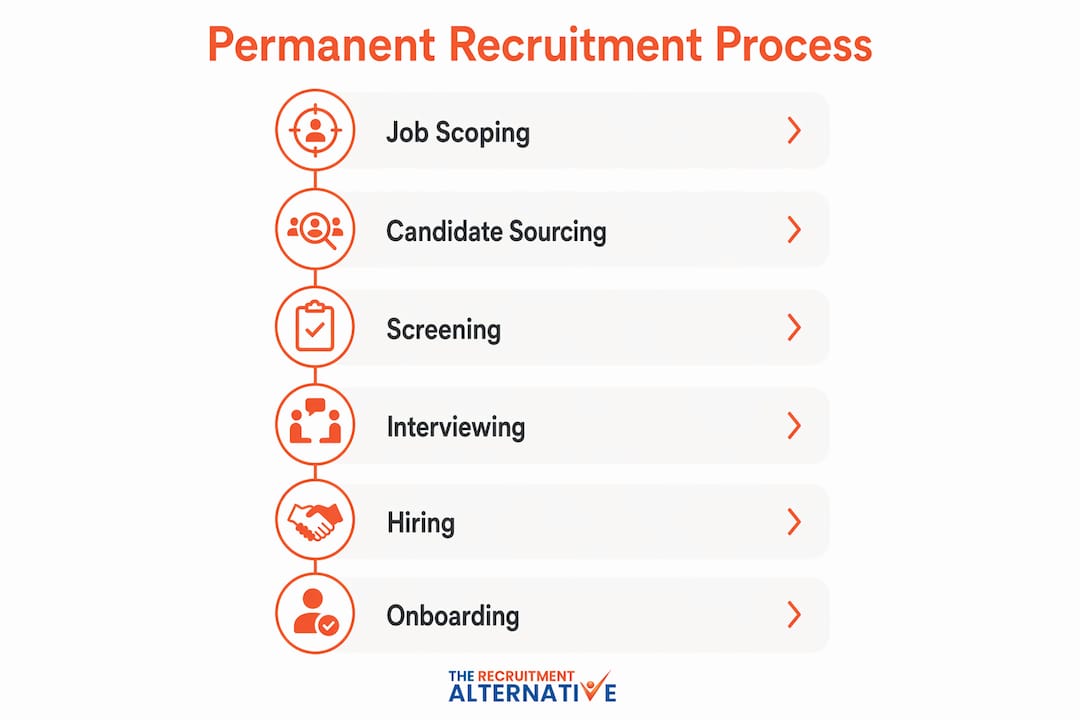
The permanent hiring process follows a clear sequence, and understanding each stage helps you manage timelines and expectations. The process typically takes 30–90 days from job scoping to offer acceptance. That timeline reflects the depth of work involved, not inefficiency.
- Job scoping. Define the role clearly before advertising. Include responsibilities, required skills, reporting lines, and salary range. Vague briefs produce vague candidates.
- Candidate sourcing. This includes advertising on job boards, searching internal databases, and proactively approaching passive candidates who are not actively job hunting. Specialist agencies access passive candidate networks that internal teams rarely reach.
- Screening. Review applications, conduct phone screens, and shortlist candidates who meet the brief. This stage filters volume down to quality.
- Interviewing. Conduct structured interviews, skills assessments, and reference checks. For senior roles, multiple interview rounds are standard.
- Offer negotiation. Present the offer, manage counteroffers, and confirm acceptance. This stage requires care, as poor handling causes candidate drop-off.
- Onboarding. A structured onboarding programme improves retention and speeds up time to productivity. Many businesses underinvest here.
Replacement guarantees are a key feature of agency-supported permanent recruitment. Guarantees typically range from 60 days to 12 months, meaning the agency will replace the candidate at no additional cost if the hire does not work out within that period. That protection significantly reduces the financial risk of a poor hire.
Pro Tip: Treat candidate experience as part of your employer brand. Slow response times and poor communication during the hiring process push quality candidates toward other offers. Set clear timelines and stick to them.
What are the benefits of permanent recruitment for small businesses?
Permanent recruitment builds workforce stability in a way that temporary or contract hiring cannot. Permanent employees tend to stay longer and align more closely with company culture, which reduces the cost and disruption of repeated hiring cycles. For a small business, losing a key team member is not just an HR problem. It affects client relationships, team morale, and day-to-day output.
The financial case for quality permanent hiring is strong. A bad hire can cost up to 300% of that person’s annual salary when you factor in lost productivity, team disruption, and the cost of rehiring. That figure makes the upfront investment in a thorough recruitment process look modest by comparison.
Permanent recruitment is an investment in human capital that builds long-term business stability through stronger culture and institutional knowledge. Permanent employees who are well-matched to a role and organisation outperform transient staff on every measure that matters to a growing business.
Key benefits for small businesses and HR professionals include:
- Reduced turnover costs. Retaining a good permanent employee costs far less than replacing one.
- Institutional knowledge. Permanent staff accumulate product, process, and client knowledge that cannot be quickly transferred.
- Cultural alignment. Long-term employees shape and reinforce the culture you are building.
- Productivity gains. Settled, engaged permanent employees outperform workers who know their role is temporary.
- Team morale. Stability in the team reduces anxiety and improves collaboration.
For guidance on retaining good staff after hiring, the investment in permanent recruitment pays dividends well beyond the initial placement.
What types of permanent recruitment services are available?
Small businesses have three main service options when it comes to permanent staff hiring: direct hire, contingency agency recruitment, and retained agency recruitment. Each suits different situations, and understanding the differences helps you choose the best fit for your budget and role.
Direct hire means your internal team manages the entire process. You write the job ad, screen applicants, conduct interviews, and make the offer. This avoids agency fees but carries a significant internal cost. Direct hiring often consumes 30–90 days of HR time screening applicants, and internal teams rarely have access to passive candidates. For high-volume or lower-skilled roles, direct hire can be cost-effective. For specialist or senior roles, the risk of a poor outcome is high.
Contingency recruitment means you engage an agency and pay a fee only when a successful placement is made. Contingency recruiting suits roles where speed and cost control matter. Multiple agencies can work the role simultaneously, which increases candidate volume but may reduce the depth of each search.
Retained recruitment requires an upfront payment, typically around one-third of the total fee, for an exclusive and dedicated search. Retained searches engage dedicated resources for complex or senior roles, providing market intelligence and depth that contingency searches cannot match. This model suits executive, technical, or mission-critical appointments.
| Service type | Fee structure | Best suited for | Speed | Risk level |
|---|---|---|---|---|
| Direct hire | Internal costs only | High-volume, lower-skilled roles | Slow | High (limited reach) |
| Contingency agency | Fee on placement | Mid-level roles, cost-sensitive briefs | Moderate | Medium |
| Retained agency | Upfront plus completion | Senior, specialist, executive roles | Thorough | Low |
| Fixed-fee agency | Flat fee regardless of salary | SMEs seeking budget certainty | Moderate | Low |
The Recruitment Alternative operates on a fixed-fee model, which removes the salary-percentage calculation entirely. That structure gives small businesses budget-predictable hiring without sacrificing the quality of a full agency search.
Pro Tip: When selecting an agency, ask specifically about their candidate database for your industry. Agencies with specialised candidate databases reach talent that job boards never surface, particularly for technical, trade, or specialist roles.
How can small businesses get better results from permanent recruitment?
Getting permanent recruitment right requires more than posting a job ad and waiting. The businesses that hire well treat recruitment as a process, not an event.
Common pitfalls to avoid:
- Vague job briefs. Undefined roles attract mismatched candidates and waste everyone’s time. Spend the time upfront to define the role precisely.
- Moving too slowly. Strong candidates receive multiple offers. A process that drags past 60 days loses good people to faster-moving employers.
- Skipping reference checks. References surface information that interviews do not. They are not optional for permanent hires.
- Neglecting onboarding. A poor onboarding experience increases early attrition. The hire is not complete until the person is settled and productive.
- Ignoring employer brand. Candidates research your business before accepting offers. Your online presence, reviews, and reputation affect who applies and who accepts.
Agency support is recommended for specialist or senior roles where the cost of a bad hire outweighs the agency fee. For core team roles, a fixed-fee agency delivers professional sourcing and screening at a predictable cost. For practical guidance on small business hiring best practices, aligning your recruitment approach with your business goals makes every hire more effective.
Monitoring post-hire outcomes also matters. Track time-to-productivity, 90-day retention, and manager satisfaction scores. That data tells you whether your recruitment process is working and where to improve it.
Key takeaways
Permanent recruitment is the most cost-effective long-term hiring strategy for small businesses when it is done with a clear process, the right service model, and a focus on quality over speed.
| Point | Details |
|---|---|
| Permanent recruitment defined | Hiring full-time, indefinite-term employees onto your payroll for long-term workforce stability. |
| Cost of a bad hire | A poor permanent hire can cost up to 300% of annual salary in lost productivity and rehiring costs. |
| Typical process timeline | The permanent hiring process takes 30–90 days and includes sourcing, screening, interviewing, and onboarding. |
| Service model choice | Fixed-fee and contingency agencies suit SMEs; retained searches suit senior or specialist roles. |
| Key success factor | Clear job scoping, fast decision-making, and structured onboarding determine whether a hire succeeds. |
Why permanent recruitment deserves more respect in small business
Small businesses in Australia and New Zealand often treat recruitment as a cost to minimise rather than an investment to get right. I have seen this play out repeatedly. A business delays filling a role to save money, then rushes the hire when the pressure becomes unbearable, and ends up with someone who leaves within six months. The total cost of that sequence far exceeds what a thorough, well-supported recruitment process would have cost from the start.
The misconception I encounter most often is that permanent recruitment is only for large organisations with dedicated HR teams. That is simply not true. A well-run small business with five employees needs quality permanent hires more than a corporation with five hundred, because every person carries more weight. One wrong hire in a team of five disrupts the entire operation.
The other trend worth noting in the Australian and New Zealand market is the shift toward fixed-fee recruitment. Businesses are increasingly questioning why they should pay a percentage of salary when the work involved in placing a $60,000 administrator is not materially different from placing a $90,000 one. Fixed-fee models answer that question directly, and they are changing how small businesses think about working with a recruitment consultant.
My advice is straightforward. Invest in getting the brief right, choose a service model that matches the role’s complexity, and treat the candidate experience as seriously as you treat the client experience. The businesses that do this consistently build teams that stay, perform, and grow with them.
— Josh Townsend
How The Recruitment Alternative supports permanent hiring for SMEs
The Recruitment Alternative specialises in recruiting top staff for small and medium businesses across Australia and New Zealand, using a flat-fee model that delivers full agency service at a fraction of traditional costs. There are no percentage-of-salary surprises, just a transparent fixed price and a proven process.
The team recruits across sales, administration, finance, engineering, healthcare, technology, trades, and executive leadership. Every placement comes with a replacement guarantee, so your investment is protected if the hire does not work out. Whether you are filling your first permanent role or building out a whole team, The Recruitment Alternative brings the sourcing reach, screening depth, and industry knowledge that internal hiring simply cannot match.
FAQ
What is permanent recruitment?
Permanent recruitment is the process of hiring full-time, indefinite-term employees directly onto a company’s payroll. These roles have no predetermined end date and carry full employment entitlements including leave and superannuation.
How long does the permanent recruitment process take?
The permanent recruitment process typically takes 30–90 days, covering job scoping, candidate sourcing, screening, interviewing, offer negotiation, and onboarding.
What is the difference between permanent and temporary recruitment?
Permanent recruitment fills open-ended roles with full employment benefits, while temporary recruitment fills fixed-term roles with limited or no entitlements and no expectation of ongoing employment.
What does a replacement guarantee mean in permanent recruitment?
A replacement guarantee means the recruitment agency will find a replacement candidate at no additional cost if the original hire leaves within a specified period, typically ranging from 60 days to 12 months.
When should a small business use a recruitment agency for permanent hiring?
Agency support is recommended for specialist, technical, or senior roles where the cost of a bad hire is high. For these roles, the agency fee is outweighed by the reduced risk and access to passive candidates that internal teams cannot reach.

