

A recruitment brief is defined as an internal strategic document that captures the full picture of a role, including technical requirements, business context, team dynamics, and success metrics for the first 3–12 months. Unlike a job description, which is an external marketing tool, a recruitment brief aligns your internal team and your recruitment partner around a shared, detailed understanding of what the right hire actually looks like. Employers who treat this document as a genuine strategic tool, rather than a procedural formality, consistently achieve better shortlists, faster decisions, and stronger long-term hires. The Recruitment Alternative works with employers across Australia to build briefs that drive results from the very first conversation.
What is a recruitment brief and how does it differ from a job description?
A recruitment brief is a strategic internal document. It goes well beyond listing duties and qualifications. Where a job description tells the market what a role involves, a recruitment brief tells your recruiter why the role exists, what success looks like, and what kind of person will thrive in your specific environment.
The distinction matters because job descriptions serve as external marketing tools, written to attract applicants. A recruitment brief is written to inform and guide. It gives your recruiter the context to screen candidates with precision, ask the right questions, and present your opportunity compellingly to people who are not actively looking.
Think of it this way. A job description opens the door. A recruitment brief tells the recruiter exactly who should walk through it and why they would want to.
What key elements should a recruitment brief include for permanent staff hires?
An effective recruitment brief covers six core areas. Each one removes a layer of assumption from the process.

Role context and business rationale
Start with why the role exists. Is it a replacement, a growth hire, or a response to a structural change? Describe what the business needs this person to achieve in their first 3–6 months. Concrete success metrics here are far more useful than vague performance language.
Technical and soft skill requirements
Limiting must-haves to 3–5 non-negotiables reduces time spent on unsuitable candidates. Separate mandatory qualifications and experience from skills that can be developed on the job. The best briefs also distinguish between trainable skills and cultural fit factors, creating a candidate profile that is precise yet adaptable.
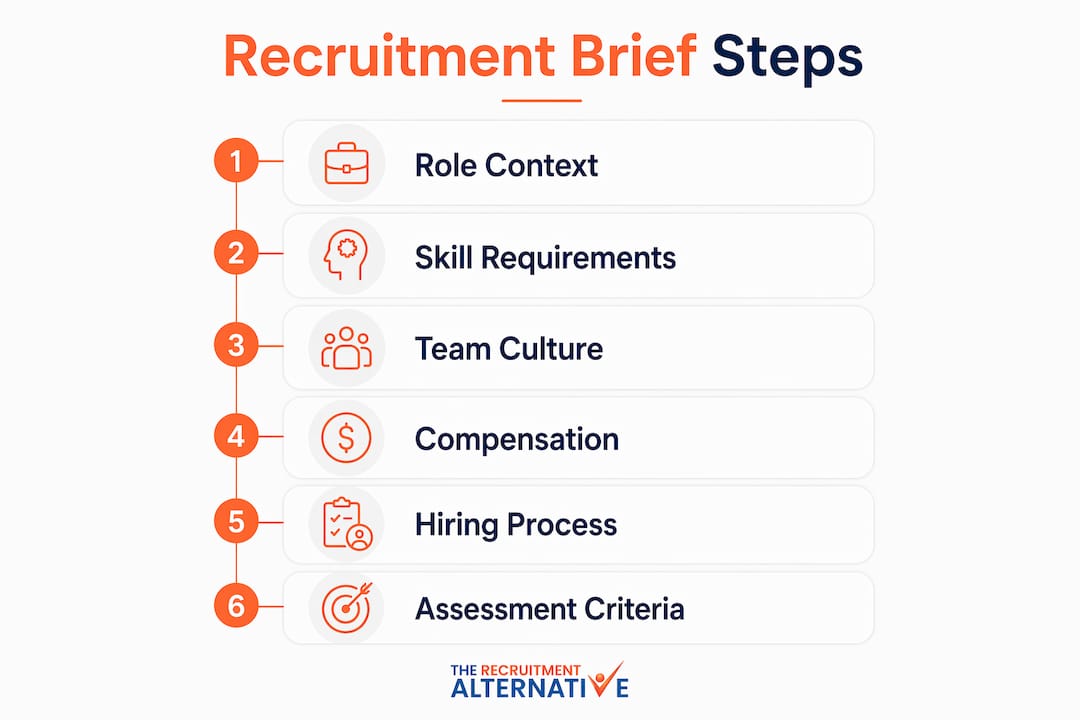
Team and organisational culture
Describe the team structure, reporting lines, and working style. Is the environment fast-paced or process-driven? Does the team value autonomy or close collaboration? These details help recruiters assess fit beyond the CV.
Salary, package, and flexibility
Transparent salary ranges, not aspirational figures, prevent candidate drop-off and shortlisting inefficiencies. Include superannuation, bonuses, flexible working arrangements, and any other benefits upfront. Candidates at the quality end of the market will not engage with vague or evasive compensation details.
Hiring process and timeline
Outline the number of interview stages, who is involved, and your target start date. Recruiters use this to set candidate expectations and maintain momentum through the process.
Screening and assessment criteria
Specify any testing, reference check requirements, or work rights considerations. The more your recruiter knows, the less time is lost on candidates who cannot proceed.
Pro Tip: Write your brief as if you are briefing a recruiter who has never met you, never visited your office, and knows nothing about your industry. If they could build a precise candidate profile from your document alone, the brief is working.
How does a recruitment brief improve hiring outcomes?
The difference between a recruitment brief and a job description is not just format. It is the quality of what follows. Specific, well-contextualised briefs generate more genuine interest and faster, higher quality applications. That is because a strong brief enables your recruiter to engage passive candidates, the high performers who are not browsing job boards, with a credible, compelling narrative about your opportunity.
The table below shows how the two documents compare across key hiring outcomes.
| Dimension | Job description | Recruitment brief |
|---|---|---|
| Primary audience | Job seekers | Recruiters and internal hiring teams |
| Purpose | Attract applications | Align expectations and guide sourcing |
| Candidate quality | Variable, volume-driven | Targeted, quality-driven |
| Passive candidate reach | Limited | High, through recruiter advocacy |
| Hiring speed | Slower, more iterations | Faster with clear criteria |
| Market adaptability | Static | Iterative, refined with feedback |
Effective collaboration between employers and recruiters in the briefing process accelerates hiring and improves candidate fit. That acceleration comes from alignment. When your recruiter understands the business problem you are solving, not just the role you are filling, they can make better decisions at every stage of the search.
The brief also supports better recruitment process improvement over time. Each search generates market intelligence. Salary benchmarks, skill availability, and candidate expectations all feed back into the brief, making your next hire faster and sharper.
What are common mistakes employers make when creating recruitment briefs?
Most employers who struggle with recruitment briefs make the same errors. Recognising them early saves significant time and cost.
-
Treating the brief as a formality. Viewing the recruitment brief as merely procedural reduces hiring success. The brief is a strategic conversation, not a form to complete. Engaged hiring managers who share genuine insight into role outcomes give their recruiter a significant advantage.
-
Creating a fixed document. Most hiring managers treat briefs as static, but effective briefs must be iterative. If the market is not producing candidates who match your original criteria, the brief needs to flex. Refusing to adapt based on real-world feedback leads to longer searches and weaker shortlists.
-
Providing vague or incomplete information. Incomplete briefs cause recruiters to make assumptions, which leads to mismatched shortlists and extended timelines. Vague language like “strong communicator” or “team player” without context is not useful. Describe what those qualities look like in your specific role and environment.
-
Listing too many must-haves. When every requirement is non-negotiable, the candidate pool shrinks to near zero. Prioritise ruthlessly. Three to five genuine non-negotiables is the right number for most permanent roles.
-
Not collaborating with your recruitment partner. A brief written in isolation, without input from your recruiter, misses a critical perspective. Your recruiter knows the current market. They can tell you whether your salary range is competitive, whether your timeline is realistic, and whether your ideal candidate profile actually exists. Use that knowledge before you finalise the document.
Pro Tip: After your first round of candidate feedback, schedule a 15-minute debrief with your recruiter. Use what you learn to refine the brief before the second round. This single habit cuts average search time significantly.
If you want to avoid the most common recruitment mistakes, treating the brief as a living document is the single most effective change you can make.
How to collaborate with recruitment agencies using your recruitment brief
The brief is not the end of the conversation. It is the beginning. Employers who get the most from their recruitment partners treat the brief as a shared working document, not a handover note.
Effective collaboration looks like this:
- Share complete and honest information. Tell your recruiter about previous failed searches, internal candidates who were considered, and any sensitivities around the role. Gaps in context create gaps in the shortlist.
- Engage in a discovery conversation. The best recruiters will ask questions that challenge your assumptions. Welcome that. A recruiter who pushes back on your salary range or skills list is doing their job well.
- Use the brief to sell the role. The recruitment brief transforms hiring from transactional to strategic by enabling recruiters to present compelling narratives to passive candidates. Give your recruiter the material they need: growth opportunities, team culture, leadership quality, and the genuine appeal of the role.
- Build a feedback loop. After each round of CVs, share specific feedback. “Not quite right” is not useful. “Strong technical skills but lacks the stakeholder management experience we need” is. Specific feedback refines the search.
- Set realistic timelines. Rushed briefs produce rushed hires. If you are hiring staff in a hurry, be transparent about that constraint so your recruiter can adjust their sourcing approach accordingly.
Working effectively with a recruitment agency starts with the quality of the brief you bring to the first meeting. The more your recruiter knows, the better they perform.
Key takeaways
A recruitment brief is the single most important document in a permanent hiring process, and treating it as a strategic, iterative tool is what separates fast, quality hires from prolonged, costly searches.
| Point | Details |
|---|---|
| Brief vs job description | A recruitment brief aligns internal teams and recruiters; a job description markets the role externally. |
| Core components | Include role context, non-negotiable skills, culture, transparent salary, and hiring timeline. |
| Iterative approach | Refine the brief after 2–3 weeks of market feedback to improve shortlist quality and reduce search time. |
| Collaboration is critical | Share complete information and specific feedback with your recruiter at every stage of the search. |
| Avoid vague criteria | Limit must-haves to 3–5 non-negotiables and describe soft skills with specific, contextual examples. |
The brief is where hiring is won or lost
I have worked with hundreds of employers across Australia, and the pattern is consistent. The hires that go wrong almost always trace back to a brief that was incomplete, rushed, or never revisited after the first round of candidates. The hires that go right almost always start with a hiring manager who treated the brief as a genuine conversation.
What surprises most employers is how much the brief reveals about their own clarity. When you sit down to write what success looks like in 12 months, or to separate your genuine non-negotiables from your wish list, you often discover that internal alignment was missing before the recruiter ever entered the picture. The brief forces that conversation. That is its hidden value.
The other thing I see consistently is resistance to adapting the brief when the market pushes back. Clients who resist adapting their briefs to real-time market data experience longer searches and poorer candidate quality. The market is not wrong. If your ideal candidate does not exist at your salary range, the brief needs to change. The sooner you accept that, the faster you hire.
A strong brief does not just help your recruiter find candidates. It helps your recruiter advocate for your business to people who were not looking for a new role. That advocacy is what gets you access to the best talent in the market.
— Josh Townsend
Recruitment briefs that work: how The Recruitment Alternative can help
Getting a recruitment brief right from the start is where The Recruitment Alternative adds real value for employers across Australia.
The Recruitment Alternative offers flat-fee permanent recruitment across a broad range of industries, including sales, management, administration, finance, engineering, healthcare, and technology. Every engagement starts with a thorough briefing process, where our consultants work with you to build a precise, market-tested candidate profile. You get expert guidance on structuring your brief, realistic salary benchmarking, and a recruitment partner who will challenge and refine the brief as the search progresses. For employers who want quality hires without the commission-based price tag, learn how recruitment agencies work and what to expect from a well-structured engagement.
FAQ
What is the difference between a recruitment brief and a job description?
A job description is an external document used to attract applicants. A recruitment brief is an internal document that aligns your hiring team and recruiter around the full context of the role, including business rationale, success metrics, culture, and compensation.
How long should a recruitment brief be?
There is no fixed length, but an effective brief covers role context, skills requirements, culture, salary, and hiring process in enough detail that a recruiter could build a precise candidate profile without asking follow-up questions.
When should you update a recruitment brief?
Effective briefs are iterative and should be reviewed after 2–3 weeks of market feedback. If candidates are not matching expectations, refine the criteria, salary range, or role scope before continuing the search.
What are the most important elements to include in a recruitment brief?
The non-negotiable elements are role context, 3–5 must-have criteria, transparent salary range, team culture description, and a clear hiring timeline. These give your recruiter everything they need to source and screen with precision.
Can a recruitment brief help attract passive candidates?
A well-constructed brief gives recruiters the material to present a compelling narrative to candidates who are not actively looking. Specific, contextualised briefs generate stronger interest from high-quality candidates who would otherwise ignore a generic job advertisement.

