

Recruitment advertising is the practice of creating and distributing candidate-facing communications to attract qualified applicants for open roles. It sits within the broader talent acquisition process, distinct from recruitment marketing but before screening begins. For small business owners and HR managers across Australia and New Zealand, understanding this distinction is the difference between filling a role quickly and filling it well. Application volume increased 13% year-over-year as of 2025, and 27% of organisations now use AI in recruiting. That means the competition for candidate attention has never been tighter.
What are the main types and channels of recruitment advertising?
Recruitment advertising spans a wide range of channels, from traditional job boards to fully automated programmatic platforms. Each channel serves a different purpose depending on your role type, budget, and urgency.
Traditional channels include general job boards like Seek and Indeed, niche industry sites, LinkedIn, and print media. These work well for roles with broad appeal and clear job titles. Social media platforms, particularly LinkedIn and Facebook, allow you to target candidates by location, industry, and experience level. Niche sites, such as healthcare-specific or engineering-focused boards, deliver a more qualified audience for specialised roles.

Programmatic recruitment advertising is the automated approach. Programmatic platforms manage hundreds of publishers from a single campaign setup, using real-time bidding to place your ad where it will perform best. This removes the guesswork from budget allocation and replaces manual posting with data-driven decisions. Programmatic tools reduce time-to-fill by half compared to manual methods.
| Channel | Best for | Cost structure | Key limitation |
|---|---|---|---|
| General job boards (Seek, Indeed) | Broad roles, high volume | Pay per post or per click | High competition, ad fatigue |
| Professional and management roles | Pay per click or sponsored | Higher cost per click | |
| Niche industry sites | Specialised or trade roles | Pay per post | Smaller audience reach |
| Programmatic platforms | Multi-role or ongoing hiring | Automated bidding | Requires setup and monitoring |
| Social media (Facebook, Instagram) | Entry-level, local roles | Pay per click | Lower intent from candidates |
Pro Tip: If you are hiring for more than two roles at once, a programmatic platform like EarnHire will distribute your ads across multiple job boards automatically, saving you hours of manual posting and reducing your cost per qualified applicant.
How does recruitment advertising differ from headhunting and recruitment marketing?
These three terms are often used interchangeably, but they describe fundamentally different activities. Confusing them leads to wasted budget and the wrong hire.
Recruitment marketing is the top-of-funnel activity. It builds employer brand awareness before a role even exists, through careers pages, social content, employee testimonials, and culture videos. The goal is to create a pool of interested candidates who already know and trust your organisation. Companies using integrated recruitment marketing see significantly higher conversion rates at each stage of the hiring funnel compared to those using isolated tactics.
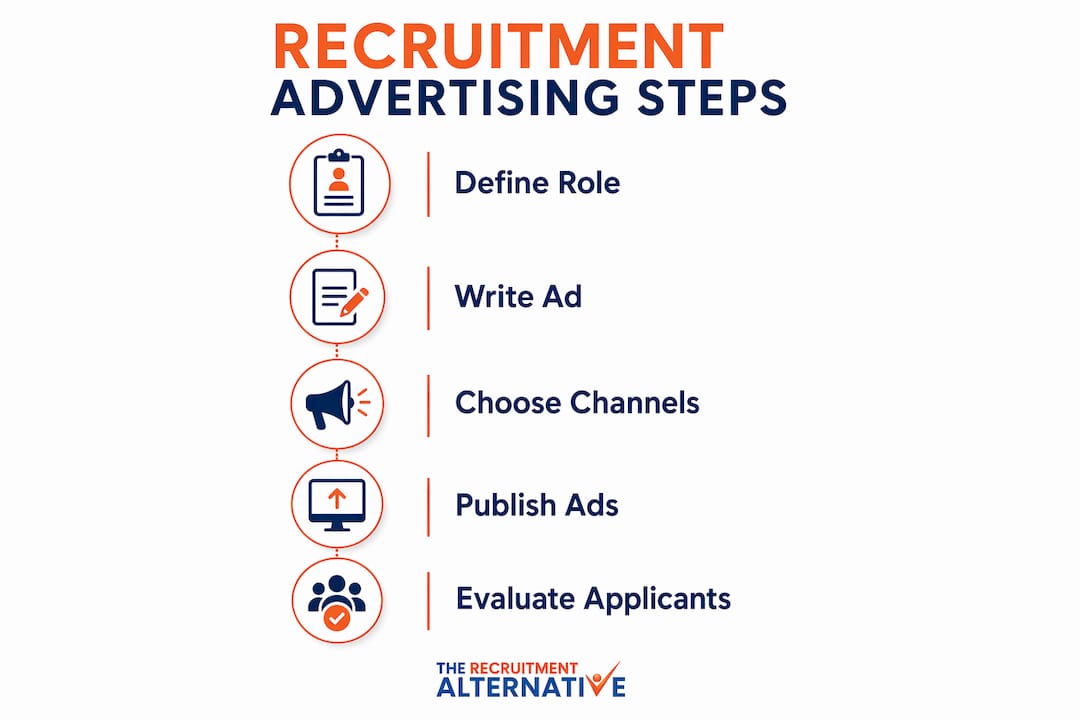
Recruitment advertising is what happens next. Once a vacancy exists, you create and place targeted ads to attract applicants. It is candidate-facing, role-specific, and time-bound. The messaging is direct: here is the job, here is why you should apply, here is how.
Headhunting, also called executive search or retained search, is a proactive, research-led approach targeting passive candidates who are not actively looking. Retained search firms charge retainer fees of around 20–35% of the hire’s first-year compensation. Retained engagements are exclusive and paid upfront, making them suited to executive roles that advertising methods cannot effectively reach. For a general manager or C-suite hire, headhunting delivers a completion rate above 90% for senior roles.
| Method | Purpose | Candidate source | Cost structure | Best for | Typical timeline |
|---|---|---|---|---|---|
| Recruitment advertising | Attract active applicants | Job boards, social media | Pay per post or click | Mid-level, volume roles | 2–6 weeks |
| Recruitment marketing | Build employer brand | Organic and paid content | Ongoing investment | Long-term talent pipeline | Months to years |
| Headhunting / retained search | Source passive candidates | Direct research and networks | Retainer + success fee | Senior and executive roles | 8–16 weeks |
For most small businesses in Australia and New Zealand, recruitment advertising is the right tool for permanent staff hires at the operational and mid-management level. Executive staff recruitment warrants a different approach entirely.
What strategies improve recruitment advertising outcomes for small businesses?
The goal of recruitment advertising is not the highest number of applications. The goal is qualified candidates at the lowest cost-per-hire. That distinction changes how you write ads, where you place them, and how you measure success.
Write ads that attract, not just inform
A job ad is not a job description. A job description lists duties. A job ad sells the opportunity. Lead with what makes the role or your business worth choosing. Mention team culture, flexibility, career growth, or a specific benefit that competitors do not offer. Candidates in Australia and New Zealand have more options than ever, and a flat, duty-heavy ad gets scrolled past.
Consistent employer brand storytelling across your ads and careers page builds what recruiters call “pre-apply trust.” Without it, even a well-placed ad fails to convert. Your careers page should answer the question every candidate asks before applying: “What is it actually like to work here?”
Prioritise data over gut feel
- Track where your best hires come from, not just where you get the most applications.
- Use source-of-hire data to reallocate budget away from underperforming channels.
- Set a target cost per qualified applicant before you launch, not after.
- Review ad performance at the 72-hour mark and pause ads that are not generating clicks.
- Programmatic advertising reallocates budget in real time based on conversion data, removing the need for manual monitoring.
Use local platforms strategically
Seek remains the dominant job board in Australia and New Zealand for permanent roles. LinkedIn performs well for management, finance, and technology positions. For trades and healthcare, niche boards and industry associations often outperform general platforms. Do not default to the same channel for every role. Match the channel to the candidate.
Pro Tip: Before posting any ad, check your recruitment process fundamentals to confirm your screening criteria, interview process, and offer timeline are ready. Candidates drop out when the process stalls after application.
How to measure and manage recruitment advertising spend effectively
Recruitment advertising spend is the total budget allocated to paid channels used to attract candidates. Managing it well requires tracking the right metrics, not just counting applications.
The metrics that matter most are:
- Cost per qualified applicant: the total spend divided by the number of applicants who meet your minimum criteria. This is more useful than cost per application.
- Source of hire: which channel produced the candidate you actually hired. This tells you where to invest next time.
- Time to fill: the number of days from ad posting to accepted offer. Longer times often signal a messaging or channel problem, not a candidate shortage.
- Application-to-interview conversion rate: if you are getting applications but not progressing many to interview, your ad is attracting the wrong people.
- Offer acceptance rate: a low rate suggests your employer brand or compensation is not competitive.
One-off ad posting without tracking is the most common mistake small businesses make. You spend money, get some applications, hire someone, and have no idea whether the spend was efficient. The next vacancy starts from zero again. Neglecting ongoing recruitment brand content causes candidate interest to drop, making even well-placed ads less effective over time.
Automated platforms help here. They surface performance data in real time and shift budget toward the ads and channels that are converting. For businesses hiring regularly, this compounds into significant savings over a financial year. For effective recruitment for SMEs, the combination of clear metrics and consistent brand presence is what separates businesses that hire well from those that hire repeatedly for the same role.
Key takeaways
Recruitment advertising is the most direct and cost-efficient method for attracting permanent staff, but only when it is paired with clear metrics, consistent employer branding, and the right channel selection.
| Point | Details |
|---|---|
| Define the method correctly | Recruitment advertising is candidate-facing and role-specific, not the same as recruitment marketing or headhunting. |
| Match channel to role type | Use Seek for broad roles, LinkedIn for professional hires, and niche boards for trades and healthcare. |
| Focus on quality, not volume | Track cost per qualified applicant and source of hire, not total application numbers. |
| Build pre-apply trust | A consistent careers page and employer brand story directly improves ad conversion rates. |
| Use programmatic for scale | Automated platforms reduce time-to-fill and reallocate budget based on real conversion data. |
What I have learned from watching businesses advertise badly
Most small business owners treat a job ad like a classified listing. They post the title, list the duties, add a salary range, and wait. When the applications are poor, they blame the market. The market is rarely the problem.
The businesses that hire well treat every ad as a piece of communication. They think about who they are talking to, what that person cares about, and why this role is worth their attention. That shift in thinking produces better ads, better applicants, and shorter hiring cycles.
The other pattern I see constantly is the one-off approach. A business posts an ad when a seat is empty, hires someone, and goes quiet until the next vacancy. There is no careers page, no employer brand presence, no consistency. When the next role opens, they start from scratch. Candidates who visited the website six months ago and saw nothing have moved on.
Programmatic advertising is genuinely useful for businesses hiring more than a handful of people per year. But it is not a substitute for a clear message. Automation distributes your ad efficiently. It cannot fix a bad ad or an invisible employer brand.
The businesses I have seen get the best results combine three things: a compelling ad written for the candidate, a careers page that answers real questions, and a consistent presence on the channels their candidates actually use. That is not complicated. It is just disciplined.
— Josh Townsend
How The Recruitment Alternative can help you hire smarter
The Recruitment Alternative works with small and medium businesses across Australia and New Zealand to fill permanent roles without the cost of traditional percentage-based agency fees. The flat-fee model means you know exactly what you are paying before the search begins, whether you are hiring in Perth, Melbourne, Sydney, or anywhere in between. The team handles candidate sourcing, screening, and shortlisting across industries including sales, administration, finance, engineering, healthcare, and technology. If you are ready to move beyond one-off job ads and want a budget-friendly recruitment agency that delivers qualified permanent candidates, The Recruitment Alternative is worth a conversation. For businesses in Western Australia, explore affordable recruitment in Perth as a starting point.
FAQ
What is recruitment advertising?
Recruitment advertising is the creation and placement of candidate-facing communications to attract applicants for specific open roles. It includes job ads on boards like Seek, paid social media posts, and programmatic ad campaigns.
How does recruitment advertising differ from headhunting?
Recruitment advertising targets active job seekers through paid channels, while headhunting proactively approaches passive candidates, typically for senior or executive roles. Headhunting uses retainer fees of around 20–35% of first-year salary, making it a different cost structure entirely.
What is programmatic recruitment advertising?
Programmatic recruitment advertising uses automated real-time bidding to place job ads across multiple platforms from a single campaign. It reduces time-to-fill and reallocates budget automatically based on which channels are converting best.
What should I track to manage recruitment advertising spend?
Track cost per qualified applicant, source of hire, time to fill, and offer acceptance rate. These four metrics give you a clear picture of whether your spend is producing the right candidates at a reasonable cost.
When should a small business use recruitment advertising vs. a recruitment agency?
Recruitment advertising suits businesses with the time and skills to manage candidate screening in-house. A recruitment agency is the better choice when you need a faster result, lack internal HR capacity, or are hiring for a role that requires specialist sourcing.

