

A recruitment service agreement is a legally binding contract between an employer and a recruitment agency that defines the terms, scope, fees, and obligations governing the hiring process. The Lawpath template outlines how these agreements cover obligations, fee and payment terms, dispute resolution, probation, termination, and indemnities. For business owners and HR managers in Australia and New Zealand, understanding this contract before signing protects your business from unexpected costs and legal disputes. The standard industry term is “recruitment services agreement,” though “recruitment service contract” is used interchangeably across the sector.
What is a recruitment service agreement and what does it cover?
A recruitment service agreement is the governing document for the entire relationship between your business and the recruitment agency. It is not an employment contract. The agreement does not set out the terms of employment for the candidate you hire. It sets out the commercial and legal terms between you and the agency.
Sprintlaw NZ confirms that Australian and New Zealand recruitment agreements must clearly specify the parties involved, the scope of services, fee trigger events, confidentiality obligations, and dispute resolution processes. Each of these elements carries real commercial weight. A vague scope clause, for example, can lead to fee disputes months after a hire is made.

The recruitment agreement definition covers the full lifecycle of the agency’s involvement. That includes how candidates are sourced, how they are screened, how shortlists are presented, and what happens if a placement does not work out. Getting this document right before any work begins is the single most effective way to avoid costly disagreements later.
What are the key components of a recruitment service agreement?
Every well-drafted recruitment service contract contains several core clauses. Each one protects a different aspect of the commercial relationship.
Scope of services
The scope clause defines exactly what the agency will do. Sprintlaw UK notes the critical difference between full-cycle recruitment (sourcing, screening, shortlisting, coordinating interviews, and managing offers) and a simple candidate introduction service. If your agreement only covers introductions, you cannot expect the agency to manage the full process. Clarify this before signing.
Fee structure and payment terms
Fees are typically structured as a percentage of the placed candidate’s salary, a flat fee, or a retainer. Capstone Search Group details that payment windows commonly run 15, 30, or 45 days from invoice. Late payment clauses and accepted payment methods should also be confirmed upfront so the terms align with your accounts payable cycle.
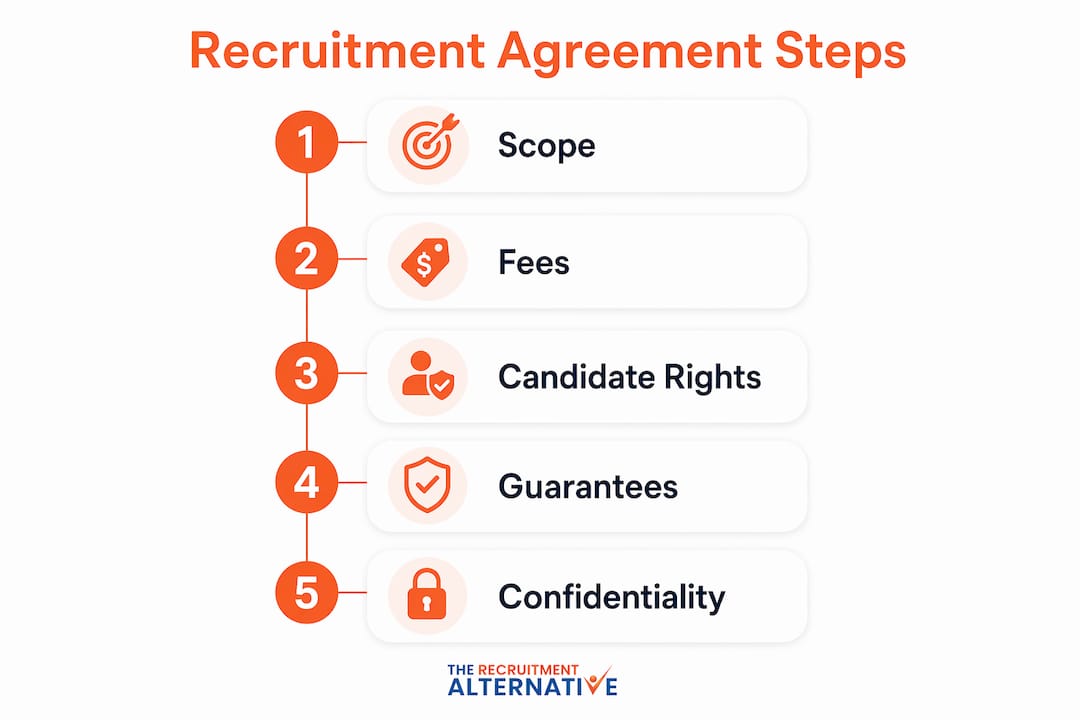
Candidate ownership and referral rights
Advocate Gandhi outlines that candidate ownership periods typically run 6 to 12 months. During this window, the agency retains the right to a fee if you hire that candidate, even through a different channel. This clause catches many employers off guard.
Replacement guarantee
Capstone Search Group specifies that guarantee periods commonly run 30 to 180 days. The clause must state the start date, what qualifies as a failed placement, and the exact process for claiming a replacement or refund. A guarantee without procedural detail is effectively unenforceable.
Confidentiality and dispute resolution
Confidentiality clauses protect sensitive business information shared during the recruitment process, such as salary bands, headcount plans, and organisational structure. Dispute resolution clauses set out whether disagreements go to mediation, arbitration, or court, and in which jurisdiction.
Pro Tip: Ask the agency to confirm in writing which specific services are included in the scope before you sign. A one-page service summary attached to the agreement as a schedule removes ambiguity entirely.
The table below compares the most common clause options across each key component:
| Component | Option A | Option B |
|---|---|---|
| Scope | Full-cycle recruitment | Candidate introduction only |
| Fee model | Percentage of salary | Flat fee |
| Payment window | 15 days | 30–45 days |
| Guarantee period | 30–60 days | 90–180 days |
| Dispute resolution | Mediation first | Direct arbitration |
How do recruitment agreements protect both employers and agencies?
The recruitment agreement governs the legal relationship with the agency. It does not govern the employment relationship with the candidate you hire. This distinction matters because it means the agreement is your primary protection against fee disputes, scope creep, and liability claims.
Forms-Legal Australia describes how direct hire and right-of-referral clauses define when agency fees apply, even if an employer later hires a candidate through a different channel. Without a clearly defined referral period, you could owe a fee on a hire made months after the agency’s involvement ended. Clear fee triggers remove this ambiguity.
The following protections are standard in well-drafted agreements:
- Fee trigger clarity: Specifies the exact event that creates a payment obligation, such as the candidate accepting an offer or commencing employment.
- Indemnity clauses: Allocate liability if the agency provides inaccurate candidate information or if the employer misrepresents the role.
- Data protection obligations: Require both parties to handle candidate personal information in line with the Privacy Act 1988 (Cth) and the Privacy Act 2020 (NZ).
- Confidentiality obligations: Prevent the agency from sharing your business information with competitors or other clients.
Disputes commonly arise around service scope, fee triggers, and candidate referral duration. Employers should negotiate these terms actively rather than accept boilerplate language from the agency’s standard contract.
Tips for working with a recruitment agency reinforce that understanding your legal expectations before the relationship begins reduces friction significantly.
How to select and negotiate a recruitment service agreement for permanent hires
Selecting the right agreement starts with assessing whether the agency’s service offering matches your actual hiring needs. A business hiring for a senior finance role has different requirements than one filling a high-volume administration position. The agreement should reflect that difference.
Follow these steps when reviewing and negotiating a recruitment service contract:
- Confirm the scope in writing. Verify whether the agency provides sourcing, screening, shortlisting, reference checks, and offer management, or only introductions. Attach a written service schedule to the agreement.
- Negotiate the fee percentage or flat fee. Percentage-based fees on senior roles can be substantial. The Recruitment Alternative’s flat-fee recruitment model offers a fixed-price alternative that removes salary-linked cost escalation.
- Review the candidate ownership period. Advocate Gandhi confirms ownership periods run 6 to 12 months. Negotiate this window to align with your typical hiring timelines.
- Check exclusivity clauses. Some agencies require exclusivity on a role. Understand whether you can engage multiple agencies simultaneously and what fee applies if you do.
- Implement internal tracking controls. Capstone Search Group warns that referral documentation gaps can result in paying two fees for the same candidate introduced by different agencies. Log every candidate introduction with the agency name and date received.
- Negotiate the replacement guarantee window. A 90-day guarantee is a reasonable starting point for permanent placements. Confirm the procedural steps required to activate it.
Pro Tip: Before signing any recruitment service agreement template, have a solicitor review the fee trigger, candidate ownership, and replacement guarantee clauses. These three terms generate the majority of post-placement disputes.
Key questions to ask a recruitment agency provides a practical checklist that maps directly to the contract terms you should clarify before committing.
How does a recruitment agreement differ from other hiring documents?
Business owners frequently confuse recruitment service agreements with other contracts involved in the hiring process. Each document serves a distinct purpose.
The table below summarises the key differences:
| Document | Parties | Purpose |
|---|---|---|
| Recruitment service agreement | Employer and agency | Governs the commercial relationship and fee terms |
| Employment contract | Employer and candidate | Sets out the terms of the candidate’s employment |
| Candidate confidentiality form | Agency and candidate | Protects candidate personal information during the process |
| Contractor agreement | Employer and contractor | Governs temporary or project-based engagements |
Sprintlaw UK is clear that recruitment contracts govern agency-client relations, not the employment terms of the hired candidate. Signing a recruitment agreement does not create an employment relationship between your business and the candidate until a separate employment contract is executed.
When hiring contractors or temporary staff, a different agreement applies entirely. Temporary placements typically require a separate labour hire agreement that addresses hourly rates, timesheet approval, and the agency’s employer-of-record obligations. The recruitment service agreement covers permanent placements only unless the contract explicitly states otherwise.
Privacy compliance is also a distinct obligation. Both parties must handle candidate data in accordance with Australian and New Zealand privacy legislation, regardless of what the recruitment agreement says. The agreement can reinforce these obligations but cannot override statutory requirements.
Key takeaways
A recruitment service agreement is the single most important document governing your relationship with a recruitment agency, and its fee, scope, and guarantee clauses require active negotiation before signing.
| Point | Details |
|---|---|
| Agreement definition | A legally binding contract between employer and agency covering scope, fees, and obligations. |
| Candidate ownership period | Agencies typically retain fee rights for 6 to 12 months after introducing a candidate. |
| Guarantee clause detail | Specify start date, length, qualifying conditions, and claim process to keep the guarantee valid. |
| Fee trigger clarity | Define the exact event that creates a payment obligation to prevent unexpected invoices. |
| Internal tracking controls | Log every candidate introduction by agency and date to avoid paying duplicate fees. |
Why the fine print in recruitment contracts matters more than most employers realise
Having worked across hundreds of permanent placements in Australia and New Zealand, the pattern I see most often is this: employers sign the agency’s standard agreement without reading it, then discover six months later that they owe a fee on a candidate they thought they found independently.
The candidate ownership clause is the most misunderstood term in any recruitment service contract. Employers assume that once the agency’s involvement ends, their obligations end too. They do not. If an agency introduced a candidate and you hire that person within the ownership window, the fee applies regardless of how the final hire came about. I have seen this catch businesses that re-engaged a candidate through LinkedIn, through a referral, and even through a second agency.
The replacement guarantee is the second area where I see employers lose out. A guarantee that does not specify the claim process is not a guarantee at all. If the contract does not state how to notify the agency, within what timeframe, and what evidence is required, the agency can decline the claim on procedural grounds. That is not bad faith. It is a drafting gap that the employer could have fixed before signing.
My advice is straightforward. Do not treat the recruitment agreement as a formality. Treat it as a commercial negotiation. The agency’s standard template is written to protect the agency. Your job is to negotiate terms that protect your business too. Engage a solicitor for senior or high-volume hiring arrangements. For smaller placements, at minimum read the fee trigger, ownership period, and guarantee clauses before you sign anything.
Understanding what to look for in a recruitment agency before you engage one is the best way to avoid signing an agreement that does not serve your interests.
— Josh Townsend
Recruitment agreements made clear with The Recruitment Alternative
Signing a recruitment agreement should not feel like a legal minefield. The Recruitment Alternative works with business owners and HR managers across Australia and New Zealand to make the process straightforward and fair.
The Recruitment Alternative’s flat-fee recruitment model removes the salary-linked cost escalation common in percentage-based agreements. The fee is fixed, the scope is clear, and the replacement guarantee terms are explained before any work begins. For small businesses in particular, affordable permanent recruitment means access to a professional hiring process without the financial risk of open-ended commission structures. Contact The Recruitment Alternative to discuss your next permanent hire and get clear answers on every contract term before you commit.
FAQ
What is a recruitment service agreement?
A recruitment service agreement is a legally binding contract between an employer and a recruitment agency. It defines the scope of services, fee structure, candidate ownership period, replacement guarantee, and dispute resolution process.
How is a recruitment agreement different from an employment contract?
A recruitment agreement governs the commercial relationship between the employer and the agency. An employment contract governs the terms of employment between the employer and the hired candidate. The two documents are entirely separate.
What is a typical candidate ownership period in Australia?
Candidate ownership periods typically run 6 to 12 months. During this window, the agency retains the right to a placement fee if the employer hires the introduced candidate through any channel.
What should a replacement guarantee clause include?
A replacement guarantee clause must specify the start date, the length of the guarantee period, what qualifies as a failed placement, and the exact steps required to claim a replacement or refund. Without procedural detail, the guarantee may be unenforceable.
Can I negotiate the terms of a recruitment service agreement?
Yes. Fee percentages, payment windows, candidate ownership periods, exclusivity clauses, and guarantee lengths are all negotiable. Employers should review the agency’s standard template carefully and seek legal advice before signing for senior or high-volume roles.
Recommended
- The Recruitment Alternative is a generalist agency – The Recruitment Alternative
- Recruitment consultation process: a guide for smes
- The Recruitment Alternative affordability just got better with Affordability Plus! – The Recruitment Alternative
- So you want to be a Recruitment Consultant? – The Recruitment Alternative

