

A recruitment service level is a formal, documented agreement that sets measurable performance standards between an employer and a recruitment partner. The industry term for this is a Recruitment Service Level Agreement, or recruitment SLA. Understanding what is recruitment service level means knowing exactly what your agency commits to delivering, what you commit to in return, and what happens when either party falls short. For business owners and HR managers in Australia and New Zealand, a well-structured recruitment SLA is the difference between a hiring process that runs on time and one that stalls without explanation.
What is recruitment service level and why does it matter?
A recruitment SLA is a binding document that defines specific performance standards for every stage of the hiring process. Standard benchmarks include shortlist delivery within five business days, CV review within 48 hours, and post-interview feedback within 24–48 hours. These are not aspirational targets. They are agreed commitments that both parties sign off on before work begins.
The SLA matters because it converts vague expectations into measurable obligations. Without one, “we’ll get back to you soon” means something different to every person in the room. With one, “we’ll deliver a shortlist by Thursday” is a contractual commitment with consequences attached.

A recruitment SLA also protects your business financially. Replacement guarantees are a standard component, covering candidate replacement within a set period if an initial hire does not work out. Typical guarantee windows sit around three months. That clause alone justifies the time spent drafting the document.
Understanding how recruitment agencies work helps you set realistic SLA benchmarks from the start.
What are the key recruitment service metrics and benchmarks?
Recruitment performance indicators fall into two categories: leading indicators that predict process health, and lagging indicators that confirm outcomes after the fact. The best SLAs track both.
Leading indicators
- Time-to-shortlist. Time-to-shortlist is almost entirely within agency control and serves as the most reliable predictor of a successful placement. Tracking it per role type and per consultant reveals where the process slows down before a hire is missed.
- Submission-to-interview rate. Top-performing agencies achieve a submission-to-interview rate above 55%. A rate below that signals a mismatch between the candidates being submitted and what the hiring manager actually wants.
Lagging indicators
- Time-to-fill. The total days from role approval to accepted offer. Useful for workforce planning but tells you nothing about where delays occurred.
- Offer acceptance rate. A low rate points to problems with candidate preparation, salary benchmarking, or both.
- Cost-per-hire. The total spend divided by the number of hires made. Flat-fee models make this figure predictable from day one.
- Source-of-hire. Tracks which sourcing channels produce successful placements, helping you allocate budget to what works.
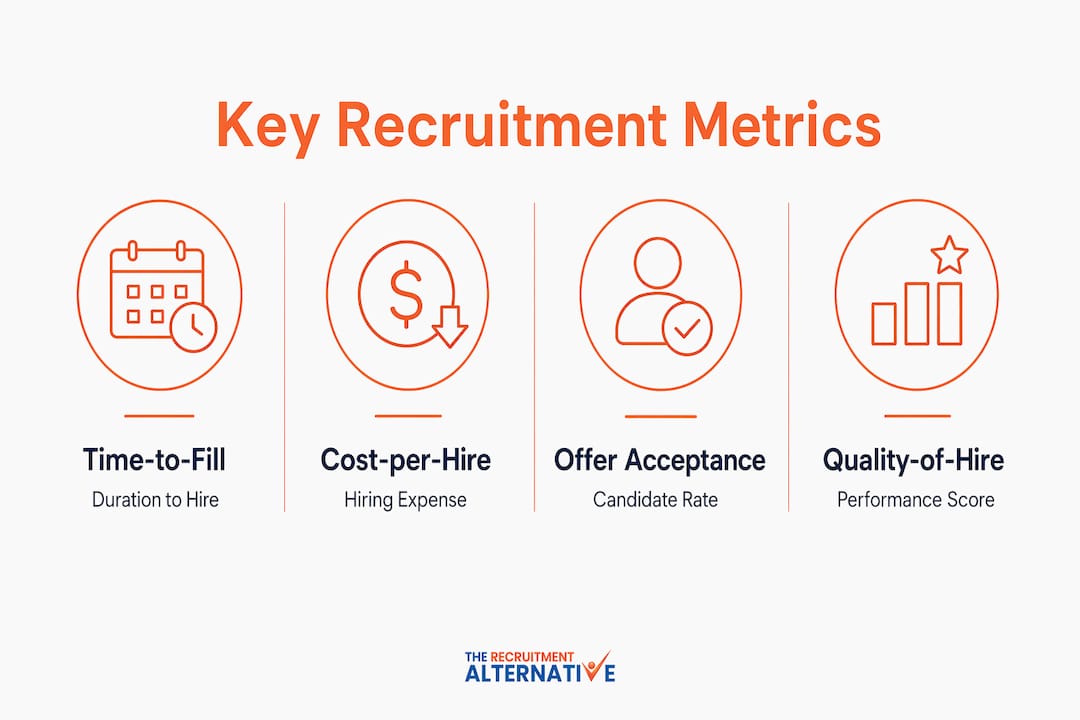
Effective recruitment service levels focus on five core KPIs: time-to-fill, cost-per-hire, quality-of-hire, offer acceptance rate, and source-of-hire. These five balance speed, cost, and talent quality across the full hiring cycle.
| Metric | Type | What it tells you |
|---|---|---|
| Time-to-shortlist | Leading | Agency responsiveness and process efficiency |
| Submission-to-interview rate | Leading | Candidate quality and brief alignment |
| Time-to-fill | Lagging | End-to-end hiring speed |
| Offer acceptance rate | Lagging | Candidate experience and salary competitiveness |
| Cost-per-hire | Lagging | Financial efficiency of the recruitment process |
Pro Tip: Track time-to-shortlist separately for each role type. A technical engineering role and an administration role have very different sourcing timelines. Blending them into one figure hides the real story.
Why bilateral obligations and accountability matter in recruitment SLAs
Most SLAs fail because they only list what the agency must do. A recruitment SLA must be bilateral. Client obligations are binding and include commitments like providing interview feedback within 48 hours and confirming role briefs before sourcing begins. When a client delays, the recruiter’s performance metrics adjust to reflect that external hold-up. Without this clause, an agency can be penalised for delays it did not cause.
Accountability requires consequences. SLAs without defined escalation procedures are suggestions, not agreements. Escalation triggers, such as automatic review meetings when a shortlist is not delivered on time, enforce adherence and prevent hiring delays from compounding. The trigger does not need to be punitive. A scheduled call to diagnose the problem is often enough to get things moving again.
Vanity metrics undermine accountability. Tracking total CVs sent does not predict whether a placement will succeed. Submission-to-placement conversion is a clearer measure of process health. An agency that sends 20 CVs and places one candidate is performing worse than one that sends eight and places two.
Key bilateral obligations to include in your SLA:
- Employer side: Confirm role brief within two business days of engagement, provide structured interview feedback within 48 hours, and nominate a single point of contact for the process.
- Agency side: Deliver an initial shortlist within five business days, present only candidates who meet the agreed brief, and provide a written update if the timeline shifts.
- Shared: Agree on escalation triggers, review meeting frequency, and the replacement guarantee window upfront.
Pro Tip: Ask your recruitment partner to show you their submission-to-interview rate for roles similar to yours before signing an SLA. That one number tells you more about their process quality than any brochure.
A recruitment service agreement that covers both sides of the relationship gives you a genuine risk management tool, not just a document filed in a drawer.
How to implement and manage recruitment service levels effectively
A recruitment SLA only works if it is documented, signed, and actively managed. The following steps give you a practical framework for getting one in place.
- Draft the document with both parties present. Metrics agreed in isolation get challenged later. Sit down with your recruitment partner, define each KPI, and agree on what “on time” means for your specific roles and business context.
- Get formal sign-off. Formal documentation and signed acknowledgement are the critical steps that separate an effective SLA from a verbal understanding. Both parties must sign before sourcing begins.
- Set a review cycle. Regular review cycles and dynamic updating keep the SLA relevant as your business grows and your hiring needs change. A quarterly review is a practical starting point for most Australian and New Zealand businesses.
- Define escalation triggers clearly. Specify the exact conditions that trigger a review meeting. For example: shortlist not delivered within seven business days, or submission-to-interview rate dropping below 40% over two consecutive roles.
- Integrate tracking with your existing tools. Whether you use an applicant tracking system, a shared spreadsheet, or a recruitment dashboard, the metrics in your SLA must be visible to both parties in real time. Opacity kills accountability.
- Treat the SLA as an operational document. Review it at the start of each new hiring campaign, not just at the annual contract renewal. A role brief for a senior finance manager in Sydney requires different benchmarks than a customer service hire in Auckland.
Pro Tip: Build a one-page SLA summary that both your hiring manager and your recruitment contact can refer to during the process. The full document lives in the contract folder. The summary lives on the desk.
For practical guidance on improving your recruitment process, small businesses in particular benefit from having these standards written down before the first role is opened.
Common pitfalls when working with recruitment service levels
Most SLA failures come down to the same handful of mistakes. Recognising them early saves time and money.
- Ignoring client-side responsibilities. When employers do not commit to feedback timelines, the entire process slows. An agency cannot shortlist effectively without a confirmed brief, and cannot progress candidates without timely interview outcomes.
- Tracking irrelevant metrics. Total CVs sent, total calls made, and total job ads posted are activity metrics, not performance metrics. They measure effort, not results. Focus on conversion rates and time-based KPIs instead.
- Skipping escalation procedures. Without a defined trigger for escalation, missed deadlines go unaddressed. One missed shortlist becomes two, and the hiring manager loses confidence in the process before it has a chance to recover.
- Setting static benchmarks. A benchmark that made sense for a junior administration role will not apply to an executive search. SLAs that do not distinguish between role types produce misleading performance data.
- Treating the SLA as a one-off document. Businesses that file the SLA after signing and never revisit it lose the operational benefit entirely. The document should be a living reference, not a historical record.
The key questions to ask a recruitment agency before signing any agreement will help you identify whether a prospective partner has the systems and culture to honour an SLA properly.
Key takeaways
A recruitment SLA is only as effective as the bilateral commitments, measurable KPIs, and active review cycles built into it.
| Point | Details |
|---|---|
| Define measurable benchmarks | Set specific timelines like shortlist delivery within five business days and feedback within 48 hours. |
| Track predictive metrics | Prioritise time-to-shortlist and submission-to-interview rate over vanity metrics like total CVs sent. |
| Include bilateral obligations | Both employer and agency must have documented responsibilities for the SLA to be enforceable. |
| Build in escalation triggers | Define the exact conditions that prompt a review meeting to prevent delays from compounding. |
| Review and update regularly | Treat the SLA as an operational document and revise it at the start of each new hiring campaign. |
Why I think most businesses underestimate the SLA
Working across Australian and New Zealand hiring markets, I have seen the same pattern repeat itself. A business engages a recruitment partner, the process starts well, and then something stalls. A hiring manager goes on leave. Interview feedback takes a week instead of two days. The shortlist sits in an inbox. By the time anyone raises the issue, three weeks have passed and the best candidates have accepted other offers.
The SLA does not prevent these situations on its own. What it does is give both parties a shared language for addressing them quickly. When the escalation trigger is written into the agreement, neither side has to feel awkward about raising a delay. The document does it for them.
I have also seen businesses set SLA benchmarks that are completely disconnected from their own capacity to respond. Committing to 24-hour interview feedback is meaningless if your hiring panel only meets on Thursdays. The most effective SLAs I have worked with are built around the actual rhythms of the business, not an idealised version of how fast things should move.
My strongest advice: treat the SLA conversation as a diagnostic tool before you sign anything. If a recruitment partner cannot clearly explain how they measure time-to-shortlist or what their submission-to-interview rate looks like for roles similar to yours, that tells you something important about how they will perform once the engagement begins.
— Josh Townsend
Recruitment that comes with clear commitments built in
The Recruitment Alternative works with business owners and HR managers across Australia and New Zealand who want a recruitment process they can actually hold someone accountable to. Our flat-fee recruitment model means your cost-per-hire is fixed from day one, and our service commitments are documented before sourcing begins.
Whether you are hiring for a small business or filling a senior management role, our process is built around the same measurable standards covered in this article. Visit our small business recruitment page to see how we structure service commitments for businesses of every size across Australia and New Zealand.
FAQ
What is a recruitment service level agreement?
A recruitment service level agreement is a formal document that sets measurable performance standards between an employer and a recruitment agency. It covers timelines, quality benchmarks, bilateral obligations, and escalation procedures.
What metrics should a recruitment SLA include?
A recruitment SLA should include time-to-shortlist, submission-to-interview rate, time-to-fill, offer acceptance rate, and cost-per-hire. These five KPIs balance speed, quality, and financial efficiency across the hiring process.
How long should a recruitment guarantee period be?
Typical replacement guarantee windows sit around three months. This period covers candidate replacement at no additional cost if the initial hire does not work out within that timeframe.
What happens when an SLA target is missed?
A well-drafted SLA includes escalation triggers that activate a review meeting when a target is missed. These triggers prevent delays from compounding and give both parties a structured way to resolve the issue quickly.
How often should a recruitment SLA be reviewed?
A quarterly review cycle is a practical starting point for most businesses. The SLA should also be revisited at the start of each new hiring campaign to reflect any changes in role type, business context, or sourcing benchmarks.


