

Hiring manager partnership is defined as a structured, collaborative relationship between recruiters and hiring managers that aligns expectations, roles, and workflows to produce better hiring outcomes. This is the recognised industry concept behind the phrase, and it goes well beyond simply handing off a job brief. 90% of recruiting teams rate the hiring manager and recruiter relationship as good or excellent, yet 58% admit they would rather work around their counterpart due to misalignment. That gap reveals the core problem: surface-level goodwill does not replace structured collaboration. Organisations like The Recruitment Alternative build this partnership into every engagement, because alignment between recruiters and hiring managers directly reduces time-to-fill and lifts candidate quality.
What is hiring manager partnership and what roles define it?
Hiring managers hold final selection authority and own performance expectations for the role. Recruiters own the recruitment process architecture, including sourcing strategy, candidate assessment, and interview design. Misunderstanding these complementary responsibilities creates friction at every stage of the hiring funnel. Clarifying who owns what, before the search begins, removes ambiguity and keeps both parties accountable.

The Recruiter as Business Partner (RBP) model takes this further. Under the RBP model, the recruiter acts as a commercial advisor who challenges whether a role is needed, defines business outcomes, and translates those outcomes into hiring requirements. This shifts the recruiter’s role from coordinator to strategic contributor. Hiring managers benefit because they receive candidates assessed against real business needs, not just a job description checklist.
Clear role definition also sets practical expectations for both parties:
- Hiring managers define the 90-day success profile, conduct structured interviews, and provide timely feedback after each candidate interaction.
- Recruiters manage the candidate pipeline, design the interview process, and hold accountability for hiring outcome quality.
- Both parties agree on submission timelines, feedback windows, and escalation paths before the search opens.
Pro Tip: Document role responsibilities in a one-page partnership brief at the start of every search. Refer back to it when disagreements arise. It removes personal friction and replaces it with an agreed process.
How does structured communication improve hiring partnerships?
The intake meeting is the most critical hour of any recruitment search. Intake meetings work best when they focus on what the new hire needs to accomplish in the first 90 days, not just their pedigree or the job description. This forces the hiring manager to define success in concrete terms, which gives the recruiter a precise sourcing and assessment brief. A meeting that produces a 90-day success profile is worth far more than one that produces a list of desired qualifications.
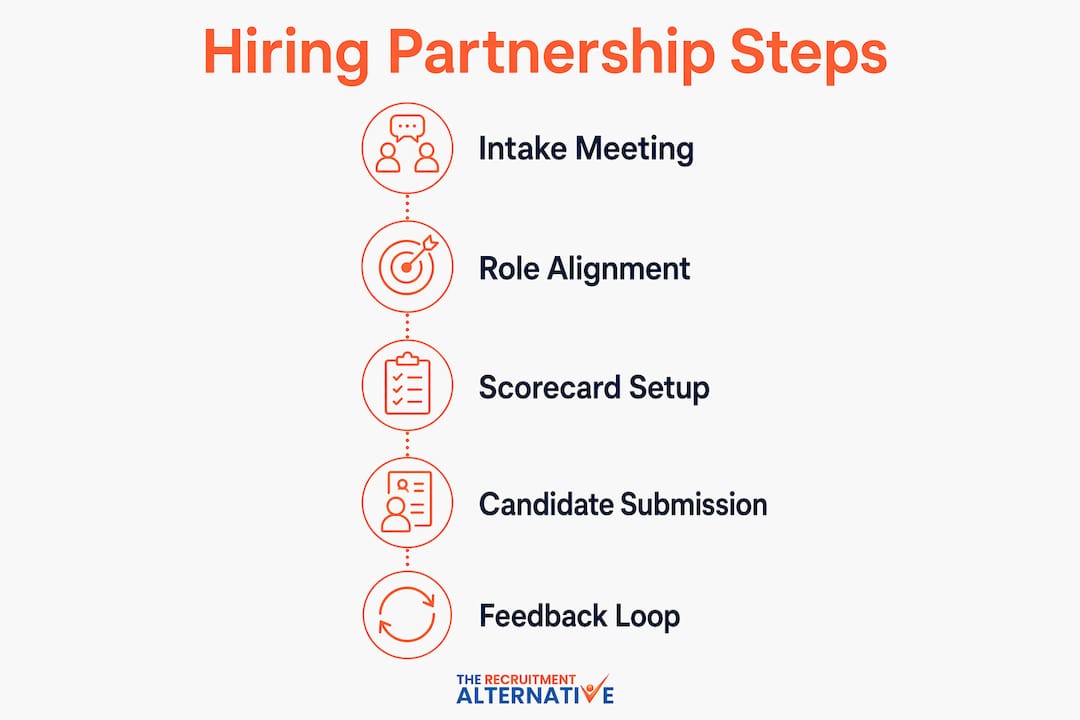
Documented briefs anchored to scorecards are the next layer of structure. Shared captured evidence closes 60–70% of alignment drift between recruiter notes and hiring manager expectations during the first month of a search. That figure reflects how much misalignment is caused simply by relying on memory and verbal agreement. A written scorecard, agreed upon at the intake meeting, gives both parties a shared reference point throughout the process.
Service Level Agreements (SLAs) formalise the communication rhythm. A recruitment service level agreement sets clear obligations for both sides. Common 2026 standards include:
- Hiring managers review shortlisted candidates within 48 hours of submission.
- Hiring managers submit interview scorecards within 24 hours of each interview.
- Recruiters deliver three calibrated candidate profiles within 10 business days of the intake meeting.
These SLA standards create accountability without requiring constant meetings. Both parties know what is expected and when. Shared platforms or applicant tracking systems that provide real-time pipeline visibility reduce the need for status calls and keep both sides informed between formal touchpoints.
Pro Tip: Attach the agreed scorecard to every candidate profile you submit. It anchors the hiring manager’s feedback to the criteria you both set, rather than gut feel formed in the moment.
| Communication tool | Purpose | Frequency |
|---|---|---|
| Intake meeting | Align on 90-day success profile and role requirements | Once per search |
| Documented scorecard | Shared assessment criteria for all candidates | Updated per candidate |
| SLA agreement | Formalise submission and feedback timelines | Set at search open |
| Pipeline review | Track candidate progress and address blockers | Weekly or fortnightly |
What common challenges hinder effective hiring partnerships?
The most common pitfall is treating the partnership as a handoff. Recruiters measured on process metrics and hiring managers measured on outcome metrics operate with different definitions of success. A recruiter who fills the pipeline quickly may consider the job done, while the hiring manager is still waiting for the right candidate. Aligning both parties on a shared 90-day success profile, rather than a static job description, closes this incentive gap.
Other challenges that regularly derail collaboration include:
- Competing priorities. Hiring managers carry full operational workloads. Recruitment often sits below their immediate priorities, which delays feedback and slows the process.
- Lack of transparency. When either party withholds information about constraints, budget changes, or internal politics, trust erodes quickly.
- Verbal-only alignment. Teams relying on verbal syncs risk alignment collapse when personnel change. Documented scorecards and calibration notes accessible to new team members prevent this drift.
- Unclear escalation paths. When a candidate is rejected without clear reasoning, recruiters cannot recalibrate. Structured feedback forms resolve this.
Mutual trust and transparency about priorities and constraints form the foundation of every strong hiring partnership. Honest, constructive feedback improves candidate quality, decision-making, and retention. Without it, both parties default to assumptions, and the process suffers.
What practical steps can SMEs take to build effective hiring partnerships?
Small to mid-sized businesses face a specific challenge: they rarely have dedicated talent acquisition teams. HR professionals often manage recruitment alongside other responsibilities, which makes structured partnership practices even more valuable, not less. The following steps apply directly to SME contexts.
Set expectations before the search opens. A recruitment service agreement between the recruiter and hiring manager documents submission timelines, feedback obligations, and decision authority. This single document prevents the majority of common misalignments.
Train hiring managers on their role in the process. Most hiring managers have not been taught how to conduct structured interviews or write useful candidate feedback. A short briefing before each search, covering the scorecard and interview format, lifts the quality of every hiring decision.
Run intake meetings focused on outcomes, not descriptions. Ask the hiring manager: “What does this person need to achieve in their first 90 days for you to consider this hire a success?” That question produces a more useful brief than any job description template.
Partner with a recruitment agency that understands SME constraints. Agencies like The Recruitment Alternative bring structured partnership processes to businesses that lack internal recruitment infrastructure. Partnering with a trusted agency gives SMEs access to proven intake frameworks, candidate assessment tools, and SLA structures without building them from scratch.
Run retrospective reviews after each hire. Ask both the recruiter and the hiring manager what worked, what slowed the process, and what they would change. Document the answers and apply them to the next search.
Pro Tip: Keep a shared folder with the intake brief, scorecard, and calibration notes for every completed search. When a similar role opens six months later, you have a ready-made brief and a record of what worked.
Key takeaways
Hiring manager partnership succeeds when both parties share clear role ownership, documented communication tools, and a mutual commitment to honest, timely feedback throughout the recruitment process.
| Point | Details |
|---|---|
| Define roles clearly | Hiring managers own final decisions; recruiters own the process and candidate assessment. |
| Use structured intake meetings | Focus on 90-day success profiles, not job descriptions, to produce a precise sourcing brief. |
| Formalise communication with SLAs | Set candidate review windows of 48 hours and feedback submission within 24 hours. |
| Document everything | Scorecards and calibration notes prevent alignment drift and survive personnel changes. |
| Address incentive gaps | Align both parties on shared outcome metrics, not separate process and result measures. |
The partnership problem most SMEs ignore
The conversation about hiring manager partnership tends to focus on process tools: scorecards, SLAs, intake meetings. Those tools matter. But the deeper issue I see repeatedly in Australian SMEs is a cultural one. Hiring managers often view recruiters as a service provider, not a strategic partner. That framing produces a transactional relationship where the recruiter fills a brief and the hiring manager judges the output. It rarely produces great hires.
The shift I have seen work is when hiring managers treat the recruiter as a commercial advisor, someone who can push back on a brief, challenge whether the role is scoped correctly, and flag when the salary range will not attract the right candidates. That is the RBP model in practice. It requires the hiring manager to be open to challenge, and the recruiter to have the confidence to offer it.
The rise of AI-assisted sourcing and screening will not change this dynamic. Technology can surface candidates faster, but it cannot replace the judgement call that comes from a well-run intake meeting between two people who trust each other. If anything, faster pipelines will expose misalignment more quickly. The businesses that invest in the relationship now will be better placed to use those tools effectively.
My advice to HR professionals in SMEs: treat the hiring manager relationship as a business asset. Protect it with documentation, feed it with honest feedback, and review it after every search. The cost of a poor hire far exceeds the cost of building a better process.
— Josh Townsend
How The Recruitment Alternative supports hiring manager partnerships
The Recruitment Alternative works with small to mid-sized businesses across Australia to build the kind of recruiter and hiring manager collaboration that produces consistent results.
Every engagement includes a structured intake process, documented briefs, and clear SLAs so both parties stay aligned from day one. The flat-fee model means businesses get dependable, affordable recruitment without the cost pressure that often shortcuts the partnership process. Whether you are hiring for administration, finance, technology, or management, The Recruitment Alternative brings the structure and expertise that turns a hiring brief into a successful appointment. Speak with the team today to find out how a structured partnership approach can improve your next hire.
FAQ
What is a hiring manager partnership in recruitment?
A hiring manager partnership is a structured collaboration between a recruiter and a hiring manager that aligns roles, expectations, and workflows to improve hiring outcomes. It goes beyond a simple handoff by establishing shared accountability and documented communication tools.
Why do hiring manager and recruiter relationships fail?
Misalignment is the primary cause, with 58% of recruiting teams reporting they would prefer to work around their counterpart despite rating the relationship positively. Differing incentive metrics, verbal-only alignment, and unclear role boundaries are the most common triggers.
What is an SLA in a hiring manager partnership?
A Service Level Agreement (SLA) is a documented set of obligations for both the recruiter and hiring manager, such as reviewing candidates within 48 hours and submitting interview feedback within 24 hours. SLAs create accountability and reduce delays caused by unclear expectations.
How does the Recruiter as Business Partner model work?
The RBP model positions the recruiter as a commercial advisor who challenges role design, defines business outcomes, and translates those outcomes into hiring requirements. This replaces the traditional coordinator role with a more strategic function.
How can small businesses build effective hiring partnerships?
Small businesses benefit most from structured intake meetings focused on 90-day success profiles, documented scorecards, and clear SLAs. Partnering with a recruitment agency gives SMEs access to proven partnership frameworks without building internal infrastructure from scratch.
Recommended
- What’s Your Biggest Hiring Challenge Right Now? – The Recruitment Alternative
- Why Partnering with a Recruitment Agency Saves Time and Money – The Recruitment Alternative
- Partnering with a Trusted Recruitment Agency – The Recruitment Alternative
- Importance of Strong Candidate-Recruiter Relationships – The Recruitment Alternative

