
Regional recruitment in Australia is the practice of sourcing, screening, and hiring candidates within specific regional or remote communities to meet the distinct labour demands of those local markets. Unlike metro hiring, it requires knowledge of local industry mix, commute patterns, wage expectations, and community culture. For small to medium Australian businesses operating outside major cities, understanding regional recruitment is not optional. It is the difference between filling a role in weeks and leaving it vacant for months.
Australia’s regional labour market is not uniform. Employment rates vary sharply across regions, with some areas outperforming the national average while others struggle with persistent skill shortages. The national average employment rate fell slightly to 76.7% by december 2024, yet the Southern Murray-Darling Basin climbed from 76.4% to 80.1% in a single year. That contrast tells you everything about why a one-size-fits-all hiring approach fails in regional Australia.
What is regional recruitment in Australia and how does it differ from urban hiring?
Regional recruitment, also referred to as localised hiring or place-based recruitment, differs from urban hiring in three fundamental ways: talent pool size, geographic context, and community dynamics.
Urban hiring draws from dense, mobile candidate pools where job seekers frequently move between roles and suburbs. Regional hiring operates in tighter communities where word-of-mouth carries weight, local reputation matters, and candidates weigh lifestyle factors as heavily as salary. A job ad that performs well in Sydney may attract zero qualified applicants in Dubbo or Mackay if it ignores local realities.

Regional and remote areas face persistent skill shortages across agriculture, healthcare, transport, and construction. These shortages are not temporary. They reflect structural gaps between where workers live and where work exists. SMEs in these sectors cannot rely on passive job boards alone.
Key characteristics that separate regional from urban hiring include:
- Smaller candidate pools that require proactive sourcing through community networks, not just online listings
- Geographic isolation that affects both candidate willingness to relocate and employer ability to attract metro talent
- Industry concentration where a single sector such as mining, farming, or aged care may dominate local employment
- Lifestyle-driven decisions where candidates prioritise housing affordability, schooling, and community ties over career progression alone
- Local employer reputation that travels fast in small towns, making every hire and every exit a public signal
Localised recruiting that integrates community knowledge, including commuting patterns and local industry mix, produces better sourcing, screening, and retention outcomes than generic national approaches. That is not a soft claim. It reflects the practical reality that a recruiter who knows the local market writes better job ads, screens more accurately, and predicts retention more reliably.
How do Australian Government programs support regional recruitment?
The Australian Government has built a structured set of programmes to address regional labour shortages, and SMEs should know what is available before spending a dollar on recruitment.
The primary initiative is Workforce Australia Local Jobs, which operates across 51 employment regions nationwide. The programme provides three core resources:
- Local Job Coordinators who work directly with employers and job seekers to match skills with vacancies in specific regions
- Skills Taskforces that identify emerging skill gaps and coordinate training responses at the local level
- Funding access through the Local Recovery Fund and the National Priority Fund, both of which support businesses and workers in regions experiencing economic disruption
Beyond Workforce Australia, the government operates the Pacific Australia Labour Mobility (PALM) scheme, which allows regional businesses to access workers from Pacific nations when local candidates are insufficient. The PALM scheme consolidates the former Seasonal Worker Programme and Pacific Labour Scheme into a single pathway. For agricultural and horticultural businesses in particular, this scheme fills critical seasonal gaps that local labour markets cannot meet.
SMEs that engage with these programmes gain more than just candidate referrals. They gain access to local intelligence about workforce trends, training pipelines, and community employment conditions that no job board provides.
What are the benefits of regional recruitment strategies for Australian SMEs?
A targeted regional recruitment strategy delivers measurable advantages over generic national hiring. The benefits are practical, not theoretical.
Employers who tailor messaging and offers to local lifestyle and wage expectations see faster fills and better candidate fit. That translates directly to lower time-to-fill and reduced cost-per-hire. When a job ad speaks to the realities of living and working in Bendigo or Townsville rather than describing a generic role, qualified local candidates respond at higher rates.
The retention benefit is equally significant. SMEs investing in regional recruitment reduce turnover and fill crucial roles faster because candidates who are genuinely suited to the regional lifestyle stay longer. A candidate who relocates for a role without understanding the community often leaves within twelve months. A candidate sourced locally, with realistic expectations set from the start, is far more likely to remain.
Additional benefits include:
- Access to untapped talent pools in regions where competition for candidates is lower than in capital cities
- Stronger community ties that build employer brand organically through local networks and referrals
- Alignment with regional growth sectors such as renewable energy, agribusiness, and aged care, where demand for skilled workers is rising
- Lower salary competition in some regional markets, where candidates value lifestyle and stability over maximum pay
Pro Tip: When advertising a regional role, include specific details about the town, not just the job. Mention local schools, housing costs, and community amenities. Candidates researching a potential move will respond to this information far more than a generic job description.
What practical steps can SMEs take to implement effective regional recruitment?
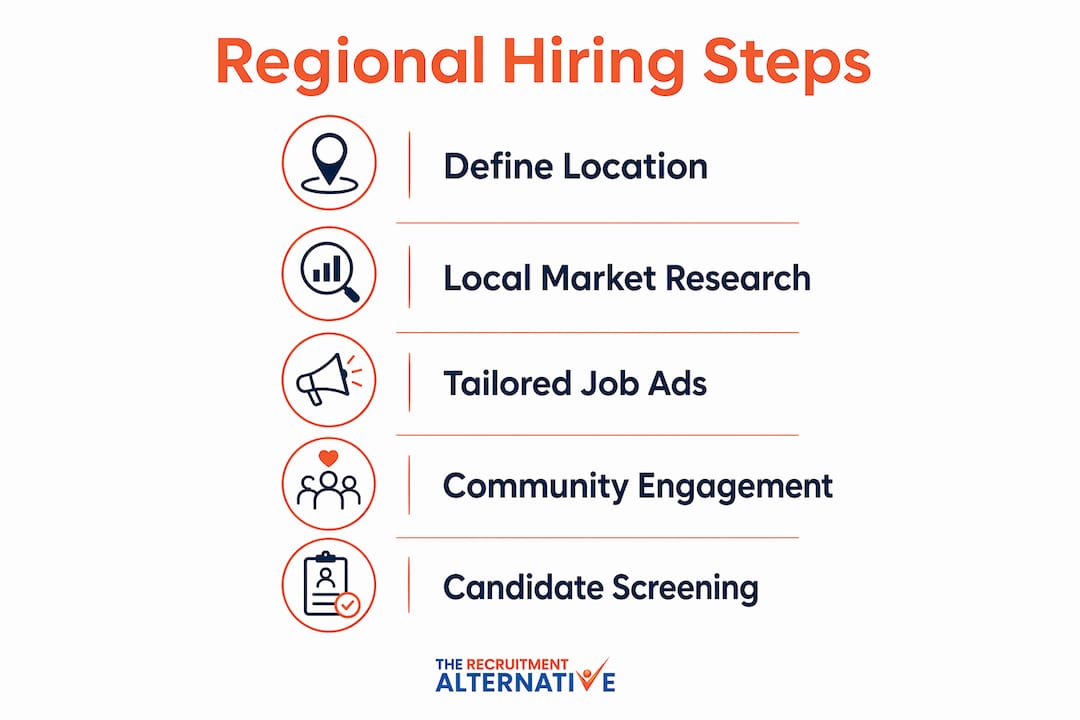
Effective regional recruitment requires a deliberate process, not a copy-paste of your metro hiring approach. The following steps give SMEs a structured path to better outcomes.
-
Analyse your regional labour market before advertising. Review hiring outcomes by location, including application volume, qualified candidate rate, and time-to-fill. If a region consistently underperforms, the issue is usually the job ad or the sourcing channel, not candidate quality.
-
Use local job boards and community channels. Regional candidates are not always active on national platforms. Local Facebook community groups, regional newspapers, TAFE noticeboards, and industry-specific forums often reach candidates that Seek or Indeed miss entirely.
-
Customise job descriptions for regional realities. Adjust salary ranges to reflect local cost of living. Mention relocation assistance if you offer it. Describe the lifestyle, not just the role. A location-sensitive job description converts significantly better than a generic template.
-
Partner with local training providers. TAFE campuses in regional areas produce qualified graduates in trades, healthcare, and business administration. Building a relationship with a local TAFE gives you early access to candidates before they enter the open market.
-
Attend regional career fairs and industry events. Face-to-face presence in a regional community builds trust faster than any digital campaign. Candidates in tight-knit communities want to know who they are working for before they apply.
-
Work with a recruitment agency that understands regional hiring. Agencies with genuine regional hiring experience bring local market knowledge, established candidate networks, and screening processes calibrated to regional roles. The Recruitment Alternative operates nationally and applies this localised approach across a broad range of industries.
Pro Tip: Track your regional hiring metrics separately from your metro data. Application volume, time-to-fill, and 90-day retention rates will tell you which regions need a different approach and which are performing well.
The table below summarises the key differences between generic national hiring and a targeted regional approach:
| Factor | Generic national hiring | Targeted regional hiring |
|---|---|---|
| Job ad content | Role-focused, location-neutral | Location-specific, lifestyle-aware |
| Sourcing channels | National job boards | Local boards, community networks, TAFE |
| Candidate screening | Standard criteria | Adjusted for regional skills and fit |
| Retention outcomes | Variable | Higher due to better candidate alignment |
| Time-to-fill | Often longer in regional areas | Reduced with localised sourcing |
Key takeaways
Regional recruitment in Australia requires location-specific knowledge, tailored job advertising, and deliberate use of local sourcing channels to produce better hiring outcomes than generic national approaches.
| Point | Details |
|---|---|
| Regional markets vary significantly | Employment rates differ sharply by region, so a single hiring strategy will not work across all locations. |
| Government programmes are underused | Workforce Australia Local Jobs and the PALM scheme offer real support that most SMEs never access. |
| Local knowledge drives retention | Candidates sourced with regional context in mind stay longer and perform better than those hired through generic processes. |
| Job ads must reflect local realities | Customising salary, lifestyle details, and community information improves application quality and conversion rates. |
| Data review is non-negotiable | Tracking application volume, qualified candidate rate, and time-to-fill by region reveals where your approach needs adjustment. |
Why I think most SMEs are approaching regional hiring backwards
Most SMEs I have worked with treat regional recruitment as a scaled-down version of their city hiring process. They post the same job ad, use the same platforms, and then wonder why they get three applications in six weeks. The problem is not the region. The problem is the assumption that what works in Melbourne works in Mount Gambier.
The businesses that hire well in regional Australia share one trait: they invest time in understanding the community before they write a single job ad. They know which local employer has just made redundancies. They know whether the nearest TAFE runs a relevant course. They know that the candidate pool in a town of 8,000 people is finite, and that burning a candidate relationship with a poor hiring experience has consequences that last years.
The other mistake I see regularly is treating regional hiring as a cost-cutting exercise. Yes, salary benchmarks can differ from metro rates. But candidates in regional areas are not naive. They know their value. If your offer does not reflect the local cost of living and the genuine difficulty of the role, you will lose the best candidates to employers who have done their homework.
My honest view is that affordable recruitment for small businesses does not mean cheap recruitment. It means spending your recruitment budget on the right activities: local sourcing, proper screening, and a job offer that reflects regional realities. That is where The Recruitment Alternative adds genuine value. The flat-fee model means you are not penalised for hiring well in a regional market where salaries may be lower than metro equivalents.
— Josh Townsend
How The Recruitment Alternative supports regional hiring for SMEs
Regional hiring is not a niche service at The Recruitment Alternative. It is a core part of how the agency operates across Australia.

The Recruitment Alternative works with SMEs in regional and metro markets alike, applying a flat-fee recruitment model that removes the cost penalty of percentage-based agency fees. For businesses hiring in regional areas where salaries may sit below metro benchmarks, this matters. You pay a fixed price regardless of the role’s salary, which means your recruitment budget goes further. The agency’s candidate sourcing covers local networks, regional job boards, and direct outreach, not just national platforms. If you are ready to recruit top staff for your regional business without overpaying for the process, The Recruitment Alternative is built for exactly that.
FAQ
What is regional recruitment in Australia?
Regional recruitment in Australia is the practice of sourcing and hiring candidates within specific regional or remote communities, using location-specific strategies that reflect local labour market conditions, industry needs, and community characteristics.
How does regional recruitment differ from standard hiring?
Regional recruitment uses localised sourcing channels, community networks, and location-aware job advertising rather than generic national platforms. It accounts for smaller talent pools, geographic isolation, and lifestyle factors that influence candidate decisions in regional areas.
What government support exists for regional hiring in Australia?
The Australian Government’s Workforce Australia Local Jobs initiative operates across 51 employment regions, providing Local Job Coordinators, Skills Taskforces, and access to the Local Recovery Fund and National Priority Fund. The PALM scheme also helps regional businesses access Pacific workers when local candidates are unavailable.
What industries face the biggest skill shortages in regional Australia?
Agriculture, healthcare, transport, and construction consistently face skill shortages in regional and remote areas. These shortages are structural and require targeted recruitment and community engagement to address.
How can SMEs improve retention after regional hiring?
SMEs improve regional retention by setting realistic expectations during recruitment, sourcing candidates who genuinely suit the regional lifestyle, and aligning job offers with local wage benchmarks and community conditions from the outset.