

A recruitment budget is a planned financial allocation covering every cost required to hire permanent staff, from job advertising through to onboarding. Australian businesses face total hiring costs of A$20,000 to A$26,000 per professional role when direct and indirect expenses are counted together. To build a recruitment budget in Australia for 2026, you need accurate cost benchmarks, a clear channel strategy, and a contingency buffer built in from day one. This guide covers all three, with specific figures and practical frameworks for business owners and HR professionals planning permanent hires.
What does it cost to build a recruitment budget in australia 2026?
Understanding your cost baseline is the first step in recruitment budget planning for 2026. The average direct recruitment cost per hire sits at A$10,500, with total costs rising to A$20,000–A$26,000 once onboarding, HR time, and lost productivity are included. That figure surprises many business owners who only account for the job ad and agency invoice.
The total cost per hire is the industry standard term for this fully loaded figure. It captures everything spent to get a new employee to their first productive day, not just the visible line items on a supplier invoice.
Three cost categories make up the total:
- Direct costs: Job board advertising on SEEK or LinkedIn, recruitment agency fees, background checks, and skills assessments.
- Indirect costs: Internal HR time, hiring manager hours spent reviewing CVs and conducting interviews, onboarding programme delivery, and IT setup.
- Soft costs: Lost team productivity during a vacancy, overtime paid to cover the gap, and the administrative overhead of managing the process.
Recruitment agency fees alone represent a significant portion of direct spend. Agency fees typically sit at 15–20% of a candidate’s first-year salary, meaning a role paying A$80,000 generates a fee of A$12,000–A$16,000. That single line item can consume the majority of a small business’s entire hiring budget for one role.
Pro Tip: Build your budget using the total cost per hire figure, not just the agency fee or ad spend. Finance teams and business owners who only track direct costs routinely underestimate their true recruitment expenditure by 40% or more.
How should you allocate your recruitment budget across channels?
Strategic channel allocation is where most Australian SMEs leave money on the table. A practical budget split for Australian businesses looks like this: agencies 40%, LinkedIn and job boards 30%, employee referrals 15%, and outbound sourcing 15%. Adding a 10% contingency on top of this base allocation protects against mid-year salary shifts or unplanned headcount needs.

The 40% agency allocation reflects the reality that specialist roles, executive hires, and hard-to-fill positions genuinely benefit from agency reach. The remaining 60% directed at lower-cost channels keeps your average cost per hire manageable across the full hiring plan.
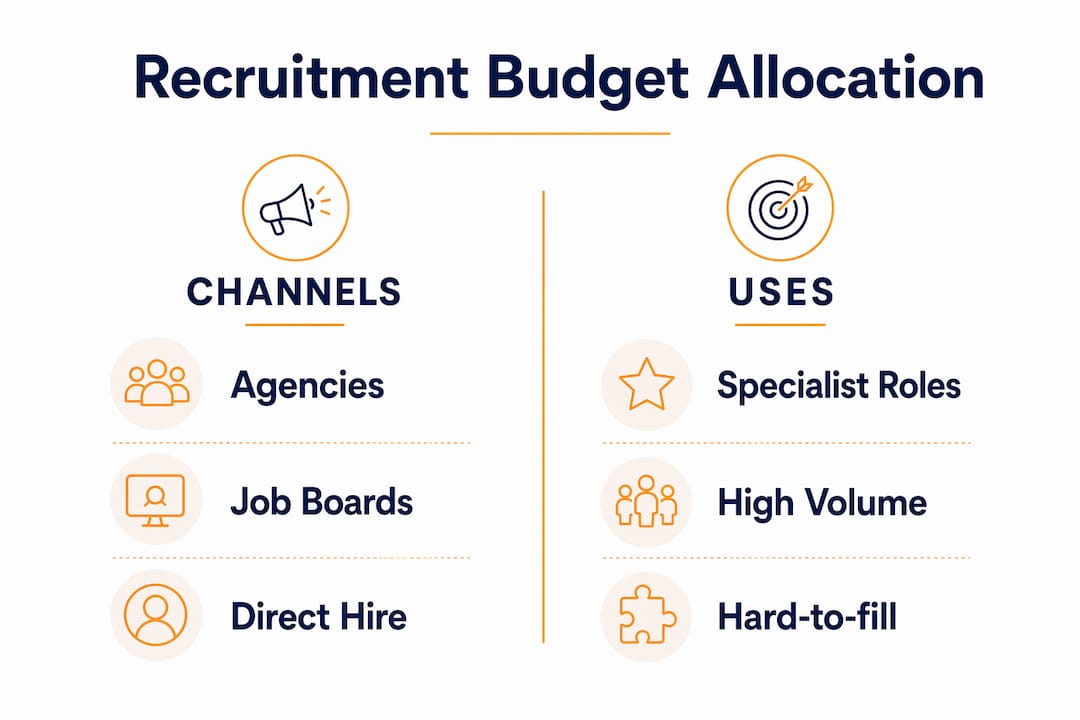
Role priority should drive where the largest share of your budget lands. Sales and engineering roles should receive 50–60% of the total hiring budget because of their direct impact on revenue. A vacant sales manager position costs the business in lost pipeline every week it remains unfilled. Prioritising budget to fill those roles faster pays for itself.
| Channel | Typical Budget Share | Best Used For |
|---|---|---|
| Recruitment agencies | 40% | Specialist, executive, and hard-to-fill roles |
| LinkedIn and job boards | 30% | Professional and volume roles |
| Employee referrals | 15% | Culture-fit hires and lower-cost sourcing |
| Outbound sourcing | 15% | Passive candidates and niche skill sets |
| Contingency buffer | 10% (added on top) | Unplanned hires and salary adjustments |
Mixing channels also reduces risk. Relying solely on SEEK or LinkedIn means your pipeline dries up the moment those platforms underperform for a specific role. A blended approach gives you multiple candidate streams running in parallel, which reduces time-to-fill and keeps cost-per-hire predictable.
Pro Tip: Review your in-demand jobs data before locking in channel allocations. Roles with high candidate supply need less agency spend. Roles with scarce talent pools need more.
What tools and techniques improve recruitment budget accuracy?
Accurate budgeting for hiring in Australia requires more than a spreadsheet with salary figures. The two most impactful techniques are partial-year cost modelling and recruitment tech stack consolidation.
Partial-year cost modelling reduces first-year salary budget requests by 20–30% by calculating costs from the actual hire start date to year-end rather than assuming a full twelve months. A role budgeted to start in july costs roughly half what a january start costs in that financial year. Finance teams approve these budgets more readily because the numbers reflect reality, not worst-case assumptions.
Tech stack consolidation delivers a different kind of saving. Fragmented recruitment tools can cost over A$30,000 per year in software licences alone, while a consolidated stack of integrated tools can bring that figure below A$10,000 and save more than 130 hours of administrative time annually. Many businesses are paying for an applicant tracking system, a separate job board subscription, a CV database, and a video interviewing platform without realising the combined cost.
To calculate a fully loaded cost per hire, include these components:
- Base salary for the role
- Superannuation (currently 11.5% of ordinary time earnings)
- Recruitment agency fee or advertising spend
- Onboarding costs including training, equipment, and induction time
- HR and hiring manager time at their hourly rate
- Lost productivity during the ramp-up period (typically 8–12 weeks for professional roles)
Historical recruitment data is your most reliable forecasting input. If your last three finance hires each took nine weeks and cost A$22,000 on average, that benchmark is more accurate than any industry estimate. Build your 2026 recruitment funding strategy on your own data first, then cross-reference against published benchmarks like the Australian HR and People Cost Benchmarks 2026.
Presenting your budget as a strategic investment rather than a cost line also matters. Framing the budget against the cost of a vacancy, including lost revenue, overtime, and team morale, gives leadership a clear ROI picture and improves approval rates.
What pitfalls should you avoid when managing your hiring budget?
The most common mistakes in recruitment budget management are predictable and avoidable. Knowing them in advance protects your plan from the budget shortfalls that derail hiring timelines.
-
Over-relying on agencies for every role. Avoiding unnecessary agency engagement saves A$10,000–A$20,000 per hire. For volume roles like administration, customer service, and junior finance, building internal sourcing capability delivers better cost control than defaulting to an agency every time.
-
Underestimating indirect and soft costs. Businesses that only budget for job ads and agency fees routinely run out of money mid-year. Indirect costs including HR time, hiring manager hours, and onboarding can match or exceed direct spend on some roles.
-
Skipping the contingency buffer. Markets shift. Salary expectations move. A key employee resigns unexpectedly. Without a 10% contingency built into your plan, every unplanned hire creates a budget crisis.
-
Failing to track spend quarterly. A recruitment budget set in january and reviewed in december is not a budget. It is a wish list. Quarterly reviews let you reallocate funds from underperforming channels to those delivering results.
-
Ignoring onboarding investment. Research from the construction sector shows that targeted onboarding investment accelerates time-to-productivity for new hires. Faster productivity means lower soft costs and a better return on every dollar spent recruiting.
Pro Tip: Use your quarterly review to compare budgeted cost per hire against actual cost per hire by channel. That single metric tells you where your budget is working and where it is being wasted.
Key takeaways
Building an effective recruitment budget in Australia for 2026 requires accurate cost benchmarks, strategic channel allocation, partial-year modelling, and a contingency buffer to protect against market shifts.
| Point | Details |
|---|---|
| Know your true cost per hire | Total hiring costs in Australia reach A$20,000–A$26,000 per role when all direct and indirect costs are included. |
| Allocate by channel and role priority | Direct 50–60% of budget to revenue-generating roles and split channels across agencies, job boards, referrals, and outbound sourcing. |
| Use partial-year cost modelling | Calculating costs from actual hire start dates reduces budget requests by 20–30% and improves finance approval rates. |
| Consolidate your tech stack | Reducing fragmented recruitment tools can cut software costs from over A$30,000 to under A$10,000 annually. |
| Build in a contingency buffer | Add 10% above your base allocation to cover unplanned hires, salary adjustments, and mid-year market shifts. |
Why recruitment budgets deserve more strategic attention
I have reviewed a lot of recruitment budgets over the years, and the pattern is almost always the same. The budget is built around the agency fee and the job ad cost, with everything else treated as someone else’s problem. That approach works until it doesn’t, and it usually stops working at the worst possible time.
The businesses that get this right treat their recruitment budget the way a CFO treats a capital expenditure plan. They model costs precisely, they allocate by strategic priority, and they track performance against the plan every quarter. They also understand that recruitment spend as a strategic investment generates measurable returns when tied to vacancy costs and revenue impact.
The other thing I have seen consistently is that businesses which build internal hiring capability for their volume roles end up with a structural cost advantage. They are not paying agency fees for roles they hire every year. That saving compounds over time and frees up budget for the specialist and executive hires where agency expertise genuinely adds value.
Tech stack consolidation is underrated. Most businesses are paying for tools they barely use because no one has audited the stack since it was set up. A single afternoon reviewing your recruitment software subscriptions can free up A$15,000 or more in annual spend.
The volatile talent market heading into 2026 makes adaptability the most important quality in a recruitment budget. Build your plan with clear assumptions, review it quarterly, and be prepared to shift allocations when the data tells you to.
— Josh
How Therecruitmentalternative can help you hire smarter in 2026
Therecruitmentalternative is an Australian award-winning budget recruitment agency that helps businesses hire exceptional permanent staff without the cost of traditional commission-based fees. The flat-fee model means you know exactly what you are paying before the search begins, which makes recruitment budget planning straightforward and predictable.
Whether you are hiring in sales, finance, engineering, healthcare, administration, or technology, Therecruitmentalternative combines personalised candidate sourcing with a proven process to fill roles quickly and cost-effectively. For businesses managing tight hiring budgets in 2026, the fixed-price model removes the single largest variable in most recruitment cost calculations. Explore budget recruitment solutions tailored to your industry and find out how much you could save on your next hire.
FAQ
What is the average recruitment cost per hire in australia in 2026?
The average total recruitment cost per hire in Australia sits between A$20,000 and A$26,000 for professional roles, including direct costs, HR time, and onboarding expenses.
How do i create a recruitment budget for my australian business?
Start by calculating your total cost per hire using direct costs, indirect costs, and soft costs, then allocate funds across channels including agencies, job boards, referrals, and outbound sourcing, and add a 10% contingency buffer.
What percentage of salary do recruitment agencies charge in australia?
Australian recruitment agencies typically charge 15–20% of a candidate’s first-year salary, which translates to A$12,000–A$16,000 for an A$80,000 role.
What is partial-year cost modelling in recruitment budgeting?
Partial-year cost modelling calculates salary costs from the actual hire start date to year-end rather than assuming a full twelve months, reducing budget requests by 20–30% and improving finance team approval rates.
How much should i allocate to recruitment agencies versus job boards?
A practical split for Australian SMEs is 40% to agencies, 30% to LinkedIn and job boards, 15% to referrals, and 15% to outbound sourcing, with a separate 10% contingency added on top of the total.

