

Recruiting finance staff for a small business is defined as the process of identifying, attracting, and selecting candidates who can own your financial operations end to end. Done well, it protects your cash flow, keeps you compliant with Australian Taxation Office requirements, and gives you the financial visibility to grow with confidence. The challenge is that small businesses in Australia and New Zealand compete for the same talent pool as large corporates, often without a dedicated HR team or a large hiring budget. The strategies in this guide close that gap.
How to recruit finance staff for your small business: define the role first
The single biggest mistake small business owners make is writing a job ad before they know exactly what they need. A vague title like “Finance Officer” tells a candidate nothing about what success looks like in your business.
Defining finance roles by specific owned outcomes and 90-day milestones improves recruitment clarity and new hire productivity. That means writing down what the person must deliver in their first three months, not just listing duties. For example: “Own the monthly close process and produce a P&L by the 5th business day” is far more useful than “assist with financial reporting.”
Your job description should also name the exact tools your business uses. Naming ERP and payroll systems in job ads significantly increases the volume and quality of applicants. Candidates filter ads heavily by software. If you use Xero, MYOB, or NetSuite, say so explicitly.
Pro Tip: Write three to five non-negotiable outcomes for the role before you write a single line of the job ad. If you cannot articulate what “great” looks like at 90 days, you are not ready to hire.
A well-defined role description does three things at once. It attracts the right candidates, repels the wrong ones, and gives you an objective basis for comparing applicants later in the process.
- State the role’s primary financial ownership (e.g., accounts payable, payroll, management reporting)
- List the specific software and systems the candidate must know
- Include the 90-day success criteria as a separate section in the ad
- Specify whether the role is full-time, part-time, or contract
- Include a salary range or band to filter serious applicants from browsers
What are the best sourcing channels for small business finance recruitment?
Most small business owners post on a general job board and wait. That approach works for some roles, but finance recruitment responds better to targeted sourcing.

Employee referral programmes yield the highest-quality candidates in finance recruitment, outperforming general job boards on both quality and retention. Your existing team, accountant, or bookkeeper likely knows qualified people who are open to a move. A simple referral incentive of a few hundred dollars is far cheaper than a bad hire.
Beyond referrals, LinkedIn outreach to candidates with specific credentials (CPA, CA, CPA Australia members) produces strong results for roles above entry level. Local CPA chapter networks and professional accounting associations in Australia and New Zealand are underused by small businesses. These communities concentrate exactly the candidates you want.
Pro Tip: Post your finance role in LinkedIn groups for Australian accounting professionals, not just on your company page. The reach is broader and the audience is self-selected.
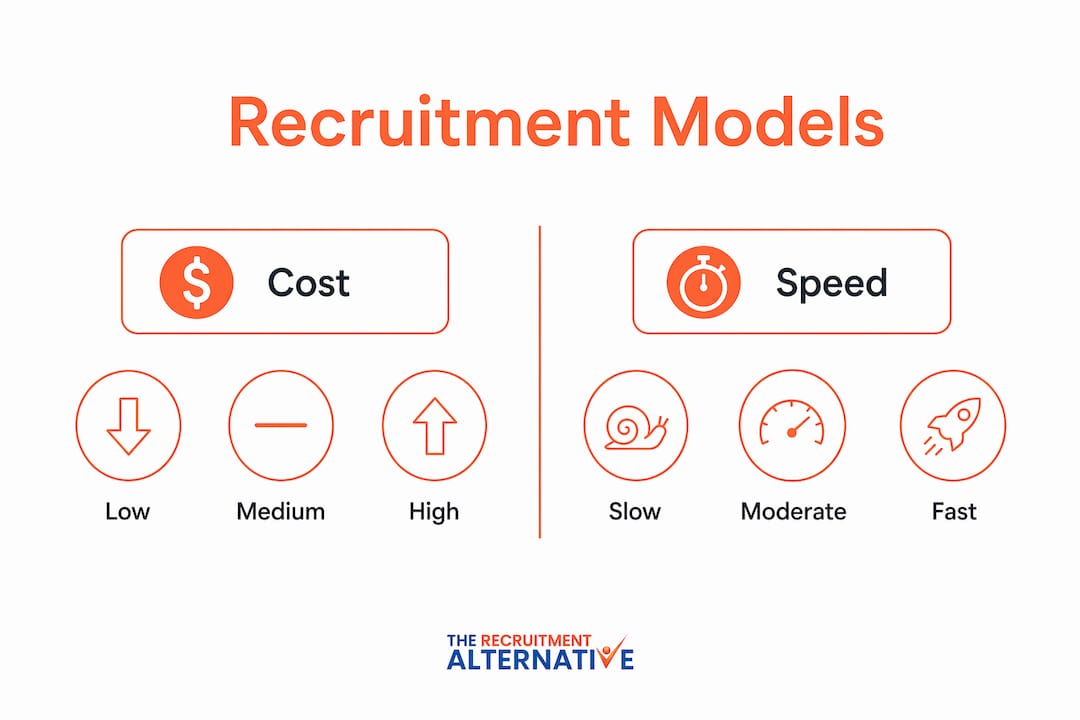
Comparing recruitment models by cost and speed
The model you choose affects both your budget and your timeline. Here is a plain comparison of the three main options available to small businesses.
| Recruitment model | Typical cost | Time to fill | Best suited for |
|---|---|---|---|
| General job board (DIY) | Low | 4–8 weeks | Entry-level or high-volume roles |
| Flat-fee recruitment agency | Fixed, predictable | 2–4 weeks | Permanent roles with budget constraints |
| Retained search | 25%–33% of salary | 10–16 weeks | Senior or confidential finance appointments |
Retained search fees for senior finance roles typically range from 25% to 33% of first-year cash compensation. That cost is justified for a CFO or Financial Controller appointment, but it is rarely the right model for a small business hiring its first bookkeeper or finance analyst.
Specialised recruitment models can cut time to fill by up to 30%, delivering candidates in as little as 3 to 5 days for urgent finance roles. Speed matters when a key finance person has resigned and your month-end reporting is at risk. The Recruitment Alternative offers affordable finance recruitment through a flat-fee model that removes the percentage-of-salary cost that makes traditional agencies prohibitive for smaller businesses.
How do you interview and assess finance candidates effectively?
A single unstructured interview is the weakest predictor of job performance. Finance roles carry real risk if the wrong person is hired, so your process needs more rigour than a conversation over coffee.
Structured two-phase interviews with standardised scorecards improve hiring outcomes in finance roles. The two phases serve distinct purposes. Phase one is a technical deep-dive. Phase two assesses leadership style, communication, and cultural fit. Separating them prevents the halo effect, where a likeable candidate masks weak technical skills.
Here is a practical interview process for small business finance roles:
- Phone screen (20 minutes): Confirm salary expectations, notice period, and software experience. Eliminate mismatches before investing more time.
- Technical interview (60 minutes): Ask the candidate to walk through a recent month-end close, explain a reconciliation they found and resolved, or describe how they built a cash flow forecast. Listen for specificity.
- Practical assignment: Give a short, real-world task relevant to your business. Ask them to review a sample P&L for errors, or build a simple budget model in Excel or Google Sheets.
- Cultural fit interview (45 minutes): Involve a second person from your team. Assess communication style, how they handle ambiguity, and how they describe past managers.
- Reference checks: Speak directly to a former finance manager or CFO, not just an HR contact. Ask specifically about accuracy, deadlines, and how they handled pressure.
A 14-day working trial can effectively validate a candidate’s practical skills, reducing the risk inherent in interview-only hiring. This is particularly useful for roles with complex technical demands, such as a management accountant or a finance business partner position.
Pro Tip: Use a simple scorecard with five to eight criteria rated 1 to 5. Share it with everyone involved in the interview. Gut feel is useful, but a scorecard forces you to articulate why someone is or is not the right fit.
For more guidance on structuring your process, the tips on interviewing candidates resource from The Recruitment Alternative covers common pitfalls in detail.
What mistakes should you avoid when hiring and retaining finance staff?
Hiring mistakes in finance are expensive. A mis-hire in a bookkeeper or accountant role costs you in errors, rework, and the time to recruit again. The most common mistakes are avoidable.
Small businesses often fail to advertise finance roles as career growth opportunities, losing top candidates to larger competitors. If your ad reads like a list of tasks with no mention of growth, learning, or impact, you will attract candidates who are settling rather than candidates who are motivated.
Avoid these common errors:
- Vague job ads: No salary range, no software stack, no success criteria. These ads attract volume, not quality.
- Rushing the decision: Filling a seat quickly feels urgent, but a poor hire costs far more than a short vacancy. Use a trial period to reduce risk.
- Ignoring retention from day one: Onboarding, clear expectations, and a 30-60-90 day check-in plan are not optional extras. They are the difference between a hire who stays and one who leaves within six months.
- Offering no growth pathway: Top finance talent values career progression, exposure to decision-making, and access to modern digital tools. If your role offers none of these, your best candidates will leave for a business that does.
- Skipping reference checks: References on finance roles are non-negotiable. Accuracy and integrity are hard to assess in an interview alone.
Retention starts before the contract is signed. Be honest about the role’s challenges, the team’s size, and the tools available. Candidates who join with accurate expectations stay longer. For practical guidance on keeping good people, the resource on holding on to good staff is worth reviewing.
Key takeaways
Recruiting finance staff for a small business requires clear role definition, targeted sourcing, structured interviews, and a deliberate retention plan from day one.
| Point | Details |
|---|---|
| Define outcomes, not just titles | Write 90-day success criteria before drafting your job ad to attract the right candidates. |
| Name your tools in the ad | Listing specific software like Xero or MYOB increases applicant quality and volume. |
| Use targeted sourcing | Employee referrals and niche finance networks outperform general job boards for quality hires. |
| Structure your interviews | A two-phase interview with scorecards reduces bias and improves hiring accuracy. |
| Retain through growth and honesty | Offer career pathways and set accurate expectations from the start to reduce early turnover. |
What I have learned about finance recruitment in small businesses
By Josh Townsend
After working with hundreds of small businesses across Australia and New Zealand, the pattern is consistent. Owners who struggle to hire good finance people almost always have the same problem. They know what they want the person to do, but they cannot articulate what success looks like. They write an ad that describes a day in the life rather than an outcome. Then they wonder why the candidates they attract are underwhelming.
The businesses that hire well do the opposite. They spend time before the process starts. They define the role by what it must deliver, not by what the last person did. They are honest about the size of the business, the state of the systems, and the growth trajectory. That honesty attracts candidates who are genuinely interested, not just available.
The other thing I have seen consistently is that small businesses underestimate the value of a structured process. A scorecard feels bureaucratic when you are a team of eight. But it is the single most effective tool for keeping a hiring decision objective when you are tired, under pressure, and the candidate in front of you seems like a good person. Good people and good finance hires are not always the same thing.
Sourcing is the third lever most small businesses pull last, when it should be first. If you are only posting on Seek and waiting, you are fishing in the same pond as every other business. Referrals, professional networks, and a specialist agency with finance expertise will consistently produce better candidates than a passive ad. The effort is front-loaded, but the result is a hire who actually fits.
— Josh Townsend
How The Recruitment Alternative helps small businesses hire finance staff
Small businesses across Australia and New Zealand use The Recruitment Alternative to fill finance roles without the cost of a traditional percentage-based agency.
The Recruitment Alternative operates on a flat-fee recruitment model that gives you a fixed, predictable cost regardless of the salary level of the role. That means no surprise invoices and no percentage calculations. The service covers permanent and temporary placements across finance, accounting, and a broad range of other disciplines. Whether you need a bookkeeper, a management accountant, or a finance business partner, the process is the same: thorough candidate sourcing, structured screening, and a shortlist of qualified applicants delivered to you. Visit the small business recruitment services page to see how the model works and what it costs.
FAQ
What does it cost to recruit a finance staff member for a small business?
Cost depends on the recruitment model you choose. A flat-fee agency like The Recruitment Alternative charges a fixed amount regardless of salary, while retained search firms typically charge 25%–33% of first-year compensation for senior roles.
How long does it take to fill a finance role in a small business?
Timelines vary by model and seniority. Specialised recruitment can deliver candidates in as little as 3 to 5 days for urgent roles, while a full retained search for a senior appointment typically takes 10–16 weeks.
Should I use a working trial when hiring finance staff?
A 14-day working trial is an effective way to validate a candidate’s practical skills before making a permanent offer. It reduces the risk of a mis-hire, particularly for roles with complex technical requirements.
What should a small business finance job ad always include?
Every finance job ad should include a salary range or band, the specific software and systems used (such as Xero or MYOB), and a clear statement of the role’s primary financial responsibilities and 90-day success criteria.
How do I retain finance staff once I have hired them?
Top finance talent stays when they have clear career progression, exposure to business decision-making, and access to modern tools. Setting accurate expectations during the hiring process and conducting regular check-ins in the first 90 days significantly reduces early turnover.

