
To hire a production manager in Australia, define what the role must deliver in output, quality and safety. Benchmark the salary against current market data. Source beyond job boards, and assess candidates on how they have run a floor, not on how well they interview. A good hire can take weeks to find, so plan for that. A flat-fee recruiter can keep the cost predictable, whatever salary the role carries.
This guide is for owners and general managers of small and mid-sized manufacturers, food producers, fabricators and processors. It covers the brief, the pay, where to find people, how to assess them and what the process costs.
TL;DR
- Write the brief around results (output, yield, on-time delivery, safety, team size), not a list of tasks.
- Salary data varies widely. One public dataset puts the average manufacturing production manager base salary at AU$93,780, with a range of roughly AU$66k to AU$137k. Your industry, location and team size decide where you land.
- Strong production managers are usually employed. Direct approaches and referrals reach them more reliably than a job advert alone.
- Assess with scenarios from your own floor, reference checks with former reports, and, if useful, a psychometric profile.
- A fixed-fee model, such as our Recruit at an $895 engagement fee plus a $3,900 to $5,000 placement fee, keeps costs known before you start.
Table of Contents
- What a production manager actually owns
- Write a brief that attracts the right people
- What to pay a production manager
- Where to find production managers
- How to assess candidates
- Making the offer and keeping the hire
- What production manager recruitment costs
- Our perspective
- Hire your production manager with a fixed fee
- Related roles and how the approach carries over
- FAQ
- Sources
What a production manager actually owns
A production manager is accountable for turning orders into finished product on time, to specification and safely. The title covers very different jobs. In a 15-person bakery it means running the roster, the ovens and the supplier calls. In a 50-person sheet metal shop it means scheduling jobs, managing supervisors and reporting to the general manager on margin.
Search any Australian job board and you will see the spread. Titles include production manager, manufacturing manager, production operations manager and plant manager, often for near-identical work. Listings range from single-site fabrication businesses to multi-line factories. The first step in hiring is to decide which of these jobs you are actually filling.
Ask yourself four questions:
- How many people will report to this person, directly and indirectly? Managing six operators is a different hire from managing 50 across shifts.
- What does the role control? Scheduling, purchasing, maintenance, quality, WHS, costing, or only some of these.
- Who is the role replacing, and why did that person leave? The answer often exposes the real gap, whether technical, people-related or a lack of authority.
- What will be different in 12 months if this hire is a success? Faster changeovers, lower scrap, fewer late orders, a safer site.
Write a brief that attracts the right people
Experienced production managers read adverts quickly. They look for the size of the operation, what you make, the reporting line and the pay. A vague advert for a “dynamic production leader” is skipped.
What to include
- The operation: product type, shifts, headcount, site location, equipment and systems used (ERP, scheduling tools, lean practices if you run them).
- The reporting line: who the manager answers to and how much decision-making authority sits with the role.
- The outcomes: two or three measurable results you want in the first year.
- The package: salary range, superannuation, any bonus, vehicle or flexibility. Candidates will filter on this first.
- Must-haves versus nice-to-haves: limit must-haves to the things that cannot be taught quickly, such as years leading a team of a similar size or experience in your type of process.
Common brief mistakes
The first is asking for a candidate who has done everything: engineering degree, Six Sigma, ERP implementation, union negotiation and 15 years in your exact niche. Few people match that, and the ones who do are expensive. Decide which one or two skills matter most.
The second is leaving out the pay. Without a range, strong candidates assume it is below market and move on.
The third is describing the job as it was five years ago. If you have added a second shift, new equipment or a compliance requirement, say so.
What to pay a production manager
Salary is where many hiring plans fail. Published figures differ by source, industry and location, so use several and then test against what candidates tell you.
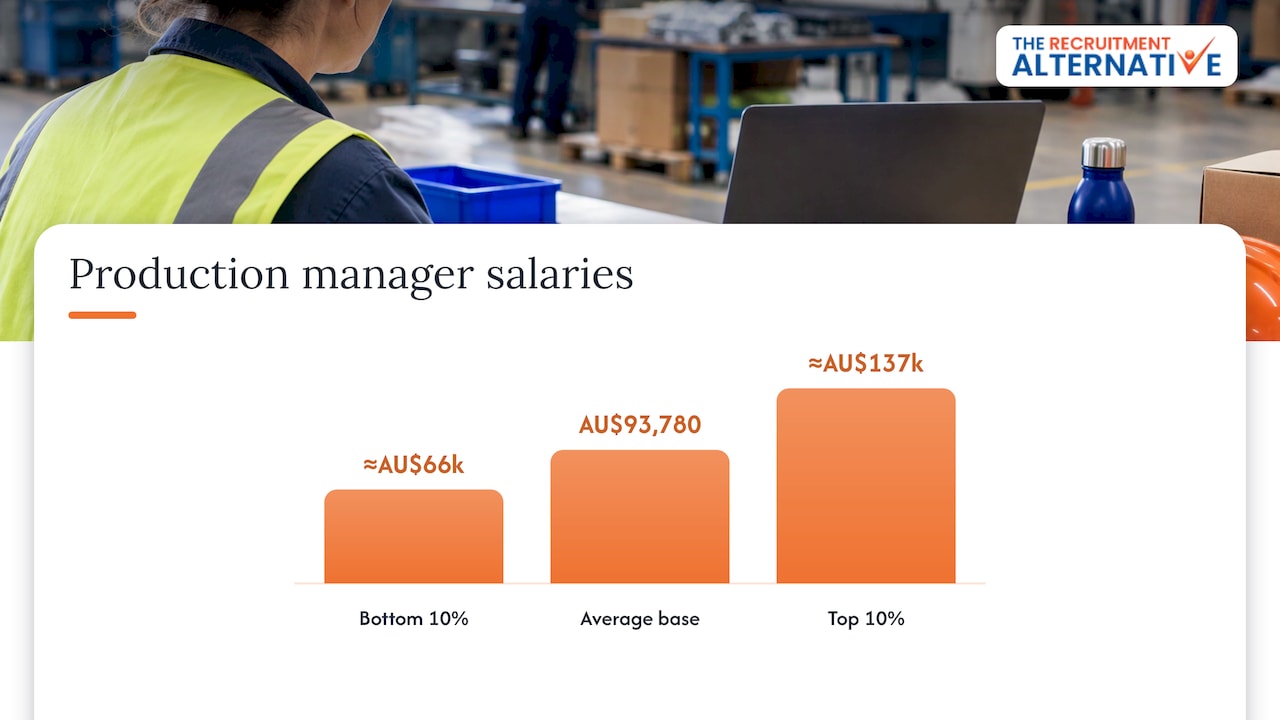
Payscale’s Australian dataset, based on 234 salary profiles and last updated in May 2026, shows an average base salary of AU$93,780 for a manufacturing production manager, with the bottom 10% near AU$66k and the top 10% near AU$137k. Live job advertisements on the major boards often sit higher for senior roles. Some listings for production managers leading around 50 staff in Western Sydney show packages in the low-to-mid $100,000s plus super. Treat advertised ranges as a signal of what you are competing with, not as an average.
Factors that move the number:
| Factor | Pushes pay up | Pushes pay down |
|---|---|---|
| Team size | Multiple shifts, 30+ staff | Single shift, under 10 staff |
| Scope | Owns P&L, purchasing, maintenance | Schedules and supervises only |
| Industry | Specialised or regulated (food safety, medical, heavy engineering) | General light assembly |
| Location | Major metro labour markets, remote or regional sites that need incentive | Smaller local markets with fewer competing employers |
| Experience | Proven turnaround or lean results | First management role |
If your budget is below the market for the scope you want, change the scope or accept a more junior hire with a development plan. Do not keep the scope and lower the pay.
Where to find production managers
The best candidates are often not looking. They are running a floor and doing well. You reach them through several channels at once.
Channels that work
- Job boards: useful for volume and visibility. They also bring a lot of unsuitable applications, so screening time is the cost.
- Direct approach: identify people in similar businesses and contact them with a clear description of the role. This takes time and some discretion.
- Referrals: ask your supervisors, suppliers, equipment vendors and industry associations. Production managers tend to know each other.
- Internal promotion: a strong supervisor or leading hand may be ready, particularly if you can add training and a clear development path.
- A recruitment agency: useful when you do not have the time to run sourcing and screening alongside a busy production schedule.
Why a general advert is not enough
Search interest in this area is strong. “Production recruitment” alone draws about 1,900 searches a month in Australia, and the same pool of job seekers sees every board. Active job seekers are only one slice of the market. If your role needs someone with a track record in your type of manufacturing, an advert tends to bring a mix of people who are available, not necessarily the best fit.
For wider context on hiring at manager level, see our management recruitment strategies guide and our overview of recruiting management roles.
How to assess candidates
Production managers are practical people, so assess them practically. A polished interview is a poor predictor of how someone handles a breakdown on a Friday afternoon.
Screening call (20 to 30 minutes)
Confirm the basics: current scope, team size, the systems they use, salary expectation, notice period and why they are leaving. Ask them to describe their site in plain terms. People who really run a floor describe it in specifics: volumes, shifts, bottlenecks.
Structured interview
Use the same questions for each candidate and score the answers against your brief. Good prompts include:
- Describe a time output dropped suddenly. What did you check first, and what did you change?
- How do you plan a week when two orders clash and one machine is down?
- Tell me about a team conflict you inherited. What happened?
- What did you measure in your last role, and how did those figures move?
- Describe a safety incident or near miss and what you did afterwards.
Listen for ownership. Candidates who say “we” for every problem and “I” for every success are worth probing.
Site visit or scenario task
Walk the candidate through your floor and ask what they would look at first. A practical scenario, such as rescheduling a week of orders given a short staff roster, shows how they think. Keep it to an hour and be clear it is part of the process.
References and checks
Speak to at least one former direct report as well as a former manager. Ask about how the person handled pressure, how they communicated change and whether the team stayed. For roles with duty-of-care or site-access needs, a criminal history check may be appropriate. Our process offers an optional criminal check at $129 and a psychometric evaluation at $199 per candidate.
Making the offer and keeping the hire
Strong candidates usually have options, so move quickly once you have chosen. A delay of a week can lose the person to a competing offer or a counter-offer from the current employer.
- Make the offer verbally first and confirm the package, start date and reporting line.
- Follow with a written contract that reflects what you discussed, including any probation terms and the applicable award or agreement if one covers the role.
- Plan the first 90 days. Agree two or three early goals, schedule introductions to the supervisors and key suppliers, and decide who supports the new manager during the first month.
- Check in often. Regular catch-ups in the first weeks pick up small misunderstandings before they become reasons to leave.
A new production manager who is given authority but no onboarding often struggles. A new manager who is given an onboarding plan but no authority struggles faster.
What production manager recruitment costs
Traditional agencies commonly charge a percentage of the first-year salary. On a production manager package in the low $100,000s, that fee grows with every salary dollar. A flat-fee model removes that link.
Our pricing is published and tiered by the salary of the role. We offer two service levels:
| Service | Engagement fee | Placement fee |
|---|---|---|
| Recruit | $895 | $3,900 to $5,000 |
| Recruit+ | $2,495 | $5,000 to $6,000 |
The engagement fee starts the search. The placement fee is paid when a candidate is successfully placed. Optional extras include a $129 criminal check and a $199 per candidate psychometric evaluation. The full detail sits on our flat fee pricing page.
We claim savings of over 70% compared with traditional commission-based agencies. Your own saving depends on the salary of the role and the fee you would otherwise be quoted, so compare the quoted figures side by side.
If the hire does not work out
We offer candidate replacement cover for hires who leave in the first two to three months. A replacement campaign costs $1,000. Details are on our candidate replacement page.
Our perspective
Production manager hiring goes wrong for two reasons: the brief is vague, and the fee structure rewards speed over fit. We built our model to fix both.
A flat fee means the price of a hire does not climb because you are paying a good salary. A business owner paying a production manager well should not be penalised with a bigger recruitment bill for doing so. You know the cost before the search begins, and you can budget the salary, the onboarding and the equipment around it.
We also believe the work is in the search, not the advert. Our approach is to source widely, screen against the brief and put forward candidates who match the operation you actually run. Small and mid-sized manufacturers do not have a spare HR team to sift through hundreds of applications, and we are set up to do that sifting.
If you are hiring a production manager and want a price you can plan around, talk to us about Recruit or Recruit+ and we will help you choose the right level for the role.
Josh Townsend
Hire your production manager with a fixed fee
If you are ready to fill the role, our fixed fee recruitment service covers permanent hires across manufacturing, engineering, trades, management and more, for businesses throughout Australia and New Zealand. The price is set by the salary band of the role, not by a percentage of the package.

Start on our fixed fee recruitment page or review the Recruit and Recruit+ fee structure to see which level suits your role.
Related roles and how the approach carries over
Much of this process applies to other management hires. If you are also building a project function, see our guide to project manager hiring. Many production managers work closely with project and operations leads, and clear role boundaries between them prevent duplicated effort.
For a wider look at how permanent hiring works from brief to start date, our guide to permanent recruitment for employers explains the stages.
FAQ
How long does it take to hire a production manager?
It depends on the role and the market, but plan for several weeks from brief to offer, plus the candidate’s notice period. Experienced managers often have notice periods of a month or more. Starting the search early and having a clear brief are the two things you control.
Should I hire from inside or outside the business?
Promote from within when a supervisor already understands your product, people and equipment and is ready for broader accountability. Hire externally when you need experience your team does not have, such as lean implementation, multi-shift planning or a new process. Many employers run both options in parallel.
How much does a flat-fee recruiter charge for a production manager?
Our Recruit service has an $895 engagement fee and a placement fee of $3,900 to $5,000. Recruit+ has a $2,495 engagement fee and a placement fee of $5,000 to $6,000. The level depends on the role and salary band, and the pricing page sets out the detail.
What happens if the production manager leaves soon after starting?
Our replacement cover applies when a hire leaves within the first two to three months. A replacement campaign is $1,000, and you can read how it works on our replacement page.

