

To hire a medical receptionist in Australia, write a clear position description, set pay and hours against the Health Professionals and Support Services Award, screen for confidentiality and patient-handling skills as well as software experience, and run a structured induction. A practice can do this alone or use a recruiter. We offer a fixed-fee option, so the cost of the hire is known before the search begins.
The front desk is the first and last contact patients have with your practice. A poor hire shows up quickly in missed recalls, frustrated patients and a clinical team doing reception work. This guide takes you through each step, from the role itself to the first months after the start date.
TL;DR
- A medical receptionist’s duties cover greeting patients, booking and recording appointments, answering calls, handling complaints and maintaining records, so write the position description around those tasks.
- Reception and admin staff in private medical practices are generally covered by the Support Services stream of the Health Professionals and Support Services Award (MA000027). Duties, not job titles, decide the classification level.
- Screen for confidentiality, communication under pressure and practice software, and always check references and a current police check.
- Give every new starter the Fair Work Information Statement and a structured induction, with regular check-ins in the first months.
- With The Recruitment Alternative, a permanent hire costs a fixed fee rather than a percentage of salary, and a replacement guarantee applies if the hire does not work out in the first two to three months.
Table of Contents
- What a medical receptionist actually does
- Write a position description that attracts the right people
- Pay, hours and employment conditions
- Where to find medical receptionist candidates
- Screening and interviewing
- Privacy and confidentiality obligations
- Onboarding that keeps your new receptionist
- What it costs to hire through an agency
- Perspective
- Fill your reception role at a fixed fee
- Common mistakes when hiring a medical receptionist
- FAQ
- Sources
What a medical receptionist actually does
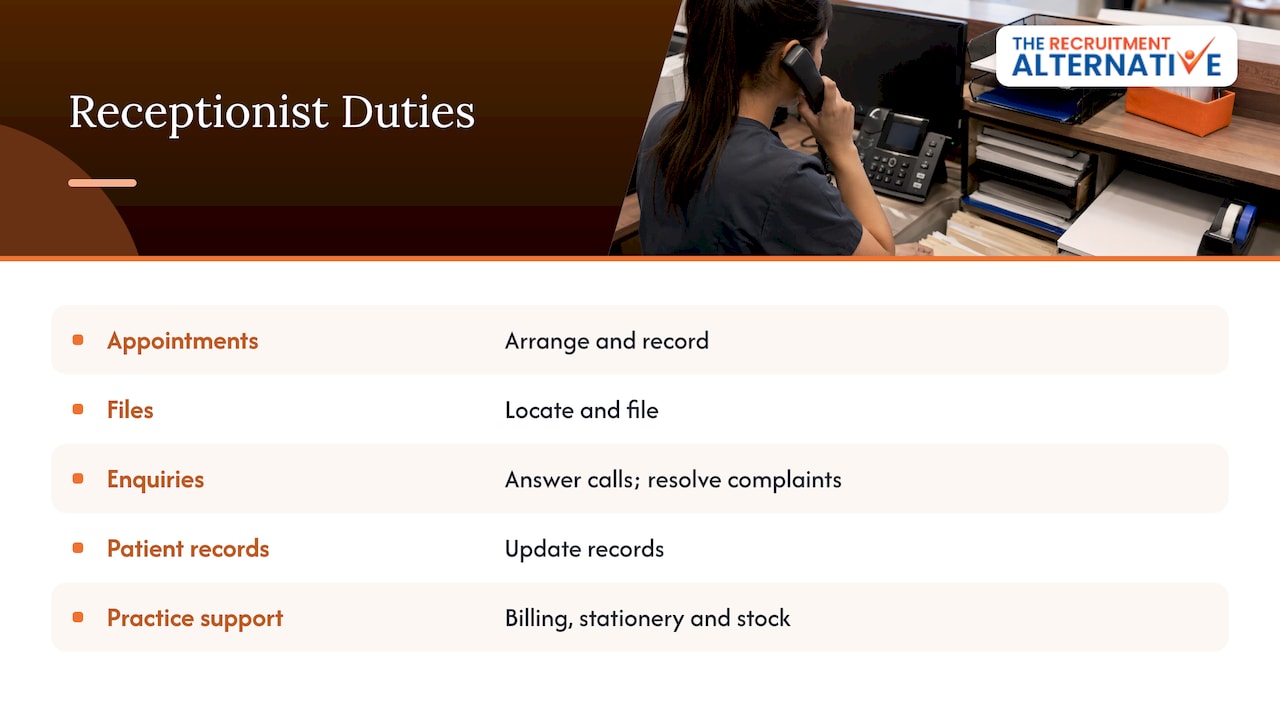
Jobs and Skills Australia describes the occupation as greeting patients and clients, arranging and recording appointments, locating files, answering enquiries and calls, resolving complaints and maintaining reception, with clerical work such as data entry and filing as part of the job. In a working practice that usually extends to billing support, updating patient records and managing stationery and stock.
The duties differ by setting. A solo GP clinic may need one person who does everything. A larger multi-doctor or allied health practice may split the front desk into reception, billing and patient liaison. Decide which you are hiring before you write an advertisement, because candidates read the advertisement as a promise about their day.
Questions to settle before you write the advertisement
- Is this a replacement role or a new position? A new position needs a clearer description of how it fits with existing staff.
- What hours must be covered? Early starts, late sessions and Saturday mornings all affect who applies and what you pay.
- Which practice management and billing software does the role use daily?
- Does the receptionist handle triage-style calls, or is that done by nursing staff?
- Is there a supervisor or practice manager for them to report to?
Write a position description that attracts the right people
An effective position description identifies the tasks, key responsibilities, required skills, qualifications or experience, employment type and hours. Vague descriptions cost you twice: they bring in unsuitable applicants and they set up disagreements after the start date. TalentMed suggests that unclear position descriptions are a major driver of early resignations in medical practices, so clarity is a retention tool as well as a hiring one.
Essential criteria worth including
Australian templates for this role are consistent. The Practice Assist template lists professionalism and confidentiality, strong computer literacy, excellent written and verbal communication, initiative, teamwork and the ability to communicate with diverse people as essential. A regional health service position description adds pressure tolerance, workload prioritisation, time management and a current police check.
Desirable criteria
The same Practice Assist template treats previous medical reception or similar administrative experience as desirable. It also lists knowledge of medical terminology, the Medicare Benefits Schedule, Windows software and general practice accreditation as desirable. Keep these as desirable rather than essential unless you truly cannot train for them. A candidate with excellent communication skills and a clean record in a busy customer-facing role can often learn your software in a few weeks.
Qualifications: what the data shows
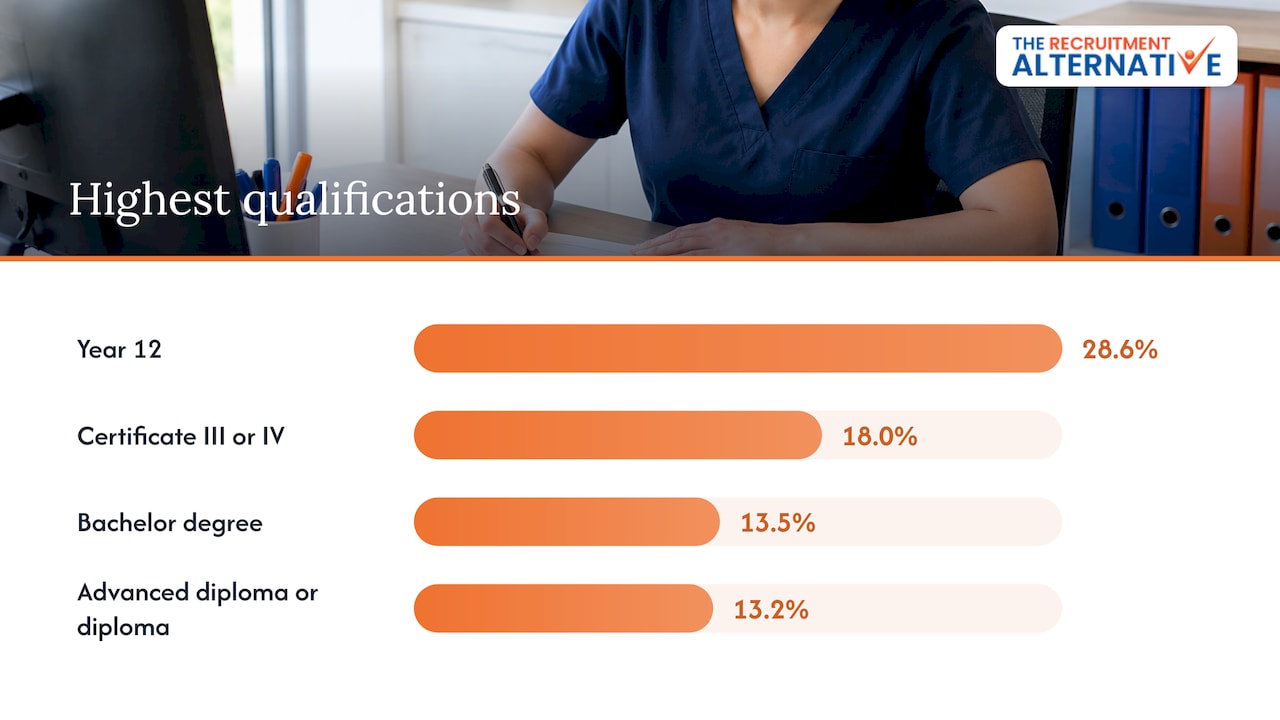
There is no single required qualification. In the 2021 Census data on medical receptionists’ highest qualifications, Year 12 was the most common at 28.6%, followed by a bachelor degree at 13.5%, a Certificate III or IV at 18.0% and an advanced diploma or diploma at 13.2%. In practice, that means requiring a specific certificate will shrink your candidate pool without necessarily improving quality. Ask for relevant training if it matters to your setting, and treat it as a plus.
Pay, hours and employment conditions
Reception and admin staff in private health practices, including medical practices, are covered by the Support Services stream of the Health Professionals and Support Services Award (MA000027). The award sets out classifications, pay, overtime, penalty rates and leave. Under the award text, full-time ordinary hours average 38 hours per week over a fortnight or four-week period. For day workers in private medical practices, ordinary hours run from 7.30 am to 9.00 pm Monday to Friday and from 8.00 am to 4.30 pm on Saturday.
Getting the classification right
Culture of One makes the point that duties, not job titles, determine the award level, based on accountability, discretion and supervision. A receptionist who also handles billing, supervises other front-desk staff or manages rosters may sit above an entry-level classification. Check the current minimum rates on the Fair Work Commission’s pay guide for the date you are hiring, because award rates are adjusted each year.
Budgeting beyond the hourly rate
When you set a salary or hourly rate, allow for:
- the award minimum for the classification, or a higher market rate if you want to attract experienced candidates
- penalty rates for any Saturday, Sunday or evening work
- superannuation, leave entitlements and workers compensation insurance
- training and induction time during which the new starter is not yet fully productive
- the cost of recruitment itself, whether advertising time or an agency fee
Many practices pay above the award to secure strong people, and a competitive rate can shorten the search. Whatever you offer, state it clearly in the advertisement and the employment contract.
Where to find medical receptionist candidates
The job boards are full of medical receptionist roles in every capital city, which tells you two things. Candidates have choices, and a plain, generic advertisement will be buried. Good candidates tend to come from four places:
- Job boards. They produce volume, but you sift through many unsuitable applications.
- Referrals. Your clinical team and existing reception staff often know capable people.
- Adjacent industries. Hospitality, hotels, banking and retail produce people used to high-volume, customer-facing work.
- A recruiter. A recruiter reaches passive candidates, screens them first and presents a shortlist.
If you advertise yourself, state the hours, location, software and pay range, describe the practice’s patient profile, and say what training you provide. People who read that and still apply are better matched from the start.
Screening and interviewing
An Avant recruitment checklist for practices recommends interviews and role-relevant assessment tests, checking qualifications, registrations or certificates, and reference checks, using an interview template so that every candidate is assessed on the same criteria. That consistency matters when two candidates look similar on paper.
A phone screen first
A 15 to 20 minute call filters out most mismatches before you spend an hour on an interview. Our candidate screening questions script gives a structure you can adapt for reception roles: availability, pay expectations, notice period and motivation.
Interview topics that matter for reception
Medical Reception Academy’s hiring guidance suggests asking about healthcare experience, handling frustrated or upset patients, medical or practice management software, prioritising competing tasks and patient confidentiality. Turn those into scenarios:
- “A patient is upset about a 40-minute wait and the phone is ringing. What do you do?”
- “A relative calls and asks whether a family member attended an appointment today. How do you respond?”
- “Two doctors both want an urgent slot at the same time. How do you decide?”
- “Tell me about a time you made a mistake with a booking or a record. What happened next?”
Listen for calm, specific answers. The best candidates describe what they did, not what they would ideally do. On the confidentiality question, the right answer is a clear refusal to share information, a polite explanation and a note of the call, not a hesitant guess.
Check the practical skills
A short typing and data entry task, or a simulated booking exercise on your own software, shows more than a CV. You can also add an optional psychometric evaluation as a further data point when you choose to use one. Keep any assessment short and relevant to the actual job.
References and checks
The Practice Assist template expects a pre-employment interview and appropriate references that can be contacted. Call at least two referees, ideally recent managers. Ask about reliability, how the person handled difficult patients or customers, how they dealt with confidential information, and whether the referee would rehire them. Confirm the candidate’s identity and work eligibility, and see our right to work check guide for employers. Where the role handles sensitive records, a police check is common practice, and the regional health template above lists a current one as essential.
Privacy and confidentiality obligations
Patient information is the most sensitive thing your receptionist handles every day. The Australian Health Practitioner Regulation Agency’s code of conduct says staff must be aware of their ethical and legal obligations to treat patient information confidentially, with appropriate security applied to electronic and hard copy records. The same code makes practitioners responsible for ensuring that their staff respect patient privacy and do not discuss patients outside professional settings.
In practical terms, that means:
- put a confidentiality clause in the employment contract and position description
- cover privacy in induction, including screen positioning, phone conversations in the waiting room and records handling
- give each user their own login to your practice software, and never allow shared passwords
- ask your practice’s legal or professional adviser if you are unsure how privacy law applies to your setting
Onboarding that keeps your new receptionist
The hire is not finished when the contract is signed. Under the Fair Work rules, every new employee must receive the Fair Work Information Statement before they start or as soon as possible afterwards.
The Avant checklist describes an induction that covers staff, patient profile, occupational health and safety, policies, the position description and the performance review system, followed by weekly supervisor meetings and regular reviews. It also recommends that employers supply the equipment and workspace needed and have the new starter sign policies and procedures.
A simple first-month plan:
| Period | Focus |
|---|---|
| Day 1 | Welcome, introductions, tour, logins, Fair Work Information Statement, policies to sign |
| Week 1 | Shadowing an experienced receptionist, phones, appointment book, patient profile, emergency procedures |
| Weeks 2 to 4 | Supervised responsibility for bookings, billing and recalls, with weekly check-ins |
| End of month 1 | Review against the position description, agree on training needs |
For more on this stage, see our guides to onboarding a new staff member step by step and welcoming your new employee. A broader employee onboarding step by step guide can also help you think about how a structured start supports retention.
What it costs to hire through an agency
Traditional agencies usually charge a percentage of the candidate’s salary. That model makes a mid-level hire expensive and puts small practices off using a recruiter at all. We charge fixed fees instead, and the price is published.
Here is how our flat-fee structure works:
| Service | Engagement fee | Placement fee |
|---|---|---|
| Recruit | $895 | $3,900 to $5,000 |
| Recruit+ | $2,495 | $5,000 to $6,000 |
The placement fee depends on the candidate’s salary. Optional extras include a criminal check at $129 and a psychometric evaluation at $199 per candidate. You pay the placement fee on a successful permanent placement. If the hire does not work out in the first two to three months, a Replacement Campaign costs $1,000.
We claim savings of over 70% compared with traditional commission-based agencies. For a front-desk role, that is a material difference for a small practice. Read more about what the engagement fee covers.
Perspective
Most practices we speak to do not struggle to find people who can answer a phone. They struggle to find someone who is calm with an anxious patient, careful with confidential information and reliable on the days the practice is busiest.
That is a screening problem, and screening takes time that practice managers rarely have. It is why we built a fixed-fee model: a practice should be able to use professional recruitment for a front-desk hire without a percentage of salary attached.
Our approach is to agree the position description with you first, source and screen candidates against it, and present people who fit the role and the team. The replacement guarantee means a hire that does not settle in the first two to three months does not leave you carrying the whole cost again.
If you are hiring a receptionist as part of a larger healthcare team, the same process applies to nurses, practice managers and allied health roles. Our healthcare recruitment process sets out the six stages we follow.
Josh Townsend
Fill your reception role at a fixed fee
We recruit permanent staff across Australia and New Zealand, including administration and healthcare roles, on a fixed-fee model rather than a percentage of salary. You can start with our Fixed Fee Recruitment service, listed from $4,795, and we will agree the position description, hours and pay range with you before sourcing begins.

If you also need a practice manager, we have a fixed-fee option for practice manager hiring. For a wider view of the process, see our guide to recruiting healthcare workers permanently.
Common mistakes when hiring a medical receptionist
- Hiring for software alone. Systems can be taught. Temperament and judgement are harder to change.
- Skipping reference calls. A short call with a former manager often tells you more than the interview.
- Leaving the award out of the budget. Penalty rates on Saturdays and evenings add up, so cost the roster before you offer.
- No induction plan. A new starter left to find their own way is more likely to resign early.
- Delaying the decision. Strong reception candidates usually have several options, so a slow process loses them.
FAQ
How long does it take to hire a medical receptionist?
Timelines vary with the market and your process. A focused search that moves from advertisement to shortlist to offer without gaps can run for a few weeks, plus the candidate’s notice period. Delays usually come from slow interview scheduling, so book interview slots before you advertise.
Do I need to hire someone with medical reception experience?
Not always. Practice Assist’s template treats previous medical reception or similar administration experience as desirable rather than essential. If you can provide a thorough induction, candidates from customer service backgrounds with strong communication and confidentiality skills can succeed.
Which award covers medical receptionists?
Reception and administrative staff in private medical practices are generally covered by the Support Services stream of the Health Professionals and Support Services Award (MA000027). The classification depends on the duties performed. Check the Fair Work Commission’s current pay guide for rates, and seek advice if your arrangements are unusual.
What does it cost to use a recruiter for a medical receptionist?
With The Recruitment Alternative, the Recruit service has an $895 engagement fee and a placement fee of $3,900 to $5,000, depending on salary. Recruit+ has a $2,495 engagement fee and a placement fee of $5,000 to $6,000. Optional checks are priced separately.
Sources
- Medical Receptionists, Jobs and Skills Australia
- Health Professionals and Support Services Award 2020 (MA000027), Fair Work Commission
- Admin and Receptionist Award Rates 2026: MA000027, Culture of One
- Position Description Template: Medical Receptionist, Practice Assist
- Medical clinic receptionist position description, Orbost Regional Health
- Employing new staff guide, AMA NSW
- Managing Staff in a Medical Practice, TalentMed
- Recruitment and selection checklist, Avant
- How to Hire a Good Medical Receptionist, Medical Reception Academy
- Code of conduct for registered health professionals, AHPRA
- Employee onboarding step by step guide

