

Hiring a project manager well comes down to four decisions: defining the outcomes the role must deliver, budgeting the full cost, assessing candidates on evidence of past delivery, and meeting your Australian employment obligations before you make an offer. This guide covers each one, with current salary data, on-costs and recruitment fee options, so you can hire with a clear plan.
TL;DR
- Write the role around outcomes (on time, on budget, in scope, to quality), not a list of tools and certificates.
- Budget for more than salary: the average Project Manager base salary is $140,335 a year, and total employment cost often runs 1.3 to 1.5 times base pay.
- Screen on documented project results, then test with a case study and structured interviews.
- Check the award, employment status and right to work before the offer goes out.
- A fixed-fee agency can replace a 15 to 25% percentage fee with a published, salary-tiered price.
Table of Contents
- What a project manager actually does, and what to specify
- What a project manager costs in Australia
- Where to find project manager candidates
- How to screen and assess project managers
- How long does hiring take?
- Employment requirements to check before the offer
- What recruitment fees look like
- Our perspective
- How our fixed-fee recruitment works
- A hiring checklist
- FAQ
- Sources
What a project manager actually does, and what to specify
A project manager is accountable for delivering a defined piece of work on time, on budget, within scope and to the required quality, while managing risk along the way. That is how the Queensland Government’s role profile describes the job, and it is a good base for your position description.
The same profile treats tertiary qualifications as advantageous rather than essential. What it lists as essential is:
- significant experience working in project teams
- communication and negotiation skills
- team leadership
- risk management
It also notes that experience with the PRINCE2 methodology is highly regarded. Treat methodology as a tick for roles where it is how your organisation works, not as a filter that removes strong candidates who deliver with other approaches.
Define the project before you define the person
Before you write the advertisement, answer these questions in writing:
- What is the project, and what does “done” look like?
- What is the budget the manager will control, and how many people will they lead directly or influence?
- Which stakeholders will they report to?
- Is the work a one-off project (suggesting a contract) or a continuing program of work (suggesting a permanent role)?
- Which industry knowledge is truly required, such as construction, IT, healthcare or finance?
The answers decide the seniority you need. A project manager running a $200,000 internal system upgrade is a different hire from a senior manager running a multi-site rollout with a large budget. Candidates read vague advertisements as a sign of a vague role, and the good ones move on.
What a project manager costs in Australia
Salary benchmarks
According to Indeed Australia (updated 14 June 2026, 423 salaries reported), the average base salary is $140,335 a year for a Project Manager and $160,412 for a Senior Project Manager. Other sources report lower figures because they sample different industries and levels, so treat any single average as a starting point and test it against live advertisements for your industry and city.
On-costs sit on top of salary
The base salary is not the cost of the hire. Statutory and practical on-costs include:
- Superannuation: the Superannuation Guarantee rate reached 12% on 1 July 2025. Our page on changes to superannuation in Australia explains the background.
- Workers’ compensation: typically 0.5% to 3% of wages, depending on the industry and state.
- Payroll tax: set by each state and applied above state wage thresholds, with large-employer rates such as 4.75% to 6.85%.
- Leave accruals and onboarding: annual leave, personal leave and the weeks it takes a new hire to reach full productivity.
Taken together, these often push total first-year employment cost to 1.3 to 1.5 times base salary once recruitment fees are included. On a $140,335 salary, that is roughly $182,000 to $210,000 (our calculation from the Indeed and Expert360 figures). Confirm your own payroll tax and workers’ compensation position with your state revenue office and insurer, or with your accountant.
Permanent or contract?
Contractors are priced by the day. One benchmark puts the median Australian Project Manager day rate at A$1,012, with a typical range of A$1,012 to A$1,242. A contractor suits a fixed-scope project with an end date. A permanent project manager suits a business that runs projects continually and wants the knowledge to stay in the company.
Where to find project manager candidates
Project managers tend to be in work and selective, so a single job board advertisement reaches only the active part of the market. Use several channels together:
- Job boards: the large boards carry thousands of project manager advertisements at any time, so your advertisement competes with many others. A clear title, a salary range and the project’s scale help it stand out.
- Your own network and staff referrals: project managers know other project managers. Ask your team, suppliers and clients.
- Professional bodies and LinkedIn: industry groups and professional networks let you reach people who are not actively applying.
- Former contractors: a contractor who has already delivered for you can be offered a permanent role.
- A recruitment agency: useful when you lack the time to source, screen and reference check, or when the role is hard to fill. Our overview of what permanent recruitment involves shows how the process works from an employer’s side.
If you are recruiting for an engineering or construction project, see our notes on engineering recruitment in Australia, where the same sourcing challenges apply.
How to screen and assess project managers
Resumes for this role are full of the same words: stakeholder management, delivery, governance, Agile. Keywords tell you little. A practical approach is to look for documented evidence of outcomes, such as delivery within budget and scope, and to use structured interviews with the same questions for every candidate. Practical case studies and planning exercises, along with multi-stage interviews with key stakeholders, help you judge technical and cultural fit.
Step 1: Shortlist on results
For each candidate, look for:
- the size of the budget they managed, in dollars
- team size and who they reported to
- planned versus actual delivery date and cost
- a project that went wrong and what they changed
Candidates who describe only activities (“coordinated meetings”) rather than outcomes need probing.
Step 2: Run a structured interview
Use the same core questions for everyone and score the answers against the same criteria. Useful questions include:
- Walk me through the last project you delivered. What was the scope, budget and timeline, and how did it finish?
- Tell me about a time scope grew mid-project. What did you do?
- How do you build and track a risk register? Give an example of a risk that materialised.
- Describe a disagreement with a senior stakeholder and how it was resolved.
- How do you report bad news to a sponsor?
- How would you plan the first 30 days on this project?
Listen for specifics: names of tools, numbers, decisions and their consequences.
Step 3: Set a short practical exercise
Give the candidate a brief based on a realistic scenario, such as a project with a fixed deadline and a resource shortfall, and ask them to outline a plan and the key risks in 30 to 45 minutes or talk it through in the interview. Keep it short and respectful of their time. What you want to see is how they structure the problem, not a finished document.
Step 4: Check references properly
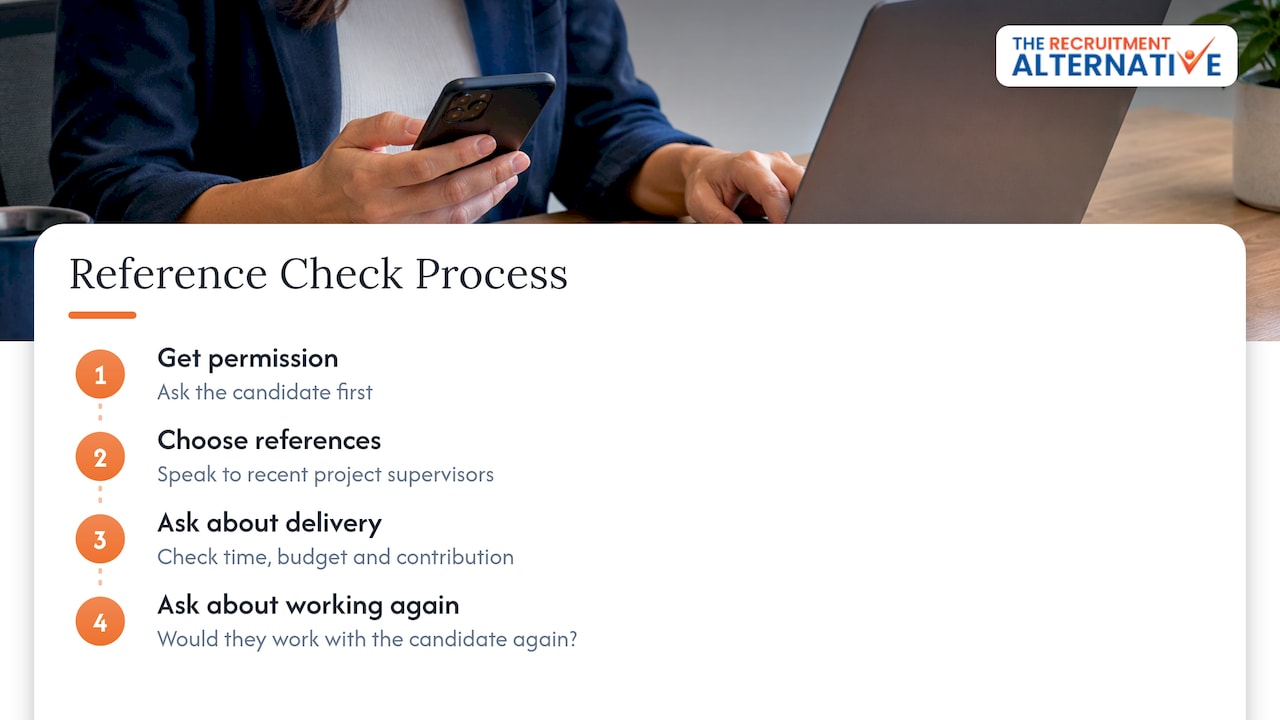
The Fair Work Ombudsman notes that reference checks help you verify the claims applicants make in interviews, and it publishes a template. Get the candidate’s permission first, and speak to people who supervised the work, ideally a sponsor or senior stakeholder from a recent project. Ask whether the project finished on time and budget, what the candidate’s own contribution was, and whether they would work with them again. Our guide to background checks in Australia covers what checks are commonly used and how they fit in the process.
How long does hiring take?
Timelines vary with seniority, industry and how many candidates are in the market. As a planning guide, allow time for each stage rather than expecting one number: defining the role and advertising, sourcing and screening, two interview rounds, references and checks, the offer and the candidate’s notice period. Notice periods for experienced professionals commonly add weeks after the offer is accepted, so build that into the project start date.
To keep things moving:
- agree the interview panel and dates before you advertise
- decide the salary range in advance so you can make a prompt offer
- give feedback within days, because strong project managers often hold more than one offer
- run reference checks while the final interviews are being scheduled
Employment requirements to check before the offer
Before you hire, the Fair Work Ombudsman says to find the right award, check whether an enterprise agreement applies, and decide whether the role is full-time, part-time or casual. Pay rates in your advertisement must not breach the Fair Work Act or an award or enterprise agreement. Many project managers are paid well above award rates, but you still need to check whether an award covers the role.
Onboarding obligations in Australia include:
- verifying the right to work, using VEVO for visa holders
- providing the Fair Work Information Statement
- setting up PAYG withholding and Single Touch Payroll reporting
- collecting a Tax File Number declaration
- completing a superannuation standard choice form
Our right to work check guide for employers explains the first of these in more detail.
What recruitment fees look like
Traditional agencies charge a percentage of the first-year salary, commonly 15 to 25%. On the average Project Manager salary of $140,335, that works out to roughly $21,050 to $35,084 (our calculation). Our page on permanent placement fees compares percentage and fixed models in more detail.
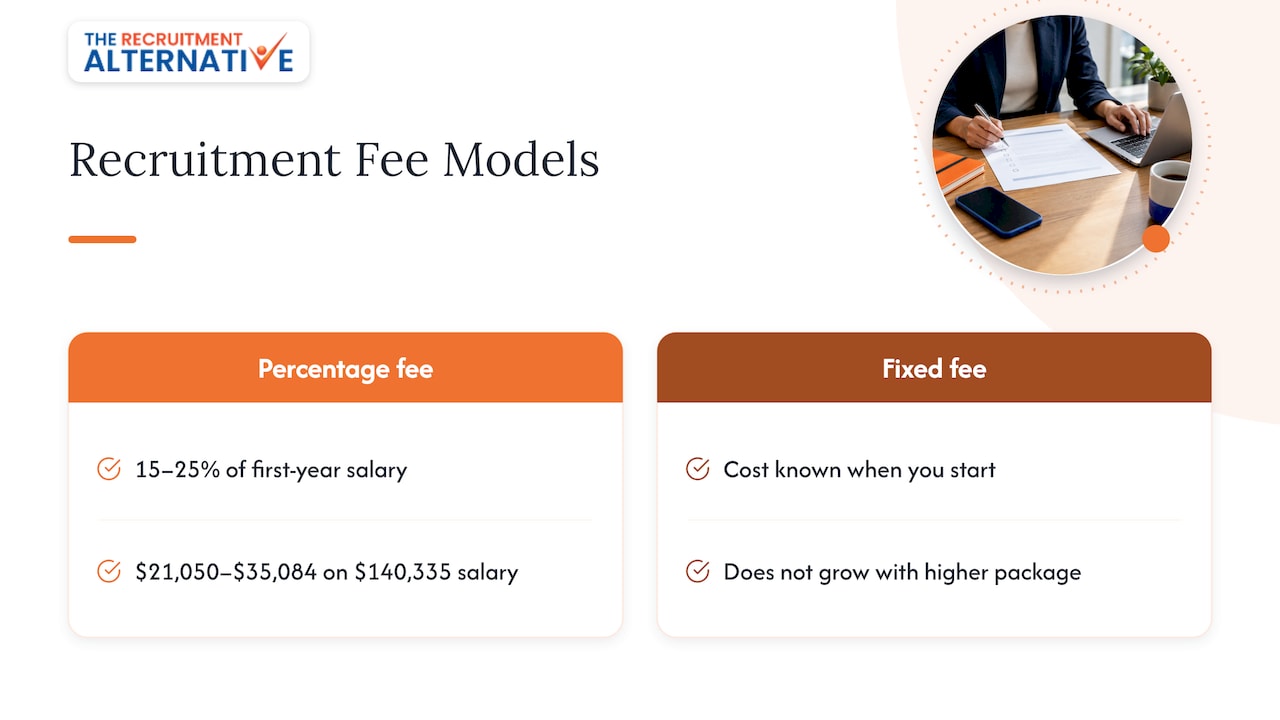
A fixed-fee model removes the link between the fee and the salary band. You know the cost when you start, and it does not grow if the candidate negotiates a higher package.
Our perspective
Most employers we speak to do not struggle to attract applications for a project manager role. They struggle to tell which applicants have really delivered. That is where a recruiter earns a fee: sourcing beyond the job boards, screening on outcomes, and presenting a shortlist you can interview with confidence.
We believe that fee should not rise with the salary. A senior hire does not take proportionally more of our effort, so our pricing is tiered by salary band, published, and fixed. Our claim is that this model can deliver more than 70% in savings compared with traditional commission-based agencies, without compromising on the quality of the shortlist.
We also stand behind the placement. If a hire does not work out in the first two to three months, our candidate replacement cover is there so you are not paying twice for the same problem.
Josh Townsend
How our fixed-fee recruitment works
The Recruitment Alternative recruits permanent staff across Australia and New Zealand, including management and technology roles, for a fixed fee set by the candidate’s salary. The structure on our flat fee pricing page is:
| Service | Engagement fee | Placement fee |
|---|---|---|
| Recruit | $895 | $3,900 to $5,000 |
| Recruit+ | $2,495 | $5,000 to $6,000 |
Optional extras are a criminal check at $129 and a psychometric evaluation at $199 per candidate. If a replacement is needed, a replacement campaign costs $1,000.
To see which tier fits your project manager’s salary, start from our fixed fee recruitment page and tell us about the role.
A hiring checklist
- Write the project outcomes and the budget the role controls.
- Set a salary range using current advertisements and benchmarks, then add on-costs.
- Decide permanent or contract.
- Advertise and approach candidates directly.
- Shortlist on documented results.
- Run structured interviews and a short practical exercise.
- Check references with former sponsors or supervisors.
- Confirm the award, employment status and right to work.
- Make a prompt written offer and plan the first 30 days.
FAQ
How much does it cost to hire a project manager in Australia?
The average base salary is $140,335 for a Project Manager and $160,412 for a Senior Project Manager, according to Indeed Australia. Add superannuation at 12%, workers’ compensation, payroll tax where it applies, leave and onboarding. Then add the recruitment fee if you use an agency.
Do project managers need a degree or certification?
Not necessarily. The Queensland Government’s role profile describes tertiary qualifications as advantageous rather than essential. Experience in project teams, communication, leadership and risk management carry more weight. Ask for certifications such as PRINCE2 only if your organisation works that way.
Should I hire a permanent project manager or a contractor?
Choose a contractor for a fixed-scope project with a clear end date, and a permanent hire when you run projects continually. Contractor rates are quoted per day, with one benchmark median of A$1,012. A permanent hire keeps the project knowledge in your business.
What should I check before making an offer?
Confirm which award or enterprise agreement applies, the employment status, and the pay rate against the Fair Work Ombudsman’s hiring guidance. Then verify the right to work and complete reference checks. Our background checks guide lists the usual checks.
Sources
- Project manager role profile, Queensland Government
- Senior project manager salary in Australia, Indeed
- The True Cost of Hiring an Employee in Australia (2026), Expert360
- Project Manager Day Rate in Australia 2026, PayMetric Labs
- A Practical Guide to Project Management Recruitment
- Reference checking template, Fair Work Ombudsman
- Hiring employees, Fair Work Ombudsman
- HR Onboarding in Australia: Your Essential Checklist, Rippling

