

The recruitment process is the end-to-end workflow a business follows to move from identifying a hiring need through to onboarding a new employee. In IT and technology roles, this process is formally called the technology recruitment process, though the term “IT recruitment process” is widely used by employers searching for practical guidance. Recruitment process explained research shows the average hire takes 44 days and costs the equivalent of $4,700 USD per role. For small business owners and HR managers across Australia and New Zealand, understanding each stage of this workflow is the difference between a hire that sticks and one that costs you twice.
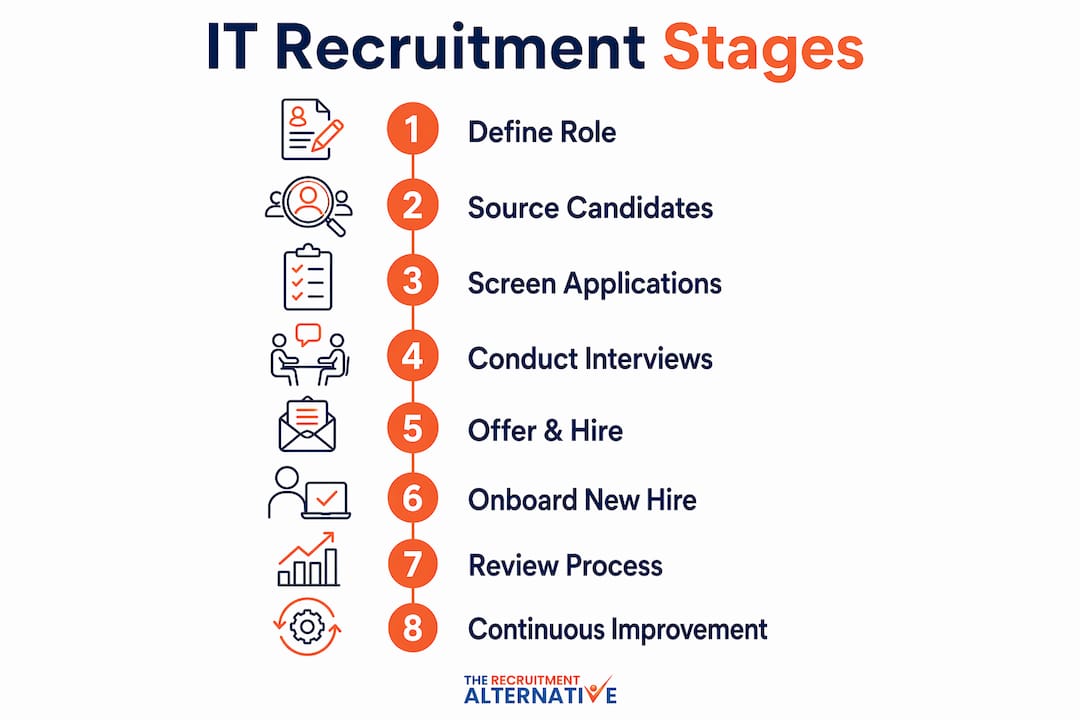
What are the key stages of the IT recruitment process?
A structured recruitment system for small businesses covers seven to eight core steps, from workforce planning through to onboarding. Each stage builds on the last. Skipping one creates problems downstream that no amount of candidate sourcing can fix.
-
Workforce planning and needs assessment. Define why the role exists, what success looks like in 90 days, and what budget is available. Companies with formal workforce plans fill roles 20% faster than those hiring reactively. That gap is significant for a small business running lean.
-
Job description creation. Write a job description that specifies outcomes, not just duties. Include the reporting structure, key performance indicators, and non-negotiable skills. Vague job ads attract vague candidates.
-
Candidate sourcing. Post to relevant job boards such as Seek and LinkedIn. Use employee referrals, which consistently produce faster hires with lower turnover. AI-driven sourcing tools now automate much of the initial search, freeing managers to focus on higher-value decisions.
-
Application screening and shortlisting. Review applications against the criteria set in step one. Shortlist to a manageable number before moving to interviews. Screening more than 20 candidates for a single role without a scoring rubric wastes time and introduces inconsistency.
-
Structured interviews. Use the same set of behavioural questions for every candidate. Structured interviews reduce bias and produce better hiring decisions than unstructured conversations.
-
Selection and reference checking. Score candidates independently before group discussion. Check at least two professional references. Verify employment history and, where relevant, qualifications.
-
Offer, negotiation, and acceptance. Present a written offer promptly. Delays between verbal and written offers lose candidates to competitors. A clear negotiation process reduces back-and-forth and protects the relationship.
-
Onboarding. The first 45–90 days are critical. 20% of new hires leave when onboarding is treated as a compliance exercise rather than a genuine introduction to the role and team.
Pro Tip: Build a simple staff recruitment checklist for small business use that maps each of these eight stages. A one-page checklist cuts the chance of missing a step under pressure.
How does technology improve the recruitment process?
Nearly 70% of organisations struggle to fill full-time positions. Technology does not solve that problem on its own, but it reduces the time and effort required at each stage. The key is knowing which tools to use and where.
- Applicant tracking systems (ATS). Platforms such as Workable, Greenhouse, and JobAdder manage candidate pipelines, store applications, and track communication history. An ATS removes the need for spreadsheets and reduces the risk of losing a strong candidate in an overflowing inbox.
- AI resume screening. AI tools scan applications against defined criteria and rank candidates by relevance. This cuts screening time significantly on high-volume roles. The risk is over-reliance: AI tools can filter out unconventional but strong candidates if the criteria are too narrow.
- Interview scheduling automation. Tools like Calendly and HireVue eliminate the back-and-forth of booking interviews. Candidates self-select a time, reducing delays and improving the candidate experience.
- Assessment platforms. Skills-based assessments from platforms such as TestGorilla give objective data on candidate capability before the interview stage. This is particularly useful for technology recruitment, where technical skills are hard to assess through conversation alone.
- Collaboration tools. Shared scoring sheets in Google Workspace or Microsoft Teams allow hiring panels to record independent assessments before discussing candidates together.
Pro Tip: Do not automate the intake and scoping phase. The intake call with your hiring manager is the most critical step in the entire process. Misalignment here causes delays that no ATS can fix.
What legal and compliance steps apply in Australia and New Zealand?
Legal compliance is not optional in the recruitment process. Getting it wrong exposes a business to Fair Work Act penalties in Australia and Employment Relations Act obligations in New Zealand.
- Work eligibility verification. Confirm every candidate has the right to work in Australia or New Zealand before making an offer. Use the Department of Home Affairs Visa Entitlement Verification Online (VEVO) system for visa holders.
- Tax and superannuation obligations. Register new employees for payroll tax, superannuation, and PAYG withholding before their start date. In New Zealand, KiwiSaver enrolment applies from day one.
- Anti-discrimination compliance. Job ads and interview questions must not reference age, gender, religion, disability, or family status. The Australian Human Rights Commission and the New Zealand Human Rights Commission both publish guidance on lawful interview questions.
- Proper documentation. Keep signed employment contracts, position descriptions, and reference check records for every hire. Documentation protects the business if a dispute arises.
- Privacy obligations. Candidate data collected during recruitment is subject to the Privacy Act 1988 in Australia and the Privacy Act 2020 in New Zealand. Store it securely and delete it when no longer needed.
A structured recruitment system integrates these compliance steps at the relevant stage rather than treating them as an afterthought. Doing so reduces regulatory risk and builds candidate trust.
How to build a structured recruitment process for better outcomes

A repeatable recruitment workflow is the single biggest improvement most small businesses can make to their hiring results. Treating every hire as a unique project delays decisions and introduces inconsistency. A standard process with defined steps, questions, and scoring criteria speeds things up and reduces bias.
The table below shows the difference between a reactive and a structured approach across five key areas.
| Area | Reactive approach | Structured approach |
|---|---|---|
| Role definition | Informal, verbal brief | Written intake form with success criteria |
| Candidate scoring | Gut feel after interviews | Predefined rubric, scored independently |
| Interview questions | Varies by interviewer | Standard behavioural question set |
| Reference checks | Sometimes skipped | Mandatory, documented |
| Onboarding | Ad hoc first week | 30/60/90-day plan in place before start date |
Tracking recruitment KPIs gives you the data to improve over time. The most useful metrics for small businesses are time to fill, cost per hire, offer acceptance rate, and 90-day retention rate. Review these after every hire and adjust the process where the numbers show a gap.
- Run an intake call before advertising. The scoping call with the hiring manager aligns expectations on salary, culture fit, and must-have skills. Skipping it is the leading cause of misaligned shortlists.
- Score candidates independently. Interviewers who score before group discussion produce more objective decisions. Groupthink is a real risk in small teams where one strong opinion can override everyone else.
- Build a talent pipeline proactively. Keep warm relationships with strong candidates who were not hired. When the next role opens, your pipeline shortens the time to fill considerably.
For a practical overview of small business hiring best practices, The Recruitment Alternative publishes updated guidance tailored to the Australian and New Zealand market.
What common recruitment mistakes do small businesses make?
Most recruitment failures trace back to a small number of repeatable errors. Knowing them in advance is the fastest way to avoid them.
Unclear role requirements are the most common cause of a misaligned hire. When the job description does not reflect what the hiring manager actually needs, every subsequent step is built on a faulty foundation. A poor intake phase causes recruitment delays regardless of how many candidates you source.
Skipping legal checks creates risk that surfaces months later. Work eligibility errors, missing superannuation registrations, and undocumented reference checks are all avoidable with a simple checklist.
Interview bias affects small teams more than large ones because there are fewer decision-makers to balance each other out. Using the same behavioural questions and scoring independently before discussion reduces this risk materially.
Neglecting onboarding is the most expensive mistake of all. The total first-year investment in a new hire is approximately 112–125% of base salary. Losing that person in the first 90 days because onboarding was poor means starting the entire process again.
Pro Tip: Reactive hiring, where you only start recruiting when a seat is empty, consistently produces worse outcomes than proactive pipeline building. Set a calendar reminder every quarter to review your talent pipeline, even when you are not actively hiring.
Key takeaways
A structured recruitment process is the most reliable way for small businesses to hire well, hire faster, and retain the people they bring on board.
| Point | Details |
|---|---|
| Define the role before advertising | Run an intake call and write a clear job description with measurable success criteria. |
| Use structured interviews | Ask the same behavioural questions to every candidate and score independently before group discussion. |
| Integrate compliance early | Verify work eligibility, document references, and register payroll obligations before the start date. |
| Technology supports, not replaces | Use an ATS and AI screening tools to reduce admin, but keep human judgement at the intake and decision stages. |
| Onboarding drives retention | A 30/60/90-day onboarding plan reduces the risk of losing a new hire in the first three months. |
Recruitment is a process, not a transaction
I have worked alongside small business owners who treat recruitment as something to get through rather than something to get right. The result is almost always the same: a hire that looks fine on paper but does not work out, followed by a rushed replacement process that costs more than the first one.
The businesses that hire well share one habit. They treat the intake call as seriously as the final interview. Hiring is a psychological negotiation, and the scoping conversation is where you either set yourself up for a great outcome or guarantee a mediocre one. Most small business owners skip it because they think they already know what they need. They rarely do.
Technology has genuinely changed what is possible in recruitment. AI screening, automated scheduling, and skills assessments give small businesses capabilities that were once only available to large HR teams. But the businesses that over-automate lose the human quality that makes candidates choose them over a larger employer. Speed and transparency are competitive advantages, as SHRM research confirms, but they work best when paired with a process that treats candidates as people, not applications.
My honest advice: build your recruitment process once, document it properly, and refine it after every hire. The upfront effort pays back many times over.
— Josh Townsend
How The Recruitment Alternative can help your business hire better
Small and medium businesses across Australia and New Zealand face the same challenge: finding quality candidates without paying the high percentage fees that traditional agencies charge. The Recruitment Alternative was built specifically to solve that problem. The agency offers a flat-fee recruitment model that covers roles across sales, technology, engineering, finance, administration, and executive leadership, with no hidden costs and no percentage of salary.
Whether you are hiring your first employee or building out a team, The Recruitment Alternative provides personalised service, extensive candidate sourcing, and a proven process that gets the right people in front of you quickly. Contact The Recruitment Alternative today to find out how affordable recruitment services can work for your business.
FAQ
What is the IT recruitment process?
The IT recruitment process is the structured sequence of steps a business follows to hire technology staff, from defining the role through to onboarding. It typically covers workforce planning, job description creation, sourcing, screening, interviews, selection, offer, and onboarding.
How long does the recruitment process take on average?
The average recruitment process takes 44 days from job posting to accepted offer. Businesses with a formal, structured process fill roles faster than those hiring reactively.
What legal checks are required when hiring in Australia?
Australian employers must verify work eligibility using the VEVO system, register new employees for superannuation and PAYG withholding, and comply with anti-discrimination laws under the Fair Work Act and Australian Human Rights Commission guidelines.
How do structured interviews improve hiring decisions?
Structured interviews use the same behavioural questions for every candidate and require independent scoring before group discussion. This reduces interviewer bias and produces more consistent, objective hiring decisions.
What recruitment KPIs should small businesses track?
The four most useful recruitment KPIs for small businesses are time to fill, cost per hire, offer acceptance rate, and 90-day retention rate. Reviewing these after every hire identifies where the process needs improvement.

