
To hire a dental assistant in Australia, define the role and its scope, budget against the current award rates, screen for the right qualifications and checks, and make a conditional offer once references clear. Doing that well takes time a practice owner rarely has between patients. We recruit permanent staff for Australian and New Zealand businesses on a fixed fee, so a practice knows its hiring cost before it starts, rather than paying a percentage of the assistant’s salary.
This guide walks through each stage: what the role is, what to look for, what to pay, how to assess applicants and how to onboard them.
TL;DR
- Dental assistants are not registered practitioners, so the role must be written around tasks they are trained and competent to do, under a dentist’s supervision.
- Look for a Certificate III or IV in Dental Assisting, infection control knowledge, CPR and the checks your practice requires. Radiography needs a separate licence.
- Most private practices fall under the Health Professionals and Support Services Award. Classifications and pay rates changed from 1 April 2026, so budget from current rates.
- Score applicants against the position description, interview the top few and make a conditional offer while you check references.
- Our flat-fee model starts at $895 to engage and $3,900 to $5,000 on placement for Recruit, with a replacement option if a hire does not work out early.
Table of Contents
- What a dental assistant does, and where the role stops
- Plan the hire before you advertise
- Qualifications, experience and checks to look for
- What to pay a dental assistant
- Assess applicants and verify suitability
- Write the position description and onboarding plan
- What recruiting a dental assistant costs with us
- Our view on hiring dental assistants
- FAQ
- Sources
What a dental assistant does, and where the role stops
The Dental Assistants Professional Association (DAPA) notes that Australia uses the term dental assistant rather than dental nurse. The role covers chairside and clinical assisting, cleaning and preparing the surgery, cleaning and processing reusable instruments, organising appointments, invoicing and taking payments, and reception duties. In a small practice, one person often does most of that list. Say so in the advertisement, because applicants decide quickly whether a job is chairside only or an all-rounder.
The limits matter just as much. According to the Australian Dental Association NSW, a dental assistant is not a registered practitioner and has no defined scope of practice under the National Law, and cannot perform restricted dental acts. Assistants may perform only procedures for which they are trained and competent, and the dental practitioner is responsible for supervising them. The Australian Dental Association’s policy is that dental diagnosis and treatment belong to AHPRA-registered practitioners.
In practice, write the duties in your position description as tasks that support the dentist, and keep anything clinical tied to documented training. That protects the patient, the assistant and your registration.
Plan the hire before you advertise
A rushed dental assistant hire usually fails at the planning stage, not the interview. Settle these points first:
- Employment type. Full-time, part-time or casual. This changes the rate, the applicant pool and how you roster.
- Experience level. A trainee you will develop, a Certificate III assistant who can start chairside, or a Certificate IV assistant with extra skills such as radiography.
- Duties. Chairside only, or chairside plus sterilisation, reception and billing.
- Budget. Work out the pay and on-costs from the award, not from job-board ads.
- Timeline. Allow for advertising, screening, interviews, reference checks, notice periods and the checks that the role requires.
If you also need front-of-house cover, our guide to medical receptionist hiring covers that role, and our guide on how to recruit healthcare workers permanently sets out the wider process for health practices.
Qualifications, experience and checks to look for
There is no legal requirement for a dental assistant to complete a training program, but nationally recognised courses exist. The Certificate III is the core qualification: DAPA describes HLT35021 Certificate III in Dental Assisting as the nationally recognised vocational qualification, available through registered training organisations and, in most states, as a traineeship. It can also be done as a school-based traineeship in years 11 and 12 in some states.
Certificate IV electives, according to the ADA NSW information sheet, include dental radiography, oral health promotion, assisting with general anaesthesia and conscious sedation, extended duties, dental practice administration and working with diverse people.
Radiography needs a licence
If the assistant will take X-rays, a qualification alone is not enough. DAPA states that assistants who have completed the Certificate IV in Dental Assisting (Radiography) must hold a licence to expose radiographs with the relevant state or territory authority, and that overseas radiography qualifications do not comply. Ask for the licence number and the issuing authority at interview.
What employers typically list as mandatory
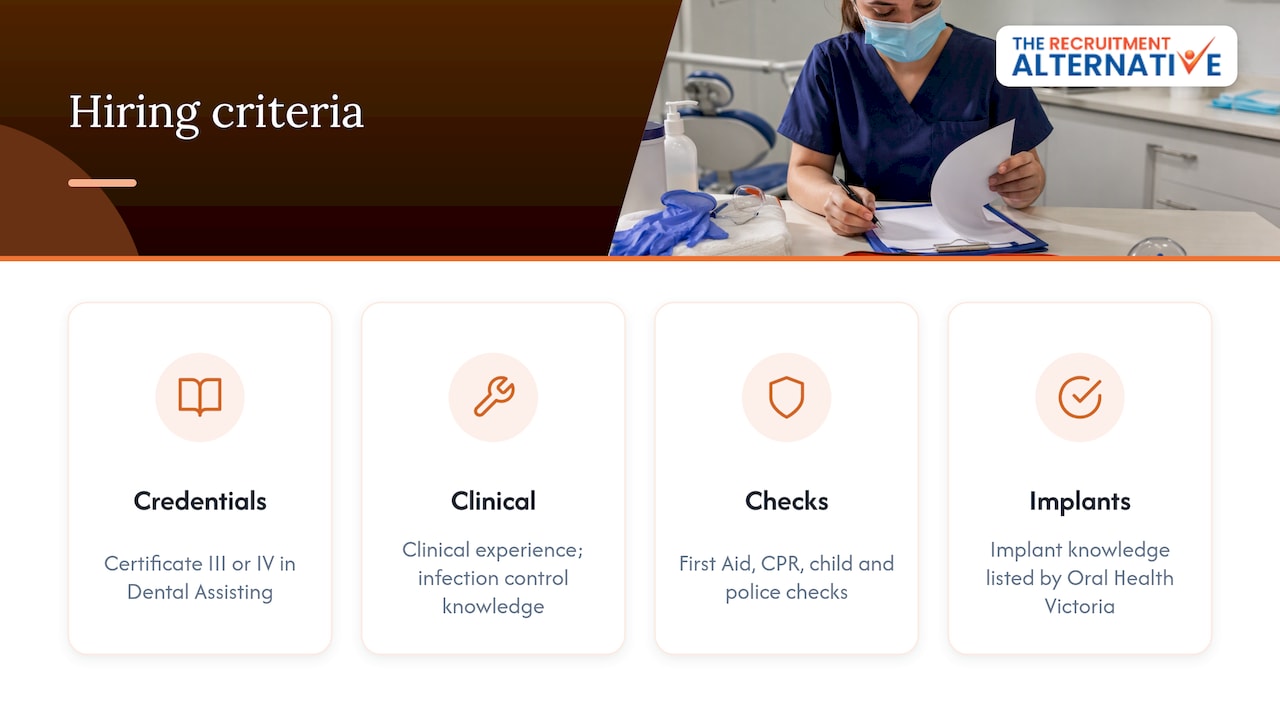
Published position descriptions show a consistent pattern. The Aboriginal Health and Medical Research Council’s duty statement lists a Certificate III or IV in Dental Assisting, clinical experience, infection control knowledge, First Aid and CPR, a Working with Children Check and a National Police Check. Oral Health Victoria’s position description requires a Certificate III, police and Working with Children checks, CPR certification and infection control experience, plus knowledge of implants.
A private practice does not need to copy those lists, but they are a sound starting point. Decide which items are essential and which are desirable, and be consistent when you compare applicants.
Checks sit alongside this. Through us, an optional criminal check is $129 and a psychometric evaluation is $199 per candidate, so you can add the checks that suit the role without building them into every placement.
What to pay a dental assistant
DAPA explains that most private practices employ assistants under the Health Professionals and Support Services Award (MA000027), where dental assisting is classed as a support service. It adds that pay is generally slightly above award and varies by state, with city private practices averaging around $25 per hour and country practices paying less. Treat that as a historical guide, because the award has moved since.
The 2026 classification changes
The Fair Work Ombudsman confirms that classifications and pay rates for dental assistants changed from the first full pay period starting on or after 1 April 2026. The Fair Work Commission’s December 2025 decision set out the two-stage implementation, giving practices time to make administrative changes. It also noted that assistants with around four years’ experience are often paid above award for attraction and retention reasons.
Under the re-aligned structure, as summarised by Employer Services:
| Level | Who it covers |
|---|---|
| Level 3 | Unqualified, under 12 months’ industry experience |
| Level 5 | Unqualified, 12 months up to 4 years’ experience |
| Level 6 | Certificate III or equivalent, or unqualified with 4 or more years’ experience |
| Level 7 | Certificate IV or equivalent |
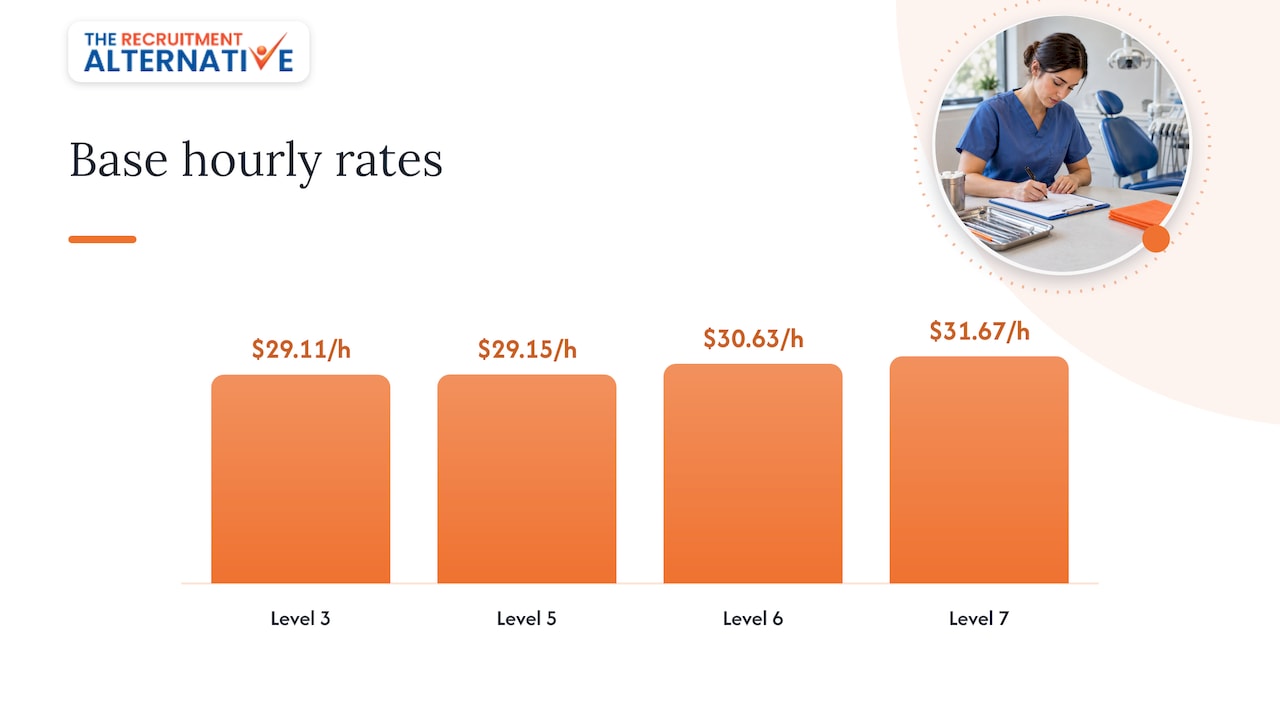
One tracking tool lists the base rates from 1 July 2026 as $30.63 an hour for Level 6 and $31.67 for Level 7, with casual rates of $38.29 and $39.59. Level 3 sits at $29.11 and Level 5 at $29.15. Confirm the figures against the Fair Work Commission’s award before you advertise, since rates are indexed and further stages apply.
For comparison, the Victorian public sector salary circular lists Dental Assistant Grade 1 at $64,855.45 and Grade 3 at $77,813.93 from 1 July 2026. Public salaries are a useful marker of what applicants may weigh your offer against.
Allow for on-costs
The hourly rate is not the full cost. Add superannuation, leave loadings for casuals, workers compensation and training time. Keeping those costs organised through the year is easier with a clear record of business expenses, and a guide to tax deductions by job can help you and your accountant see what applies.
Assess applicants and verify suitability
A structured process beats a gut feel, particularly when applications arrive in volume. business.gov.au recommends a matrix rating system: put each candidate’s name across a page, list the role requirements down the side, score each from 1 to 5 and add the totals to see who to interview.
For a dental assistant, the matrix rows might be:
- Certificate III or IV (or equivalent) and any radiography licence
- Infection control and sterilisation experience
- Chairside experience with your type of work, such as general, orthodontic or implants
- Reception, billing and appointment skills, if the role includes them
- Communication with anxious patients
- Availability against your roster
Interview questions that show competence
Ask about real situations rather than general preferences. How did the candidate manage instrument reprocessing at their last practice? What do they do when a dentist asks for something outside their training? How do they calm a nervous child? The second question tests the scope boundary described earlier, and the answer tells you whether the person understands where an assistant’s role stops.
A short working trial in the surgery is common in practices, but agree its length, pay and terms first, and make sure it complies with Fair Work rules.
Make a conditional offer
business.gov.au advises that you can make a conditional offer while you check references, and that a written offer and employment contract setting out terms helps manage expectations and protect the business. DAPA lists what applicants should confirm: position type, weekly hours, duties, whether pay is above award, probation and when pay will be reviewed. Have those answers ready in writing.
Write the position description and onboarding plan
The business.gov.au guidance says a good position description includes the job title, reporting lines, a summary of the job and of the business, employment type, key responsibilities, selection criteria and desirable personal attributes. The AH&MRC duty statement follows a similar layout and also sets a six-month probationary period with performance reviews every 12 months, a useful model for your own timeline.
For the first weeks, plan:
- A sterilisation and infection control walk-through, with sign-off
- Shadowing the dentist on your most common procedures
- Written boundaries on what the assistant does and does not do
- A check-in at the end of week one, month one and the end of probation
Good onboarding also protects your investment. Our pieces on how to hold on to good staff and on staff retention cover what keeps a new hire past the first year.
What recruiting a dental assistant costs with us
Most agencies charge a percentage of salary, so a better-paid hire costs more. We charge a flat fee. Our published structure is:
| Option | Engagement fee | Placement fee |
|---|---|---|
| Recruit | $895 | $3,900 to $5,000 |
| Recruit+ | $2,495 | $5,000 to $6,000 |
Our Fixed Fee Recruitment option is $4,795 one-off. Fees depend on the candidate’s salary, and you pay per successful permanent placement. If a hire does not work out in the first two to three months, a Replacement Campaign is $1,000. We work with businesses of all sizes across Australia and New Zealand, and recruit in healthcare among other fields. Our engagement fee page explains what the first payment covers.
The full structure is on our flat-fee pricing page. If you want us to run the search while you run the practice, start from our Fixed Fee Recruitment page.

Our view on hiring dental assistants
Practice owners tell us the same thing about hiring: the cost is not only the fee, it is the weeks of chair time lost to advertising, sorting applications and interviewing. A percentage fee also grows with every award increase, which makes the budget harder to predict.
We built our model so the price is known upfront. A tiered engagement fee and a placement fee set by salary band mean a practice can plan a hire before it begins. A replacement option sits behind it for the early months, when a mismatch is most likely to show.
Our position is that a small practice should have the same access to professional recruitment as a large group. A dental assistant is the person who keeps the surgery moving, and choosing one carefully is worth doing properly, without the cost climbing alongside the salary.
Josh Townsend
FAQ
Do I need to hire a dental assistant with a qualification?
There is no requirement for assistants to complete a training program, but Certificate III and IV courses are nationally recognised. Many employers list a Certificate III or equivalent as mandatory, as published position descriptions show. An unqualified applicant can still be hired and trained, usually at a lower award level.
What can a dental assistant not do?
Assistants cannot perform restricted dental acts or diagnose and treat patients, which are reserved for registered practitioners. They may only do procedures they are trained and competent in, under the dentist’s supervision. Taking X-rays requires a licence from the relevant state or territory authority.
How much does a dental assistant earn per hour?
Under the award from 1 July 2026, base rates run from about $29 to about $32 an hour across Levels 3 to 7, with casual rates higher. Many practices pay above award, particularly for experienced assistants. Check the Fair Work Commission award for current rates before you advertise.
How long does it take to hire a dental assistant?
It depends on how many applicants you attract and the notice period they owe their current employer. Allow time for advertising, screening, interviews, reference checks and any police or working with children checks. A recruiter running the search for you shortens the time your team spends on it.
Sources
- Dental Assistants Information Sheet, ADA NSW
- Working in Australia, DAPA
- Becoming a Dental Assistant, DAPA
- Policy Statement 2.2.10, Australian Dental Association
- Dental Assistant Duty Statement, AH&MRC
- Dental Assistant Position Description, Oral Health Victoria
- Gender undervaluation priority awards review, Fair Work Ombudsman
- FWCFB 297 decision, AustLII
- New classification levels for dental assistants, Employer Services
- Dental Assistant Pay Rate Australia 2026-27, FairWork Mate
- Victorian public sector salary circular
- Interview and recruit employees, business.gov.au

