

Local recruitment means hiring from the candidates in your own suburb, city or region. National recruitment means searching across Australia and being open to people who will relocate, commute or work remotely. For most small businesses the answer is not one or the other: start local where the role allows it, and widen nationally when the skills are scarce, the location is remote or the first round of applications is thin.
This guide explains how the two approaches differ in reach, cost and speed, where each one fails, and how to decide for a specific role.
TL;DR
- Local recruitment is faster to arrange and suits roles that depend on place, but it caps your candidate pool at whoever lives nearby.
- National recruitment widens the pool for specialist, senior and regional roles, and it asks more of you in sourcing, screening and relocation support.
- Australian employers take an average of 29 days to fill a role, so a thin local pool is a real cost, not just an inconvenience.
- A fixed-fee model keeps the cost of a national search predictable, because the price does not rise with the salary of the person you hire.
- Decide role by role: the more specialised the job and the smaller your town, the stronger the case for searching nationally.
Table of Contents
- What local and national recruitment mean in practice
- How reach changes the candidates you can access
- Advantages and limits of recruiting locally
- Advantages and limits of recruiting nationally
- Cost and time to hire: what the Australian data shows
- How to decide, role by role
- Methods that reach both markets
- Our perspective: price should not decide the geography
- What a fixed-fee national search costs
- Fixed-fee recruitment across Australia and New Zealand
- Common mistakes when choosing a geography
- FAQ
- Sources
What local and national recruitment mean in practice
The two terms describe the geography of your search, not the quality of the people you find.
Local recruitment targets candidates who already live within commuting distance. You advertise where locals look, lean on word of mouth and community networks, and interview face to face with little notice. Everyone in the process shares the same labour market, the same commute and often the same industry contacts.
National recruitment targets candidates anywhere in Australia, and for some employers New Zealand as well. The role is advertised on national channels, candidates are screened by phone or video, and some of them will need to move, fly in for interviews or work from another city. Remote and hybrid roles make this far more common than it was a decade ago.
A third option sits between them: regional recruitment, where the vacancy is outside a capital city and the employer needs to attract people from elsewhere. We cover that in more depth in our guide to regional recruitment in Australia.
How reach changes the candidates you can access
The main difference is the size and mix of the pool. A local search gives you the people who are nearby and looking right now. A national search adds people who are not looking in your town but would consider your job.
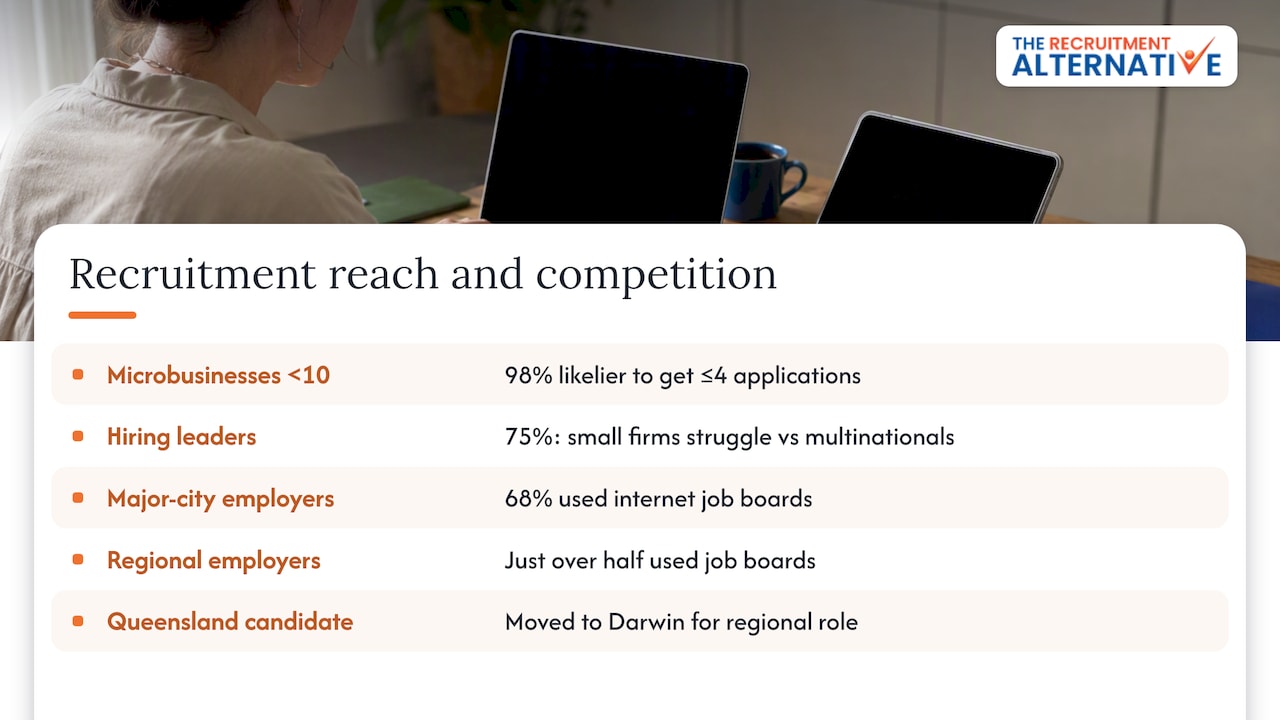
That matters most for small employers. Employment Hero research from 2023 found that Australian microbusinesses with fewer than 10 employees were 98% more likely than larger firms to receive four or fewer applications per role. In the same report, 75% of hiring leaders in Australia and New Zealand agreed that small businesses struggle to compete for talent against multinational corporations. A small pool plus big competitors is the usual reason a local-only search stalls.
National sourcing can also reach people who would never see a local advertisement. SEEK describes a case where a candidate living in Queensland was identified as open to moving and relocated to Darwin for a regional role. That candidate was not applying to Darwin jobs. Someone went and found them.
The channels differ too. Jobs and Skills Australia reports that in 2022 68% of recruiting employers in major cities used internet job boards, compared with just over half of regional employers. Regional employers lean more on word of mouth and local networks. Those methods work well inside a town and do very little outside it.
Advantages and limits of recruiting locally
Where local recruitment works well
- No relocation. The candidate already has housing, school and family nearby, so offers are less likely to fall over.
- Easy interviews. You can meet in person within days, and candidates can visit the workplace before they accept.
- Local knowledge. People who know the area, the customers and the competing businesses need less orientation.
- Lower upfront cost. A single local ad and your own networks can fill many roles without outside help.
- Reliable attendance. For roles that need someone on site at a set time, such as a front counter, a workshop or a clinic, local candidates are the practical choice.
Where it falls short
- Small pool. If only a handful of people in your area have the qualifications, you may wait months or compromise on skills.
- Competition from larger employers. The best local candidates are often being courted by bigger names that can offer more.
- Network bias. Word-of-mouth hiring tends to bring in people who look like your current team, which narrows your view of who could do the job well.
- Slow fills for specialists. Engineers, finance managers, senior sales leaders and some health professionals are scarce in most towns.
Cost can be lower than people expect. Employment Hero’s 2023 data puts the average cost of advertising a single role at $5,380, while the median is only $200, because many employers rely on free or low-cost methods. That gap tells you the average is pulled up by expensive searches. Most local roles are filled cheaply, and the costly ones are usually the hard-to-fill roles.
Advantages and limits of recruiting nationally
Where national recruitment works well
- Depth of talent. You can compare people from several cities, not just whoever happens to be local.
- Better matches for specialist roles. A niche skill set is far more likely to exist across the country than across one postcode.
- Regional and remote vacancies. Sourcing beyond the immediate area is often the only way to fill them.
- Remote-friendly roles. If the job can be done from anywhere, a local-only search throws away most of your options.
- Speed when the local market is dry. A wider pool can shorten a search that would otherwise sit open for months.
Where it falls short
- More screening. A bigger pool means more applications, and someone has to read them, call them and shortlist.
- Relocation risk. A candidate who has to move a family has more reasons to pull out between offer and start date.
- Remote management. Hiring someone you manage from a distance needs clear expectations and good communication from day one.
- Higher agency costs under commission models. If a recruiter charges a percentage of salary, a senior national search can become very expensive.
That last point is where pricing structure matters, and we return to it below.
Cost and time to hire: what the Australian data shows
Neither approach has one fixed price, but the figures below give a sense of scale for Australian employers.
| Measure | Figure | Source |
|---|---|---|
| Average time to fill a role | 29 days | Employment Hero, 2023 |
| Average cost to advertise one role | $5,380 (median $200) | Employment Hero, 2023 |
| Average annual hiring spend, small business | $8,090 | Employment Hero, 2025 |
| Average annual hiring spend, medium business | $18,371 | Employment Hero, 2025 |
The averages do not split cleanly into local and national, so treat them as a benchmark rather than a verdict. What they do show is that an average hire takes about a month, and that a failed or stalled search is expensive for a small business with a small hiring budget.
Conditions are also tight right now. As of February 2026, 51% of employers surveyed by Jobs and Skills Australia were actively recruiting, and 43% reported difficulty in the process. When nearly half of recruiting employers find it hard, a local-only strategy has less room for error.
How to decide, role by role
Use these questions for every vacancy rather than setting one policy for the whole business.
- Does the job have to be done on site? If yes, a local or relocating candidate is required. Search locally first and widen only if the pool is empty.
- How scarce is the skill? Common administration and customer service roles are usually filled locally. Engineering, senior finance, specialist healthcare and technology roles often need a national view.
- How big is your local market? In a capital city you may have enough depth. In a regional town you may not.
- How long can the role stay empty? If lost output costs you more each week than a wider search would cost, go national early.
- Can you support a relocation? If you can help with moving costs or flexible start dates, you open the door to interstate candidates. If not, be realistic about who will say yes.
- Can the role be remote or hybrid? If so, there is little reason to limit the search by postcode.
A practical sequence for many small businesses: advertise locally and tell your network for two weeks, review the quality of what comes in, then widen to national channels if you do not have a strong shortlist. Our overview of candidate sourcing channels in Australia shows where to look at each stage. If the role is remote, our page on hiring remote staff in Australia explains how that search works.
Methods that reach both markets
You do not need a different toolkit for each geography, but you do need to use it differently.
- Online job boards. These are the most common method. Jobs and Skills Australia reports that in 2022 internet job boards, social media and word of mouth were the methods employers most often reported, and that methods differed significantly by where the vacancy was located.
- Digital sourcing. Active searching, not just posting an ad, can move fast. In a 2025 campaign, Horner Recruitment filled 98% of 250 regional roles within three weeks using digital sourcing on Indeed. That is one campaign by one company, so read it as proof that scale and speed are possible, not as a promise for your role.
- Employee referrals. Strong locally, and still useful nationally if your staff have wide professional networks.
- Government support. The Department of Employment and Workplace Relations notes that employers can manage recruitment themselves or get no-cost personalised help through Workforce Australia, a national network. It is worth checking for entry-level and general roles.
- Specialist outreach. For sales hiring in particular, some businesses also bring in AI-powered sales development support to keep their pipeline moving while a new salesperson is found and onboarded.
Our perspective: price should not decide the geography
We see the same pattern with small business owners again and again. They would like to search nationally, but a percentage-of-salary fee makes a wide search for a senior or specialist person look unaffordable, so they settle for the local pool. That is a pricing problem, not a hiring strategy.
Our model is a fixed fee. The cost does not climb with the salary of the candidate, and it does not change because the person lives in another state. Within the published tiers, a role is priced by the salary band. That lets an owner ask the right question, which is where the best person for this job is, instead of where the budget allows us to look.
We also think local hiring still deserves respect. For a customer-facing role in a small town, a local candidate with the right attitude often beats a better-credentialled stranger. Our advice is to keep both options open for as long as the shortlist is weak, and to commit to one only when you have people worth interviewing.
— Josh Townsend
What a fixed-fee national search costs
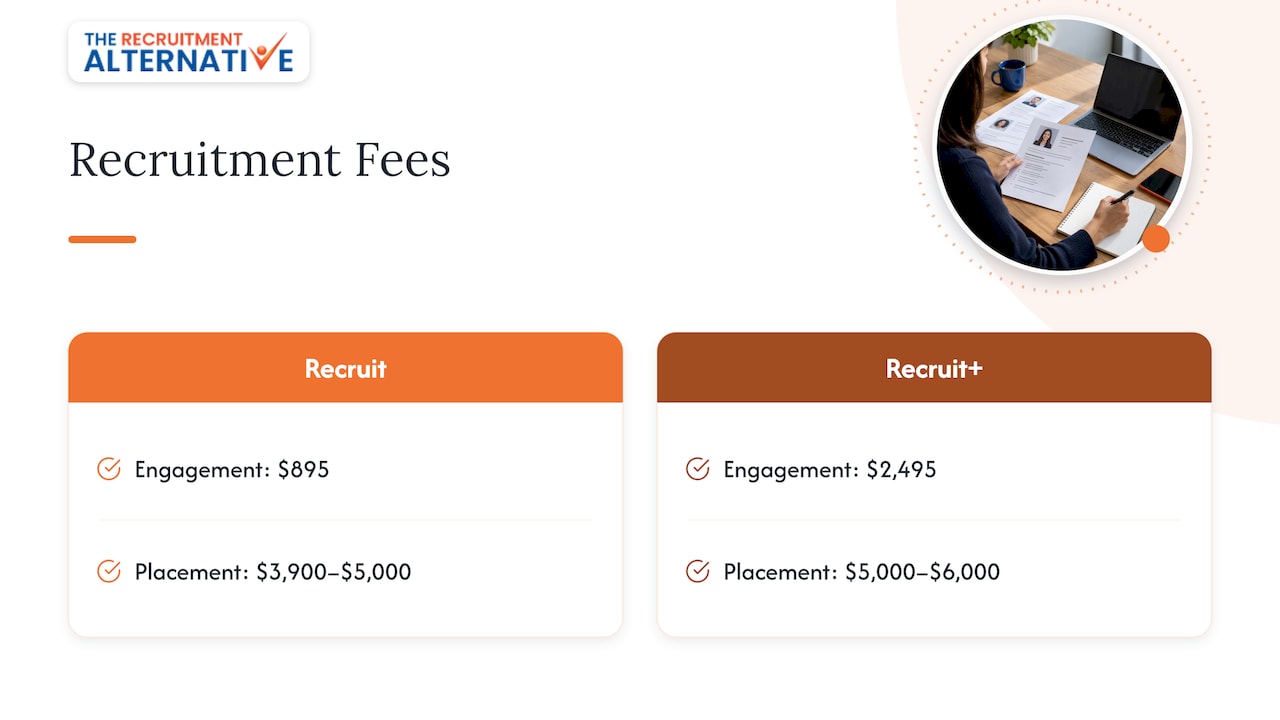
We publish our pricing so you can compare it with the cost of a stalled search. The Recruit service has an engagement fee of $895 and a placement fee of $3,900 to $5,000, depending on the candidate’s salary. Recruit+ has an engagement fee of $2,495 and a placement fee of $5,000 to $6,000. The engagement fee starts the search and the placement fee is paid when you hire.
Optional extras include a criminal check at $129 and a psychometric evaluation at $199 per candidate. If a hire does not work out in the first two to three months, a replacement campaign costs $1,000.
The same fees apply whether we search in your city or across the country. Our page on budget recruitment across Australia explains how national searches work for smaller employers.
Fixed-fee recruitment across Australia and New Zealand
If you want a wider pool without a percentage-based bill, our fixed fee recruitment service covers permanent roles in sales, administration, finance, engineering, healthcare, trades, technology and executive leadership, for businesses across Australia and New Zealand. Fixed Fee Recruitment starts at a one-off $4,795.
You can see the full fee structure on our flat fee pricing page, and read how the model compares in our guide to flat fee recruitment benefits for Australian employers.
Common mistakes when choosing a geography
- Treating national as better. A wider search is only better if the extra candidates are qualified and willing to move. For a role that must be on site, a thousand interstate applicants may produce no real option.
- Searching nationally without a relocation plan. If you cannot offer help with moving or a flexible start date, many interstate candidates will drop out late.
- Relying on word of mouth alone. It is cheap and often effective, but it limits the diversity of your pool.
- Waiting too long to widen. A role that has been open for weeks with weak applications is telling you the local market is thin. Act on that early.
- Ignoring fit because the CV looks good. Whichever geography you use, check motivation and values, not only skills. Our hints in recruitment SME style show how to spot a candidate who will stay.
FAQ
What is the difference between national and local recruitment?
Local recruitment draws candidates from the area around the workplace, usually people who can commute. National recruitment searches across Australia and includes people who will relocate or work remotely. The difference is the size of the pool and the support needed to land a candidate, not the standard of the people.
Is local recruitment cheaper than national recruitment?
Often it is, because local roles can be filled through free or low-cost channels. Employment Hero’s 2023 data shows a median advertising cost of $200 per role. National searches for specialist roles cost more in time and sourcing effort, but a fixed-fee model makes the agency cost predictable.
When should a small business widen its search nationally?
Widen the search when the skill is scarce locally, when the role can be remote, when your town is small, or when a local search has produced few suitable applicants after a couple of weeks. Roles that must be done on site and are easy to fill locally rarely need a national search.
Does national recruitment take longer?
Not necessarily. A national search involves more screening and sometimes relocation, but it can end a search that would otherwise stay open for months. The average Australian employer takes 29 days to fill a role, and a thin local pool pushes that figure up.
Can you use a recruitment agency for local hiring only?
Yes. An agency can run a search in one city, one region or the whole country. With a fixed fee, the price is set by the salary band of the role rather than by how far the agency searches.
Sources
- Employment Hero, State of Recruitment Report ANZ 2023
- Employment Hero, The Hiring Snapshot: Current Trends in Recruitment 2025
- Jobs and Skills Australia, Recruitment methods used by employers
- Jobs and Skills Australia, Recruitment Experiences and Outlook Survey
- Department of Employment and Workplace Relations, Hiring staff
- SEEK, How to find the right candidate for regional roles
- Indeed, Horner Recruitment regional hiring testimonial

