

Most Australian engineering recruiters charge a percentage of the placed engineer’s first-year salary, so the fee climbs with every dollar of pay. A flat-fee model charges a set amount whatever the salary. The difference is small on a $70,000 graduate hire and large on a $150,000 senior engineer. This guide shows how each fee is built, what it should cover, when you pay it and how to compare quotes properly. We also set out our own published flat fees, so you can run the numbers against any proposal on your desk.
TL;DR
- Percentage-based agencies usually calculate the fee on the engineer’s annual salary. The more senior or scarce the engineer, the more you pay.
- Flat-fee recruitment fixes the cost up front. Our Recruit service totals $4,795 to $5,895 and Recruit+ totals $7,495 to $8,495, depending on the salary tier.
- Compare quotes on total cost, what is included, when each payment falls due and the length and terms of the replacement guarantee.
- Engineering pay is rising in several disciplines, which pushes percentage fees up with it.
Table of Contents
- How engineering recruitment fees are calculated
- What engineering recruitment costs in practice
- Why engineering fees are under upward pressure
- What a fee should include
- When the fee is payable
- Replacement guarantees: read the fine print
- Our flat fees for engineering roles
- A worked comparison for a three-hire year
- Questions to ask any agency before you sign
- Hiring versus developing: a cost check
- Our perspective: why we price engineering placements the way we do
- Frequently asked questions
- Sources
How engineering recruitment fees are calculated
There are two common structures for permanent engineering placements.
Percentage of salary. The agency agrees a percentage with you, applies it to the candidate’s annual package and invoices you when the engineer accepts or starts. The rate is negotiated, and agencies typically set it higher for senior, scarce or urgent roles. Our guide to permanent placement fees for Australian employers compares the 25% style of quote with fixed alternatives in more detail.
Flat fee. You pay a stated dollar amount for the placement, usually in two parts: a fee to start the search and a fee when you hire. The amount is set by a salary band, not by the exact salary you negotiate with the candidate.
Two details change the final invoice more than the headline rate does.
- What counts as salary. Ask whether the fee applies to base salary only or to the full package, including superannuation, allowances, vehicle, bonuses or overtime. Engineering offers often carry site allowances, so the definition matters. Get it in writing.
- When the fee is locked in. Some agreements calculate on the salary you advertise, others on the salary you actually pay. A candidate negotiated up by $10,000 can raise a percentage fee after the quote.
What engineering recruitment costs in practice
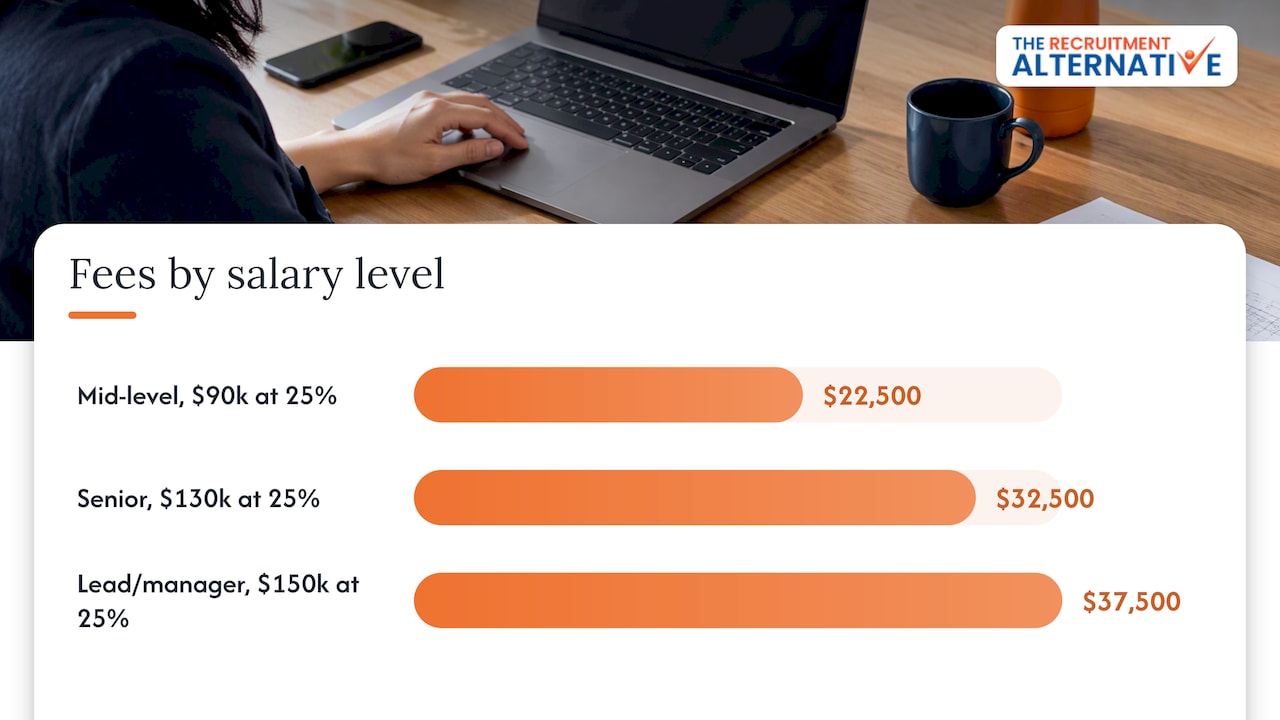
The figures below are illustrations, not quotes. They apply a hypothetical 20% and 25% rate to three salaries, so you can see the shape of the cost.
| Engineer’s salary | Fee at 20% | Fee at 25% |
|---|---|---|
| $90,000 (mid-level) | $18,000 | $22,500 |
| $130,000 (senior) | $26,000 | $32,500 |
| $150,000 (lead or manager) | $30,000 | $37,500 |
The fee rises by $2,000 to $2,500 for every $10,000 of extra salary, while the amount of work for the recruiter changes little. That is the central argument for fixed pricing: the effort of sourcing, screening and presenting a senior structural engineer is not proportionally larger than for a mid-level one.
Agencies’ own rates vary, and so should your expectations. The Australian National University notes that charges vary considerably depending on the agency chosen and the level of support required. Treat any single “typical” percentage you read online as a starting point for negotiation, not a market rule.
Why engineering fees are under upward pressure
Percentage fees follow salaries, and engineering salaries have moved. Engineers Australia’s labour market overview found that many disciplines saw above-average wage growth, with maintenance and reliability engineer salaries up 20% in 2023 to 2024. The same report points to strong growth for engineering managers and clean-energy occupations.
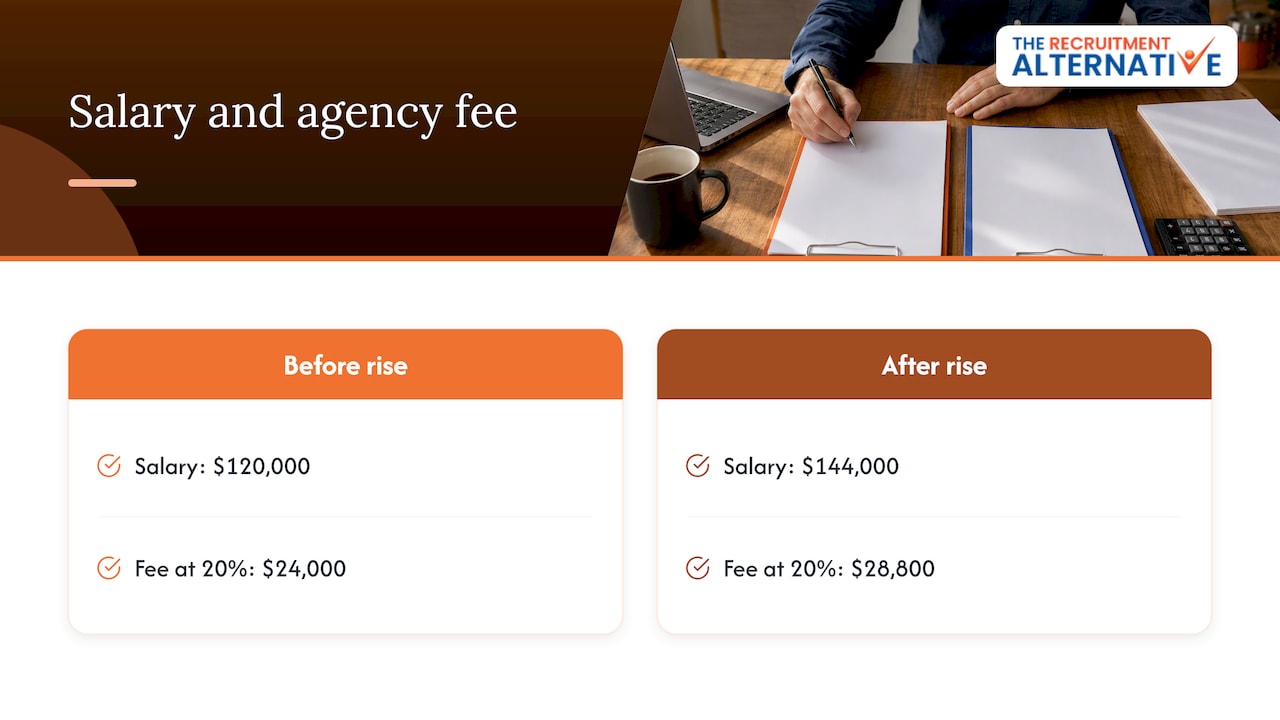
For an employer, the effect compounds. A higher salary raises the cost of the hire itself, and if your agency charges a percentage it raises the agency fee too. A role that cost $24,000 to fill on a $120,000 salary at 20% costs $28,800 at the same rate after a 20% pay rise. Nothing about the service changed.
Flat fees sit outside this loop. If you are hiring in a fast-moving discipline, a fixed fee removes one variable from your budget. Our page on engineering recruitment challenges covers the other pressures employers face in this market.
What a fee should include
A fee is only comparable once you know what it buys. ANU lists the services agencies may provide: advertising, shortlisting, first-round interviews, reference checks, skills tests, interview organisation and negotiation assistance. It also notes that advertising and travel expenses are usually excluded from its indicative fees.
For engineering hires, add these questions to your checklist:
- Technical screening. Who judges whether a candidate’s design software, standards knowledge or site experience is real? A generalist screening for keywords will pass weak shortlists to you.
- Registration and licences. Will the agency verify chartered status, professional registration, licences or working rights, or is that left to you?
- Advertising costs. Are job board costs inside the fee or billed separately?
- Background checks. Are criminal checks or psychometric assessments included, or charged per candidate?
- Shortlist commitment. How many candidates will you see, and in what time frame?
On the last two points, our own add-ons are listed openly: an optional criminal check is $129 and a psychometric evaluation is $199 per candidate, both shown on our pricing page.
When the fee is payable
Payment timing differs more between agencies than the rates do. The usual patterns are:
- Retained. A portion is paid to start the search and the rest on completion.
- Contingent. Nothing is paid until you hire. Agencies working this way typically build more risk into the percentage.
- Staged. Payments are split across offer acceptance, start date and the end of the guarantee period.
There is no single right structure. What matters is that the invoice dates are tied to events you control, and that you know what happens to payments already made if the search fails. We explain the common options in our guide to placement fee payment terms and four payment structures.
Replacement guarantees: read the fine print
Every agency says it has a guarantee. The wording is where they differ. Before you sign, check:
- Length. Is it one month, three months or longer?
- Trigger. Does it apply if the engineer resigns, is dismissed, or both? Some exclude dismissal for performance.
- Remedy. Is it a free replacement search, a partial refund or a credit against future work?
- Conditions. Is it void if you change the role, salary or reporting line, or if you miss a payment?
- Cost of replacing. Is the replacement truly free, or is there a charge to restart?
With us, candidate replacement insurance covers situations where a hire does not work out in the first two to three months. If you need a replacement campaign, it is a flat $1,000. The terms are on our replacement campaign page.
Our flat fees for engineering roles
We recruit permanent engineering staff across Australia and New Zealand, alongside sales, finance, healthcare, trades, technology and executive roles. Our pricing has two service levels, each with an engagement fee and a placement fee. The placement fee is set by the salary tier of the role.
| Service | Engagement fee | Placement fee | Total |
|---|---|---|---|
| Recruit | $895 | $3,900 to $5,000 | $4,795 to $5,895 |
| Recruit+ | $2,495 | $5,000 to $6,000 | $7,495 to $8,495 |
Add-ons are optional. A criminal check costs $129 and a psychometric evaluation costs $199 per candidate. The full structure is on our flat fee pricing page.
Set against the illustration earlier, a $130,000 senior engineer hired at a 20% rate costs $26,000 in agency fees. The same hire through our Recruit service falls within $4,795 to $5,895, which is a saving of roughly $20,000 or more, before you consider any extras the percentage agency may bill. Your actual comparison depends on the quote you hold, so run it with real numbers.

If you would like to see where your role sits, start from our fixed fee recruitment page, which sets out the process from engagement to placement.
A worked comparison for a three-hire year
Fees matter most when you hire repeatedly. Suppose a small engineering consultancy plans three permanent hires in a year: a $95,000 design engineer, a $120,000 project engineer and a $140,000 senior engineer.
- At 20% of salary: $19,000 + $24,000 + $28,000 = $71,000.
- At 25% of salary: $23,750 + $30,000 + $35,000 = $88,750.
- Through Recruit: three fees between $4,795 and $5,895 each, so $14,385 to $17,685.
The percentage figures are hypothetical rates, and your quote may be higher or lower. The point is the gap. Even at a modest 15%, the same three hires would cost $53,250 in fees. Money saved on recruitment is money available for the salary that wins the engineer, for training, or for equipment.
Businesses often ask whether the fee is tax deductible. We cover that in are recruitment fees tax deductible in Australia; confirm your own position with your accountant.
Questions to ask any agency before you sign
Use the same list with every provider so the quotes are comparable.
- What is the fee in dollars on the salary I expect to pay, including the worst case if the offer rises?
- Is the fee calculated on base salary or total package?
- What is the payment schedule, and what is due before I see a single candidate?
- How many engineers of this discipline have you placed in the last year?
- What technical screening do you do before a candidate reaches me?
- What does the guarantee cover, for how long, and what does a replacement cost?
- Are there extra charges for advertising, checks, testing or travel?
- Is there exclusivity, and how long does it last?
If an agency will not answer in writing, you have learned something about how invoicing will go. Our guide to how recruitment agencies work explains the usual terms in plain language.
Hiring versus developing: a cost check
Not every skills gap needs a new hire. If your team already has solid engineers who lack a certification in project management, safety or compliance, upskilling can close part of the gap for far less than an agency fee. Structured professional training courses in Sydney cover areas such as project management, civil engineering and safety, and can be arranged for corporate teams. Use training for capability you can build, and recruitment for capability you must bring in.
Our perspective: why we price engineering placements the way we do
We built The Recruitment Alternative around one observation: the work of finding a good engineer does not become more expensive because the engineer is paid more. Sourcing, screening, reference checking and presenting a shortlist take broadly the same effort across salary levels. A fee that rises with salary rewards the recruiter for the candidate’s market value, not for the quality of the search.
A fixed fee also changes behaviour. Employers can approve a hire without a budget fight. Small businesses, our core customers across Australia and New Zealand, can plan two or three hires a year without gambling on a five-figure invoice each time. Our published pricing is tiered by salary, so you know the range before you speak to anyone.
We tell employers to judge us on the same criteria we recommend for everyone: total cost, inclusions, payment timing and guarantee. We claim savings of over 70% against traditional commission-based agencies, and we encourage you to check that against your own quotes. If our fee does not beat the alternative for your role, you should know that before you commit.
— Josh Townsend
Frequently asked questions
How much do engineering recruitment agencies charge in Australia?
Most charge a percentage of the engineer’s annual salary, and the rate is negotiated, so quotes differ between agencies and roles. A flat-fee provider charges a set dollar amount instead. Ask for the fee in dollars on your expected salary so you can compare like with like.
Is the recruitment fee based on base salary or total package?
It depends on the agreement. Some agencies calculate on base salary only, others include superannuation, allowances, bonuses or vehicle benefits. Check the definition before signing, particularly for roles with site allowances or overtime.
When do I pay an engineering recruitment fee?
That depends on the model. Retained and flat-fee arrangements often split payment between starting the search and placing a candidate, while contingent agencies invoice after the hire. Match the due dates to events you control and confirm what is refundable if no hire is made.
What happens if the engineer leaves soon after starting?
Most agencies offer a guarantee, but length and conditions vary, so read the clause on resignation, dismissal and the remedy offered. Ours covers a hire that does not work out in the first two to three months, and a replacement campaign costs $1,000.
Are flat-fee engineering recruiters lower quality?
Not by design. The fee model only changes how the agency is paid; it says nothing about how well it screens. Judge any provider by its screening process, the shortlists it delivers and its guarantee.
Sources
- The Australian Engineering Labour Market Overview, Engineers Australia (August 2024)
- Recruitment agencies, Australian National University Services

