

A recruitment consultant is an external hiring specialist who works with employers to source, screen, and shortlist candidates for open roles. The industry term is “recruitment consultant,” though you may also hear “talent acquisition consultant” or simply “recruiter” used interchangeably in Australian workplaces. What sets a recruitment consultant apart is the full scope of their involvement: they do not simply post a job ad and forward CVs. They analyse your hiring requirements, conduct structured interviews, run background checks, and negotiate employment terms on your behalf. For any employer looking to fill roles faster and with greater confidence, understanding this role is the first step.
What are the primary duties of a recruitment consultant?
A recruitment consultant manages the entire hiring workflow, from the initial client brief through to a signed employment agreement. This scope is broader than most employers expect when they first engage one.
The core duties include:
- Understanding client requirements. The consultant meets with you to learn the role, team culture, reporting structure, and success criteria before sourcing begins.
- Drafting and placing job advertisements. They write position descriptions and publish them across relevant job boards and professional networks.
- Sourcing candidates. Consultants use databases, LinkedIn, professional networks, and direct outreach to find both active and passive candidates.
- Reviewing applications and CVs. They filter applications against your criteria, removing candidates who do not meet the baseline requirements.
- Conducting initial interviews and assessments. Structured phone screens, video interviews, and skills tests are standard practice before any candidate reaches you.
- Running background and reference checks. Consultants verify employment history, qualifications, and professional references to reduce your hiring risk.
- Shortlisting and presenting candidates. You receive a curated shortlist with consultant notes, not a raw pile of applications.
- Coordinating interviews. They manage scheduling between you and shortlisted candidates, reducing back-and-forth.
- Negotiating salary and employment terms. Consultants negotiate on your behalf within the parameters you set, improving offer acceptance rates.
- Supporting both permanent and temporary placements. Many consultants handle temporary and permanent roles across multiple industries.
Pro Tip: Give your consultant a written role success profile, not just a job title and salary range. Describe what the person will achieve in their first 90 days. This single step dramatically improves the quality of candidates you receive.
Recruitment consultants also carry a business development function. They balance client acquisition with candidate delivery, which means a good consultant is always building their network on your behalf, even between active briefs.

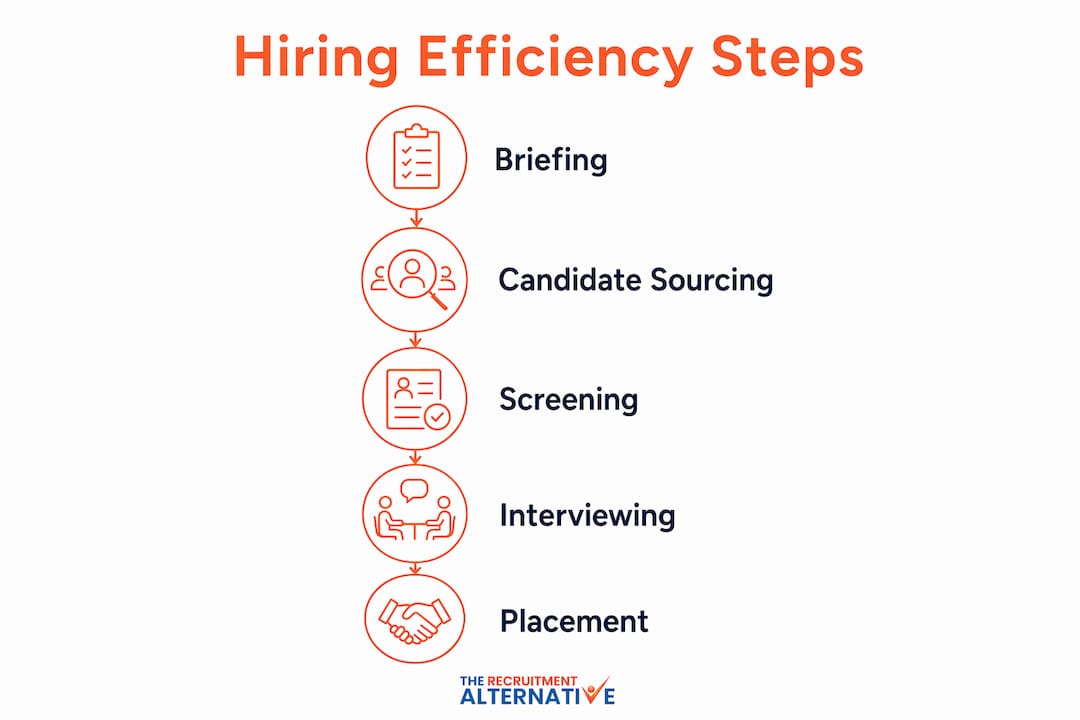
How do recruitment consultants make hiring more efficient?
Recruitment consultants reduce the time and effort employers spend on hiring by taking ownership of the most labour-intensive stages of the process.
- They act as your single point of contact. One consultant manages all candidate communication, so you are not fielding calls and emails from dozens of applicants.
- They reduce your screening workload. Consultants convert large candidate pools into a manageable shortlist after rigorous screening and matching. You only meet candidates who have already cleared multiple filters.
- They improve candidate fit. Screening combines CV reviews, structured interviews, and skills assessments to align candidates with your role success criteria, not just job titles.
- They provide salary benchmarking. Consultants advise on market rates and help you set competitive offers, reducing the risk of losing candidates at the offer stage.
- They manage compliance risks. Background and reference checks are completed before candidates reach your desk. Final hiring decisions remain with you, but the groundwork is done.
- They protect your employer brand. Every interaction a consultant has with a candidate reflects on your business. A professional consultant creates a positive candidate experience, even for applicants who are not selected.
Pro Tip: Brief your consultant on any recent negative hiring experiences. If a previous hire failed due to a specific gap, tell the consultant explicitly. They can build that filter into the screening process from day one.
Consultants also add value through market and salary insights that most employers do not have access to internally. This advisory function is often overlooked but it directly affects whether your offer gets accepted.
What should employers expect when working with a recruitment consultant?
Working with a recruitment consultant is a collaborative process. The quality of the outcome depends heavily on what you bring to the relationship, not just what the consultant delivers.
Expect the following at each stage:
- Initial briefing. The consultant will ask detailed questions about the role, team, culture, and ideal candidate profile. The more specific you are, the better the shortlist.
- Dual role awareness. Consultants balance sales and recruitment duties, meaning they are simultaneously building their client base and filling your role. A good consultant manages both without compromising your brief.
- Candidate presentation. You will receive a shortlist with consultant notes explaining why each candidate was selected. Review these notes carefully before forming opinions.
- Negotiation support. The consultant negotiates salary and terms on your behalf, but only within the boundaries you define. Unclear or ambiguous compensation ranges cause delays and reduce acceptance rates.
- Your decision-making authority. The consultant recommends. You decide. Final hiring authority always rests with you.
- Feedback loops. After each round of interviews, give the consultant specific feedback. Vague responses like “not quite right” slow the process. Specific feedback like “strong technically but lacked client-facing experience” sharpens the next shortlist.
- Fee structures. Recruitment consultancy services are priced in different ways. Traditional agencies charge a percentage of the placed candidate’s salary. Fixed-fee models, like those offered by The Recruitment Alternative, charge a flat rate regardless of salary level, which delivers significant cost savings for employers.
Understanding how to work with a consultant effectively is as important as choosing the right one. Employers who treat the relationship as a partnership consistently get better results than those who hand over a job description and wait.
How to choose the right recruitment consultant for your business
Not all recruitment consultants offer the same level of service. Choosing the wrong one costs you time, money, and sometimes the right candidate.
What to evaluate before you engage
Assess each consultant against these factors before committing:
| Factor | What to look for |
|---|---|
| Industry specialisation | Consultant has placed candidates in your sector before and understands role-specific requirements |
| Sourcing methods | Uses active outreach and databases, not just job board postings |
| Vetting rigour | Conducts structured interviews, skills assessments, and reference checks as standard |
| Communication style | Provides regular updates and responds promptly to queries |
| Fee structure | Transparent pricing with no hidden costs; fixed-fee models offer predictable spend |
| Track record | Can provide client references or case studies from similar businesses |
Red flags to watch for
A consultant who cannot explain their screening process in detail is likely relying on volume rather than quality. Avoid consultants who present candidates without accompanying notes or who cannot articulate why a specific candidate fits your brief. Also be cautious of consultants who push you to make fast decisions without adequate information. Good consultants give you tips for choosing the right agency and are transparent about their process from the first conversation.
Specialisation matters. A consultant who recruits across multiple industries with a proven process can serve most businesses well. However, for highly technical roles in engineering, healthcare, or technology, look for demonstrated experience in that specific field.
Key takeaways
A recruitment consultant is the most efficient way to convert a hiring need into a placed candidate, provided you brief them clearly and stay engaged throughout the process.
| Point | Details |
|---|---|
| Core role definition | A recruitment consultant sources, screens, and shortlists candidates while managing the full hiring workflow. |
| Briefing quality drives results | Detailed role success criteria given to the consultant directly improve shortlist quality. |
| Negotiation needs clear parameters | Ambiguous salary ranges cause offer delays; define your compensation boundaries upfront. |
| Compliance is shared | Consultants run background checks, but final hiring decisions and compliance responsibility stay with you. |
| Fee model affects total cost | Fixed-fee recruitment delivers predictable costs; percentage-based models increase with salary level. |
Why the briefing stage is where most employers lose
Most employers focus their energy on evaluating candidates. The real leverage point is the briefing you give your consultant before sourcing begins.
I have seen this play out repeatedly. An employer hands over a two-line job description and then wonders why the shortlist misses the mark. The consultant is not a mind reader. They work with the information you provide. When that information is thin, they fill the gaps with assumptions, and those assumptions rarely match what you actually need.
The most effective employers I have worked with treat the initial brief like an internal hiring committee meeting. They bring the hiring manager, define what success looks like at 30, 60, and 90 days, and flag the specific behaviours that caused problems with the last person in the role. That level of detail transforms the screening process.
There is also a common misunderstanding about what consultants do beyond sourcing. Many employers see them purely as a pipeline for CVs. The better consultants are advisers. They tell you when your salary range is below market, when your interview process is losing candidates to faster-moving competitors, and when a role brief is unrealistic for the current talent pool. That feedback is worth more than any single placement.
Finally, trust the process but stay involved. Consultants perform best when employers give timely feedback after each interview round. A two-week delay in responding to a shortlist often means your preferred candidate has accepted another offer. Treat your consultant as an extension of your hiring team, not an external vendor you check in with occasionally.
— Josh Townsend
Recruitment consultancy services from The Recruitment Alternative
Finding the right person for a role takes more than posting a job ad. The Recruitment Alternative provides expert recruitment services across Australia, covering permanent placements in sales, management, administration, finance, engineering, healthcare, technology, and executive leadership.
The Recruitment Alternative operates on a flat-fee model, which means you pay a fixed price regardless of the salary level of the role. There are no percentage-based commissions and no surprises on the invoice. Every engagement includes candidate sourcing, structured screening, reference checks, and offer negotiation. Businesses of all sizes across Australia use The Recruitment Alternative to fill roles faster and at a fraction of the cost of traditional agencies. If you are ready to hire with confidence, explore recruitment specialists Australia wide and see how the process works.
FAQ
What is a recruitment consultant?
A recruitment consultant is an external specialist who manages the hiring process for employers, including sourcing, screening, interviewing, and negotiating employment terms. They act as the link between employers and candidates throughout the entire recruitment process.
What does a recruitment consultant do day to day?
Daily duties include reviewing client briefs, sourcing candidates through databases and networks, conducting interviews, running reference and background checks, and presenting shortlists to employers. Consultants also handle salary negotiations and coordinate interview scheduling.
What are the benefits of hiring a recruitment consultant?
Employers gain access to a wider candidate pool, a reduced screening workload, salary benchmarking advice, and compliance support through background checks. The result is faster hiring with a higher likelihood of a strong candidate fit.
How is a recruitment consultant different from an in-house recruiter?
A recruitment consultant works externally, often across multiple clients and industries, which gives them broader market knowledge and a larger candidate network. An in-house recruiter works solely for one organisation and focuses exclusively on that employer’s roles.
How do recruitment consultant fees work in Australia?
Fee structures vary. Traditional agencies charge a percentage of the placed candidate’s annual salary, typically ranging from 15% to 20%. Fixed-fee agencies like The Recruitment Alternative charge a flat rate, making costs predictable regardless of the salary level of the role filled.
Recommended
- How to work with a Recruitment Consultant… – The Recruitment Alternative
- So you want to be a Recruitment Consultant? – The Recruitment Alternative
- Recruitment consultation process: a guide for smes
- What all Recruitment Consultants or Hiring Managers do when they receive your application… – The Recruitment Alternative

