

Hire a Sales Manager once you have a documented sales process, two to three quarters of pipeline data, and a founder or director spending real hours each week on tasks a manager should own. Prioritise coaching ability over past personal sales numbers, and set measurable KPIs before you write the ad. If those signals aren’t there yet, start by defining the KPIs and role brief this week.
TL;DR:
- Hire only after establishing a documented sales process, at least two to three quarters of pipeline data, and when founders are spending over 15 hours weekly on management tasks.
- Ensure KPIs include revenue targets, pipeline growth, conversion rates, and coaching cadence; write these before advertising the role to clarify expectations.
- Use a structured five-stage interview process with live coaching and deal-inspection exercises to accurately assess candidates’ management skills and fit.
- Develop a staged onboarding plan that emphasizes observation and diagnosis before implementing new processes within the first 90 days.
- Consider a fixed-fee recruitment service offering transparent pricing and thorough candidate evaluation to minimize costs and improve hiring quality.
Table of Contents
- Writing the sales manager job description and KPIs
- When should you hire a sales manager?
- The sales manager recruitment process, step by step
- What interview questions and exercises actually predict success?
- Onboarding a new sales manager: the first 90 days
- Why structure beats instinct in sales leadership hiring
- A fixed-fee way to run this hire without the commission markup
- Where to go next for hiring frameworks and pricing
- Sources
- FAQ
Writing the sales manager job description and KPIs
A Sales Manager job description that skips the numbers invites vague candidates and vaguer results. Start with scope: how many reps report in, who the manager reports to, and which day-to-day calls (pricing, discounting, hiring) sit with them versus you.
Then set the KPIs you’ll actually manage against. Queensland Government’s recruitment guidance recommends anchoring selection criteria to measurable outcomes rather than experience alone, which for a Sales Manager means:
- Revenue targets against quota, by quarter and by rep
- Pipeline growth rate and pipeline coverage ratio
- Conversion rates at each stage of the funnel
- Coaching cadence completed (weekly 1:1s, call reviews, deal reviews)
List the must-have behaviours separately from the technical requirements. Coaching skill and forecast rigour are behaviours you’ll test in interviews; CRM proficiency and reporting cadence are technical needs you can train.
Pro Tip: Write the KPI list before the job ad, not after. It forces you to define what “good” looks like at 90 days, which then shapes every interview question you ask.
When should you hire a sales manager?
Hiring too early is one of the most common and expensive mistakes in sales management talent acquisition. Research on when to hire a first sales manager points to three concrete readiness signals rather than headcount alone:
- Documented process — you have a written playbook reps actually follow, not just a CRM full of stages.
- Consistent pipeline data — two to three quarters of deal data exist, so a new manager has something real to inspect and improve.
- Founder time strain — you or another leader are spending 15 or more hours a week on tasks a manager should own, like deal reviews and forecast calls.
If those aren’t in place, two alternatives are worth considering before you open a search. Promoting your best rep works only if they show coaching instinct, not just personal quota attainment. A fractional CRO can install process and buy you three to six months before a full-time hire makes sense. Either way, budget for a proper search: a robust hiring process for this role typically demands several weeks of calendar time and meaningful hours from both sides, not a rushed two-week scramble.
The sales manager recruitment process, step by step
A rigorous sales manager recruitment process runs through five stages, and skipping any of them is where most bad hires start. According to a sales manager interview guide from Vozah, this structure typically takes two to four weeks and asks for roughly 4 to 5 hours of candidate time in total.
- Sourcer or recruiter screen (30 minutes) — confirms basics: comp expectations, team size managed, tenure pattern.
- Hiring manager screen (45 minutes) — tests motivation, management philosophy, and fit with your stage of growth.
- Structured panel interview (60 to 90 minutes) — includes the coaching and deal-inspection exercises covered below.
- Team conversation (30 to 45 minutes) — future direct reports meet the candidate and flag concerns you might miss.
- Reference checks (two to three calls, prioritising former direct reports over peers).
To keep the process fair and fast without compressing it:
- Book all interviews within a set window rather than letting them drag over six weeks.
- Use the same scoring rubric across every panellist so feedback is comparable.
- Tell candidates the timeline upfront to reduce drop-out from long, unclear processes.
- Debrief within 24 hours of each stage while impressions are fresh.
Internal recruitment tips for hiring managers can help you build out this scheduling framework if you’re running the search yourself for the first time.
What interview questions and exercises actually predict success?
Conversational questions about past wins tell you almost nothing about how a candidate will coach a struggling rep. Live exercises do. The Vozah interview guide recommends two exercises above all others.
The 60-second live coaching test. Play a short recording of a mediocre sales call, or have a team member roleplay one, and ask the candidate to coach the “rep” in real time. Score them on whether they ask questions before giving answers, whether they praise something specific, and whether they leave the rep with one concrete next action rather than five vague ones.
The deal inspection exercise. Hand the candidate a real (anonymised) opportunity from your pipeline and ask them to assess: is this deal likely to close, what’s missing from the notes, and what would they ask the rep in a deal review. Candidates who ask about decision criteria and next steps outperform those who fixate on deal size alone.
Beyond the exercises, a checklist approach from SalesAssessmentTesting backs using structured interviews and simulations specifically because they surface real-world skill and cut bias compared with open-ended chat.
Red flags worth disqualifying on:
- Coaching stories that are vague or centre entirely on the candidate’s own quota, not their team’s growth
- Forecasting described as “gut feel” with no reference to pipeline stages or coverage ratios
- No specific example of turning around an underperforming rep
SEEK’s research on hiring mistakes flags that managers who focus on personal wins rather than team development consistently underperform once promoted or hired, which is exactly what the coaching exercise is designed to catch before you make an offer.
Pro Tip: Call at least one former direct report as a reference, not just a peer or boss. Direct reports will tell you what coaching actually felt like on the receiving end.
Onboarding a new sales manager: the first 90 days
Even a well-run search into sales manager hiring only pays off if onboarding avoids the classic trap: a new manager who changes everything in week two before understanding why things work the way they do. A staged 30-60-90 plan, similar to the approach described for first-time sales manager onboarding, protects against that.
- Days 1 to 30: Shadow calls, sit in on pipeline reviews, and document the current process without changing it. The goal is diagnosis, not disruption.
- Days 31 to 60: Install one core cadence, usually weekly 1:1s or structured deal reviews, and measure whether reps actually adopt it.
- Days 61 to 90: Expand into forecasting rigour and hiring plans, and start reporting against the KPIs set in the job brief, not just activity metrics.
Pro Tip: If the new manager hasn’t changed a single process by day 30, that’s a good sign, not a bad one. It means they’re diagnosing before prescribing.
Why structure beats instinct in sales leadership hiring
Most sales manager hires fail for a boring reason: the hiring process rewarded charisma over evidence. A candidate who tells a great story about hitting quota three years running says nothing about whether they can coach a struggling rep out of a slump, which is the actual job once they’re managing rather than selling.
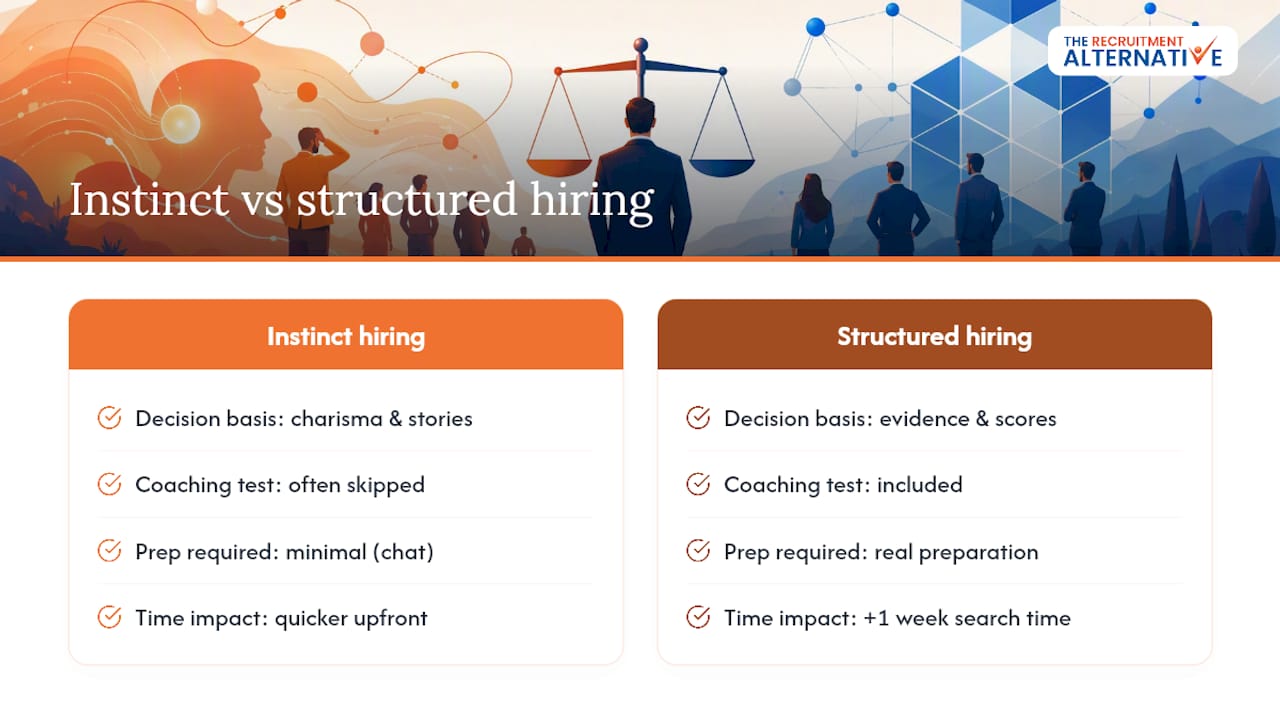
The uncomfortable truth is that hiring managers often skip the coaching test because it’s awkward to run and takes real preparation, while a chat about past achievements takes none. That trade-off is exactly backwards. A structured, evidence-backed process with scored exercises and real reference checks costs you an extra week of search time and saves you a year of managing a mis-hire.
The Recruitment Alternative built its fixed-fee model around this same logic: predictable cost, targeted sourcing, and a process that doesn’t cut corners just because a fee is fixed rather than a percentage of salary.
— Josh Townsend
A fixed-fee way to run this hire without the commission markup
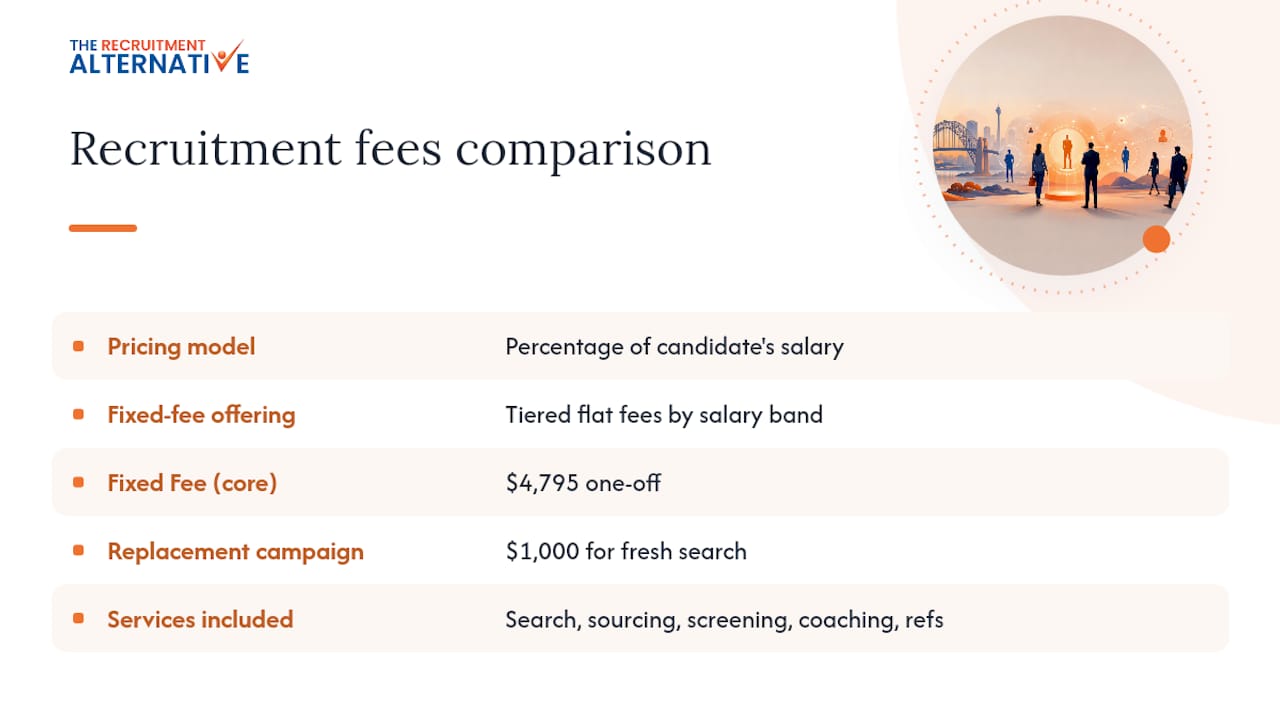
Running the process above properly, with five structured stages and live exercises, takes real time most hiring managers don’t have spare. A fixed-fee recruitment agency offers an alternative to traditional percentage-based agencies for sales manager hiring: instead of a fee that climbs with the candidate’s salary, a transparent, tiered flat fee stays predictable no matter how senior the hire.
The core offering, Fixed Fee Recruitment, runs at $4,795 one-off, and the detailed Recruit and Recruit+ pricing tiers break down engagement and placement fees by candidate salary band, so you know the cost before the search starts. If a placement doesn’t work out in the first two to three months, the Replacement Campaign covers a fresh search for a further $1,000, rather than leaving you to start again from scratch at full cost.
Such a structure means the search itself, sourcing, screening, coaching exercises, and reference checks are run by experienced consultants, while clients keep fixed-cost certainty not typically offered by commission models. Get in touch through the Fixed Fee Recruitment page to start a search for your next Sales Manager.
Where to go next for hiring frameworks and pricing
For scheduling and outreach tactics, see recruitment tips for hiring managers and the management recruitment strategies guide. For onboarding-to-marketing handoffs, BabyLoveGrowth’s automation checklist is a useful reference.
Sources
- Sales manager interview guide: hiring your first sales manager — Vozah
- The ultimate sales manager hiring checklist — SalesAssessmentTesting
FAQ
Should I promote internally or hire externally for a sales manager role?
Promote internally only if the candidate has shown real coaching instinct, not just strong personal quota attainment. If no internal candidate clears that bar, an external hire tested through structured interviews and a live coaching exercise is the safer route.
How long does a proper sales manager recruitment process take?
A structured five-stage process, sourcer screen, hiring manager screen, panel, team conversation, and references, typically takes two to four weeks and asks for around 4 to 5 hours of candidate time in total. Compressing that timeline is one of the more common ways hiring teams miss critical red flags.
What’s the biggest red flag when hiring a sales manager?
Vague coaching stories that centre on the candidate’s own past wins rather than specific examples of developing a struggling rep are the clearest warning sign. SEEK’s hiring research also flags forecasting “by feel,” with no reference to pipeline stages, as a strong predictor of poor performance in the role.
How much does it cost to use a fixed-fee recruiter for this role?
The Recruitment Alternative’s core Fixed Fee Recruitment service is $4,795 one-off, with tiered Recruit and Recruit+ pricing depending on the candidate’s salary band. This stays fixed regardless of the final salary negotiated, unlike a percentage-based agency fee.
What KPIs should a new sales manager be measured against in the first 90 days?
Revenue against quota, pipeline growth rate, and stage-by-stage conversion rates are the core measurable outcomes, alongside whether they’ve installed a consistent coaching cadence like weekly 1:1s. These should be defined in the job brief before the search starts, not invented after the hire begins.

