

Hiring an employee in Australia costs more than the salary in the job ad. You pay the wage, 12% superannuation on top, paid leave, insurance, equipment and training, plus the one-off cost of finding the person. A 2024 industry benchmark put the average cost of hiring a new employee at $20,000, and the recruitment part of that bill is the one you control most.
This guide separates the one-off costs of hiring from the ongoing costs of employing, works through an $80,000 example, and shows where employers usually overspend.
TL;DR
- Budget for the salary plus at least 12% superannuation, paid leave, workers’ compensation, and any state payroll tax once your wages pass the threshold.
- One-off costs include advertising or agency fees, interviewing time, onboarding, equipment and training. One benchmark average is $20,000 per hire.
- Agency fees are the most negotiable line. A flat fee is a fixed dollar amount, so it does not grow when the salary does.
- About one in seven new hires leaves during probation, so a replacement guarantee is part of the real price.
Table of Contents
- Two kinds of cost: getting the person and keeping the person
- The ongoing costs, line by line
- A worked example: an $80,000 hire
- The one-off costs of getting the hire
- Agency fees: where the biggest saving sits
- The cost of a hire that does not work out
- Ways to keep the total down
- Our perspective
- Fixed-fee recruitment for your next permanent hire
- FAQ
- Sources
Two kinds of cost: getting the person and keeping the person
Most cost guides blur two different budgets.
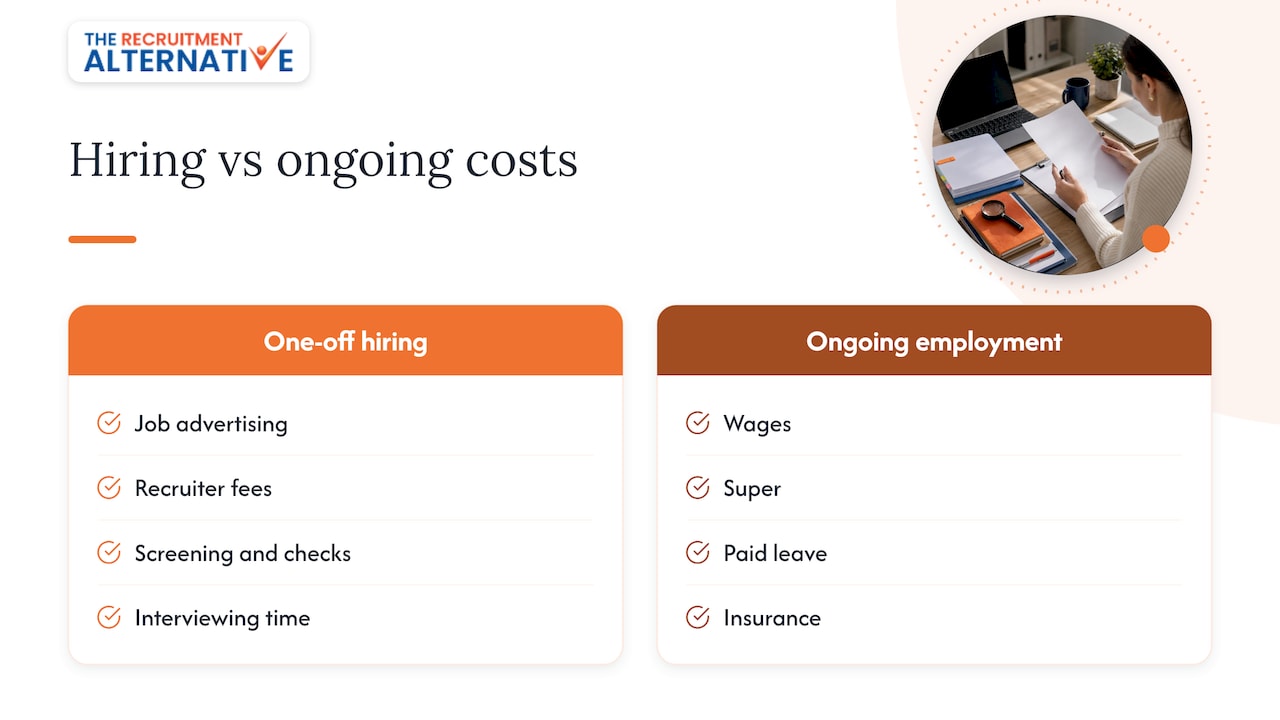
One-off hiring costs are paid once per hire: job advertising, agency or recruiter fees, screening and checks, interviewing time, onboarding, equipment and initial training.
Ongoing employment costs are paid for as long as the person works for you: wages, super, leave, insurance, payroll tax, ongoing training and tools.
The Creative Workplaces guide on what an employee will cost lists the main components as pay, superannuation, paid leave, other monetary entitlements and equipment, with tax and insurance on top. It does not give one universal multiplier, and that is the honest answer: the number depends on the award, the state, the industry and the role.
The ongoing costs, line by line
Wages and the award or minimum wage
Pay is more than a base rate. According to business.gov.au, it can include the base wage under the relevant award, hours worked, penalty rates, overtime and allowances. Staff not covered by an award or agreement still get a minimum wage and the National Employment Standards.
Check which award applies before you set a salary. Casual loadings, weekend penalties and allowances can move the real hourly cost well above the base rate.
Superannuation
For payments from 1 July 2025, the minimum super guarantee is 12% of ordinary time earnings, subject to eligibility and the maximum contribution base. On a $80,000 salary that is $9,600 a year.
Since 1 July 2026, Payday Super has changed the timing. Employers must make sure super is received by the employee’s fund within 7 business days of payday, with some exceptions. The amount did not change, but cash flow planning did: super is now a pay-cycle cost, not a quarterly lump.
Paid leave
The Fair Work Ombudsman says full-time and part-time employees generally receive 4 weeks of paid annual leave and 10 days of paid personal/carer’s leave a year, pro rata for part-timers. Eligible shiftworkers may get an extra week.
Leave is already inside a salary figure, so do not add it again when you total the cost. What you do need to budget for is the cover: when someone is on leave, work still has to be done. Some awards also add loading. The Professional Employees Award 2020, for example, provides a 17.5% annual leave loading on the base rate, subject to conditions.
Unused annual and long service leave must also be paid out when employment ends, so it is worth budgeting for that liability from the start.
Workers’ compensation insurance
Employers must take out workers’ compensation insurance in case staff are injured at work. Premiums are set by each state or territory scheme and depend on your industry and total wages, so a clerical team and a building crew pay very different rates. Ask your insurer for a quote based on your actual wages roll rather than relying on a general percentage.
Payroll tax
Payroll tax is a state tax. Employers must register and pay once total Australian wages exceed the threshold set by the relevant state or territory. In New South Wales for 2026-27, the rate is 5.45% for employers whose annual taxable wages exceed $1,200,000.
That threshold is why many small businesses pay no payroll tax at all when they add their first few staff. Check your own state revenue office, because rates and thresholds differ by jurisdiction and are reviewed regularly.
Equipment, training and tools
Laptops, phones, uniforms, licences, software seats and ticketed training are easy to forget. The My Business guide to the true cost of an employee also lists workers’ compensation premiums, FBT on benefits, any super guarantee charge and training as part of the total.
A worked example: an $80,000 hire
Here is how the ongoing cost builds for an office-based employee on $80,000, using only figures that are fixed by law or by the salary itself.
| Cost item | Annual amount | Notes |
|---|---|---|
| Base salary (includes paid leave) | $80,000 | Do not add leave on top |
| Superannuation at 12% | $9,600 | Minimum super guarantee |
| Workers’ compensation | Quote needed | Varies by state and industry |
| Payroll tax | $0 for most small employers | Only above your state’s threshold |
| Equipment and software | Varies | Largely a first-year cost |
| Training | Varies | Role dependent |
Salary plus super alone comes to $89,600, which is 12% above the base salary before insurance, equipment and training. Once those are added, you land in the range of 120% to 130% of base salary that some employment cost guides cite for typical statutory obligations and benefits. Treat that as a planning range, not a quote: your own award, insurer and state will set the real figure.
For an hourly view, $80,000 a year is about $1,538 a week. Divide by your standard hours and you have the base hourly rate to compare against charge-out rates or contractor quotes.
The one-off costs of getting the hire
The ELMO 2024 HR Industry Benchmark Report, based on Australian and New Zealand employers, gives an average hiring cost of $20,000 per new employee. An earlier 2022 study by ELMO and AHRI reported an average of $23,860 per candidate. These are averages across employers of all sizes, with internal HR time included, so a small business with a tight process can land well below them. They show the scale of what is at stake when a hire goes wrong.
Typical one-off items:
- Advertising: job board listings and promoted ads.
- Recruiter or agency fees: often the largest single line item.
- Your own time: reading applications, interviewing, checking references. Value it at your hourly rate, because it is time not spent running the business.
- Checks: reference checks, police checks and, for some roles, psychometric assessments.
- Onboarding: equipment, system access, induction and a manager’s time during the first weeks.
- Vacancy cost: the work that is not done while the seat is empty. The same benchmark put the average time to fill a role at 18 days.
Speed matters because every extra week of vacancy is a cost. If you want to shorten the process, our guide to time-to-hire benchmarks shows where the days are usually lost. For technical roles, a structured set of interview questions for IT candidates helps you screen faster and more consistently.
Agency fees: where the biggest saving sits
Traditional agencies commonly charge a percentage of the first-year salary. That means the fee rises with every dollar you pay the candidate. On an $80,000 role, a percentage fee is a significant outlay; on a $150,000 role it is far larger, although the agency does the same work.
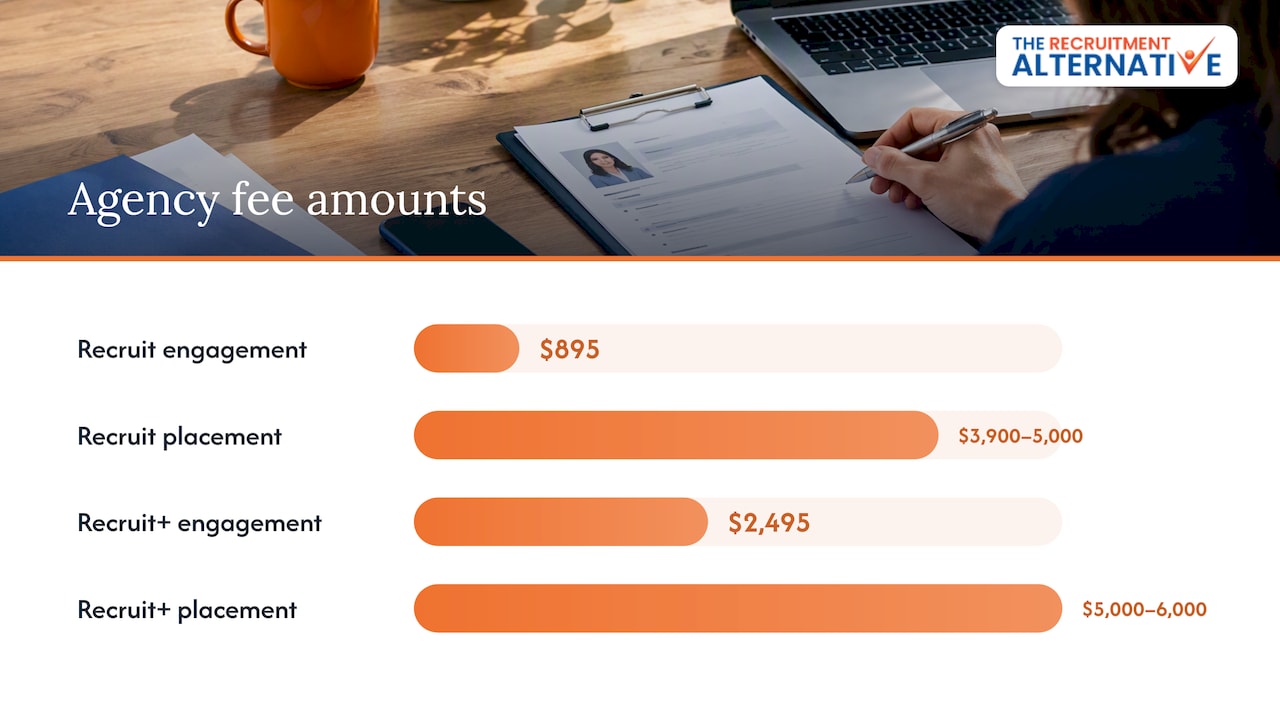
A flat fee breaks that link. Our own model is fixed-price and split into two parts: an engagement fee to start the search, and a placement fee when you hire. Published prices on our flat fee structure page are:
| Service | Engagement fee | Placement fee |
|---|---|---|
| Recruit | $895 | $3,900 to $5,000 |
| Recruit+ | $2,495 | $5,000 to $6,000 |
The placement fee depends on the salary of the role. Optional extras are priced separately: a criminal check at $129 and a psychometric evaluation at $199 per candidate. You can read more about how the engagement fee works and why it exists. For comparison with other pricing models, see our breakdowns of engineering recruitment fees and executive recruitment fees.
Other fee types, such as retained search or contingency percentages, also include costs that are easy to miss. We cover them in hidden costs of traditional recruitment.
The cost of a hire that does not work out
The ELMO benchmark found about one in seven new hires leaves during probation in Australia. Each early exit means paying the hiring costs a second time, plus the wages and training invested in the person who left.
This is why replacement terms belong in any cost comparison. We offer candidate replacement cover if a hire does not work out in the first two to three months, and a Replacement Campaign costs $1,000. Compare that with starting a fresh search from zero. Our article on how recruitment protects against bad hires explains the screening that reduces the risk in the first place.
Ways to keep the total down
- Write the role clearly before you advertise. A vague brief produces more unsuitable applications and longer interviews.
- Use the right award classification. Misclassifying a role leads to underpayment risk and back-pay costs later.
- Choose fee models you can predict. A fixed dollar fee is easy to put in a budget. A percentage fee is not.
- Invest in retention. The cheapest hire is the one who stays. Our staff retention tips cover the basics.
- Plan hiring as a strategy, not a reaction. A hiring strategy for a growing business spreads costs and avoids rushed, expensive decisions.
- Consider contract work for bounded projects. For short, defined work, a contract specialist can be more cost-effective than a permanent hire because it avoids lead times and exit liabilities. For ongoing roles, permanent staff usually make better financial sense.
Our perspective
Employers tend to ask what a hire will cost in salary, and then meet the rest of the bill later. Super, leave, insurance and recruitment arrive as separate invoices, and the recruitment one is often the least predictable.
We built our model around that problem. A fixed engagement fee and a fixed placement fee mean you know the recruitment cost before the search begins, and it does not climb as the salary does. We claim savings of over 70% compared with commission-based agencies, and the structure of our pricing is published so you can check it against any quote you receive.
We also think the first few months decide whether a hire pays back. That is why we pair our search with a 2 to 3 month replacement guarantee and a clear process for screening candidates, so small businesses are not left carrying the whole risk of a bad match.
Josh Townsend
Fixed-fee recruitment for your next permanent hire
If you are planning a permanent hire in Australia or New Zealand, our model gives you the recruitment cost up front. Choose Recruit or Recruit+ depending on the role, pay the engagement fee to begin, and pay the placement fee when you hire. See all prices on our flat fee structure page.
If you want the detail on how the fixed fee compares with percentage pricing, read our guide to flat fee recruitment benefits for Australian employers, or start from our fixed fee recruitment service.
FAQ
How much does it cost to hire a new employee in Australia?
One 2024 benchmark gives an average of $20,000 per hire across Australian employers, and a 2022 study reported $23,860. Your figure depends on the role, how you recruit and how long the seat stays empty. Add the ongoing employment costs on top, starting with 12% super.
How do I calculate the true cost of an employee from their salary?
Start with base salary, then add super, penalties, allowances, bonuses, workers’ compensation, payroll tax if you are over the threshold, and training. Leave is already inside the salary figure, so do not count it twice. Guides such as the My Business calculation method set out each step.
Do small businesses pay payroll tax on new hires?
Only once total Australian wages pass the threshold set by their state or territory. In NSW in 2026-27, the rate of 5.45% applies to wages over $1,200,000. Check your state revenue office for your own threshold.
What does a flat-fee recruiter charge?
With us, there is an engagement fee ($895 for Recruit, $2,495 for Recruit+) and a placement fee ($3,900 to $5,000 for Recruit, $5,000 to $6,000 for Recruit+). The placement fee depends on the role’s salary. Current details are on our pricing page.
Sources
- ELMO 2024 HR Industry Benchmark Report
- The cost of hiring new workers doubles to more than $23,000 (IT Brief)
- Creative Workplaces: work out what an employee will cost
- business.gov.au: Guide to hiring employees
- ATO: How much quarterly super to pay
- ATO: About Payday Super
- Fair Work Ombudsman: Small business and the Fair Work Act
- Professional Employees Award 2020
- Westpac: Working out the cost of a new employee
- ABLIS: Registration for Payroll Tax, NSW
- My Business: How to calculate the true cost of an employee
- AYP Group: Cost of hiring in Australia
- Expert360: The true cost of hiring an employee in Australia
- 30 IT interview questions to ask job candidates

