

Hiring a maintenance planner well comes down to three decisions: defining a role that is genuinely planning and not a catch-all, screening for planning experience and not just trade experience, and recruiting without a percentage-of-salary fee that grows with every salary dollar. For a role that commonly sits around the $100,000 mark, a percentage fee is a large bill. Our flat-fee model through Fixed Fee Recruitment is built for exactly this: a published engagement fee and placement fee, set by the salary of the role, with no commission on top.
This guide covers what the role is, what to ask for, where to find people, how to screen them and what to check before you make a permanent offer.
TL;DR
- A maintenance planner plans and schedules maintenance work. They do not carry out the work, so write the position description around planning, work orders, parts and shutdowns.
- Experience matters more than a certificate alone: Jobs and Skills Australia found lack of occupation experience was the most common reason trades and technician applicants were unsuitable.
- Budget for a role in the order of $100,000 or more in many metro settings, and more in mining, with superannuation on top.
- Ask referees to describe scheduling, work orders and CMMS work, not trade execution.
- Our flat-fee recruitment starts with an $895 engagement fee on Recruit, with a placement fee of $3,900 to $5,000, and a replacement option if the hire does not work out.
Table of Contents
- What a maintenance planner does
- Define the role before you advertise
- Qualifications and experience to ask for
- What to budget for salary
- Where to find candidates
- Screening and interviewing
- Checks before a permanent offer
- What recruiting a planner costs with us
- Start your planner search with us
- Our view: plan the hire like you plan the shutdown
- FAQ
- Sources
What a maintenance planner does
A maintenance planner decides what maintenance happens, in what order, with which parts and when. The Australian Bureau of Statistics describes the occupation as developing maintenance planning strategies and schedules, and coordinating and monitoring maintenance of plant equipment, infrastructure and machinery. That covers preventative plans, planned downtime, adjusting schedules when emergency work lands, working with procurement on materials, and making sure procedures and regulations are followed.
The same classification lists alternative titles, which matters when you write an ad and when candidates search: Maintenance Scheduler, Maintenance Superintendent, Shutdown Coordinator and Shutdown Planner. Specialisations include aircraft, electrical, mechanical and rail maintenance planner.
A CMMS (computerised maintenance management system) is the software where work orders, asset records and schedules live. Planners spend much of their day in one, so the system you run is a core part of the role.
What real Australian ads ask for
Two live ads show how the role is written in practice.
Boral’s permanent full-time quarry role in NSW centres on preventative maintenance programs, maintenance schedules and work plans, creating, prioritising and closing work orders, keeping CMMS data accurate, and reporting on equipment reliability and compliance. It asks for working knowledge of a CMMS such as Maximo, SAP, MEX, Pronto or Oracle EAM, plus communication, organisational and analytical skills.
ANSTO’s Production Maintenance Planner role in Sydney is a regulated-environment version. It adds improving SAP maintenance processes and master data, keeping critical spare parts records, and planning work orders across scheduled cycles and shutdowns.
The common thread is clear: planning discipline, a CMMS, and data you can trust.
Define the role before you advertise
Most hiring problems with this role start in the position description. The most common mistake in planner job descriptions, according to Boostpoint’s 2026 guide, is combining planner, scheduler, storeroom and supervisor duties into one job. That guide advises stating clearly whether scheduling is part of the role and protecting time for field walk-downs, where the planner inspects the job before writing the plan.

A planner who is pulled onto emergency work and technician allocation every day stops planning. If you are a small business, you may genuinely need one person to cover several of these. Then say so plainly in the ad, and hire for that blend, instead of advertising a pure planner and disappointing the person who accepts.
A five-step position description
The Australian Government’s Creative Workplaces resource sets out five steps for preparing a job description: the purpose of the job, key responsibilities, day-to-day tasks, required skills and attributes, and reporting lines. It also advises checking the description against any applicable award or enterprise agreement classification so you do not underpay the employee.
Applied to a planner, that looks like this:
- Purpose: keep plant and equipment available and safe by planning maintenance work ahead of time.
- Responsibilities: preventative maintenance plans, job plans, weekly schedules, shutdown planning, parts and materials coordination, backlog and performance reporting.
- Daily tasks: raising and closing work orders, field walk-downs, updating CMMS records, liaising with supervisors and procurement.
- Skills: the CMMS you use by name, scheduling knowledge, MS Office, analytical and communication skills.
- Reporting line: who the planner reports to and who they coordinate with.
The ANU’s HR guidance adds two useful rules: describe the position and not the person, and list only inherent requirements, meaning essential outcomes that cannot be given to someone else. It also recommends minimising jargon and acronyms. Name your CMMS, but do not pad the list with every tool you have ever owned.
Qualifications and experience to ask for
This is a trade-heavy occupation. Jobs and Skills Australia’s profile, built on the 2021 Census, shows that 54.1% of maintenance planners hold a Certificate III or IV as their highest qualification, 15.8% an Advanced Diploma or Diploma and 11.4% a Bachelor degree. Compared with all occupations, that is far more trade-qualified and far fewer degree-qualified.
In practice, strong candidates often come up through a trade, then move into planning. Jobs and Skills WA lists a Certificate IV in Engineering, a Diploma of Engineering (Technical), an Advanced Diploma of Engineering, or a plant mechanic apprenticeship of 42 to 48 months as typical pathways. It also notes that conditions can be noisy or dirty and may involve on-call and shift work, which is worth stating in your ad so applicants know what the role involves.
A mining example shows the top end of requirements. Fortescue’s Senior Maintenance Planner role in Port Hedland asks for significant mining process plant planning experience, a recognised mechanical or electrical trade qualification, and advanced SAP CMMS, MS Office and MS Project knowledge.
A sensible split for most small and mid-sized employers:
- Must have: relevant maintenance experience in your type of plant, working knowledge of a CMMS, and evidence of planning or scheduling work.
- Strong advantage: a trade or engineering qualification in the discipline you maintain, and experience with your specific system.
- Trainable: a particular CMMS brand, if the candidate has used a comparable one.
When the planner will work with production or manufacturing schedules, it also helps to understand how your scheduling tools fit together. This explainer on production scheduling software for manufacturers is a handy reference for working out which system skills you really need to list.
What to budget for salary
Salary expectations vary widely by industry, location and experience. A published public-sector marker is ANSTO’s ongoing full-time Production Maintenance Planner roles in the Sutherland Shire, offering $100,000 to $112,000 plus 15.4% superannuation. That is one employer’s advertised range, not a market rate, but it shows where a metro, ongoing planner role can sit.
Mining and resources pay more. The FIFO Hub’s 2026 guide gives indicative annual bands of $115,000 to $165,000 for a maintenance planner or scheduler, and notes that bands vary with roster, duties and employer. Treat it as a reference only, and check the applicable award or agreement and your actual offer.
Plan your budget in three layers: base salary, superannuation, and any allowances or roster loadings. Then add your recruitment cost. This is where the fee model matters.
Where to find candidates
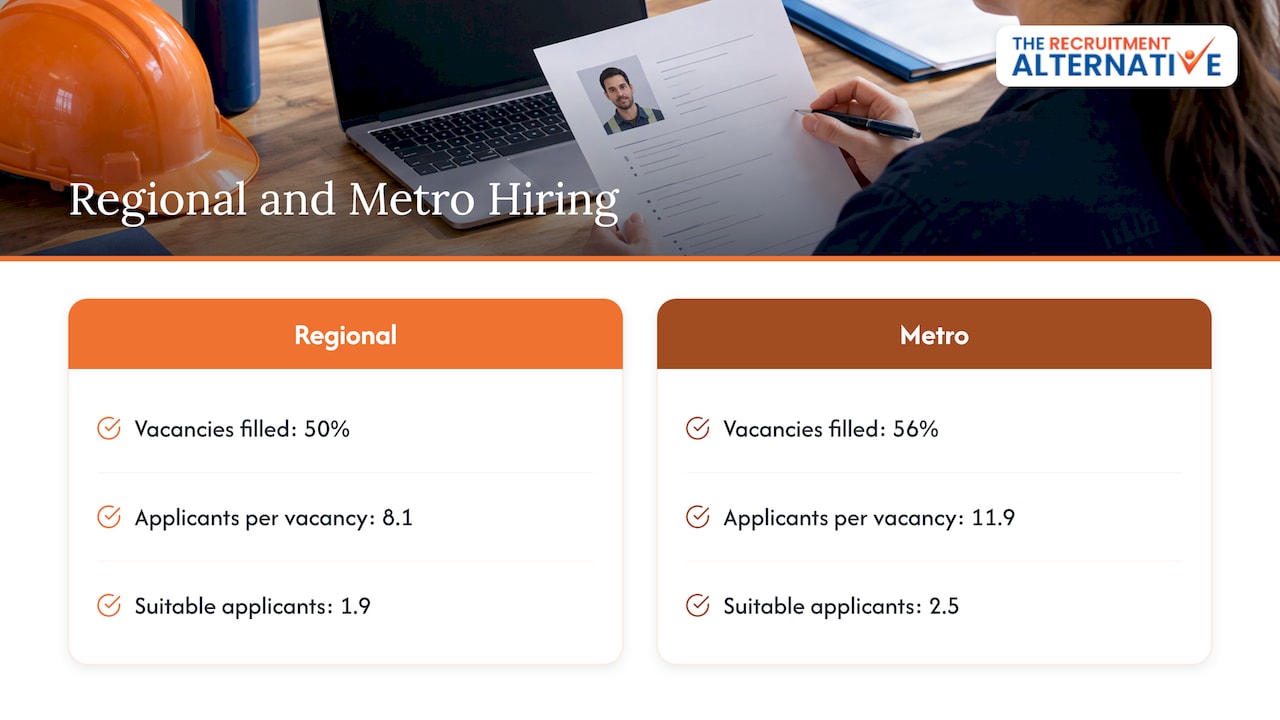
Planners are in demand. Jobs and Skills Australia’s Skills Priority List rates the occupation as having strong national future demand, and the same factsheet shows how location changes the field. Regional employers filled 50% of technician and trades vacancies against 56% for metro employers, received 8.1 applicants per vacancy against 11.9, and considered 1.9 suitable against 2.5. When suitable applicants were lost, the usual reasons were taking other work, unwillingness to relocate, or not agreeing on pay.
The lesson for a regional or small employer is that posting an ad and waiting is a thin approach. Good planners are often already employed, so reach matters, and the offer needs to be set right before you start. Our guide to regional recruitment in Australia covers what small and medium businesses need to plan for outside the capital cities.
Also search under the alternative titles: Maintenance Scheduler, Shutdown Planner, Shutdown Coordinator. A candidate with the right experience may carry a different title on their résumé.
Screening and interviewing
The same Jobs and Skills Australia survey found that the most common reason technician and trades applicants were unsuitable was a lack of occupation experience, cited by two-thirds of employers, followed by lack of the required qualification or registration at close to half. It also found 86% of employers required a formal qualification, commonly a Certificate III or IV.
So screen for both, and screen for the right kind of experience. A tradesperson and a planner have different daily work.
Check for planning, not just trade work
VETASSESS, the assessing authority for the occupation, lists highly relevant tasks including writing job plans, using CMMS records, planning preventative maintenance and shutdowns, and managing spare parts. Use that as your interview and reference-check list. Ask each candidate to describe:
- A job plan they wrote: the steps, labour estimate, parts and permits.
- How they built a weekly schedule and what they did when emergency work broke it.
- How they kept CMMS data accurate, and what went wrong when it was not.
- A shutdown or turnaround they planned, including how they sequenced it.
- How they managed critical spares.
When you call referees, ask them to describe schedule development, work-order generation and CMMS administration. A reference that only describes hands-on repair work is a reference for a tradesperson.
Compare candidates on measures
A useful way to separate good from average is to talk in the measures planners are judged on. A maintenance planner role document from Swainsmith lists accuracy of labour and material estimates, the share of planned jobs with parts kits identified, planning effectiveness, backlog measured in crew weeks, and mean time between failures. Ask what these looked like at the candidate’s last site and what they did to improve them. Specific numbers and a clear account of how they moved are a good sign.
If you want objective data on fit, we offer a psychometric evaluation at $199 per candidate as an add-on to our service.
Checks before a permanent offer
Once you have a preferred candidate, sort out screening in the right order. Guidance from the NSW Public Service Commission, written for public employers but sensible for any, says to base checks on the essential requirements and risks of the role, obtain the candidate’s consent, state the checks in the ad or application and complete them before a formal offer. Where that is not possible, make the offer conditional on satisfactory results, and do not start the person before checks are complete.
Working rights are the other check. As the Victorian Department of Families, Fairness and Housing explains, eligible workers include Australian citizens, permanent residents, New Zealand citizens with work entitlements and non-citizens on a valid visa with work entitlements, and working rights must be verified during recruitment. That guidance also says a person on a limited working visa must not be given an ongoing role. For a permanent planner position, confirm this before you make the offer.
For roles with site access or sensitive responsibilities, we offer an optional criminal check at $129.
What recruiting a planner costs with us
Traditional agencies charge a percentage of the candidate’s salary. We publish fixed amounts instead, and you pay per successful permanent placement. The fees on our flat-fee pricing page are:
| Service | Engagement fee | Placement fee |
|---|---|---|
| Recruit | $895 | $3,900 to $5,000 |
| Recruit+ | $2,495 | $5,000 to $6,000 |
Optional extras are a criminal check at $129 and a psychometric evaluation at $199 per candidate. Our Fixed Fee Recruitment service is listed at $4,795 one-off.
If a hire does not work out in the first two to three months, our candidate replacement insurance applies, and a replacement campaign is $1,000. You can read how it works on the replacement campaign page. We claim savings of over 70% compared with traditional commission-based agencies.
For a planner on $100,000, a percentage fee on a typical agency scale would be many times the placement fees above. Because ours are set amounts, you can plan the full cost of the hire at the start. For more on how the model works, see our page on flat-fee recruitment benefits for Australian employers.
Start your planner search with us
We recruit permanent staff across engineering, trades, management and more for businesses of all sizes in Australia and New Zealand. If you have a maintenance planner role to fill, Fixed Fee Recruitment gives you a known cost from the first day.

If you are also hiring around the planner, our guides to project engineer hiring and project manager hiring follow the same practical approach.
Our view: plan the hire like you plan the shutdown
A maintenance planner earns their keep by removing surprises. The best hiring process does the same. Define the role so everyone knows it is a planning job. Screen for planning evidence. Know your total cost before the search starts.
Small businesses are often told that professional recruitment means paying a slice of the salary. We built our model on the opposite idea: the cost should be known up front and should not rise because the candidate is good. That is why our fees are set amounts, tiered by the salary of the role.
For a skilled technical role like this one, that matters. The money you keep goes towards the salary that wins the candidate, and towards the tools and training that help them settle in.
Josh Townsend
FAQ
What is the difference between a maintenance planner and a maintenance scheduler?
The planner defines the work: the job plan, labour, parts and procedures. The scheduler decides when the work happens and who does it. In many Australian workplaces one person does both, and the ABS lists Maintenance Scheduler as an alternative title for the occupation. Whatever you choose, state it in the position description.
How long does it take to hire a maintenance planner?
It depends on your location, your pay offer and how specific your requirements are. Regional employers receive fewer applicants per vacancy, so allow more time and keep your requirements focused on the essentials. Starting the search with a clear position description and salary range shortens the process.
Do I need a qualification-holder or can I train someone up?
Most employers ask for a formal qualification, usually a Certificate III or IV trade qualification, and relevant experience. Planning experience is the harder thing to teach quickly. A tradesperson with strong site knowledge and some scheduling exposure may suit a business that can support their move into planning.
What happens if the planner does not work out?
With us, our candidate replacement insurance covers a hire who leaves or does not work out in the first two to three months, and a replacement campaign is $1,000.
Sources
- ABS: Occupation 313331 Maintenance Planner
- Boral: Maintenance Planner job ad
- ANSTO: Maintenance Planner job details
- Boostpoint: Maintenance Planner Job Description
- Creative Workplaces: How to prepare a job description
- ANU: Developing the position description
- Jobs and Skills Australia: Maintenance Planners profile
- Jobs and Skills WA: Maintenance planner
- Fortescue: Senior Maintenance Planner
- The FIFO Hub: 2026 Mining Salary Guide
- Jobs and Skills Australia: Technicians and Trades Workers factsheet
- VETASSESS: Maintenance Planner skills assessment
- Swainsmith: Maintenance Planner role
- NSW Public Service Commission: Pre-employment screening checks
- Victorian DFFH: Application process
- Production scheduling software for manufacturers

