

To hire a data analyst well, decide what problem the person will solve, write the role around the tools your business actually uses, budget the full salary plus super, and test candidates on your own data questions. A flat-fee agency model also keeps the cost of the search predictable. We recruit permanent staff for Australian and New Zealand businesses on fixed fees, starting with an engagement fee of $895 and a placement fee of $3,900 to $5,000 on our Recruit option, so the fee does not climb with the salary you offer.
This guide is for small and mid-sized employers filling their first or second analyst role. It covers scoping, pay, screening, compliance and cost.
TL;DR
- Confirm you need an analyst. If your team spends its time hunting for data and rebuilding reports by hand, a data engineering fix may help more than another analyst.
- Name the tools in the ad (SQL, Excel, Power BI or Tableau, Python or R) and the years of experience, so the right people apply.
- Budget for salary plus 12% super. A “$100,000 package” and “$100,000 plus super” are different offers.
- Screen with a short practical task on your own kind of data, then a structured interview.
- Choose a fixed-fee recruiter if you want the cost known before the search starts.
Table of Contents
- Decide whether you need an analyst, and which kind
- Write a position description that attracts the right people
- Budget the real cost: salary, super and the hiring fee
- Where to find analysts, and what each route costs you
- Screen candidates with a practical task
- Check the legal points before you make an offer
- Making the offer and keeping the hire
- Our view: why a flat fee suits an analyst hire
- What fixed-fee recruitment looks like in practice
- FAQ
- Sources
Decide whether you need an analyst, and which kind
Most small businesses reach for an analyst when reporting requests pile up. That is often the right call, but check the cause first. One data strategy guide points out that a growing backlog may look like a capacity problem when analysts are really spending their time finding data or rebuilding transformations, in which case better data plumbing would help more than another head.
A quick test: list the last ten reports or questions your team asked for. For each, note how long was spent getting the data and how long was spent analysing it. If most of the time goes on analysis and interpretation, you need an analyst. If most goes on cleaning and joining, say so in the ad and look for someone with strong SQL and data preparation skills.
Then decide the level:
- Junior or graduate: builds reports and dashboards from data that is already organised. Needs direction and review.
- Mid-level: owns a reporting area, writes their own queries, and explains findings to non-technical managers.
- Senior: sets measures, advises leaders and can mentor others.
For a first hire in a small business, a mid-level analyst usually makes sense. They can work with less supervision, which matters when nobody in the business is an analyst.
Write a position description that attracts the right people
Vague ads attract hundreds of mismatched applications. A specific one filters for you. A useful model is a real Australian position description: Foodbank Victoria’s data analyst role asks for two to three years’ experience, a business intelligence tool such as Qlik Sense, Power BI or Tableau, knowledge of Python, R or SQL, strong Excel skills, and experience with CRM and ERP data.
The lesson is the structure. Name the tools, the type of data and the experience, in that order of importance. For your own ad:
- The business question. One sentence on what the analyst will help answer, such as “which customers are most likely to leave” or “where margin is being lost by product line”.
- The systems. Name your CRM, accounting package or ERP. Experience with the same type of system shortens the learning curve.
- Must-have and nice-to-have skills. Keep must-haves to four or five. SQL and Excel are common, with a visualisation tool on top.
- Reporting line and hours. Who they report to, whether the role is on-site, hybrid or remote, and the salary range.
- Communication. Analysts spend a lot of time presenting. Say who they will brief.
Including the salary range is worth doing. Candidates skip ads without one, and it keeps your own budget honest.
Budget the real cost: salary, super and the hiring fee
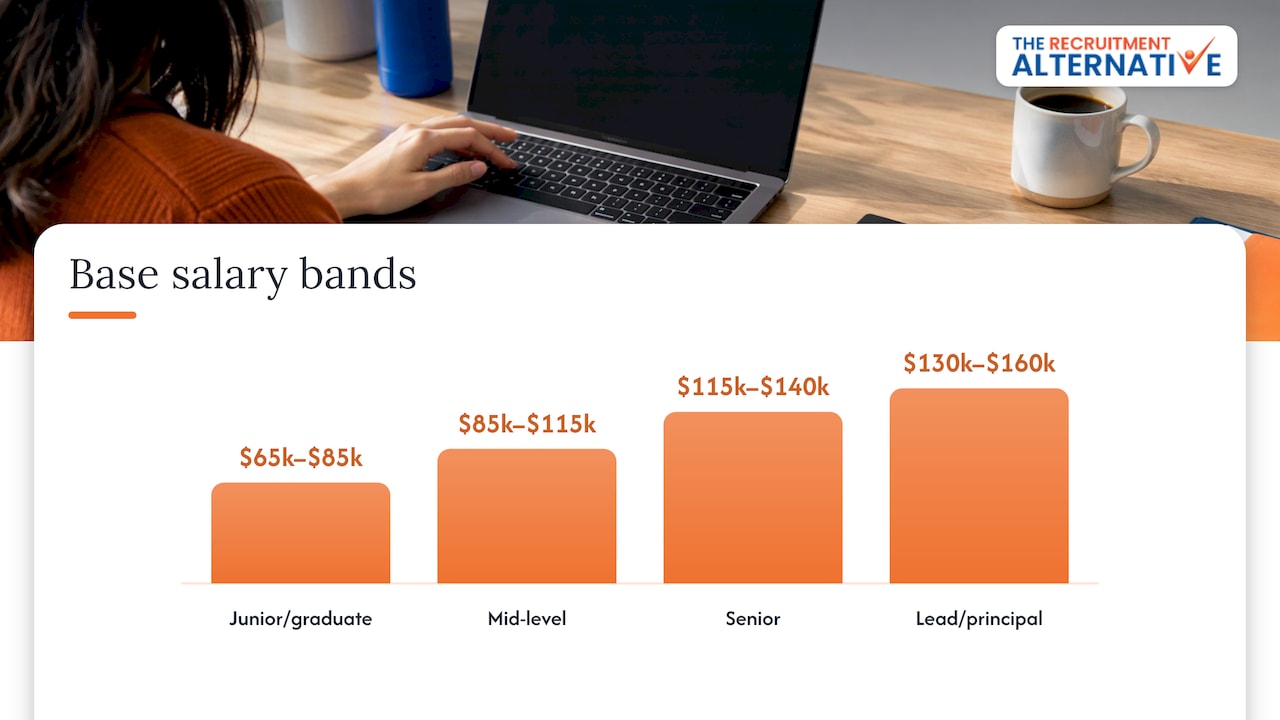
Salary bands for Australian permanent data analysts vary by source and by city. One 2026 career guide drawing on SEEK, Glassdoor and Hays data reports about $65,000 to $85,000 for juniors, $85,000 to $115,000 for mid-level, $115,000 to $140,000 for senior and $130,000 to $160,000 for lead roles. Treat those as a starting range, then check against live job ads for your city and industry, since technology and finance employers tend to pay more.
| Level | Typical experience | Indicative base salary (2026) |
|---|---|---|
| Junior or graduate | 0 to 2 years | $65,000 to $85,000 |
| Mid-level | 2 to 5 years | $85,000 to $115,000 |
| Senior | 5 to 8 years | $115,000 to $140,000 |
| Lead or principal | 8+ years | $130,000 to $160,000 |
Superannuation sits on top. The super guarantee rose to 12% on 1 July 2025, and that is the final scheduled increase. On a $100,000 salary quoted “plus super”, you pay a further $12,000. If you advertise a “$100,000 package” that includes super, the base is about $89,286. Be explicit in the ad about which you mean, because candidates compare offers on that basis.
Beyond pay, add software licences (a business intelligence tool seat is a recurring cost), a laptop, onboarding time from your own managers, and the cost of the hiring process itself. Our breakdown of the cost to hire an employee in Australia lists the items that are easy to miss.
For New Zealand employers, the pay bands above are Australian figures. Use local job ads in NZD for your budget, and note that the Australian super rules do not apply.
Where to find analysts, and what each route costs you
There are three ways to source candidates:
- Advertise yourself. Cheap in cash, expensive in time. A popular analyst ad can bring in a large pile of applications, and someone in your business has to read every one.
- Use a percentage-fee recruiter. The agency does the sourcing and shortlisting, but the fee is a share of salary. On a $110,000 role that can become a large bill, and it rises every time you raise the offer.
- Use a flat-fee recruiter. You get the sourcing and shortlisting with a fee set by tier, not by a percentage.
The third route is the one we built our business around. Our pricing is tiered by candidate salary and split in two: an engagement fee up front, then a placement fee when a hire is made. A fixed fee also changes how you negotiate. When you are deciding between a $105,000 and a $115,000 candidate, you pick on merit rather than on what the extra $10,000 does to the agency invoice. Our page on flat fee recruitment benefits for Australian employers sets out how this works, and why recruitment transparency matters covers what to look for in any fee schedule.
Screen candidates with a practical task
A CV tells you which tools a person has listed. It does not tell you whether they can turn a messy spreadsheet into a clear recommendation. A three-stage screen works well for small teams.
Stage 1: a short phone screen
Twenty minutes. Ask them to describe a recent analysis from start to finish: the question, the data, the method, the result and what the business did about it. Strong candidates talk about the decision, not only the technique. Check pay expectations and availability here, so you do not spend an hour with someone outside your budget.
Stage 2: a practical task
Give a small dataset similar to yours, with a few deliberate problems such as duplicates, blanks or inconsistent date formats. Ask for two or three findings and a one-page explanation, with a time limit of an hour or two. Look for:
- Did they notice and handle the data quality issues?
- Is the logic traceable, whether in SQL, Excel or Python?
- Could a non-technical manager act on the summary?
Keep tasks short and relevant. Long unpaid assignments put off strong candidates who have other offers. Candidates commonly prepare for SQL challenges, behavioural questions using the STAR method and a five-minute portfolio presentation, so build your interview around those formats and you will be comparing like with like.
Stage 3: a structured interview
Ask every candidate the same core questions and score answers against the same criteria. This keeps the process fair and makes the final decision easier to defend. Our guide to engineer interview questions and fair hiring checks shows how to structure scoring, and the same approach carries over to analyst interviews. Good questions include:
- Tell us about an analysis that changed a decision. What did you recommend?
- How do you check that numbers are right before you share them?
- Describe a time a stakeholder disagreed with your finding.
- How would you explain a confidence interval to someone in sales?
Our technology role hiring checklist and the article on how to recruit technology staff in Australia cover the wider steps for technical hires.
Check the legal points before you make an offer
Two areas deserve attention. The first is pay: use the salary benchmarking page as a starting point to make sure your offer is consistent with the relevant award or agreement where one applies, and be clear on super.
The second is the use of software in recruitment. If you screen CVs with a tool that makes or influences decisions about people, privacy reforms are relevant. A law firm’s 2026 workplace relations outlook notes that the Privacy and Other Legislation Amendment Act 2024 requires privacy policies to explain automated decision-making, with those reforms taking effect on 10 December 2026. If you use any automated screening, list the tools, review your privacy policy before that date, and take advice from your lawyer if you are unsure how the rules apply to you.
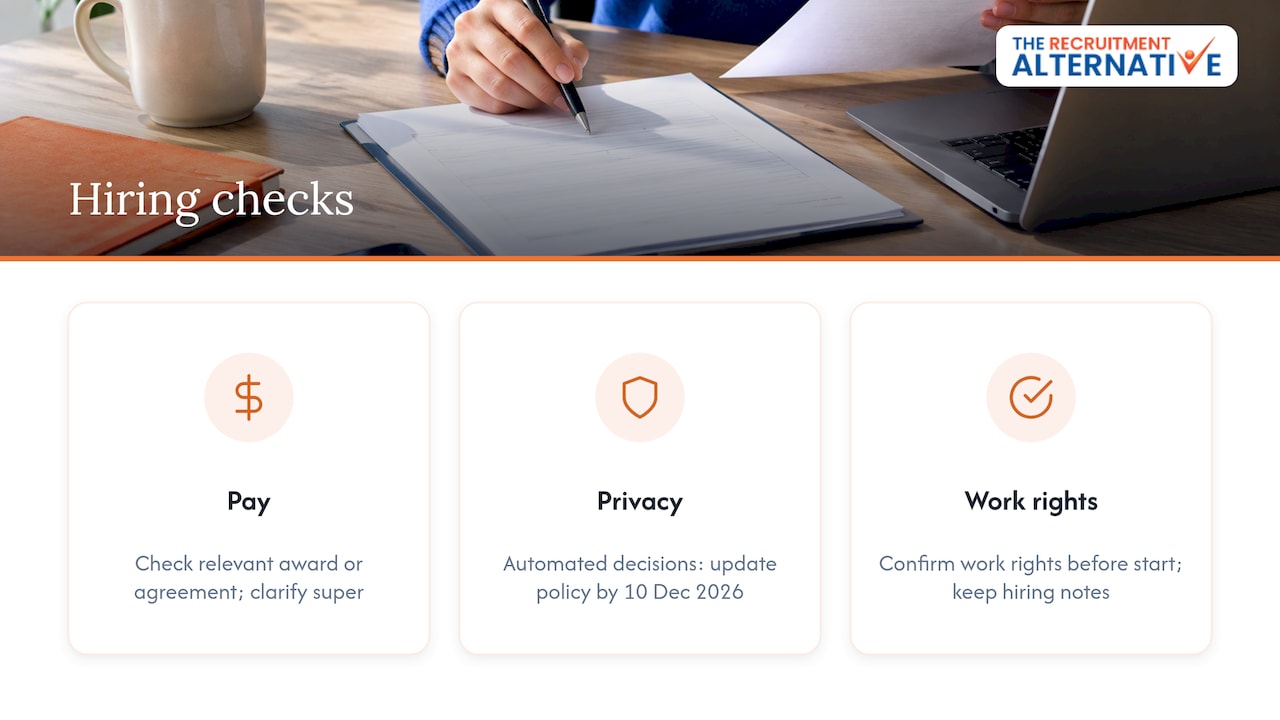
Also confirm each candidate’s right to work in Australia before you start them, and keep notes of your hiring decisions.
Making the offer and keeping the hire
Good analysts often hold more than one offer. Move quickly after the final interview, state the salary and super basis clearly, and tell them what they will work on in the first three months. Analysts leave roles where they spend their days on manual reports with no chance to do real analysis, so describe the work honestly.
Build a 90-day plan: access to systems in week one, a first small deliverable by week four, and a review of a larger piece of work by the end of month three. This also helps you judge fit within any replacement window offered by your recruiter.
Our view: why a flat fee suits an analyst hire
Data analyst roles span a wide salary range, from graduate to lead level. With a percentage fee, the agency’s income rises with the salary, so the more senior the hire, the higher your bill. We think that is the wrong way round for a small business.
Our model is a fixed fee in tiers. You pay an engagement fee to start and a placement fee when you hire. Our Recruit option has an engagement fee of $895 and a placement fee of $3,900 to $5,000. Recruit+ has an engagement fee of $2,495 and a placement fee of $5,000 to $6,000. You know the cost before you decide to go ahead, and it does not change when you stretch the offer to win the candidate you want.
We recruit permanent staff across technology, finance, administration, sales, engineering, healthcare, trades and executive roles, for businesses of all sizes in Australia and New Zealand. Analysts sit across all of those fields, which is why we think a generalist approach, with a clear brief from you on tools and business questions, serves this role well.
If a hire does not work out in the first two to three months, our candidate replacement insurance applies, and a Replacement Campaign is $1,000. For a first analyst hire, that makes the risk easier to carry.
Josh Townsend
What fixed-fee recruitment looks like in practice
Here is the fee picture for a mid-level analyst hired at $105,000 base. The numbers below use our published Recruit fees and exclude any optional checks.
| Item | Cost |
|---|---|
| Recruit engagement fee | $895 |
| Recruit placement fee | $3,900 to $5,000 |
| Salary | $105,000 |
| Super at 12% | $12,600 |
Optional extras are priced separately: a psychometric evaluation is $199 per candidate, and an optional criminal check is $129. For an analyst who will handle sensitive customer or financial data, those checks are worth considering.
Our Fixed Fee Recruitment service is listed at $4,795 one-off. To see which tier applies to your salary and role, the simple flat fee structure page sets out every fee, and the engagement fee explainer shows what the first payment covers.
If you are ready to start, tell us the role, the tools and the salary range, and we will take it from there.
FAQ
Is a data analyst still in high demand in Australia?
Demand for data skills remains strong across finance, retail, health and technology. AI is also shifting job ads: one 2026 report found 12.9% of ICT job ads in June 2026 mentioned AI skills. For most small businesses, that means asking whether an analyst can use modern tools sensibly, not requiring them to build models.
How long does it take to hire a data analyst?
It depends on the level, location and how quickly you move at each stage. Plan for a few weeks to source and shortlist, then interviews and notice periods. Most employed analysts need to give notice, so start early if you have a project deadline.
What should I look for in an analyst’s CV?
Look for named tools (SQL, Excel, a business intelligence tool), examples of business outcomes rather than lists of duties, and experience with data similar to yours. A portfolio or a short case study can show more than a degree.
Can AI replace a data analyst?
AI tools speed up routine tasks such as building charts or drafting queries, but someone still has to frame the question, check the output and explain it to the business. Our article on whether AI will take your job looks at this in more detail. When hiring, favour analysts who use these tools carefully and can check their own results.
Sources
- Building a Data Team: The Roles You Need at Each Stage of Your Data Strategy
- Foodbank Victoria data analyst position description
- Data Analyst in Australia 2026: Degree, Skills and Salary
- ATO: The final SG rate increase is coming on 1 July
- HFW Workplace Relations 2026: The Year Ahead
- State of AI Development in Australia 2026

