

Executive recruitment is defined as a specialised hiring process for senior leadership roles, typically at Vice President level and above, where base salaries often exceed $250,000 and total packages commonly reach seven figures. The industry term for this discipline is “retained executive search,” and understanding how it differs from standard recruitment is the first step to getting it right. The stakes are high. A poor appointment at the C-suite level costs far more than the fee paid to any search firm. This guide explains the executive search process, what distinguishes it from general hiring, and how business owners and HR professionals can engage with it effectively.
How does the executive recruitment process work?
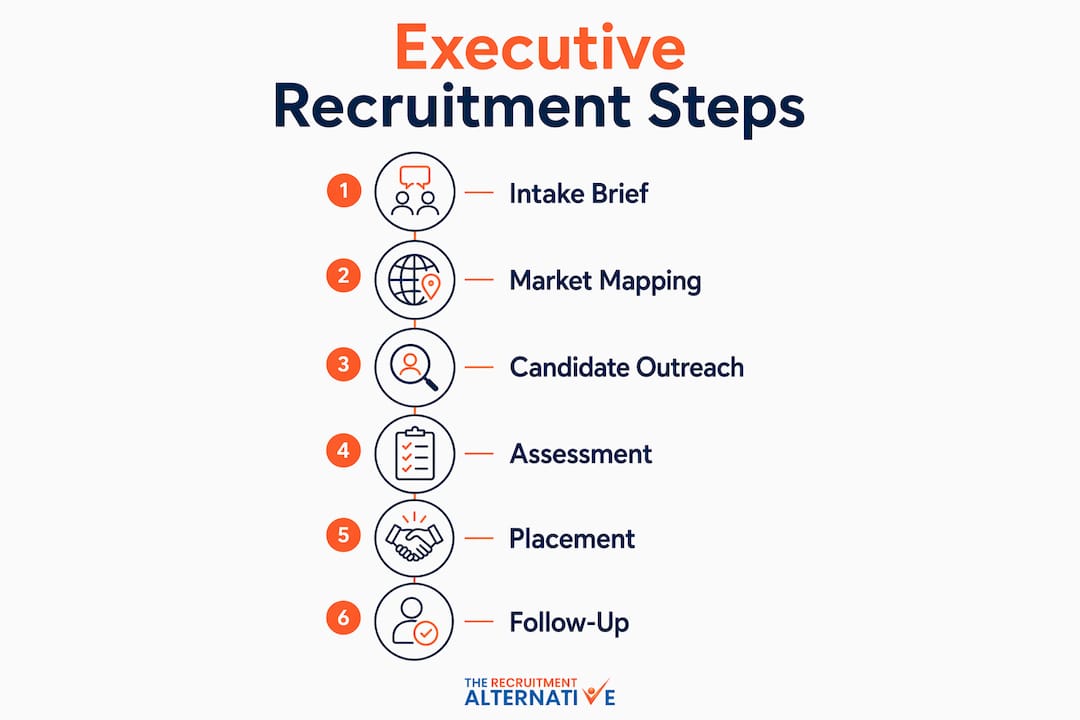
The retained executive search process follows a structured, seven-stage model. The full process spans 90 to 150 days, which reflects the depth of research and assessment required. Rushing any stage compounds risk.
-
Intake and briefing. The search begins with a detailed intake session between the client and the search firm. This is not a job description exercise. A thorough brief specifies what success looks like at 12 months and three years, including what previous incumbents struggled with. Weak briefs produce weak searches.
-
Role specification. The search firm translates the intake into a formal role specification and candidate profile. This document guides every subsequent decision in the search.
-
Market mapping. The firm builds a map of the target talent pool. Top firms identify 150 to 300 potential executives and conduct highly personalised outreach rather than mass mailings or automated messages. That level of specificity is what separates retained search from contingency recruitment.
-
Candidate outreach and sourcing. Outreach is confidential and direct. Most target candidates are passive, meaning they are not actively looking for a new role. The search firm approaches them through trusted networks and research-led contact.
-
Assessment and vetting. Candidates are assessed through structured interviews, psychometric testing tailored to the role context, and reference checks conducted before any offer is made. This stage filters the long list down to a focused group.
-
Shortlist presentation. A quality shortlist contains 3 to 5 thoroughly vetted candidates, not a large volume of unscreened résumés. Each candidate is presented with a detailed assessment report.
-
Offer management and onboarding. Retained firms manage offer negotiations actively, handling counter-offers and final package details to reduce the risk of a candidate withdrawing. Onboarding support continues for 3 to 6 months after placement, with a replacement guarantee period typically lasting 12 months.
Pro Tip: Ask your search firm to walk you through their intake process before signing any engagement. If they skip straight to fees and timelines, that is a warning sign.
What distinguishes executive recruitment from standard hiring?

Executive search operates in a fundamentally different market from general recruitment. Standard hiring targets active candidates who apply to advertised roles. Executive search targets passive candidates who are currently employed, performing well, and not looking. That distinction changes everything about how the process works.
Key differences include:
- Candidate pool. General recruitment draws from active applicants. Executive search maps and approaches a defined universe of qualified leaders who would never respond to a job board posting.
- Engagement model. Retained search is exclusive. The client pays a retainer upfront and works with one firm. Contingency recruitment is non-exclusive and only pays on placement, which incentivises speed over quality.
- Role seniority and compensation. Executive search applies to roles where compensation and organisational impact justify the investment in a thorough process.
- Research intensity. Executive search prioritises reducing leadership risk by securing candidates who fit long-term strategic needs, rather than filling a vacancy quickly.
- Assessment rigour. Psychometric testing, structured competency interviews, and pre-offer reference checks are standard in executive search. They are rare in general recruitment.
The outcome difference is significant. A disciplined, research-led process reduces average C-suite search timelines from 14 weeks to 9 weeks while improving candidate quality. Speed and quality are not in conflict when the process is built correctly from the start.
What are the common challenges and pitfalls in executive hiring?
Executive search fails more often than most clients expect. Industry-wide, executive search has a nearly 40% failure rate when operational discipline is weak. Elite firms reach success rates up to 90%. The gap between those two outcomes comes down to process.
The most common pitfalls are:
- Vague intake briefs. The most common cause of search failure is a weak intake brief that does not define the strategic delivery expectations for the role. A brief that reads like a job ad produces candidates who look right on paper but fail in the role.
- Rushing the briefing phase. Rushing the intake and role definition phase produces flaws throughout the entire hiring process. The time invested upfront is always recovered later.
- Prioritising volume over quality. Receiving 20 résumés feels productive. It is not. A focused shortlist of five vetted candidates is worth more than a pile of unscreened profiles.
- Ignoring cultural fit. A candidate who meets every technical criterion but clashes with the leadership culture will fail within 18 months. Cultural alignment must be assessed explicitly, not assumed.
- Poor offer management. Counter-offers are common at the senior level. Without active management from the search firm, a candidate who has verbally accepted can be lost in the final week.
- Neglecting onboarding. Effective onboarding of placed executives over the first 100 days is crucial to placement durability. Most early-tenure failures are preventable with structured support.
You can read more about common recruitment mistakes that employers make when briefing for senior roles.
Pro Tip: Before finalising your intake brief, ask three internal stakeholders what success looks like for this role in year one. If their answers differ significantly, resolve that disagreement before the search begins.
How can you engage effectively with executive recruitment firms?
Choosing the right search firm and managing the relationship well determines whether the process succeeds. Here is what to focus on:
- Define your hiring goals before first contact. Know the strategic problem the new leader must solve, not just the title you want to fill. Firms that receive a clear brief deliver better results faster.
- Choose retained search for senior roles. For VP-level and above, retained search is the appropriate model. Contingency arrangements at this level create misaligned incentives.
- Understand the fee structure. Retained executive search firms typically charge 30% to 35% of the placed executive’s first-year compensation. That fee reflects the research, assessment, and post-placement support included in the engagement.
- Communicate openly throughout the process. Share feedback on candidates quickly and honestly. Delays in feedback slow the search and signal disengagement to candidates.
- Expect honesty from your search firm. A quality retained firm will steer you away from unsuitable but attractive candidates. If a firm only tells you what you want to hear, that is a problem.
- Assess the firm’s track record. Ask for placement success rates, average time-to-shortlist, and examples of searches in your sector. Review their assessment criteria for search firms before committing.
- Clarify guarantee terms. A 12-month replacement guarantee is standard in retained search. Confirm what triggers it and how the replacement process works.
The Recruitment Alternative offers executive recruitment services with transparent fee structures designed to give businesses of all sizes access to quality senior hiring without the traditional cost barriers.
Key takeaways
Executive recruitment is a structured, research-driven process that targets passive senior leaders and requires disciplined intake, thorough assessment, and active post-placement support to succeed.
| Point | Details |
|---|---|
| Retained search takes 90–150 days | Allow the full timeline. Rushing any stage increases the risk of a poor placement. |
| Intake brief quality drives outcomes | Define what success looks like at 12 months and three years before the search begins. |
| Shortlists should be small and vetted | Expect 3 to 5 thoroughly assessed candidates, not a high volume of unscreened résumés. |
| Fees reflect full-service delivery | Retained firms charge 30%–35% of first-year compensation and include assessment and onboarding support. |
| Onboarding determines placement durability | Structured support over the first 100 days reduces early-tenure failure significantly. |
The intake brief is the part most businesses get wrong
After working across many senior hiring engagements, the pattern that stands out most clearly is this: the quality of the intake brief predicts the outcome of the search more reliably than any other factor. Not the firm’s network. Not the candidate market. The brief.
Most business owners and HR professionals treat the intake as a formality. They hand over an existing job description, answer a few questions about salary range, and expect the search to proceed. That approach produces mediocre results even when the search firm is excellent. The brief must answer a harder set of questions. What did the last person in this role struggle with? What does the board expect this leader to have achieved in three years? What cultural dynamics will this person need to navigate from day one?
The other misconception I see regularly is that executive search is just recruitment with a bigger fee. It is not. The fee reflects a fundamentally different service. A retained firm is accountable for the outcome, not just the activity. They manage the candidate relationship through offer and onboarding. They push back when a client is drawn to a candidate who looks impressive but does not fit the brief. That kind of honest counsel is rare and genuinely valuable.
The future of executive search will involve AI-assisted candidate mapping, which will compress the market research phase. But the intake brief, the assessment conversation, and the post-placement relationship will remain human work. The firms that invest in those elements will continue to outperform those that treat search as a volume exercise.
— Josh Townsend
How The Recruitment Alternative supports executive hiring
The Recruitment Alternative works with Australian businesses to fill senior leadership roles through a process that combines thorough candidate vetting, clear communication, and transparent pricing. Unlike traditional agencies that charge percentage-based commissions, The Recruitment Alternative’s flat-fee recruitment model gives SMEs and larger organisations access to quality executive hiring at a predictable cost.
The service covers strategic briefing, targeted candidate sourcing, structured assessment, and post-placement support. Whether you are hiring a General Manager, a department head, or a C-suite leader, the process is built to find the right person, not just the fastest available one. Contact The Recruitment Alternative to discuss your next senior leadership hire and get a clear picture of what the process involves and what it will cost.
FAQ
What is executive recruitment?
Executive recruitment is a specialised hiring process for senior leadership roles, typically at Vice President level and above, using retained search methods, confidential outreach, and rigorous candidate assessment.
How long does the executive search process take?
The retained executive search process typically spans 90 to 150 days, covering intake, market mapping, candidate outreach, assessment, shortlisting, and offer management.
What does executive recruitment cost?
Retained executive search firms typically charge 30% to 35% of the placed executive’s projected first-year compensation, covering the full search, assessment, and post-placement support.
What is the difference between retained and contingency executive search?
Retained search is exclusive and paid upfront, aligning the firm’s incentives with placement quality. Contingency search is non-exclusive and paid only on placement, which often prioritises speed over fit.
Why do executive searches fail?
The most common cause of executive search failure is a weak intake brief that does not define the strategic expectations for the role. Poor onboarding support after placement is the second leading cause of early-tenure failure.

