

Hiring an executive assistant (EA) in Australia comes down to five decisions: what the role covers, what you will pay, where you will find candidates, how you will test them, and which checks you complete before the offer. Get those right and you gain a trusted partner who frees hours of your week. Get them wrong and you lose months to a poor fit. This guide walks through each decision in order, with the costs and legal points an Australian employer needs.
TL;DR
- Define the role first: an EA supports one executive or a small team, so decide how much is diary and inbox work and how much is project and decision support.
- Budget against the full cost, not the base salary. Published Australian EA roles in 2026 range from roughly $88,000 to $127,000 plus superannuation.
- Referrals and a focused shortlist beat a wide job ad. Test candidates on real tasks, not only on conversation.
- Complete reference, identity and work-rights checks before the offer, and use probation correctly.
- With The Recruitment Alternative, an EA placement is a fixed fee that starts at an $895 engagement fee, not a percentage of salary.
Table of Contents
- What an executive assistant actually does
- The skills and attributes worth hiring for
- What to budget: salary and employment conditions
- How to source and shortlist EA candidates
- Interviews and practical assessments
- Checks to complete before you make the offer
- Perspective: what we see in EA hiring
- What recruitment costs for an EA
- Hire your executive assistant with a fixed fee
- A realistic timeline
- FAQ
- Sources
What an executive assistant actually does
Start with the definition, because “EA” covers very different jobs. The Australian Bureau of Statistics describes the Executive Assistant occupation as high-level support to individual executives, teams of executives, managers or professionals. Typical tasks include acting as a proxy, organising meeting logistics, drafting communications and setting schedules.
That is the base. Your version of the role sits somewhere on a spectrum:
- Administrative EA: diary, travel, inbox triage, meeting papers, expense reports. Success is reliability and attention to detail.
- Chief-of-staff style EA: manages projects, prepares board or leadership material, represents the executive in meetings and follows up decisions. Success is judgement and initiative.
- Team EA: supports several managers and has to prioritise between competing requests without upsetting anyone.
Write down the ten tasks you expect the person to own in the first six months, then rank them by hours per week. If more than half the hours are data entry and filing, you may need an administration assistant rather than an EA. Our admin assistant hiring checklist covers that adjacent role. If the top of your list is confidential work for an owner or CEO, you are hiring an EA.
Also note what will be delegated. Scheduling is the first thing many executives hand over, and some businesses now pair a human EA with automation for routine bookings. If that interests you, AI appointment booking is worth understanding so you can decide which scheduling tasks stay with the person and which do not need to.
The skills and attributes worth hiring for
Technical skills are easy to check: calendar software, document preparation, minute-taking, travel booking, a clear writing style. The harder, more valuable qualities are personal.
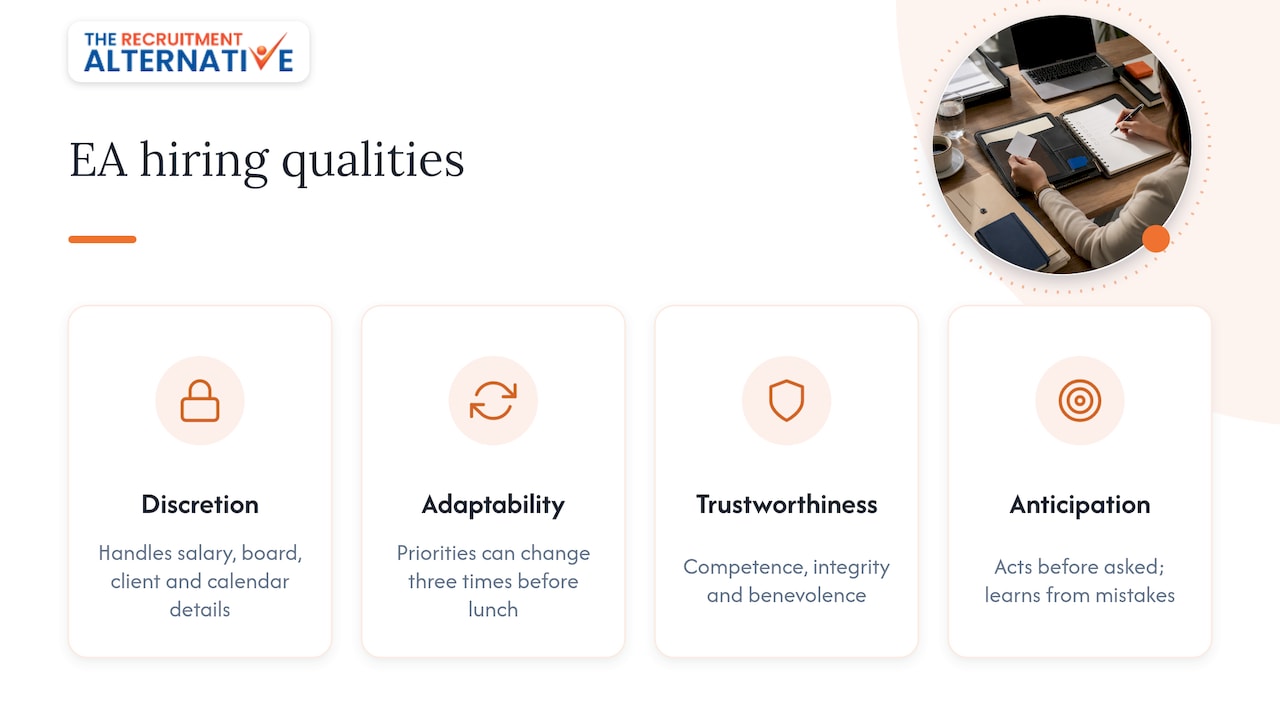
Discretion. An EA sees salary data, board matters, client disputes and personal calendars. One US-based assistant-services company, Wing Assistant, calls discretion a non-negotiable professional standard, and that matches what most Australian owners tell us.
Adaptability. The same source suggests listening for candidates who describe fast-changing environments as normal rather than stressful. In a small business, priorities can change three times before lunch.
Trustworthiness in three parts. Carnegie Mellon researcher Anita Williams Woolley, quoted by Forbes Advisor, describes trustworthiness as competence, integrity and benevolence. That is a handy interview framework: can they do it, will they be honest about it, and do they care about the outcome for you?
Anticipation. For senior executives, a strong EA understands the business well enough, including governance basics, to act before being asked. A guide to C-level assistants also argues that openness to feedback and constant learning matter more over time than never making a mistake. In practice, that means asking candidates about a time they got something wrong and what changed afterwards.
A simple scorecard
Before you advertise, score each of these from 1 to 5 for how critical it is to your role. It keeps interviews consistent and stops a charming candidate winning on personality alone.
| Attribute | What good looks like | Where to test it |
|---|---|---|
| Discretion | Declines to name past employers’ confidential details, even when prompted | Interview, referee call |
| Prioritisation | Explains how they would order five competing requests | Practical exercise |
| Written communication | Clear, accurate, right tone for the audience | Email drafting task |
| Initiative | Examples of fixing problems nobody assigned | Interview, referee call |
| Tech fluency | Fast and accurate in your tools | Short live task |
What to budget: salary and employment conditions
Australian EA pay varies widely by sector, city and seniority, so anchor your budget in real advertised roles rather than a single “average”.
- The City of Sydney’s February 2026 job ad for an Executive Assistant lists $112,968 to $126,774 a year plus superannuation, along with 26 weeks paid parental leave and a rostered day off option.
- An APS 5 Executive Assistant role at the Australian Institute of Family Studies in Melbourne offers $88,834 to $96,829 plus 15.4% superannuation, and notes that probation and clearances may apply.
Those are public-sector examples, so private employers will set their own ranges, but they show the bracket you are competing in for experienced candidates in the capital cities. A smaller business with a narrower scope can sit lower. A role supporting a CEO in Sydney or Melbourne will sit toward or above the top.
Count the full cost
Base salary is only the start. Add:
- Superannuation on top of salary
- Leave loading and accrued leave
- Software, equipment and a workspace
- Training in your systems
- Recruitment cost, covered below
The Recruitment Alternative’s own cost to hire an employee breakdown goes through these items in more detail.
Employment obligations
The Fair Work Ombudsman’s guide to starting a new job sets out the basics. Employers must comply with the Fair Work Act, provide the required information statements, meet the National Employment Standards and pay at least the applicable award or agreement rate, or the National Minimum Wage if no award or agreement applies. Many EA roles fall under the Clerks, Private Sector award or an enterprise agreement, but a senior EA on a high salary may be award-free. Confirm which applies on the Fair Work site before you write the contract.
Probation is allowed to assess suitability, but the same guide is clear that someone on probation still receives the correct minimum wage and National Employment Standards entitlements, including notice of termination. Our article on probation periods in Australia explains how to set a sensible length and what to put in writing.
How to source and shortlist EA candidates
A job ad on a major board will fill your inbox. That is the problem: a role like this can draw hundreds of applicants, most of whom skim the description. Three tactics work better.
- Ask for referrals. Catch Agent’s Nir Sabato, in a guide to hiring an EA, says referrals from other executives are the highest-yield channel. Ask peers, your accountant, your board and your own network who they would hire again.
- Write a specific ad. Lead with the executive’s industry, the size of the team, the top three responsibilities and the salary range. Specific ads attract fewer but better-matched applicants.
- Screen with a short written task. Ask applicants to answer two questions by email, such as how they would handle a double-booked meeting between your two most important clients. You learn about their writing and judgement before spending any interview time.
Keep the process moving. The same Catch Agent advice is to run a three-stage interview process within three weeks, since strong EAs are usually interviewing elsewhere. A month of silence between stages loses the best candidate.
Interviews and practical assessments
The interview should feel like a normal working day compressed into an hour. Use the same questions with every candidate and score them against your scorecard.
Questions that reveal judgement
- “Tell me about a time you disagreed with a decision your manager made. What did you do?”
- “How do you decide what interrupts an executive and what waits?”
- “Describe a confidential matter you handled. What did you do to keep it safe?” (A good candidate will answer without giving away the details.)
- “Walk me through your last week. What did you not get to, and why?”
- “What did your last manager need to tell you to improve?”
Listen for specifics. Vague answers about “being organised” are a signal to ask for an example.
Practical assessments
Keep tasks short and realistic, ideally under an hour:
- Inbox triage: a mock inbox of 12 emails to sort, reply to or flag.
- Diary conflict: a calendar with three clashes to resolve and a reply to each party.
- Writing sample: a short note to a client on behalf of the executive.
If you plan a trial shift on site, the Fair Work Ombudsman’s page on starting employment notes that an unpaid trial for assessment must be made clear to the candidate beforehand. Check the Fair Work rules on trials before you set one up, and keep any task brief and genuinely about assessment.
A psychometric view
For senior or highly confidential roles, a structured personality and work-style assessment adds a data point beyond the interview. We offer a psychometric evaluation at $199 per candidate as an optional add-on.
Checks to complete before you make the offer
Treat checks as part of the offer conditions, so a candidate knows from the start what you will verify.
- Referees: speak to at least two recent managers, not only the people the candidate nominates as friendly contacts. Ask about discretion, reliability and how they handled pressure.
- Identity and qualifications: sight original identity documents and confirm any claimed qualifications with the issuer.
- Right to work: every employer must confirm that a new employee can legally work in Australia. For non-citizens, the Department of Home Affairs’ visa checking service for employers is the official route. Do this before the start date.
- Police check: relevant when the EA handles financial, payroll or highly sensitive information. We offer an optional criminal check at $129.
Put these in the offer letter as conditions, and keep the written results with the employee record.
Perspective: what we see in EA hiring
Most small businesses hire their first EA in a hurry. The owner is drowning in email, the diary is chaos, and the job ad goes out the same week. That is the point where a hiring mistake costs the most.
Our view is that the role definition and the shortlist matter more than the advertisement. A business that knows what it wants the EA to own, and sees only five or six well-matched candidates, makes a better decision than one that reads two hundred applications.
We also believe the cost of finding that person should be predictable. A percentage-of-salary fee means a more senior, better-paid EA costs you more just to find. Our flat-fee model is built so that you know the cost of recruitment up front and are not penalised for hiring well. If the hire does not work out within the first two to three months, our candidate replacement insurance is there to protect you.
Hire for discretion and judgement first. Tools and systems can be taught in a fortnight. Character cannot.
Josh Townsend
What recruitment costs for an EA
There are three broad routes: advertise and screen yourself, use a traditional agency that charges a percentage of the first-year salary, or use a flat-fee recruiter.
Doing it yourself costs advertising and a lot of your time. For an executive running a business, reading applications, phoning referees and holding first interviews can run to many hours across a few weeks, and that time is not free.
A percentage-based agency fee rises with the salary. On a $110,000 role, even a mid-range percentage is a large cheque, and it grows if you offer more to attract a stronger candidate. Our guide to executive recruitment fees in Australia explains how those fees are usually structured.
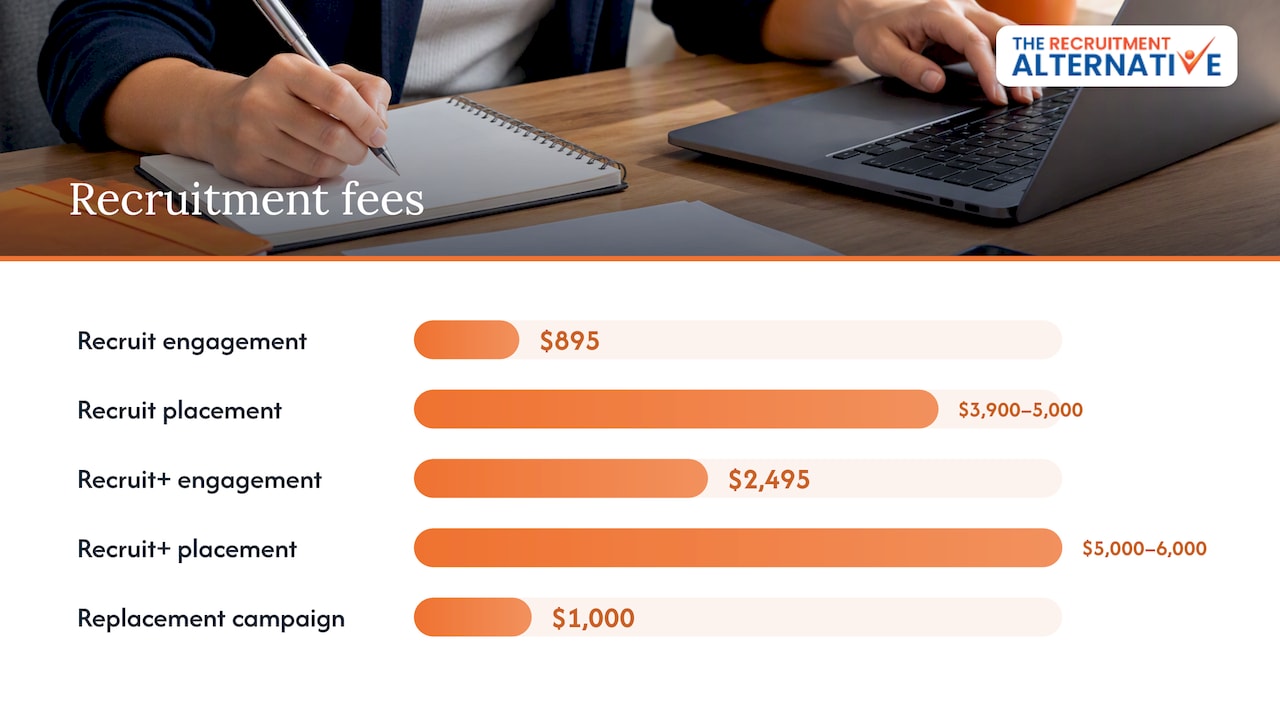
A flat-fee model charges a fixed amount set by salary band. At The Recruitment Alternative, the published structure has two parts, an engagement fee when we start and a placement fee when you hire:
| Service | Engagement fee | Placement fee |
|---|---|---|
| Recruit | $895 | $3,900 to $5,000 |
| Recruit+ | $2,495 | $5,000 to $6,000 |
The placement fee within each range depends on the candidate’s salary. Optional extras are a criminal check at $129 and a psychometric evaluation at $199 per candidate. See the full flat-fee price structure and our explanation of the engagement fee. We claim savings of over 70% compared with traditional commission-based agencies, and the benefits of flat-fee recruitment page shows how that works.
If the hire leaves in the first two to three months, a replacement campaign costs $1,000.
Hire your executive assistant with a fixed fee
If you would rather spend your time running the business than sifting applications, we can run the search. We source, screen and shortlist EA candidates against the scorecard you set, and you meet the people worth meeting. We work with employers across Australia and New Zealand, from owner-managed businesses to larger teams. See how it works on our fixed fee recruitment page.
For a wider view of the process we follow on support roles, read our guide to the administration recruitment process. Hiring for a senior or CEO-facing position? Our executive recruitment services cover Sydney, Melbourne, Brisbane and Adelaide.
A realistic timeline
Even with a good process, plan on several weeks from role brief to start date, plus the new employee’s notice period with their current employer. A typical sequence looks like this:
- Week 1: finalise the role brief, salary range and scorecard.
- Weeks 1 to 2: advertise and approach referrals; screen with the written task.
- Weeks 2 to 3: interviews and practical assessment, three stages at most.
- Week 3 to 4: referee, identity and work-rights checks; make the offer.
- After acceptance: notice period, then a structured first 90 days.
In the first month, give the new EA a handover document, access to the systems they need, and a weekly check-in with you. Set the probation review dates on day one, and say clearly what success looks like at each one.
FAQ
How much does it cost to hire an executive assistant in Australia?
Advertised 2026 salaries for experienced EAs run from about $88,000 to over $126,000 plus superannuation, depending on sector and city. On top of that, add leave, equipment and recruitment costs. With us, the recruitment cost is a fixed engagement fee plus a placement fee, starting at $895 and $3,900 respectively on our Recruit service.
How long does it take to hire an EA?
The search, interviews and checks usually take three to five weeks if you move promptly. Add the candidate’s notice period before they start. Running interviews quickly matters, as strong candidates are often talking to several employers.
Should an EA be on probation?
Yes, you can use a probation period to assess suitability, as the Fair Work Ombudsman’s guidance confirms. The employee still receives the correct minimum wage and National Employment Standards entitlements during probation. Put the length and review dates in the employment contract.
What if the EA does not work out?
Tell the employee about concerns early and document them, and follow Fair Work requirements on notice. If you hired through us and the person leaves in the first two to three months, a replacement campaign is available for $1,000.
Sources
- Occupation 522231 Executive Assistant, Australian Bureau of Statistics
- 25 Executive Assistant Skills: What to Look For in Your Hire, Wing Assistant
- Executive Assistant Job Description, Forbes Advisor
- The Essential Guide To C-Level Executive Assistants, Boldly
- Executive Assistant job details, City of Sydney
- Executive Assistant (APS5), Australian Institute of Family Studies role
- A guide to starting a new job, Fair Work Ombudsman
- Before starting employment, Fair Work Ombudsman
- How to Hire an Executive Assistant in 2026, Catch Agent

