

Recruitment agencies are intermediaries that manage the end-to-end hiring process on behalf of employers, from sourcing candidates to coordinating offers and supporting onboarding. Understanding how recruitment agencies work gives business owners and HR professionals a clear advantage when deciding whether to engage one, which fee model to choose, and how to get the best results from the relationship. The industry term for this function is “third-party recruitment” or “staffing services,” though most Australian businesses simply refer to the process as using a recruitment agency. Agencies like The Recruitment Alternative operate across permanent, temporary, and executive hiring, covering sectors from finance and engineering to healthcare and technology.
What are the key steps recruitment agencies follow?
Recruitment agencies gather a detailed upfront briefing covering job responsibilities, qualifications, salary range, and cultural expectations before sourcing a single candidate. This step is not a formality. Without a precise brief, the sourcing and screening that follows will produce mismatched candidates and wasted time for everyone involved.
The typical operational process runs as follows:
- Client consultation. The recruiter meets with the hiring manager to lock in role specifications, reporting lines, team culture, and must-have versus nice-to-have criteria.
- Job description refinement. The agency rewrites or sharpens the job description to attract the right candidates across job boards, LinkedIn, and their own candidate databases.
- Candidate sourcing. Recruiters draw from active applicants, passive candidates in their database, professional networks, and direct outreach. A well-run agency generates a longlist of 30–50 candidates within the first two working days.
- Screening and interviews. The agency conducts phone screens and structured interviews to assess skills, experience, and cultural fit. Reference checks and skills assessments are completed at this stage.
- Shortlisting. A client-ready shortlist of 3–5 candidates is delivered, typically within a 7-day speed-to-shortlist cadence. Day 1 locks the brief, days 2–3 build the longlist, day 4 interviews the top 15, and day 6 delivers the final shortlist.
- Interview coordination and offer management. The agency schedules client interviews, collects feedback, and manages offer negotiations between both parties.
- Onboarding support. Many agencies provide post-placement follow-up to confirm the candidate has settled in and the placement is tracking well.
Pro Tip: Brief your recruiter as thoroughly as you would brief an internal hiring manager. The quality of the shortlist is directly proportional to the quality of the information you provide upfront.
Structured workflows managing longlists and candidate conversations improve shortlist quality, but only when the client provides timely feedback at each stage. Delays in feedback break the evaluation rhythm and push out timelines.

How do recruitment agency fee structures work?
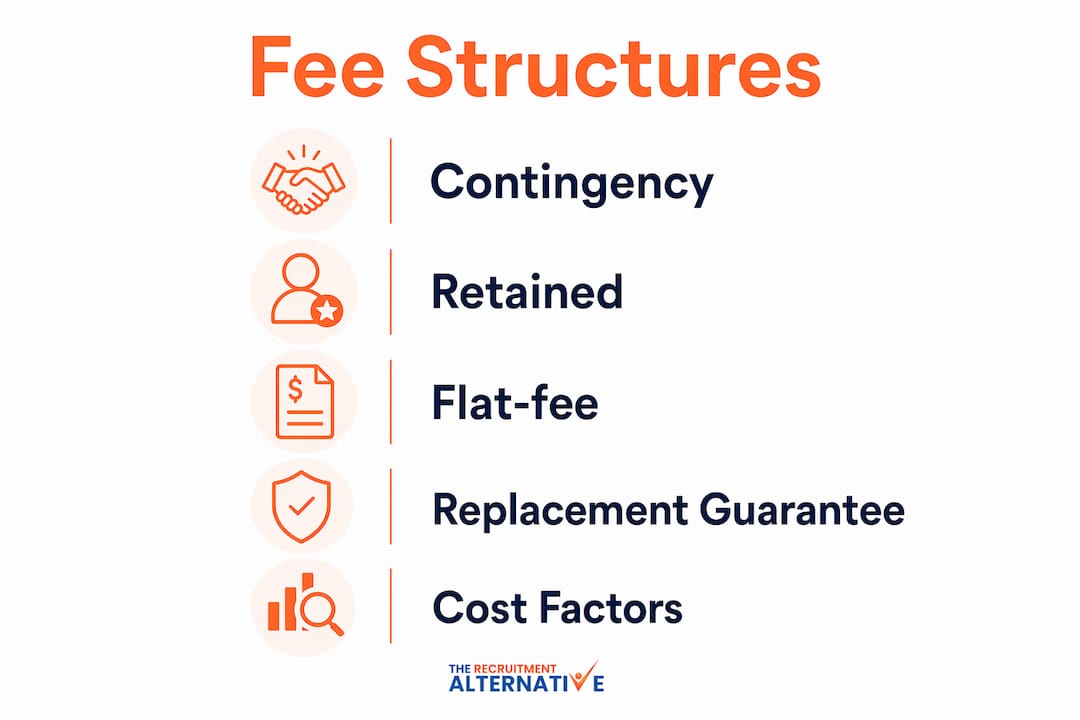
Fee structures are the single most misunderstood aspect of working with a recruitment agency. Three models dominate the Australian market, and each allocates risk differently between the agency and the employer.
| Fee model | How it works | Typical cost | Risk allocation |
|---|---|---|---|
| Contingency | Fee paid only on successful placement | 15%–25% of first-year salary | Agency bears the risk; no hire means no fee |
| Retained search | Fee paid in three instalments regardless of outcome | Approximately 33% of total first-year compensation | Employer bears partial risk; fee covers the search process |
| Temporary staffing | Hourly markup on the worker’s pay rate | 25%–40% markup above base wage | Agency acts as employer of record; employer pays for hours worked |
Contingency recruitment suits most standard permanent hires. The agency only earns a fee when you hire someone they presented, so their incentive is to find the right person quickly. The trade-off is that the agency may be working your role alongside several competing briefs, which can affect the depth of attention your search receives.
Retained search is reserved for senior, specialist, or hard-to-fill roles. The employer pays a portion of the fee upfront, another instalment at shortlist, and the final payment on placement. This model funds a dedicated, thorough search rather than a reactive one. Retained executive search timelines span approximately 90–120 days from engagement to start date, with CEO searches extending to 120–150 days.
Pro Tip: Negotiate a replacement guarantee into any contingency agreement. Most reputable agencies offer a free replacement or partial refund if the placed candidate leaves within a defined period, typically 3–6 months.
Choosing between contingency and retained models depends on role complexity, timing urgency, and your tolerance for paying during the search process. A mid-level sales manager is a contingency hire. A new Chief Financial Officer is a retained search.
What variations exist in recruitment agency services?
Not all recruitment agencies offer the same services. The three core service types differ significantly in structure, cost, and employer responsibility.
Permanent recruitment is the most common model. The agency sources and screens candidates, and the employer hires the successful candidate directly onto their own payroll. The agency’s involvement ends at placement, aside from any post-placement support period. This model suits businesses filling ongoing roles across administration, sales, finance, engineering, and technology.
Temporary and contract recruitment works differently. In temporary recruitment, the agency acts as the employer of record, managing payroll, superannuation, tax obligations, and workplace compliance. The client directs the worker’s daily tasks but carries none of the employment liability. This model suits project-based work, seasonal demand, or cover for parental leave. The Recruitment Alternative offers temporary recruitment services that handle these employer-of-record responsibilities directly.
Executive or retained search involves a structured, exclusive process for leadership roles. The agency builds a competency framework, benchmarks compensation, and maps the market before approaching candidates. Retained executive search synthesises multiple concurrent workstreams including role articulation, compensation benchmarking, and competency-framework building. The timeline is longer, but the precision is higher.
Key considerations when choosing a service type:
- Permanent recruitment suits roles where you want the candidate on your payroll from day one.
- Temporary recruitment suits short-term needs or situations where you want to assess a candidate before committing to a permanent hire.
- Executive search suits C-suite and senior leadership roles where a wrong hire carries significant financial and cultural risk.
- Agency specialisation matters. A generalist agency covering multiple sectors often provides faster turnaround for standard roles, while a specialist agency may access deeper talent pools for niche positions.
How can businesses use a recruitment agency effectively?
The employer-agency relationship produces better results when both parties treat it as a genuine partnership rather than a transactional service. Businesses that work effectively with recruitment agencies share detailed briefs, respond to shortlists promptly, and provide specific feedback after every interview.
The following practices separate high-performing hiring partnerships from frustrating ones:
- Provide a detailed role brief upfront. Include the reporting structure, team dynamics, salary range, and the specific reason the role is open. Vague briefs produce generic shortlists.
- Agree on a feedback cadence. Confirm with your recruiter how quickly you will review CVs and provide post-interview feedback. A 48-hour turnaround keeps the process moving.
- Use the agency’s market intelligence. Recruiters speak to candidates and employers daily. Ask them for salary benchmarking data, candidate availability insights, and feedback on how your role compares to competitors in the market.
- Share cultural context. Tell the recruiter what has and has not worked in the team before. Cultural fit is as important as technical skills, and recruiters can only screen for it if you describe it clearly.
- Recognise the signs you need an agency. If your last three hires took longer than eight weeks, if you are receiving low application volumes, or if you lack internal HR capacity, a recruitment agency will save you time and reduce the risk of a poor hire.
Pro Tip: Ask your recruiter to share candidate feedback from the screening process, not just the shortlist. Patterns in why candidates declined or were screened out reveal useful information about your employer brand and offer competitiveness.
Recruitment agency alternatives for small businesses include internal referral programmes, LinkedIn Recruiter, and direct advertising on platforms like Seek. These options work for straightforward roles with strong employer brand recognition. For specialist, senior, or time-critical roles, the cost of a slow or failed hire typically exceeds the agency fee.
Key takeaways
Recruitment agencies reduce hiring risk by managing sourcing, screening, and shortlisting through structured processes that most internal teams cannot replicate at the same speed or depth.
| Point | Details |
|---|---|
| Operational process | Agencies follow a structured 7-step workflow from brief to onboarding, delivering shortlists within days. |
| Fee model choice | Contingency suits standard roles; retained search suits senior hires; temp staffing suits short-term needs. |
| Service type matters | Permanent, temporary, and executive search differ in cost, timeline, and employer liability. |
| Partnership quality | Detailed briefs and fast feedback loops directly improve shortlist quality and placement speed. |
| Market intelligence | Recruiters provide salary benchmarking and candidate insights that internal teams rarely access. |
What I have learned from watching businesses get this wrong
Most businesses approach a recruitment agency the same way they approach a photocopier repair service. They call when something is broken, describe the problem in the vaguest possible terms, and expect a fast fix. That approach produces mediocre results every time.
The businesses that get the most value from agencies treat the recruiter as an extension of their hiring team. They share context that never appears in a job description: why the last person left, what the team dynamic is like, what success looks like in the first 90 days. That information changes who the recruiter targets and how they pitch the role.
Fee negotiations are another area where I see businesses make costly mistakes. Pushing a contingency fee below 15% often signals to the agency that your role will receive less priority than a client paying the standard rate. A better negotiation focuses on the replacement guarantee period and the exclusivity arrangement rather than the percentage itself.
The speed-to-shortlist metric is one I encourage every hiring manager to ask about before engaging an agency. An agency that cannot articulate its shortlist timeline has no structured process. A structured process is the difference between a shortlist in seven days and a shortlist in seven weeks. For businesses hiring staff in a hurry, that distinction is the whole game.
Finally, do not underestimate the value of a generalist agency for most roles. Specialist agencies command premium fees and longer timelines. For the majority of permanent hires across administration, sales, and operations, a well-run generalist agency with a strong candidate database will outperform a specialist every time on cost and speed.
— Josh Townsend
Flat-fee recruitment that changes the cost equation
Traditional percentage-based fees add up fast, particularly for small and medium businesses filling multiple roles in a year. The Recruitment Alternative offers a flat-fee recruitment model that delivers the full agency process, including sourcing, screening, shortlisting, and placement support, at a fixed price rather than a percentage of salary.
The Recruitment Alternative recruits across permanent, temporary, and executive roles in industries including sales, finance, engineering, healthcare, administration, and technology throughout Australia. Businesses looking for affordable recruitment for small businesses can access the same quality of service without the unpredictable cost of commission-based hiring. The process is transparent, the pricing is fixed, and the focus is on finding the right person for your team.
FAQ
What does a recruitment agency actually do?
A recruitment agency sources, screens, and shortlists candidates on behalf of an employer, managing the hiring process from brief to placement. The agency handles job advertising, candidate interviews, reference checks, and offer coordination so the employer only needs to assess a curated shortlist.
How long does it take a recruitment agency to find candidates?
A structured agency delivers a shortlist of 3–5 candidates within approximately seven days of receiving a confirmed brief. Executive and retained searches take longer, typically 90–120 days from engagement to start date.
What is the difference between contingency and retained recruitment?
Contingency recruitment charges a fee of 15%–25% of first-year salary only when a hire is made. Retained search charges approximately 33% of total first-year compensation in staged instalments, regardless of whether a hire is completed.
When should a small business use a recruitment agency?
A small business benefits from using a recruitment agency when internal HR capacity is limited, when a role requires specialist sourcing, or when previous direct hiring attempts have produced slow or poor results.
Can a recruitment agency handle temporary staff?
Yes. In temporary recruitment, the agency acts as the employer of record, managing payroll, tax, superannuation, and compliance. The client directs the worker’s daily tasks without carrying the employment liability.
Recommended
- Tips for Employers When Working with a Recruitment Agency | The Recruitment Alternative
- What to Look for in a Recruitment Agency – The Recruitment Alternative
- How to work with a Recruitment Consultant… – The Recruitment Alternative
- Onboarding Success: Tips for Welcoming Your New Employee – The Recruitment Alternative

