

Hiring an HR manager makes sense when people work has become constant and complex enough that the owner or a general manager can no longer do it well alongside everything else. Plan on a base salary of roughly $90,000 to $115,000 for a mid-market business, define the role around your real HR workload, and use structured interviews to compare candidates fairly. This guide covers each step, from the decision to hire through to the first 90 days.
TL;DR
- Hire when judgment-heavy HR work keeps piling up, for example when the owner spends 10 or more hours a week on it, not simply when headcount reaches a set number.
- Look for around five years of HR experience, solid knowledge of the Fair Work Act 2009 (Cth), modern awards and WHS law, and strong communication and conflict resolution skills.
- Budget a base salary of about $90,000 to $115,000, and expect first-year costs well above that once super, leave, recruitment and onboarding are counted.
- Use the same questions and the same scoring for every candidate, and ask what they would do in their first 90 days.
- A flat fee agency can cut the recruitment cost of the hire: our Recruit service charges a $895 engagement fee plus a placement fee of $3,900 to $5,000.
Table of Contents
- When a small business needs an HR manager
- What the role should cover
- Qualifications, experience and skills to look for
- What to budget
- Where to find HR manager candidates
- How to assess candidates
- Checks before you make an offer
- Making the offer and onboarding
- Perspective: why we think flat fees suit this hire
- What a flat fee costs with us
- Hiring an HR manager with The Recruitment Alternative
- Common mistakes to avoid
- FAQ
- Sources
When a small business needs an HR manager
Headcount is only a rough guide to HR complexity. The better signal is how much judgment-intensive people work is building up or going undone. One HR resource suggests the time to consider a dedicated hire is when the owner spends 10 or more hours a week on HR tasks, or when employee relations issues keep recurring.
In practice, the signs look like this:
- Contracts, position descriptions and policies are out of date or inconsistent between staff.
- Performance conversations are avoided until a problem becomes a dispute.
- Onboarding differs depending on which manager happens to be free.
- You are hiring regularly and recruitment is pulling managers away from their own work.
- Questions about awards, leave and termination are being answered from memory.
If two or three of these sound familiar, a dedicated HR manager is probably worth the cost. If only one applies, a part-time HR contractor or an HR officer may be a better first step. Be clear on which you need before you write the job ad.
What the role should cover
An HR manager in a small or mid-sized business is usually a generalist. The role can cover recruiting, onboarding, compliance, payroll coordination, performance, training, employee records and employee relations. You will not want all of it on day one, so rank the tasks by what is hurting the business most.
A practical way to scope the role:
- List the HR tasks currently done, and by whom. Include the ones done badly or not at all.
- Mark which need judgment (disciplinary matters, restructures, complaints) and which are administrative (records, payroll inputs).
- Decide what the new hire owns outright, what they support and what stays with the owner.
- Set the reporting line. Most small business HR managers report to the owner or managing director.
Write this into a position description. It becomes the base for your advertisement, your interview questions and your first performance review.
Qualifications, experience and skills to look for
For an Australian employer, a sensible benchmark is at least five years of HR experience, including two years in a generalist or HR management role. The same source lists sound working knowledge of the Fair Work Act 2009 (Cth), the National Employment Standards, modern awards and WHS laws as essential. A relevant degree, AHRI membership and HRIS or payroll experience are desirable rather than essential.
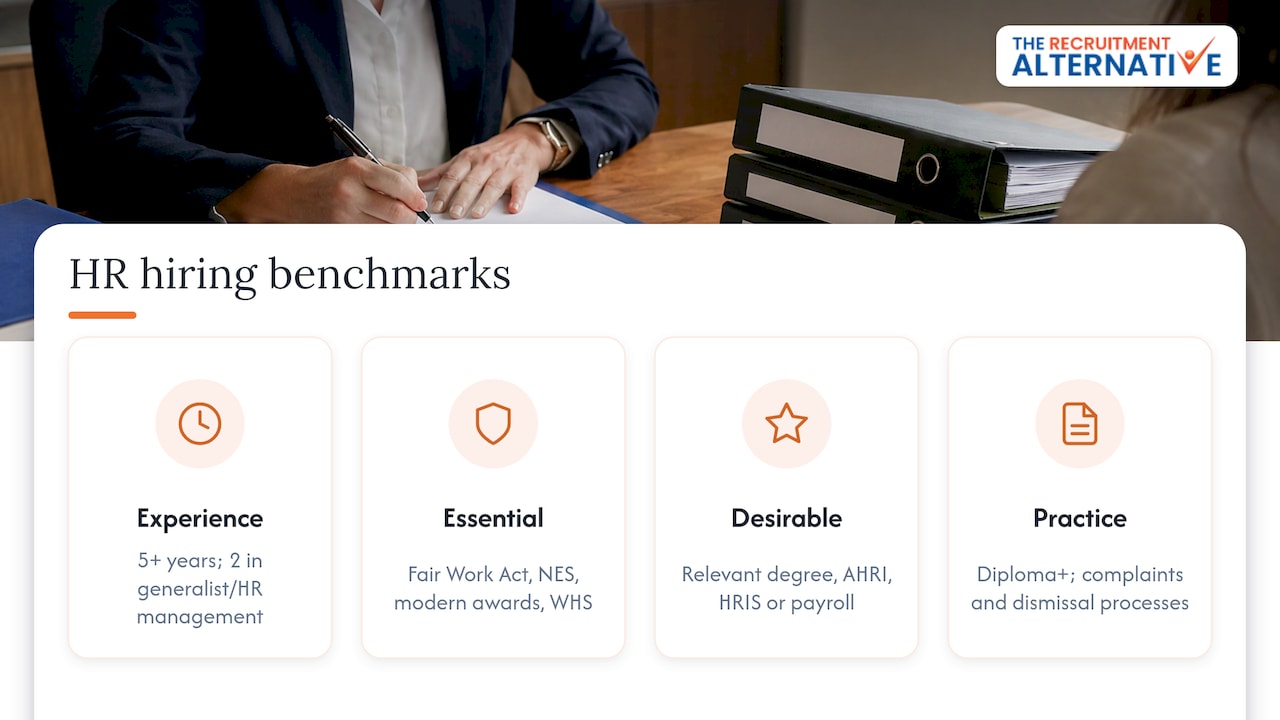
Other Australian guidance points the same way, noting that employers typically expect diploma-level credentials or higher and experience with workplace complaints and dismissal processes.
Technical skills
- Applying the correct modern award or enterprise agreement
- Running a fair performance management or termination process
- Managing employee records and HRIS data
- Coordinating payroll inputs and leave entitlements
- Reporting on turnover, absence and hiring metrics
People skills
Technical knowledge is the entry ticket. Emotional intelligence, communication and conflict resolution are what separate a good HR manager from a compliance clerk, and they are harder to teach. In a small business, the HR manager is often the person staff go to when something is wrong, so trust and discretion matter as much as knowledge.
What to budget
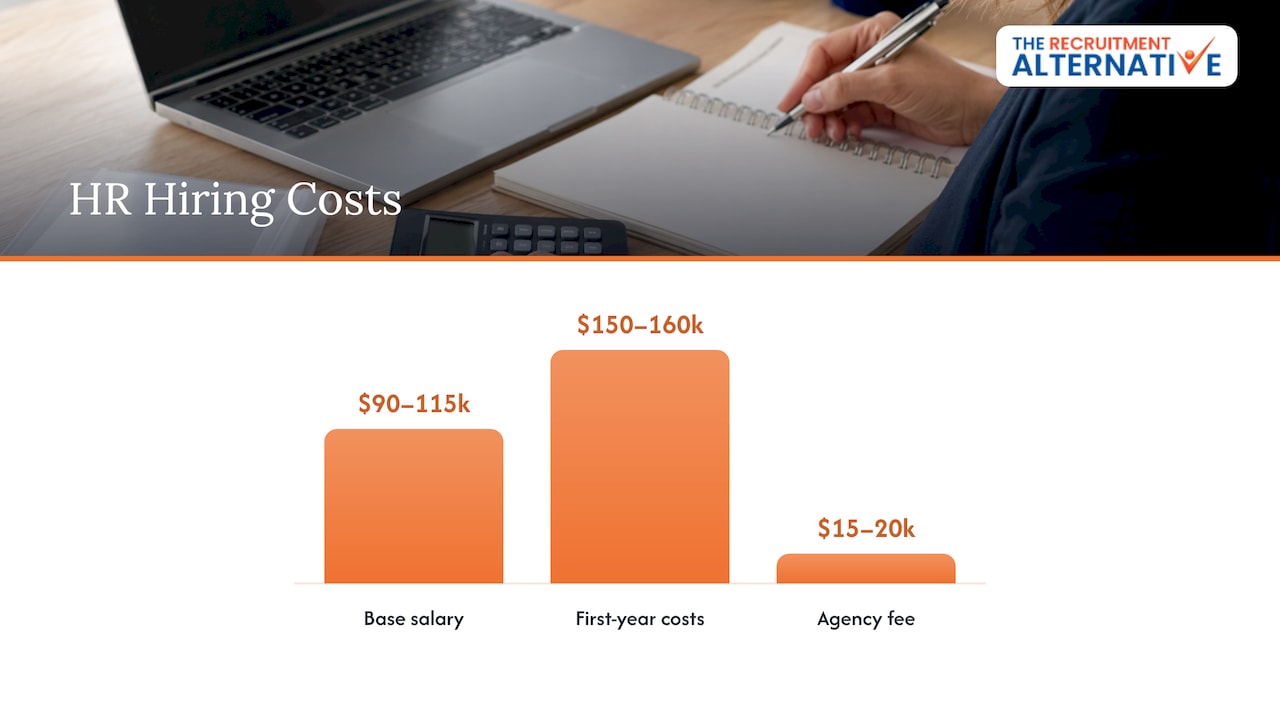
For a mid-market Australian SME, a realistic base salary is $90,000 to $115,000, and the same source estimates first-year costs of $150,000 to $160,000 once superannuation, leave, recruitment and onboarding are included. Treat these as planning figures. Your actual number will depend on city, industry and the scope of the role.
Build your budget from these parts:
| Cost item | What to allow for |
|---|---|
| Base salary | Set by role scope and location |
| Superannuation | Mandatory, 12% from 1 July 2025 |
| Leave liabilities | Annual leave accrues from the first day |
| Recruitment | Agency fee, advertising or your own time |
| Onboarding and ramp-up | Weeks of reduced productivity, tools and training |
Recruitment is the line most employers overpay. The same source puts traditional agency fees at 15% to 20% of base salary. On a $100,000 salary that is $15,000 to $20,000 before the person starts. Our own breakdown in the cost to hire an employee in Australia goes through the other costs in more detail. Any specialist hire is easier to approve when you know the full figure, and it helps to compare what it costs to hire a specialist in other functions so your HR budget sits in context.
Where to find HR manager candidates
You have four main routes:
- Job boards. Wide reach, but expect a large volume of applications to screen. Searching for HR manager roles in a capital city often returns dozens to hundreds of live vacancies, so you are competing for attention.
- Your network and referrals. Fast and cheap, but narrow, and it can limit diversity of experience.
- A percentage-based agency. Broad access to candidates, with a fee tied to salary.
- A flat fee agency. The same kind of search and screening, with a fixed price whatever the salary within the band.
HR candidates are often employed and not actively applying, which is where direct sourcing by a recruiter helps. If you are weighing the options for a small team, our affordable recruitment for small business guide explains how each route works.
How to assess candidates
HR is a field where candidates are skilled at interviewing, so a loose chat favours the smoothest talker. Use structure. Structured interviews, where every candidate gets the same predefined questions and is scored against objective criteria, help reduce bias and make comparison fair. The same guide notes that giving every interviewee timely, specific feedback in a standard format is likely to increase accountability for hiring decisions.
A simple process:
- Screen by phone for 15 to 20 minutes against the essentials in your position description. Our candidate screening questions script gives you a ready format.
- Hold a structured first interview with a scorecard completed straight after.
- Add a practical task, such as reviewing a draft warning letter or an anonymised award interpretation question.
- Meet a shortlist of two or three with the owner and one other senior person.
- Check references and make the offer.
Interview questions that reveal capability
Good questions go beyond technical knowledge to test business alignment. Asking what they would focus on in their first 90 days and how they would measure success in business terms is a useful start. Other questions suited to a small business:
- Describe a performance issue you managed from first concern to resolution. What did you document and when?
- A manager wants to dismiss an employee tomorrow. What do you do first?
- How would you build an onboarding process from nothing, with no HR budget in the first quarter?
- Tell me about a time you disagreed with a senior leader on a people matter. What happened?
- Which HR metrics would you report to the owner each month, and why?
Score every answer on the same scale, such as 1 to 5, against what a strong answer contains. Psychometric tools can add another data point on working style. We offer a psychometric evaluation at $199 per candidate as an add-on.
Checks before you make an offer
Because an HR manager handles confidential employee records, grievances and sometimes payroll data, thorough checks are reasonable. Typical checks include:
- Two or three referees, ideally including a recent direct manager, asked the same questions you asked at interview
- Verification of qualifications and any AHRI membership claimed
- Confirmation of the candidate’s right to work in Australia
- A criminal history check where it is relevant to the role and the candidate has consented
If you want a check run for you, we offer an optional criminal check at $129. Whichever checks you use, tell candidates in advance what you will do and why, and apply the same checks to every finalist. For sensitive questions about what you can lawfully ask or rely on in a particular state, confirm the position with an employment lawyer or the Fair Work Ombudsman before acting.
Making the offer and onboarding
Put the offer in a signed employment contract. A sound contract covers the position and duties, employment status and hours, pay, leave, confidentiality, intellectual property, and termination and notice. Our guide on how to create an employment contract in Australia walks through the sections in order.
Onboarding should include any required policies, a position description, a clear reporting line and probation review dates. It should also set expectations on reporting lines, review dates and workplace standards, including hours and communication.
For an HR manager specifically, add these:
- Week 1: introductions to every team and the owner’s priorities for the role
- Weeks 2 to 4: an audit of contracts, policies, awards in use and employee records, with no changes made yet
- By day 60: a short priority list of risks and fixes, agreed with the owner
- By day 90: a review against the success measures you discussed at interview
The new hire will be setting the standard for how every later employee is onboarded, so give them the access and authority to do it properly.
Perspective: why we think flat fees suit this hire
We recruit permanent staff for small and mid-sized businesses across Australia and New Zealand, and HR hires have a common pattern. The owner has been carrying people work for years, the decision to hire is made reluctantly, and the recruitment fee is the first shock.
A percentage fee ties the cost of finding someone to the salary of the person found. For a role like HR manager, that can mean a five-figure bill before the first day. We built our model on the view that the work of searching, screening and shortlisting does not change much with salary, so the price should not either.
Our approach is a transparent fixed fee, structured as an engagement fee and a placement fee, with candidate replacement cover if a hire does not work out in the first two to three months. We claim savings of over 70% compared with traditional commission-based agencies. Employers know the cost at the outset, and that lets them put the savings into salary, onboarding or the tools their new HR manager needs.
Our advice is to treat the HR manager hire as a business decision, not an administrative one. Write the scope clearly, interview with structure, and spend your recruitment budget on finding the right person rather than on commission.
Josh Townsend
What a flat fee costs with us
We offer two permanent recruitment services, and which one suits you depends on the role and how much search support you want. Full details are on our flat fee pricing page.
| Service | Engagement fee | Placement fee |
|---|---|---|
| Recruit | $895 | $3,900 to $5,000 |
| Recruit+ | $2,495 | $5,000 to $6,000 |
The placement fee is paid only on a successful permanent placement, and the figure within each range depends on the candidate’s salary. Optional extras are the criminal check at $129 and the psychometric evaluation at $199 per candidate. If the hire leaves in the early months, a replacement campaign costs $1,000. For the thinking behind the engagement fee, see our page on engagement fee recruitment.
Hiring an HR manager with The Recruitment Alternative
If you want help finding an HR manager without a percentage fee, our fixed fee recruitment service is built for small and mid-sized businesses in Australia and New Zealand. We handle sourcing and screening, and you make the final decision with a shortlist in front of you.
If the role is senior, such as a head of people reporting directly to the board, our executive recruitment services cover that level. For other management hires, see management recruitment made easy.
Common mistakes to avoid
- Hiring for the title, not the problem. Define whether you need compliance, culture, recruitment or all three.
- Skipping the scorecard. Without one, the most confident candidate tends to win.
- Underbudgeting the first year. The salary is only part of the cost.
- Giving no authority. An HR manager who cannot influence managers cannot fix anything.
- Leaving onboarding to chance. The first 90 days decide whether the hire sticks.
FAQ
How much does it cost to hire an HR manager in Australia?
For a mid-market SME, a base salary of about $90,000 to $115,000 is realistic, and first-year costs can reach $150,000 to $160,000 including super, leave, recruitment and onboarding. Recruitment is the part you can control most. With our Recruit service it is an $895 engagement fee plus a placement fee of $3,900 to $5,000.
What should an HR manager job description include?
Include the purpose of the role, the HR tasks they will own, the reporting line, essential experience and knowledge, and the measures of success. Essentials usually include around five years of HR experience and working knowledge of the Fair Work Act, modern awards and WHS law. Keep desirable items such as AHRI membership separate.
How long does it take to hire an HR manager?
Timeframes vary with the seniority of the role, your notice period expectations and how quickly you interview. Candidates who are currently employed usually need to serve notice, so allow for that on top of the search. Ask your recruiter for a timeline at the start.
Should a small business hire an HR manager or outsource HR?
If judgment-heavy HR work is constant, a dedicated hire gives you someone who knows your people and business. If the workload is occasional, a contractor or part-time arrangement may fit better. Whichever you choose, define the scope first.
Sources
- HR Manager: Role, Responsibilities, and Tools | FirstHR
- HR Manager Job Description (Australia)
- How to hire an HR manager | HumanX
- How to become a human resources manager in Australia
- The True Cost of a People and Culture Manager in Australia
- A guide to inclusive recruitment for line managers | CIPD
- HR director interview questions | HiBob
- HR Management in Australia | Sprintlaw
- How Much Does It Cost to Hire a Google Ads Specialist?

