
Australian employers are hiring across every trade, and the shortage is worst in bricklaying, ceramic tiling, carpentry and roofing, according to the Housing Industry Association’s September quarter 2026 research. If you run a small business, that means good tradespeople have choices. To hire one, you need a clear role, a wide search, a fair assessment and a fast offer. This guide covers where demand sits, what the compliance basics are, and how to run a hiring process that a small team can manage.
TL;DR
- Shortages cover all trades, with the sharpest pressure in bricklaying, tiling, carpentry and roofing, and in regional Queensland, regional South Australia, Brisbane and Perth.
- Recruitment difficulty for technicians and trades workers sat at 64% in early 2025, so plan for a longer search than you would for an office role.
- Advertise widely, score applicants against fixed criteria, and check licences and work rights before you make an offer.
- A flat-fee agency can cost far less than a percentage of salary. Our Recruit service is $895 to engage plus a $3,900 to $5,000 placement fee.
- Apprentices follow different rules from qualified tradespeople, so decide which you need first.
Table of Contents
- Which trades are Australian employers hiring for?
- Where demand is strongest
- Decide what you are hiring: tradesperson or apprentice
- Write a role definition that attracts the right people
- Where to find skilled trades candidates
- Assess applicants fairly and quickly
- Licences, contracts and compliance
- What a small business can offer to compete
- Our perspective
- What flat-fee recruitment costs for a trades hire
- Ready to hire a tradesperson?
- FAQ
- Sources
Which trades are Australian employers hiring for?
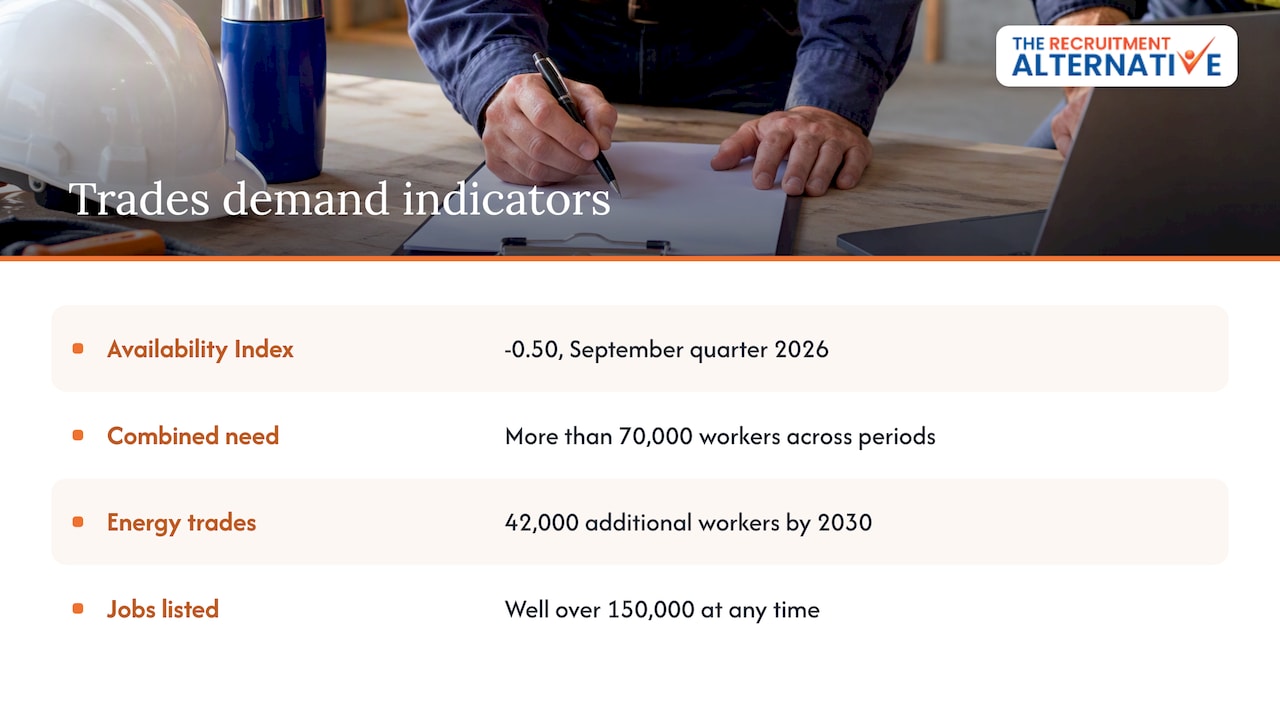
The short answer: all of them. The HIA reports that its Trades Availability Index stood at -0.50 in the September quarter 2026, which reflects continuing shortages of skilled tradespeople. It names bricklaying, ceramic tiling, carpentry and roofing as the most affected, and points to renovations, public infrastructure and data centres as sources of extra demand (HIA, September quarter 2026).
Electrical work is under particular strain. Powering Skills Organisation figures reported by Construction Australia add up to a combined requirement of more than 70,000 workers across different periods, including 42,000 additional energy trades workers by 2030. The same report says interest in electrical apprenticeships is high, but growth is limited by how many apprenticeship positions can be created and by training capacity (Construction Australia, 2026).
For a small business owner, the practical reading is simple. Whether you need a carpenter, electrician, plumber or tiler, you are competing with larger builders and infrastructure projects for the same people. The job boards confirm it: Workforce Australia lists well over 150,000 jobs at any time, with construction trades roles added constantly.
Where demand is strongest
The HIA says shortages are most acute in regional Queensland, regional South Australia, Brisbane and Perth. If you hire in those places, expect fewer applicants and more competition for each one.
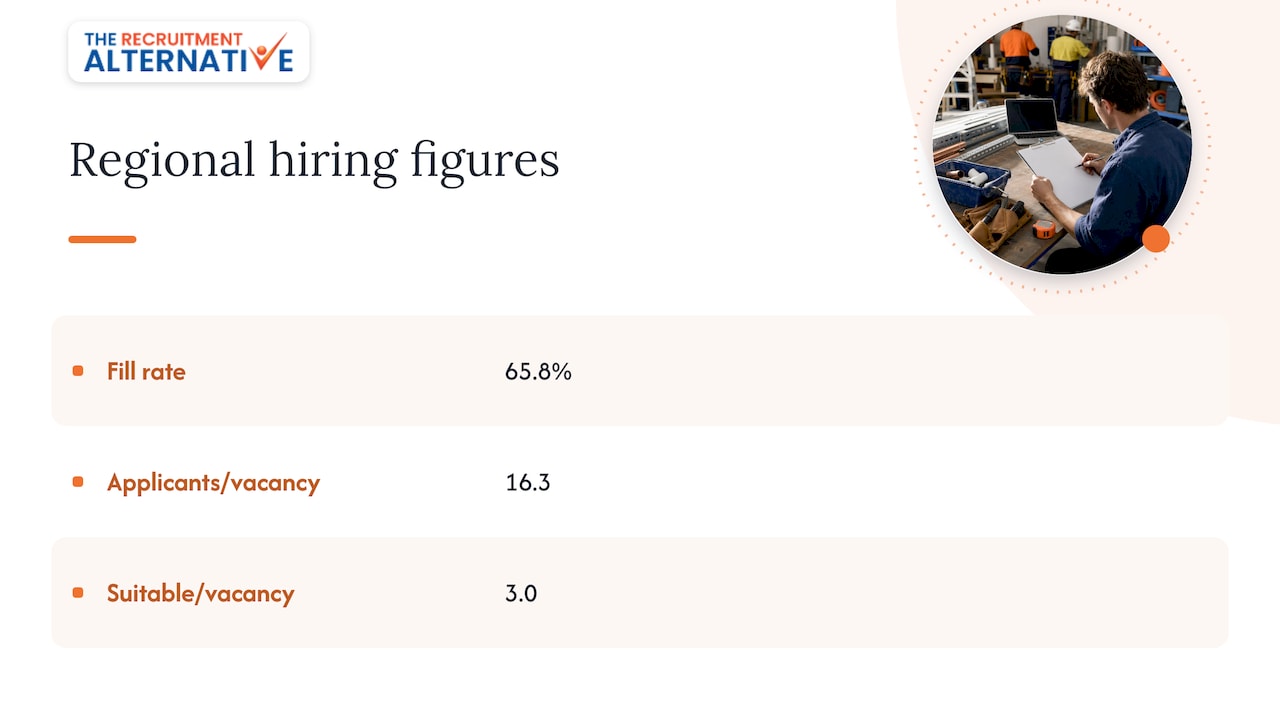
Regional data from the Jobs and Skills Australia Occupation Shortage Report for the June quarter 2025 shows what that looks like in practice. In regional areas the vacancy fill rate was 65.8%, with 16.3 applicants per vacancy but only 3.0 suitable applicants per vacancy. That gap between applicants and suitable applicants is the real hiring problem: a long applicant list does not mean a short shortlist.
Jobs and Skills Australia also found that recruitment difficulty for technicians and trades workers remained elevated at 64% in February 2025, a slight improvement from 73% a year earlier (REOS Spotlight). Even with that improvement, roughly two in three employers recruiting in these occupations found it hard.
If you hire outside the capitals, our guide to regional recruitment for SMEs covers the extra steps worth taking, and our overview of the Australian skills shortage explains the wider picture.
Decide what you are hiring: tradesperson or apprentice
These are two different hiring jobs with different rules.
A qualified tradesperson is hired as an employee on the applicable award or agreement. Awards set minimum wages and conditions, including hours, allowances, penalty rates and overtime.
An apprentice needs a registered training contract and a negotiated training plan that the registered training organisation (RTO) endorses and the apprentice agrees to. Pay and entitlements still follow the relevant award or agreement (Fair Work Ombudsman guide to taking on an apprentice).
If you cannot take on the full employment load of an apprentice, business.gov.au notes that a group training organisation employs the apprentice and carries responsibility for wages, allowances and superannuation while placing them with you as a host employer (business.gov.au). That route suits a small business with steady but limited work.
Many owners need both over time: a qualified lead hand now and an apprentice to build the pipeline. Hire the experienced person first, because they can supervise the apprentice.
Write a role definition that attracts the right people
Tradespeople read adverts quickly and they judge them on specifics. business.gov.au says an advertisement should be non-discriminatory and include wage details, benefits, location, start and closing dates, contact details and application instructions (business.gov.au).
For trades, add the things candidates actually ask about:
- The licence or ticket required, and which are only desirable.
- The type of work: residential, commercial, civil, maintenance.
- Whether a vehicle, tools or phone are supplied.
- Typical hours, travel and site locations.
- A pay range, not just “competitive”.
The Australian Human Rights Commission recommends separating essential from desirable criteria, making sure each criterion is genuinely required for the job, and deciding in advance how each will be assessed (AHRC recruitment and selection guidelines). That discipline also helps you. A role that lists ten “essentials” will exclude capable people who have nine.
Our trade staff recruitment best practices guide goes deeper on wording and sequencing.
Where to find skilled trades candidates
No single channel works. The Australian Government’s Australian Jobs 2025 report found that in 2024 about three-fifths of recruiting employers advertised on internet job boards and just over one-fifth used social media. Regional employers used social media and word of mouth more than major-city employers, while major-city employers leaned on job boards (Australian Jobs 2025).
Business.gov.au lists a spread of routes: job websites, Workforce Australia, your own website or mailing list, networks, social media, industry newsletters, trade journals, newspapers and university job boards. The Human Rights Commission adds informal networks, community groups and industry groups as ways to widen the applicant pool.
A workable plan for a small trades business:
- Ask your own crew first. Good tradespeople know other good tradespeople.
- Post on a major job board and on Workforce Australia, which is free for employers according to the NSW Government’s apprentice hiring guide.
- Use social media and local groups if you are regional, where word of mouth carries more weight.
- Contact suppliers and trade-association contacts, who often hear who is looking for a move.
- Bring in an agency when the role is urgent, senior, or you have no time to screen.
Assess applicants fairly and quickly
Business.gov.au recommends a simple matrix: list candidates across the top and requirements down the side, score each requirement from 1 to 5, then total the scores to pick who to interview. Shortlist those with the right qualifications, who fit the organisation and its culture, have aligned goals and can work in Australia. Check references before making an offer (business.gov.au).
The Human Rights Commission also recommends documenting your shortlisting decisions and the reasons for them. It takes ten minutes and protects you if a decision is questioned.
For trades, add a practical layer to the interview:
- Ask the candidate to walk through a recent job, from quote to handover.
- Ask how they handle a defect found after they have left site.
- Sight licences, tickets and white cards, and confirm they are current with the issuing body.
- Confirm work rights.
The NSW Government advises assessing motivation and a realistic understanding of the trade and workplace, not just technical experience. That matters most for apprentices, but it applies to any hire who will be working unsupervised on your customers’ properties.
If applications arrive in high volume, recruitment automation tools can take on first-round screening and structured questions, which frees your time for the site interviews that count.
Licences, contracts and compliance
Licence rules differ by state, territory and activity, so check with your state licensing body before you advertise. Business.gov.au says the licences and permits a business needs depend on its type and activities, the state or territory and the local government area, and its ABLIS tool helps you find them (business.gov.au guide to starting a business).
Two compliance points catch small trade businesses out:
- Employee or contractor. Employers must distinguish between the two. Treating an employee as a contractor to avoid responsibilities is illegal sham contracting (business.gov.au). If someone works your hours, uses your tools and takes your direction, get advice before calling them a contractor.
- Award compliance. Pay at or above the award, and include allowances and overtime where they apply.
Put the offer in writing. Our guide to creating an employment contract in Australia sets out what to include.
What a small business can offer to compete
You will rarely win on pay alone against a major infrastructure contractor. You can win on other things:
- Speed. Interview within days and decide within a week. Slow offers lose trades candidates to faster employers.
- Clear pay and progression. State the range and what it takes to move up.
- Training. Offer a ticket, licence upgrade or supervisor course.
- Predictable work. Tell candidates how many months of work are in the pipeline.
- A named supervisor. People stay for good leads.
Our hiring challenges guide and trades recruitment process walk through the steps from brief to start date.
Our perspective
Most small trade businesses we speak to are not short of effort. They are short of time. The owner is on site all day, the advert goes up on a Sunday night, and fifty applications arrive that nobody has time to read.
We built our flat-fee model for exactly that owner. A percentage fee on a tradesperson’s salary adds up quickly, and it rises every time wages do. A fixed fee does not. You know the cost before you start, and it is the same whether the candidate earns at the bottom or the top of the band.
Our advice is to treat the hire as a project with a deadline. Fix the role, decide the pay range, screen against the same criteria for every applicant and make the offer while the candidate is still interested. Where a hire does not work out in the first months, our replacement option exists so you are not starting from zero.
We recruit permanent staff across trades, engineering, administration, finance, technology, healthcare and more, and we work with businesses of all sizes across Australia. Trades hiring is where a clear process and a predictable fee make the biggest difference.
Josh Townsend
What flat-fee recruitment costs for a trades hire
Our published pricing has two parts: an engagement fee to start the search and a placement fee when you hire someone. The fee depends on the candidate’s salary, not a percentage of it.
| Service | Engagement fee | Placement fee |
|---|---|---|
| Recruit | $895 | $3,900 to $5,000 |
| Recruit+ | $2,495 | $5,000 to $6,000 |
Optional extras are a criminal check at $129 and a psychometric evaluation at $199 per candidate. If a hire does not work out, a replacement campaign costs $1,000. Check the flat fee pricing page for the current figures and which tier fits your salary band, and see what the engagement fee covers.
For comparison, we claim savings of over 70% against commission-based agencies. Work out your own number by taking your expected salary, applying the percentage a traditional agency quotes, and comparing it with the fixed totals above.
Ready to hire a tradesperson?
If you have a trades role open and no time to chase applicants, we can run the search for a fixed fee. We source candidates, screen them against your brief and put forward people who match, across Australia and New Zealand. See how fixed fee recruitment works or read about our replacement protection if a hire leaves in the first few months.

For employers who want the full picture before committing, our guide to recruitment for trades industries is the next read.
FAQ
Which trades are hardest to hire in Australia right now?
The HIA names bricklaying, ceramic tiling, carpentry and roofing as the most affected, although shortages exist across all trades. Electrical work is also under pressure because of data centres, housing and energy projects. Shortages are sharpest in regional Queensland, regional South Australia, Brisbane and Perth.
How long does it take to hire a tradesperson?
There is no fixed timeline, and it depends on the trade, location and how quickly you decide. Official data shows recruitment difficulty for trades workers at 64% in early 2025, so allow for a longer search than for an office role. Fast interviews and clear offers shorten it more than anything else.
Do I need to check licences when hiring a tradesperson?
Yes. Licence and permit requirements depend on the activity, state or territory and local area, so check with your state licensing body and use the ABLIS tool on business.gov.au. Sight the licence or ticket and confirm it is current before the person starts work.
Is it cheaper to use a flat-fee agency than a percentage agency?
Often, because the fee does not rise with salary. Our Recruit service is $895 to engage plus a $3,900 to $5,000 placement fee, and Recruit+ is $2,495 plus $5,000 to $6,000. Compare those totals with the percentage quoted on your expected salary.
Can I hire an apprentice instead of a qualified tradesperson?
Yes, but it is a different process. You need a registered training contract and a training plan endorsed by the RTO, and you must pay the award rate. A group training organisation can employ the apprentice and place them with you if you prefer not to be the direct employer.
Sources
- Trades shortages persist as work on the ground remains solid, HIA
- PSO workforce update 2026, Construction Australia
- Occupation Shortage Report, June quarter 2025, Jobs and Skills Australia
- REOS Spotlight: Shifting recruitment trends, Jobs and Skills Australia
- Guide to taking on an apprentice, Fair Work Ombudsman
- Hire an apprentice or trainee, business.gov.au
- Interview and recruit employees, business.gov.au
- Guide to starting a business, business.gov.au
- Recruitment and selection guidelines, Australian Human Rights Commission
- Steps to employ an apprentice or trainee, NSW Government
- Australian Jobs 2025, Australian Government

