

Hiring your first employee in a small business is a legal and operational commitment that requires specific preparation before anyone starts work. The process, formally known as employment engagement, covers everything from identifying the correct Modern Award under the Fair Work Act to obtaining workers’ compensation insurance and issuing mandatory documentation. Get it right and you gain a loyal, productive team member who helps your business grow. Get it wrong and you face penalties, disputes, and costly turnover. This guide covers every critical step for small business owners in Australia and New Zealand.
How do you know when your small business is ready to hire its first employee?
Readiness to hire comes down to three factors: workload, finances, and operational need. A reliable signal is when a repeatable business function consumes 15 or more hours weekly and requires consistency that a contractor simply cannot provide. Think of tasks like customer service, bookkeeping, or production work that need someone invested in your business long term.
Financial readiness matters just as much. You need at least six months of salary in cash reserves before you commit to an employment contract. The fully loaded first-year cost of an employee runs at 112–140% of base salary when you factor in superannuation, leave entitlements, training, and equipment. That figure surprises most first-time employers, so budget for it early.
The typical timeline from deciding to hire through to having a productive employee in the role is around four to five months. That includes writing the job description, advertising, screening, interviewing, completing compliance steps, and onboarding. Plan for that lead time rather than hiring in a panic.
Contractors versus employees is a distinction worth understanding before you advertise. Contractors suit project-based or specialist work with no ongoing obligation. Employees suit roles requiring loyalty, confidentiality, and day-to-day direction. Misclassifying an employee as a contractor exposes you to back-pay claims and Fair Work penalties.
Key readiness signals to assess:
- A core function is consuming more than 15 hours of your week consistently
- You need someone who can be directed, trained, and held to your standards
- You have six months of salary in reserve beyond your operating costs
- The role requires continuity of knowledge that a rotating contractor cannot hold
- Your business has a stable enough revenue base to absorb the fully loaded cost
Pro Tip: Before advertising, write down exactly what the role will do in its first 90 days. If you cannot fill a page, the role is not defined enough to hire for yet.
What are the legal and compliance requirements for your first hire in Australia and New Zealand?
Legal compliance is the foundation of small business employee hiring, not an afterthought. HR in Australia and New Zealand is fundamentally a legal risk management function. Treating it as paperwork is how owners end up in the Fair Work Commission or facing a personal grievance claim.
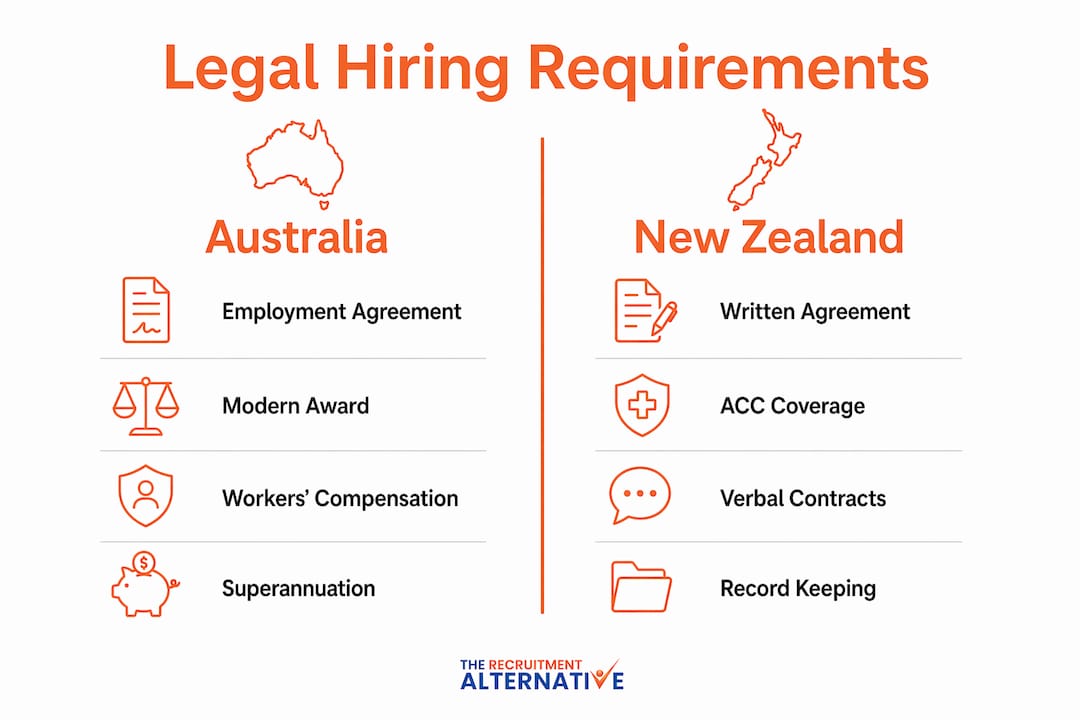
The table below summarises the core obligations by jurisdiction:
| Requirement | Australia | New Zealand |
|---|---|---|
| Employment agreement | Recommended in writing; mandatory for casuals | Written agreement mandatory before work starts |
| Tax declaration | TFN declaration form | IR330 tax code declaration |
| Superannuation / retirement | 12% employer super contribution | 3% minimum KiwiSaver employer contribution |
| Workers’ insurance | State-based workers’ compensation | ACC levies |
| Work rights verification | VEVO check for non-citizens | Passport or visa verification |
| Payroll reporting | Single Touch Payroll (STP) via compliant software | Payday filing to Inland Revenue |
| Record-keeping | Minimum 7 years | Minimum 7 years |
| Trial period | Probation period (contractual, typically 3–6 months) | 90-day trial period for employers under 20 staff |
In Australia, identifying the correct Modern Award is the first step. Awards set minimum pay rates, penalty rates, and allowances for specific industries and roles. Good intentions do not protect you from underpayment claims if you have classified the role incorrectly. Use the Fair Work Ombudsman’s Pay and Conditions Tool to confirm the applicable Award before you set a salary.
Workers’ compensation insurance and ACC coverage must be arranged before your employee starts. Failure to have cover in place exposes you to personal liability from day one. In Australia, cover is state-specific, so a Queensland business uses WorkCover Queensland while a Victorian business uses WorkSafe Victoria. In New Zealand, ACC levies apply automatically but must be factored into your payroll costs.
Superannuation in Australia requires you to pay the 12% employer contribution at the same time as wages using STP-compliant payroll software. You must also check the employee’s stapled super fund via the ATO to avoid opening a duplicate account. For a full breakdown of current super rules, the superannuation changes guide from The Recruitment Alternative is a useful reference.
In New Zealand, written employment agreements are mandatory and must be signed before the employee starts work. Verbal contracts risk penalties. The 90-day trial period is only available to employers with fewer than 20 staff, and the clause must be explicitly included in the signed agreement before the first day of work. Misuse of the trial period or incorrect contract timing invalidates it entirely and exposes you to a personal grievance claim.
Pro Tip: Casual employees in Australia require both the Fair Work Information Statement and the Casual Employment Information Statement. Missing either document removes a key legal protection for your business.
Australian employers must also keep employment records for 7 years and verify work rights for non-citizens via the VEVO system. Non-compliance can trigger audits and significant penalties.
How should a small business plan, recruit, and select its first employee?
A clear job description is the foundation of effective small business employee hiring. It defines the role, sets expectations, and filters unsuitable applicants before you spend time on interviews. Include the specific responsibilities, required skills, reporting structure, location, and a realistic salary range. Vague job ads attract vague applicants.

Where you advertise shapes who applies. Seek and LinkedIn remain the dominant platforms in Australia and New Zealand for most roles. Leveraging social media through LinkedIn posts, Facebook community groups, and Instagram can extend your reach without significant cost. For trade and technical roles, industry-specific job boards often outperform general platforms.
Screening and selection steps that work:
- Review applications against the specific criteria in your job description, not general impressions
- Phone screen shortlisted candidates before committing to face-to-face interviews
- Use structured interview questions that ask for specific past examples, not hypothetical answers
- Conduct thorough reference checks with at least two referees who have directly managed the candidate
- Verify qualifications and work rights before making an offer
Legal considerations in recruitment are often overlooked by first-time employers. You cannot ask about age, family plans, religion, or disability during interviews. Stick to questions directly relevant to the role. Unconscious bias in shortlisting is a real risk and structured scoring criteria reduce it significantly.
Recruitment method comparison:
| Method | Cost | Speed | Compliance support |
|---|---|---|---|
| In-house (DIY) | Low upfront | Slower | None |
| Recruitment agency (flat-fee) | Fixed, predictable | Faster | Included |
| Traditional agency (commission) | High (percentage of salary) | Fast | Varies |
| Employer of Record (EOR) | Ongoing fee | Fast | Full |
For most small businesses hiring their first employee, a flat-fee recruitment agency delivers the best balance of cost, speed, and compliance guidance. The fixed cost is predictable and the agency handles sourcing, screening, and reference checks, freeing you to focus on running your business.
What does an effective onboarding process look like for your first employee?
Structured onboarding programmes can boost employee retention by up to 82%. Skipping a formal onboarding plan increases turnover risk by 20% within the first 45 days. For a small business, losing your first hire within two months is a significant financial and operational setback.
A practical onboarding sequence for your first hire:
- Before day one: Set up their workstation, email, and system access. Send a welcome message with what to expect on the first day.
- Day one: Provide the Fair Work Information Statement (and Casual Employment Information Statement if applicable). Complete all tax and super paperwork. Give a tour and introduce the team.
- Week one: Walk through core processes, tools, and expectations. Assign a simple task they can complete successfully to build confidence.
- Weeks two to four: Increase responsibility progressively. Schedule daily check-ins to catch confusion early.
- 30-day review: Conduct a formal conversation about performance, questions, and any adjustments needed.
- 90-day review: Assess whether the role is working as designed and set goals for the next quarter.
Setting clear performance expectations from day one prevents the most common onboarding failure: the employee not knowing what success looks like. Write down the three to five outcomes you expect in the first 90 days and share them in writing on the first day.
Integrating your new hire into your company culture matters as much as the technical training. Introduce them to your suppliers, explain your values, and include them in decisions where appropriate. People who feel part of something stay longer.
Pro Tip: Do not wait for the 90-day review to address performance concerns. If something is not working in week two, address it directly and document the conversation. Early feedback is far less disruptive than a formal performance process later.
How do ongoing compliance and employee management duties affect small business employers?
Ongoing compliance is not a one-time task. It is a regular obligation that small business owners must build into their operations from the first pay run.
Key ongoing obligations to manage:
- Pay superannuation contributions at the same time as wages using STP-compliant payroll software, not quarterly. Late super payments attract the Superannuation Guarantee Charge.
- Run payroll through Single Touch Payroll in Australia or payday filing in New Zealand. Both systems report wages and tax to the relevant authority in real time.
- Keep accurate records of hours worked, leave taken, and pay rates for a minimum of seven years.
- Review pay rates annually when Modern Award rates increase, typically on 1 july each year in Australia.
- Follow the Small Business Fair Dismissal Code if you need to terminate employment. The Code protects businesses under 15 employees from unfair dismissal claims in the first 12 months, provided you follow procedural steps including documented warnings.
Performance management is where many first-time employers struggle. Address issues early, document every conversation, and give the employee a genuine opportunity to improve before escalating. In New Zealand, the 90-day trial period allows you to end employment without a personal grievance claim, but only if the contract was correctly signed before the start date.
Workplace safety is a legal obligation under Work Health and Safety laws in Australia and the Health and Safety at Work Act in New Zealand. Conduct a basic risk assessment before your employee starts. Identify hazards, put controls in place, and document both. Mental health is also a workplace safety issue. Check in regularly and create an environment where concerns can be raised without penalty.
Outsourcing payroll processing for a small business with 1–5 employees costs $150–$500 per month. That cost buys compliance with STP, super, and leave management with significantly less risk than managing it manually.
Key takeaways
Hiring your first employee in a small business requires legal compliance, financial preparation, structured recruitment, and a formal onboarding process to succeed from day one.
| Point | Details |
|---|---|
| Assess readiness before advertising | Confirm 15+ hours of repeatable weekly work and six months of salary in cash reserves. |
| Complete compliance before day one | Arrange workers’ insurance, identify the correct Award or agreement, and prepare all mandatory documentation. |
| Use structured recruitment | Write a clear job description, screen consistently, and conduct thorough reference checks before making an offer. |
| Onboard with a written plan | Provide legal statements on day one and set clear 30-day and 90-day performance expectations in writing. |
| Maintain ongoing obligations | Pay super with wages, keep records for seven years, and follow dismissal procedures if issues arise. |
What I have learned from watching small businesses hire their first employee
The single biggest mistake I see is owners treating the first hire as a solution to their own workload rather than as a business investment. They rush the process, skip the compliance steps, and then wonder why the person leaves within three months or why Fair Work is calling.
The owners who get it right do something counterintuitive. They slow down before they speed up. They spend time writing a proper job description, confirming the correct Award, and setting up payroll before they even post the ad. That preparation takes two to three weeks but it saves months of pain later.
I have also seen owners underestimate the cost of a bad first hire. When you factor in the time spent recruiting, the salary paid during a failed probation, and the disruption to your operations, a poor hire in a small business can cost the equivalent of six to twelve months of that employee’s salary. That is not a risk you can afford to take lightly.
The other pattern worth naming is the reluctance to use professional support. Many owners see recruitment agencies or HR consultants as something only larger businesses need. The reality is the opposite. A first-time employer with no HR experience is exactly the person who benefits most from structured support. The cost of getting it wrong far exceeds the cost of getting help.
If you are preparing to make your first hire, invest in the process. Write the job description properly. Get the compliance right. Onboard with a plan. And if you are not confident in any of those steps, find someone who is.
— Josh Townsend
How The Recruitment Alternative helps small businesses make their first hire
Making your first hire is one of the most significant decisions you will make as a business owner. The Recruitment Alternative works specifically with small businesses across Australia and New Zealand to make that process straightforward and cost-effective.
Unlike traditional agencies that charge a percentage of salary, The Recruitment Alternative offers a flat-fee recruitment service that gives you full candidate sourcing, screening, and reference checks at a fixed, predictable price. For a small business making its first hire, that transparency matters. There are no surprise invoices and no percentage-based fees that scale with salary. The Recruitment Alternative’s affordable small business recruitment service covers roles across administration, sales, finance, technology, trades, and more, with consultants who understand the compliance obligations that come with hiring in Australia and New Zealand.
FAQ
When should a small business hire its first employee?
Hire when a repeatable function consumes more than 15 hours weekly and you have at least six months of salary in cash reserves. The fully loaded first-year cost runs at 112–140% of base salary, so financial readiness is critical.
What documents must I provide on an employee’s first day in Australia?
You must provide the Fair Work Information Statement to every new employee. Casual employees also require the Casual Employment Information Statement. Failing to provide these documents removes key legal protections for your business.
Is a written employment agreement required in New Zealand?
Yes. A written employment agreement is mandatory in New Zealand and must be signed before the employee starts work. Verbal contracts risk penalties, and any 90-day trial period clause must be included in the signed agreement before the first day.
What is the employer superannuation rate in Australia?
The current employer superannuation contribution rate in Australia is 12% of ordinary time earnings. Contributions must be paid at the same time as wages using STP-compliant payroll software, not quarterly.
Can I use a 90-day trial period in New Zealand?
Yes, if your business employs fewer than 20 staff and the trial period clause is explicitly included in the written employment agreement signed before the employee’s first day. Misuse or incorrect timing invalidates the clause and exposes you to a personal grievance claim.
Recommended
- Hiring Tips for Small Businesses – The Recruitment Alternative
- Small business hiring best practices: 2026 guide
- Insights gained from hiring the first 100 employees – The Recruitment Alternative
- Hiring new staff is a critical part of a company’s growth and doing it right is paramount to success. – The Recruitment Alternative

