

Most Australian agencies charge for permanent healthcare hires as a percentage of the candidate’s first-year salary, commonly around 15% to 25%, and more for hard-to-fill roles. A fixed-fee model replaces that percentage with a set price. For a clinic, aged care provider or allied health practice, that makes the cost of each hire known before the search starts. This guide explains how both models work, what sits inside a fee, what costs extra, and what to check before you sign.
TL;DR
- Percentage fees for permanent roles commonly sit around 15% to 25% of first-year remuneration, and there is no regulated or universal rate.
- A fee is only comparable once you know the salary basis, the payment timing and the replacement terms.
- Our fixed-fee Recruit service combines an $895 engagement fee with a $3,900 to $5,000 placement fee. Recruit+ combines $2,495 with $5,000 to $6,000.
- Optional extras such as a criminal check ($129) and a psychometric evaluation ($199 per candidate) are priced separately and published.
- Always ask what happens if the hire leaves in the first months, and what a replacement search costs.
Table of Contents
- How healthcare recruitment fees work in Australia
- What a percentage fee costs on common healthcare roles
- Fixed fee versus percentage fee
- How fees are calculated and when they are payable
- What is usually included, and what may cost extra
- Permanent placement versus temporary and contract staffing
- Guarantees and replacement terms to check
- What drives the price up or down
- A practical way to compare quotes
- Our perspective on healthcare recruitment pricing
- Hiring healthcare staff with a fixed fee
- Questions before you sign with any recruiter
- FAQ
- Sources
How healthcare recruitment fees work in Australia
There is no government schedule for recruitment fees. An agency sets its own rates, and you agree them in a terms of engagement before the search begins. That is why quotes for the same nursing or allied health role can differ widely between providers.
The common arrangement for permanent placement is a success fee: you pay when a candidate you hire accepts the role and starts. The fee is a percentage of the candidate’s annual package. TradieJobs’ overview of the Australian market puts the usual range at about 15% to 25% of first-year remuneration, with senior or hard-to-fill roles reaching 25% to 30% or more. It also notes that no universal rate exists.
Healthcare sits at the more demanding end of the market for a few reasons:
- Registration is mandatory for most clinical roles, so every shortlisted candidate needs credentials checked.
- Demand for nurses, allied health professionals and specialists outstrips local supply in many regions.
- Workforce supply is shaped by policy. The RCSA notes that healthcare staffing is particularly exposed to legislative and regulatory developments, including migration settings and workforce supply challenges.
All of that tends to push percentage quotes up, because a percentage grows with salary even when the recruiter’s work does not.
What a percentage fee costs on common healthcare roles
The table below is an illustration only. It applies the 15% to 25% range quoted above to round salary figures. These are not market salaries or quotes from any agency, and your own package will differ.
| Illustrative annual salary | Fee at 15% | Fee at 20% | Fee at 25% |
|---|---|---|---|
| $70,000 | $10,500 | $14,000 | $17,500 |
| $90,000 | $13,500 | $18,000 | $22,500 |
| $110,000 | $16,500 | $22,000 | $27,500 |
Two things stand out. First, the fee for a single hire can exceed a month or two of the salary itself. Second, the cost rises in step with the salary, so the more senior or specialised the role, the more you pay for the same recruitment process.
If you hire several clinicians a year, for example a practice adding two nurses and a practice manager, these amounts add up quickly. That is the situation fixed pricing is built for.
Fixed fee versus percentage fee
A fixed-fee agency prices the service, not the salary. You know the cost of the placement before you commit, and it does not climb when a candidate negotiates a higher package.
Our published structure at The Recruitment Alternative works like this. You choose between two service levels, Recruit and Recruit+. Each has an engagement fee paid to start the search and a placement fee paid when you hire. The full list is on our flat-fee pricing page.
| Service | Engagement fee | Placement fee | Total range per hire |
|---|---|---|---|
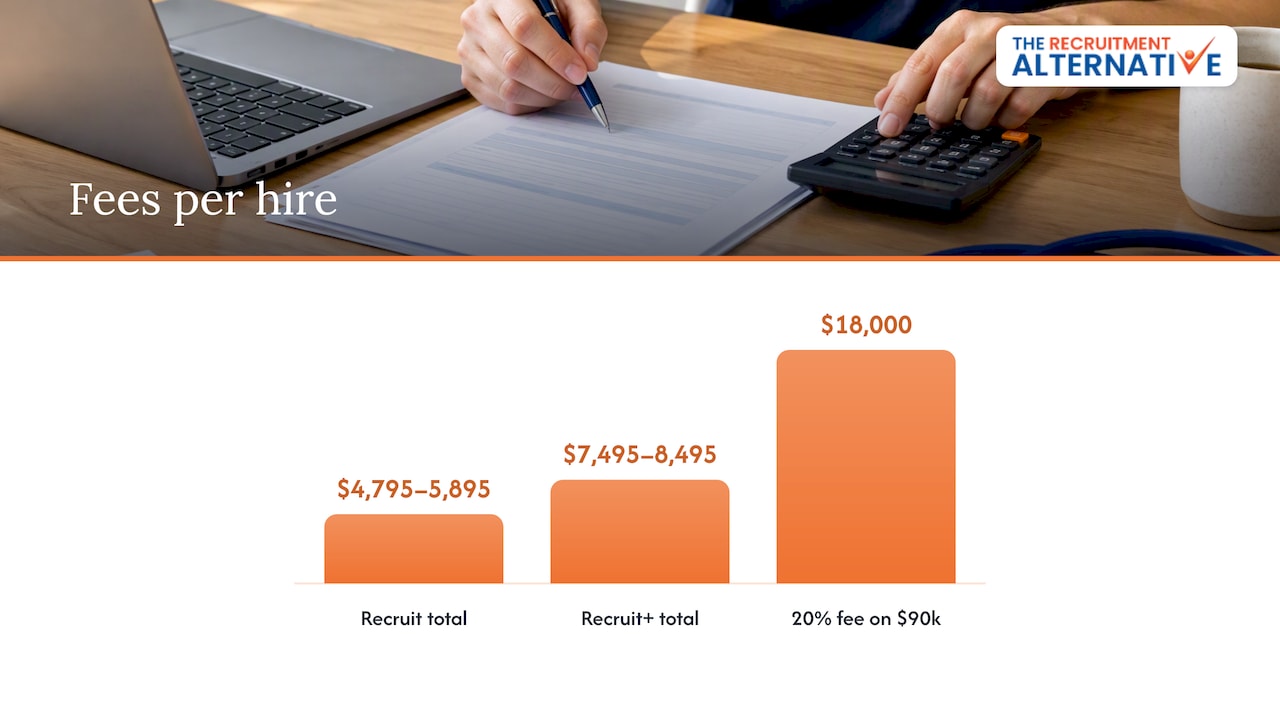
| Recruit | $895 | $3,900 to $5,000 | $4,795 to $5,895 |
| Recruit+ | $2,495 | $5,000 to $6,000 | $7,495 to $8,495 |
Compare these totals with the table above. On a $90,000 role, a 20% fee is $18,000. The same hire through Recruit comes to between $4,795 and $5,895. We claim cost savings of over 70% against traditional commission-based agencies, and the gap grows as salaries rise because our placement fee is set in a band rather than a percentage.
For a deeper look at the model itself, see our breakdown of flat-fee recruitment benefits and our comparison of 25% fees and fixed fees for permanent placements.
How fees are calculated and when they are payable
Before you compare any two quotes, pin down four points in writing.
The salary basis
Ask whether the percentage applies to base salary only or to total package. Superannuation, bonuses, car allowances and on-call or shift loadings can all be counted in some agreements. On a clinical role with penalty rates or allowances, the difference can be significant.
The payment trigger
Success fees are usually invoiced when the candidate accepts or starts. Retained or engagement-based models take part of the fee at the start of the search. Neither is better by default. An upfront component funds the active search work, while a success-only fee shifts all the risk to the agency and is often priced accordingly.
The payment terms
Check the invoice due date and whether the fee can be split. We explain the common arrangements in our guide to placement fee payment terms and four payment structures.
What counts as a placement
Some agreements charge if you hire a candidate the agency introduced within a set period, even if you did not use the agency for that specific role. Know how long that window runs and what it covers.
What is usually included, and what may cost extra
A healthcare recruitment fee generally covers the core search work: understanding the role, advertising, sourcing from a candidate network, screening, interviewing, shortlisting and supporting the offer. The sequence is laid out in our six-stage healthcare recruitment process.
The items that tend to sit outside the headline fee are:
- Pre-employment checks. Criminal history checks, reference checks beyond the standard, and pre-employment medicals.
- Assessments. Psychometric or skills testing for roles where fit and temperament matter, such as team leaders in aged care.
- Advertising costs. Premium job board placements or specialist media, when charged separately.
- Replacement searches. What you pay if the hire leaves.
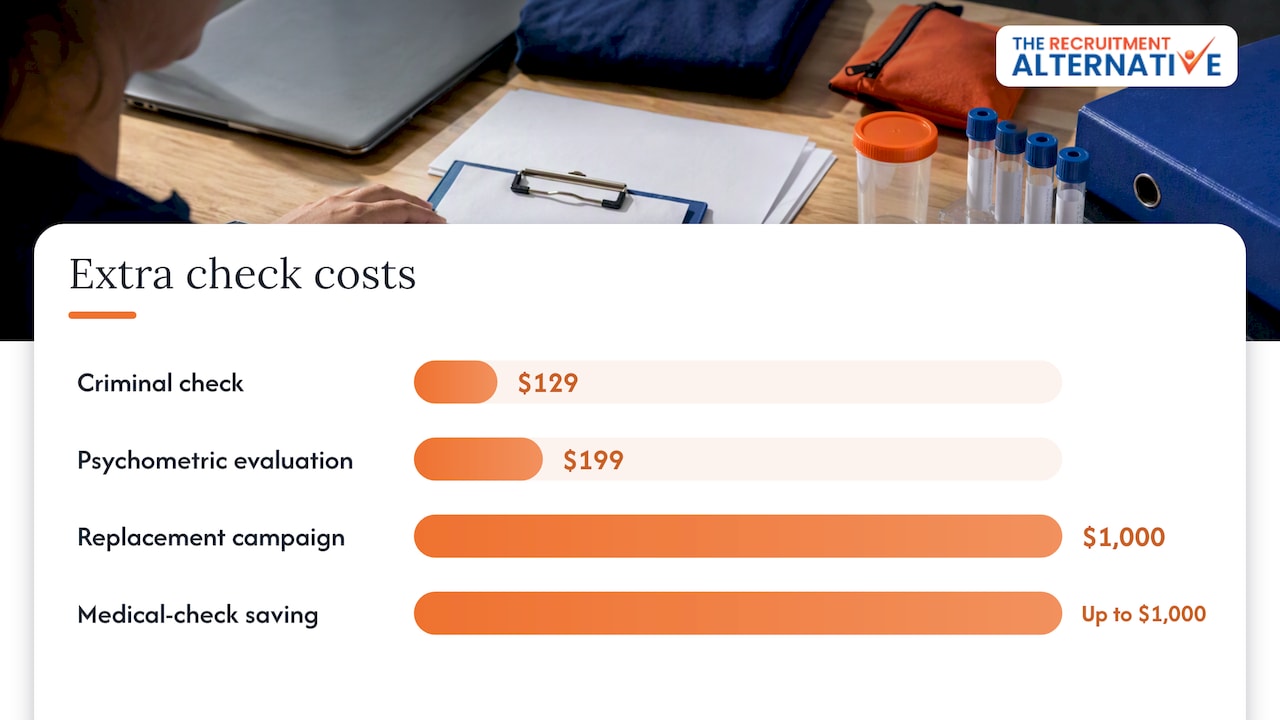
On our side, extras are published rather than negotiated. An optional criminal check is $129, and a psychometric evaluation is $199 per candidate. If a hire does not work out, a Replacement Campaign is $1,000, which we cover below.
Pre-employment medicals are one area where costs are moving. The RCSA reports that some Australian agencies use AI-powered screening tools to cut medical check costs, sometimes saving up to $1,000 per candidate. If your roles need medicals, ask whoever manages them how they are priced.
Permanent placement versus temporary and contract staffing
Permanent placement is a one-off fee for a person who joins your payroll. Temporary and contract staffing works differently. The agency employs or engages the worker and charges you an hourly rate that includes the worker’s pay plus the agency’s margin, for as long as the arrangement runs.
The practical consequences are:
- Permanent: a single fee per hire, then you carry the salary and on-costs. Cost per hire is the main number to manage.
- Temporary or contract: no large upfront fee, but a markup on every hour. Over many months, a long-running temp can cost more than a permanent placement.
- Temp-to-perm: many agreements include a conversion fee if you keep the worker on. Read that clause before you start the assignment.
If you need cover for leave or a short project, our temporary recruitment service is the right starting point. If you need a long-term team member, permanent placement is usually the better-value route. Our guide on what permanent recruitment involves explains the difference in more detail.
Guarantees and replacement terms to check
A fee is only good value if it is protected when a hire does not stay. Healthcare placements can fail for reasons nobody predicted: a registration delay, a poor team fit, a relocation that falls through. Read the guarantee clause as carefully as the fee.
Ask these questions:
- How long is the guarantee period, and does it start at the offer or the first day of work?
- Does it cover resignation, dismissal, or both?
- Is the replacement free, discounted or charged at a flat rate?
- Are there conditions, such as paying the invoice on time or following a defined onboarding process?
- If the replacement also leaves, what happens?
Our candidate replacement cover applies if a hire does not work out in the first two to three months. A Replacement Campaign costs $1,000. Full details are on our replacement campaign page.
What drives the price up or down
Several factors influence what you are quoted, whichever model you choose.
- Role scarcity. Specialists and experienced theatre or critical care nurses take longer to find than general administration staff in a healthcare setting.
- Location. Regional and remote roles often need a wider search and a stronger offer.
- Seniority. Clinical leaders and practice managers are typically priced higher on percentage models.
- Clinical versus non-clinical. Reception, practice administration, billing and operations roles are usually easier to fill than clinical ones, and the fee should reflect that.
- Volume. Hiring several people at once can justify a negotiated arrangement.
- Market structure. The RCSA observes that the healthcare staffing sector is moving toward combined tenders across nursing, medical and allied health, away from separate procurement. Larger providers feel this most, but it signals that buyers increasingly expect consistent pricing across categories.
On a fixed-fee model the main drivers are the service level and the salary band the role falls into, not a percentage of the package. That is easier to budget around.
A practical way to compare quotes
When you collect two or three quotes, convert each into a single total cost per hire for the same role.
- Write down the expected salary and package for the role.
- Convert any percentage into dollars using the salary basis the agency states.
- Add upfront or engagement fees.
- Add the extras you will actually use: checks, assessments, advertising.
- Add the cost of a replacement search if the hire leaves.
- Divide by the guarantee length to see how long you are protected.
Set the totals side by side. The cheapest headline rate is not always the cheapest hire, and the most expensive is not necessarily the most thorough. Our guide on how to choose a recruitment agency covers the non-price questions, including candidate quality, sector knowledge and communication. For how candidates are shortlisted, read our explainer on how recruiter candidate matching works.
Our perspective on healthcare recruitment pricing
Healthcare employers rarely have a hiring budget that grows as fast as the vacancies do. A practice that needs a nurse, a practice manager and a receptionist in the same quarter should not face three invoices that each swell with the salary.
We built our model around that reality. The work of a recruitment search, which is defining the role, reaching candidates, screening and presenting a shortlist, does not become ten times harder because a package is higher. So we price the service, publish the numbers and keep the structure the same for every employer.
Our approach is designed to give small and midsize healthcare employers a cost they can plan for, with a replacement option if a placement does not hold in the first two to three months. We would rather an employer know the full cost on day one, including the optional extras, than discover it at invoice time.
Our advice is simple: ask every agency for the same four numbers, which are the fee basis, the payment timing, the extras and the replacement terms. Then compare the total.
Josh Townsend
Hiring healthcare staff with a fixed fee
If you are filling a permanent clinical, allied health or healthcare administration role, our Fixed Fee Recruitment service starts from a published structure with no percentage of salary. You choose Recruit or Recruit+, pay the engagement fee to begin and the placement fee when you hire, and add checks or assessments only if you want them.

See the full list of fees on our flat-fee pricing page, or start your search through Fixed Fee Recruitment. For the step-by-step approach to hiring clinicians, our guide on how to recruit healthcare workers permanently is the next read.
Questions before you sign with any recruiter
A short checklist keeps you in control of the conversation:
- Is the fee quoted on base salary or total package?
- What is payable at the start, and what is payable on placement?
- What happens if the candidate withdraws before starting?
- What is the guarantee period and the cost of a replacement?
- Which checks and assessments are extra, and at what price?
- Are there exclusivity or introduction-period clauses?
If a provider cannot answer these plainly, treat that as information about how the rest of the relationship will run. Our overview of what to check in a flat-fee recruitment contract goes through the clauses one at a time.
FAQ
How much do recruitment agencies charge in Australia for healthcare roles?
For permanent roles, percentage-based agencies commonly charge about 15% to 25% of the first-year package, and harder-to-fill roles can exceed that. There is no regulated rate, so quotes vary. Fixed-fee providers instead publish a set price, such as our Recruit service at $895 engagement plus a $3,900 to $5,000 placement fee.
Is a fixed fee cheaper than a percentage fee?
Often it is, especially on higher salaries, because a percentage rises with the package while a fixed fee does not. On a $90,000 role a 20% fee is $18,000, against $4,795 to $5,895 for a Recruit placement. Compare totals including extras and replacement terms rather than headline rates alone.
When do I pay a recruitment fee?
It depends on the agreement. Success-fee models invoice when the candidate accepts or starts, while engagement-based models charge part of the fee at the beginning of the search. Under our model you pay an engagement fee to start and a placement fee when you hire. Confirm the due date and any instalment options in writing.
What happens if a healthcare hire leaves soon after starting?
That depends on the guarantee in your agreement, so check its length, what it covers and what a replacement costs. With us, if a hire does not work out in the first two to three months, a Replacement Campaign is $1,000.
Are background checks included in the recruitment fee?
Often they are not. Criminal history checks, psychometric assessments and medicals are commonly charged separately. Our optional criminal check is $129 and a psychometric evaluation is $199 per candidate. Ask any agency for a written list of included and excluded items.
Sources
- How Much Do Recruitment Agencies Charge in Australia? (TradieJobs)
- Health Staffing 2026: A New Chapter for the Healthcare Sector (RCSA)
- Carelever Your Screening Process: RCSA Partnership Brings Smarter Medicals to Recruiters

