

Posting a job online in Australia is defined as placing a targeted, compliant advertisement on a suitable digital platform to attract qualified candidates for a specific role. Done well, it is one of the most cost-effective hiring tools available to small business owners. Done poorly, it wastes money, attracts the wrong applicants, and can expose your business to legal risk under Australian anti-discrimination legislation and the Australian Consumer Law. This guide covers every stage: legal preparation, writing the ad, choosing the right platform, setting up screening, and avoiding the mistakes that derail most small business hiring efforts.
What legal and preparatory steps must you complete before posting a job?
Legal compliance is the foundation of every successful job ad in Australia. Australian job ads must comply with federal and state anti-discrimination laws, as well as the Australian Consumer Law, which prohibits false or misleading statements about the role, pay, or location. Breaching these laws can result in discrimination complaints or misleading conduct claims, both of which carry serious reputational and financial consequences.

Before you write a single word of your ad, three documents must be ready. Employers should have a legally compliant employment contract, a privacy policy, and an objective interview rubric prepared before advertising. These documents let you move quickly once a strong candidate appears, and they protect your business if a hiring decision is ever challenged.
Your privacy policy matters more than most employers realise. Candidates submit personal information when they apply, and the Privacy Act 1988 governs how that data must be handled. A clear, accessible privacy policy signals professionalism and reduces your legal exposure from day one.
| Requirement | What you need |
|---|---|
| Anti-discrimination compliance | Review federal and state laws; avoid age, gender, or disability bias in ad language |
| Australian Consumer Law | Ensure all salary, location, and role details are accurate and verifiable |
| Employment contract | Prepare a compliant contract template before the role is advertised |
| Privacy policy | Have a current policy covering candidate data collection and storage |
| Interview rubric | Define objective scoring criteria before the first application arrives |
Pro Tip: Have your employment contract and privacy policy reviewed by a solicitor before your first hire. The upfront cost is far less than defending a complaint later.
How do you write a clear, attractive, and compliant job ad?
The job title is the single most important line in your ad. Candidates search for roles using specific terms, so your title must match real search behaviour rather than internal jargon. “Customer Service Representative” outperforms “Client Happiness Champion” every time because it is what candidates actually type into a search bar.
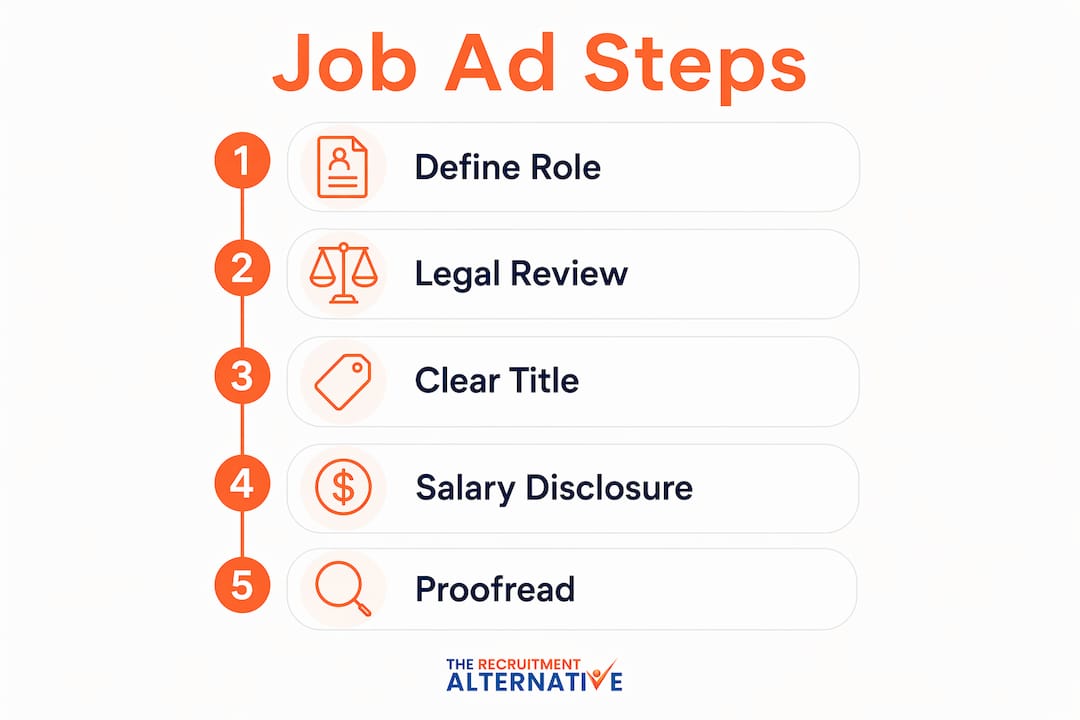
Transparency around salary and work flexibility is not optional. Ads that omit salary details attract fewer qualified professionals. Candidates increasingly treat salary disclosure as a signal of employer credibility, and withholding it pushes strong applicants toward roles that are upfront about pay.
The body of your ad should separate essential criteria from desirable ones. Listing every possible requirement as mandatory discourages qualified candidates who meet 80% of the criteria. Write a short, honest description of the role, the team, and the working arrangements. Include a clear equal opportunity statement and specific instructions for how to apply.
What to include and what to avoid:
- Do write a job title that matches common candidate search terms
- Do list salary range or at minimum a salary band
- Do separate must-have criteria from nice-to-have criteria
- Do state work location, remote options, and hours clearly
- Do include an equal opportunity statement
- Don’t use language that implies a preference for a particular age, gender, or background
- Don’t make promises about career progression or flexibility that the role cannot deliver
- Don’t copy and paste a position description and call it a job ad
Pro Tip: Read your finished ad aloud. If a sentence sounds like it came from a legal document rather than a conversation, rewrite it. Candidates respond to clarity, not corporate language.
Which job posting platforms suit different roles in Australia?
No single job board is universally best for every role. Platform choice must be driven by the seniority, technicality, and volume requirements of the specific position. Choosing the most popular platform by default often results in an overflow of low-quality applications that consume more time than they save.
Seek leads the Australian job board market for mid-to-senior and high-volume roles. LinkedIn is the preferred platform for professional and white-collar positions. Indeed and Jora perform well for fast, high-volume roles in retail, hospitality, and administration. For technical or hard-to-fill positions, niche job boards and specialised networks consistently yield higher quality applicants than generalist platforms. You can also read specific advice on posting jobs on Seek to get more from Australia’s largest board.
| Platform type | Best suited for | Key advantage |
|---|---|---|
| Generalist boards (e.g. Seek) | Mid-to-senior, high-volume roles | Largest candidate pool in Australia |
| Professional networks (e.g. LinkedIn) | White-collar and management roles | Access to passive and active candidates |
| Quick-apply platforms (e.g. Indeed, Jora) | Retail, hospitality, administration | Fast application process, high volume |
| Niche and industry boards | Technical, trade, and specialist roles | Higher applicant quality, less noise |
| Social media platforms | Entry-level, casual, and local roles | Cost-effective reach and targeting |
Social media platforms are worth including for certain roles. Guidance on leveraging social media for recruitment shows how Facebook, LinkedIn, and Instagram can extend your reach beyond traditional job boards, particularly for local and casual positions.
- Match platform to role type, not platform popularity
- Use candidate filters and screening questions where the platform allows
- Post on two or three platforms rather than every board available
- Monitor application quality within the first 48 hours and adjust if needed
How do you set up an effective screening and interview process?
Screening questions are the most underused tool in online job advertising. Pre-set screening questions can filter out 50–70% of unqualified candidates in some sectors. That figure represents hours of saved time and a sharper focus on applicants who genuinely meet your requirements.
Set up your screening process before the ad goes live. The steps below create a structured pipeline from the moment applications arrive.
- Define your non-negotiables. List the two or three criteria that immediately disqualify a candidate. Build screening questions around these.
- Write two to four screening questions. Ask about specific licences, qualifications, or experience that the role requires. Avoid questions that could be interpreted as discriminatory.
- Design your interview stages. A two-stage process works well for most roles: a short video call to assess communication and fit, followed by a skills task or structured interview.
- Set a response timeline. Decide how quickly you will contact shortlisted candidates. Top applicants are often off the market within a week of applying.
- Prepare your interview rubric. Score each candidate against the same criteria to keep the process objective and defensible.
Preparing interview processes before posting prevents the most common cause of losing strong candidates: slow response times. A candidate who applies on Monday and hears nothing by Friday has likely accepted another offer.
Pro Tip: If your platform allows knockout questions, use them. A single question asking whether a candidate holds a required licence or qualification removes unqualified applicants automatically, before you read a single CV.
What are the most common mistakes when posting jobs online?
The most damaging mistake is treating a job ad as a legal document rather than a candidate-facing communication. Vague, jargon-heavy ads reduce application quality and volume. Specific, honest ads attract candidates who understand the role and want it.
“Job ads are legally binding advertisements under the Australian Consumer Law. Misrepresentations about salary, flexibility, or career pathways can result in misleading or deceptive conduct claims.” — Sprintlaw, legal essentials for job advertisements
The most frequent errors that small business employers make include:
- Ignoring legal compliance. Discriminatory language or inaccurate salary claims create legal exposure before a single candidate is interviewed.
- Posting vague or incomplete ads. Missing salary, unclear location, or an absent equal opportunity statement reduces both quantity and quality of applications.
- Choosing the wrong platform. Posting a senior finance role on a quick-apply platform built for casual hospitality work produces volume without quality.
- Delaying the interview process. Waiting more than five business days to contact shortlisted candidates costs you the best applicants.
- Having no screening strategy. Without pre-set criteria, every application requires manual review, which is time-consuming and inconsistent.
Addressing these issues before posting costs almost nothing. Fixing them after a failed recruitment round costs considerably more, in both time and money. For a broader view of recruitment pitfalls to avoid, the consequences of poor preparation are well documented.
Key takeaways
Effective online job advertising in Australia requires legal compliance, a well-crafted ad, the right platform for the role, and a screening process set up before the first application arrives.
| Point | Details |
|---|---|
| Legal compliance first | Prepare employment contracts, a privacy policy, and an interview rubric before posting. |
| Write for candidates, not compliance | Use plain language, include salary, and separate essential from desirable criteria. |
| Match platform to role type | Generalist boards suit volume roles; niche platforms deliver quality for specialist positions. |
| Screen before you post | Pre-set knockout questions and interview stages to filter applicants efficiently. |
| Speed protects quality | Contact shortlisted candidates within five business days to avoid losing top talent. |
What I have learned from watching small businesses post jobs online
After working in Australian recruitment for years, the pattern I see most often is this: employers spend significant time writing the ad and almost no time preparing what comes after it. The ad goes live, applications arrive, and then the business owner is scrambling to write interview questions, find a contract template, and work out who is actually responsible for reviewing CVs. That scramble is where good candidates are lost.
The second thing I have noticed is that platform choice is treated as an afterthought. Employers default to the biggest board because it feels safe. But posting a niche technical role on a high-volume generalist platform is like advertising a specialist medical position in a general classifieds section. The audience is wrong, and the volume of irrelevant applications makes the process harder, not easier.
The employers who hire well consistently do three things before they post: they define the role clearly, they prepare their legal documents, and they decide exactly how they will screen and interview. That upfront work takes a few hours. It saves weeks. For small business owners who are already stretched, that trade-off is one of the most valuable investments in the hiring process.
Affordable recruitment support for small Australian businesses
Posting a job online is a skill that improves with practice. For small business owners who need results quickly or are hiring for a role outside their usual experience, professional support makes a measurable difference.
The Recruitment Alternative provides flat-fee recruitment services designed specifically for Australian businesses that need quality hires without the cost of traditional commission-based agencies. The fixed-price model means you know the cost upfront, and the process is handled by experienced consultants who specialise in sourcing permanent staff across industries including sales, administration, finance, technology, and management. For small businesses seeking affordable recruitment solutions, The Recruitment Alternative offers a practical alternative to doing it all yourself.
FAQ
What laws apply to job ads in Australia?
Australian job ads must comply with federal and state anti-discrimination legislation and the Australian Consumer Law. Misleading statements about salary, location, or role conditions can result in legal claims against the employer.
Which job board is best for small businesses in Australia?
No single platform suits every role. Seek is best for mid-to-senior positions, LinkedIn for professional roles, and quick-apply platforms like Indeed for high-volume casual or retail roles.
Should I include salary in my job ad?
Yes. Ads that display salary details attract more qualified applicants. Withholding salary information is a competitive disadvantage and can reduce application quality.
How do I filter out unqualified applicants?
Use pre-set screening questions tied to your non-negotiable criteria. Knockout questions on platforms that support them can filter out 50–70% of unqualified candidates before manual review begins.
What documents do I need before posting a job ad?
Prepare a compliant employment contract, a privacy policy covering candidate data, and an objective interview rubric before your ad goes live. These documents protect your business and speed up the hiring process.

