

Avoiding common recruitment mistakes employers make is the single most reliable way to improve hiring outcomes and reduce staff turnover. Recruitment mistakes, known in HR practice as hiring process failures, cost businesses far more than a bad salary decision. 75% of employers admit to hiring the wrong person due to structural breakdowns in their hiring process. That figure points to a systemic problem, not a run of bad luck. The Society for Human Resource Management (SHRM) and leading recruitment research consistently show that evidence-based hiring methods, structured interviews, and strong candidate experience are the three pillars that separate successful hires from costly mistakes.

What are the most frequent recruitment mistakes small businesses make?
Most hiring errors follow a predictable pattern. Recognising them early gives you the power to fix them before they cost you time, money, and good candidates.
- Vague job descriptions. A job ad that lists duties without outcomes attracts the wrong applicants. Outcome-based descriptions, such as “manage a portfolio of 50 accounts and grow revenue by 15%,” attract candidates who understand what success looks like.
- Rushing the hire. Hiring under pressure is the most damaging error for small businesses. Speed without process leads to lower quality candidates, higher turnover, and expensive rehiring cycles.
- Overreliance on gut feel. Gut feel is not a hiring method. It is a bias trigger. Interviewers who rely on first impressions consistently overlook high-performing candidates who do not fit a mental template.
- Ignoring candidate experience. Slow responses, unclear processes, and disorganised interviews signal to candidates that your business is poorly run. The best candidates withdraw from processes that feel disrespectful of their time.
- Confusing cultural fit with cultural add. Hiring for “fit” often means hiring people who think and look like your current team. Hiring for “add” means bringing in people whose perspectives strengthen the team.
- Skipping the intake meeting. Misaligned intake meetings cause wasted sourcing effort and delay. When hiring managers and recruiters do not agree on role outcomes before sourcing begins, weeks of effort can produce entirely the wrong shortlist.
These errors are common recruitment pitfalls that repeat across industries and business sizes. The good news is that every one of them has a straightforward fix.
How does structuring your recruitment process reduce hiring errors?
Structured hiring is the most evidence-backed method available to small businesses and HR managers. It removes the guesswork and replaces it with repeatable, fair, and accurate decision-making.
-
Run a synchronous intake meeting before sourcing. Capture role outcomes, non-negotiables, and deal-breakers in a single call with the hiring manager. This prevents weeks of mismatched candidate submissions and aligns everyone on what a successful hire actually looks like.
-
Write a structured interview guide. Structured interviews are 2.5 times more predictive than unstructured ones. They reduce mis-hires by 30–40% because every candidate answers the same questions, making comparison fair and accurate.
-
Use a scorecard with behavioural anchors. A scorecard lists the key competencies for the role and asks interviewers to rate each one with evidence from the interview. Well-defined scorecards with behavioural anchors and evidence quotes improve interviewer accuracy and reduce the influence of personal bias.
-
Complete scorecards within 30 minutes of the interview. Memory degrades fast. Timely scorecard completion within 30 minutes after the interview ensures higher quality data and better hiring decisions.
-
Train your interviewers. Most interviewers have never been taught how to interview. A two-hour calibration session covering question types, note-taking, and bias awareness produces measurably better outcomes. Evidence-based hiring tools and standardised interviewer training lead to 30–40% better hiring decisions.
-
Evaluate on evidence, not credentials. A degree is a credential. Delivering a project on time and under budget is evidence. Build your evaluation criteria around what the person has actually done, not what they have studied.
Pro Tip: Create a one-page interview guide for each role that lists five behavioural questions, the scoring rubric, and a reminder to complete the scorecard within 30 minutes. Share it with every interviewer before the panel meets.
What role does candidate experience play in avoiding recruitment mistakes?
Candidate experience is not a soft metric. It directly affects whether your best applicants accept your offer or take a role elsewhere.
86% of candidates say a negative interview experience changes their view of a company. Positive experiences increase offer acceptance rates by 34%. Those two numbers together explain why businesses with poor processes consistently lose top candidates to competitors who treat applicants with more care.
The key elements of a strong candidate experience include:
- Clear communication at every stage. Tell candidates what the process looks like, how many rounds there are, and when they can expect to hear back. Silence is the fastest way to lose a strong candidate.
- Timely feedback. Candidates who receive feedback, even brief feedback after rejection, are far more likely to reapply or refer others to your business.
- Streamlined applications. Long application forms with repetitive questions reduce completion rates. Ask only for what you genuinely need at the application stage.
- Respectful interviews. Start on time, introduce everyone in the room, and give candidates space to ask questions. These basics signal that your business values people.
Onboarding is the final and often overlooked part of candidate experience. Weak onboarding causes nearly one in five new hires to leave within 45 days. Pre-boarding activities, such as IT setup, paperwork completion, and role clarity communications between offer acceptance and day one, significantly reduce early turnover.
Pro Tip: Send a welcome email within 24 hours of offer acceptance. Include the start date, parking or transport details, a team introduction, and a point of contact for questions. This single step reduces new hire anxiety and early dropout rates.
Retention starts before day one. Businesses that treat holding on to good staff as a recruitment responsibility, not just a management one, consistently outperform those that treat hiring and retention as separate functions.
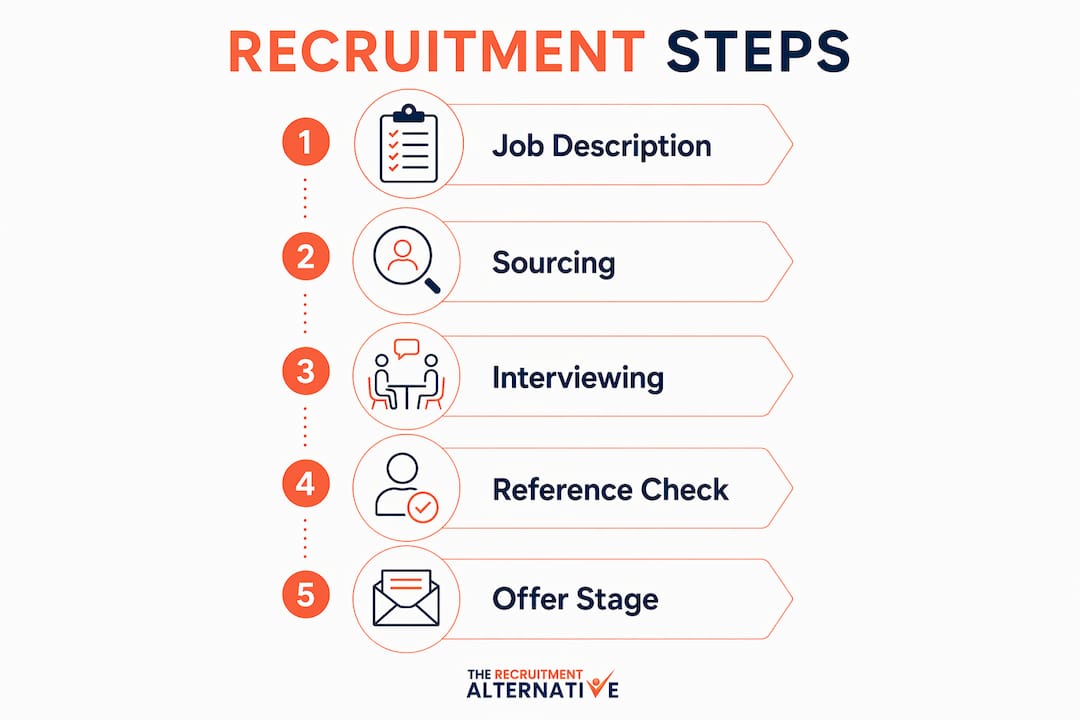
What practical steps prevent recruitment pitfalls from job ad to offer?
A structured approach to each phase of the hiring process eliminates the most common traps. The table below maps each phase to its most frequent mistake and the fix.
| Phase | Common mistake | Practical fix |
|---|---|---|
| Job description | Inflated or vague requirements | Write outcome-based descriptions; remove unnecessary degree requirements |
| Sourcing | Reactive, last-minute hiring | Build a talent pipeline before roles become vacant |
| Screening | Credential-only filtering | Assess demonstrated skills and relevant experience |
| Interviewing | Unstructured, gut-feel conversations | Use structured questions and scorecards |
| Reference checks | Skipping or rushing references | Validate specific achievements with at least two referees |
| Offer stage | Misaligned compensation | Research market rates before extending an offer |
A few of these phases deserve more detail.
Job descriptions and candidate pools. Inflated job requirements, such as unnecessary degrees, reduce diversity and shrink your candidate pool. Research shows women apply only when they meet 100% of listed requirements, while men apply at 60%. Removing credential barriers that do not reflect actual job needs immediately broadens the talent available to you.
Sourcing and talent pipelines. Reactive hiring, where you post a job only after someone resigns, forces you into rushed decisions. Employee referrals yield 45% lower turnover and faster time-to-productivity than job board hires. Building a referral culture and maintaining a warm candidate list reduces your dependency on urgent, open-market searches.
Reference checks. References are not a formality. Ask referees to describe a specific project the candidate led, a challenge they overcame, and how they handled a difficult team situation. Vague answers are as informative as detailed ones.
Offer stage. Candidates who receive offers below market rate rarely accept, and those who do often leave within 12 months. Research salary benchmarks using resources like SEEK’s annual salary insights before you set a budget for the role.
Key takeaways
Avoiding recruitment mistakes requires structured processes, not better instincts. The most effective hiring decisions come from evidence, consistency, and a genuine respect for candidate experience.
| Point | Details |
|---|---|
| Structure every interview | Structured interviews are 2.5 times more predictive and reduce mis-hires by 30–40%. |
| Fix the intake meeting first | Aligning on role outcomes before sourcing prevents weeks of wasted effort and wrong shortlists. |
| Protect candidate experience | 86% of candidates change their view of a company after a poor interview; positive experiences lift offer acceptance by 34%. |
| Pre-board new hires | Pre-boarding between offer acceptance and day one reduces early turnover significantly. |
| Remove credential barriers | Outcome-based job descriptions and skills-focused screening broaden your talent pool and improve diversity. |
Why recruitment mistakes are really process failures in disguise
Hiring mistakes are primarily process errors, not errors of judgement. That reframe matters enormously for small business owners and HR managers who blame themselves when a hire goes wrong.
I have seen this pattern repeat across hundreds of businesses. A hiring manager interviews three candidates in a week, picks the one who felt right in the room, and then wonders six months later why the person is underperforming. The problem was never the manager’s instincts. The problem was the absence of a process that could surface the right information.
The businesses that hire well are not necessarily the ones with the most experienced interviewers. They are the ones with the clearest intake meetings, the most consistent interview questions, and the discipline to complete a scorecard before the debrief. Those habits are learnable. They do not require a large HR team or an expensive system.
Small businesses face a genuine tension here. The pressure to fill a role quickly is real, especially when a resignation leaves a team short-staffed. But the cost of a rushed hire, in turnover, rehiring, and lost productivity, almost always exceeds the cost of taking two extra weeks to get it right. I have never met a business owner who regretted slowing down a hire. I have met many who regretted rushing one.
The shift worth making is from treating recruitment as an event to treating it as a process. That means maintaining a warm candidate list, running structured interviews every time, and reviewing your hiring decisions against outcomes six months later. The data will tell you where your process is leaking.
— Josh Townsend
How The Recruitment Alternative helps you hire with confidence
Small businesses across Australia and New Zealand consistently tell us that the two biggest recruitment challenges they face are cost and process. Traditional commission-based agencies charge a percentage of salary, which makes professional recruitment feel out of reach for growing businesses.
The Recruitment Alternative offers flat-fee recruitment services designed specifically for businesses that need quality hires without unpredictable costs. Every engagement includes expert consultation to define the role clearly, extensive candidate sourcing, and a proven screening process that reduces the risk of a mis-hire. For businesses looking at affordable recruitment for small businesses, the flat-fee model delivers the same quality as traditional agencies at a fraction of the cost. Get in touch with The Recruitment Alternative to find out how a structured, cost-effective approach can improve your next hire.
FAQ
What is the most common recruitment mistake employers make?
Rushing the hire under pressure is the most damaging mistake for small businesses. It consistently leads to lower quality candidates, higher turnover, and costly rehiring cycles.
How do structured interviews reduce hiring mistakes?
Structured interviews are 2.5 times more predictive than unstructured ones and reduce mis-hires by 30–40%. They work because every candidate answers the same questions, making comparison fair and removing personal bias from the decision.
Why does candidate experience affect hiring outcomes?
86% of candidates say a negative interview experience changes their view of a company. Businesses with poor candidate experience lose top applicants before an offer is even made.
How can small businesses build a talent pipeline without a large HR team?
Start with an employee referral programme and maintain a simple spreadsheet of strong candidates who were not hired due to timing. Referral hires produce 45% lower turnover than job board hires, making them the highest-return sourcing method available to small businesses.
What is pre-boarding and why does it matter?
Pre-boarding refers to structured activities between offer acceptance and the first day of work, such as IT setup, paperwork, and role clarity communications. Weak onboarding causes nearly one in five new hires to leave within 45 days, and pre-boarding directly reduces that risk.

