

Which sales recruitment agencies in Australia get results fast?
The fastest way to hire sales staff for a small business in Australia is to work with a specialist sales recruitment agency. These agencies maintain pre-vetted candidate pools, understand sales-specific competencies, and typically place candidates far quicker than a general recruiter or a DIY job board search. Four agencies stand out for Australian small businesses.
| Agency | Specialisation & Expertise | Geographic Coverage | Pricing Model | Best For |
|---|---|---|---|---|
| Sales Staff Australia | Dedicated sales roles only; deep candidate vetting | National | Not publicly listed | Businesses wanting specialist sales-only recruitment |
| SMAART Recruitment | High-calibre sales staff; tailored candidate matching | National | Not publicly listed | SMBs wanting experienced hires quickly |
| Labour Hire Service | Temporary and permanent sales placements across industries | National | Not publicly listed | Firms needing flexible contract or permanent options |
| The Recruitment Alternative | Broad industry sales recruitment; fixed flat-fee pricing | National | Flat fee | Small businesses prioritising cost and fast turnaround |
Key features to look for when evaluating any agency:
- Pre-screening processes that include behavioural assessments and simulated sales exercises
- Documented client testimonials and verifiable placement track record
- Clear industry focus, particularly in sales roles rather than general staffing
- Transparent pricing with no hidden percentage-of-salary surprises
- Retention support and onboarding assistance post-placement
Why do specialist sales agencies matter for small business growth?
Specialist sales recruitment agencies focus solely on sales roles, which produces better candidate pools and faster placements than a general recruiter can offer. A generalist agency fills roles across dozens of functions; a sales specialist knows the difference between a strong account executive and a capable sales development representative, and screens accordingly.
For a small business, a wrong sales hire is expensive in time and cash. Replacing a single underperforming sales hire can be very costly relative to their compensation. Specialist agencies reduce that risk through targeted vetting, including mock calls, role plays, and grit assessments before you ever meet a candidate.
- Access to passive candidates who are not browsing job boards
- Faster shortlists because the agency already knows the talent pool
- Reduced interview load for the business owner
- Better retention rates due to role-specific fit assessment
What sales roles do small businesses typically hire?
Understanding the role before you recruit is what separates a successful hire from a costly mismatch. These are the four positions small businesses most commonly fill.
- Sales development representative (SDR): Focuses on outbound prospecting, cold outreach, and booking qualified meetings. Hire an SDR once you have a repeatable closing process and need more pipeline volume.
- Account executive (AE): Owns the full sales cycle from discovery through to signed contract. This is usually the right first hire for a small business that needs someone to both prospect and close.
- Sales manager: Coaches and oversees a team of reps. Avoid making this your first sales hire; a manager without reps to lead adds overhead without adding revenue.
- Business development manager (BDM): Builds new partnerships and opens new market segments. Suited to businesses with an established sales function looking to expand into new channels.
Role clarity shapes everything downstream, from the job description to the interview questions to the 90-day milestones you set.
How do you choose the right sales recruitment agency?
Choosing the wrong agency costs you time you do not have. Use these criteria to assess your options, and read more in this guide on what to look for in a recruitment partner.
- Specialisation: Does the agency recruit sales roles specifically, or is sales one of fifty categories they cover?
- Geographic coverage: National coverage matters for sourcing, but local market knowledge matters for salary benchmarking and candidate availability.
- Candidate vetting: Ask directly how candidates are assessed. Behavioural interviews and sales simulations are the standard; resume screening alone is not enough.
- Pricing model: Traditional commission-based agencies charge a percentage of the placed candidate’s salary, which adds up quickly. Flat-fee recruitment removes that variable and gives you cost certainty from the start.
- Hire speed and retention: Ask for average time-to-placement and whether the agency offers a replacement guarantee if a hire does not work out.
Small businesses benefit most from agencies with national Australian coverage paired with deep local networks, so the candidate pool is wide but the shortlist is relevant.
What does the agency hiring process actually look like?
Engaging a recruitment agency follows a predictable sequence, and knowing it helps you move faster.
- Initial briefing: You describe the role, the ideal candidate profile, salary range, and your sales process. The more specific you are here, the better the shortlist.
- Sourcing and screening: The agency searches its database, advertises the role, and headhunts passive candidates. Strong agencies run behavioural assessments and sales simulations at this stage.
- Shortlist presentation: You receive two to four vetted candidates with assessment notes, not a stack of unfiltered CVs.
- Interviews and assessment: You conduct role-specific interviews and, ideally, a live sales simulation with each finalist.
- Offer and onboarding: The agency assists with offer negotiation and, in many cases, provides a structured onboarding plan to accelerate ramp-up.
Total time from briefing to accepted offer typically runs two to four weeks for a specialist agency with an active candidate pool. Budget for an additional ramp-up period before your new hire is fully productive, as even strong candidates need time to learn your product, your ideal customer profile, and your objection-handling approach.
Research-backed tips for your first sales hire

Founders should close 10–20 customers themselves before hiring their first dedicated salesperson. That personal experience lets you explain the buying process clearly, which is the most important resource your first hire has in their early weeks.
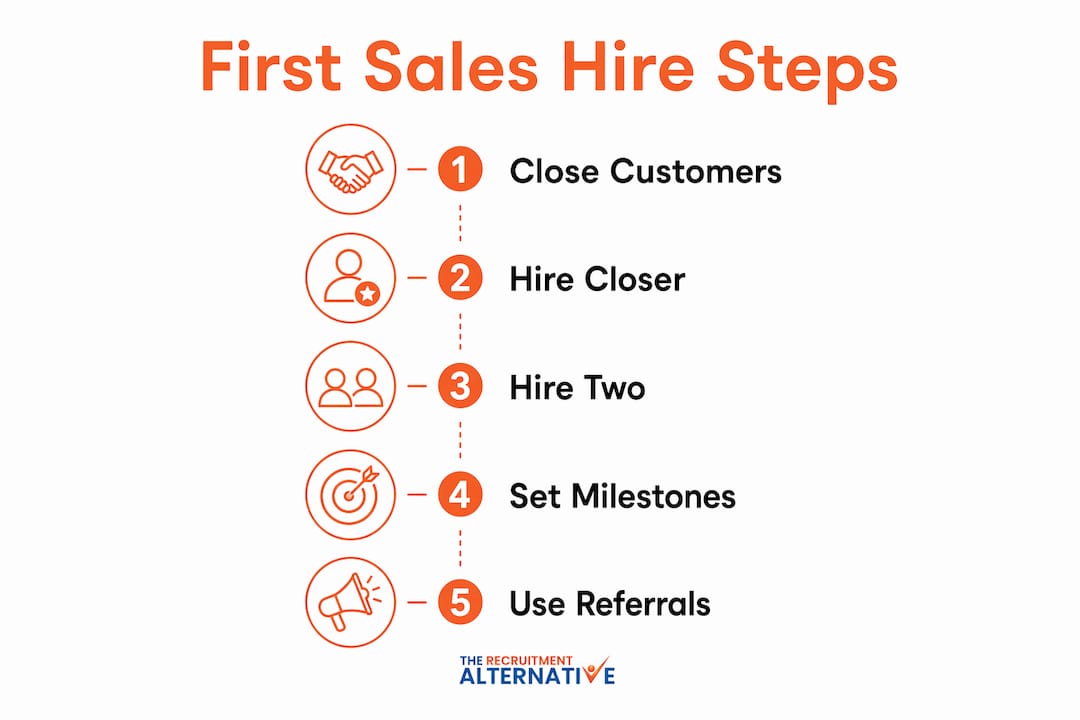
Hire a closer, not a manager. Your first sales hire needs to prospect and close from scratch, without a team, a playbook, or an established brand doing the heavy lifting. A sales manager from a large organisation often struggles in that environment. Look for someone with two to five years in a closing role who has built pipeline from nothing before.
If budget allows, hire two salespeople simultaneously. A single first hire carries a significant risk of not being the right fit. Two hires lets you compare performance, identify what good looks like for your business, and maintain momentum if one does not work out.
Set 30, 60, and 90-day activity milestones rather than annual revenue targets. The first milestone should not be closed revenue; it should be pipeline conversations and product knowledge. Topgrading hiring practices support this approach, and it gives both you and your new hire a realistic framework for early success.
Networking and referrals consistently produce stronger sales candidates than passive job boards. Ask your best customers who the best salesperson they have dealt with is. Ask your investors and other founders. The profile you want is rarely actively job-hunting.
Pro Tip: Before you post a job ad, document your sales process: the questions you ask, the objections you handle, and how you close. A candidate who cannot learn from a written process will struggle without it.

What questions should you ask sales candidates in interviews?
Focus your questions on four competencies: commercial curiosity, resilience, coachability, and execution pace. Use behavioural questions anchored to real past experience, not hypotheticals.
- “Walk me through your worst sales quarter. What happened and how did you respond?”
- “Describe a deal you lost. What would you do differently?”
- “Tell me about a time you built pipeline from scratch with no inbound support.”
- “What is the primary objective of a salesperson?” (A strong answer centres on helping the prospect find the right solution, not on closing at any cost.)
- “How have you responded when a manager gave you critical feedback on your sales approach?”
Pair these with a live sales simulation where you ask the candidate to sell you their most recent product and handle your objections in real time. This is the single most useful assessment in the process.
Red flags to watch for when evaluating sales candidates
Some warning signs are easy to miss in a confident interview. Watch for these specifically.
- A CV vague on targets, attainment figures, and specific wins. Strong salespeople are proud of their numbers.
- Stints of 18 months or less in consecutive sales roles, which often signals they did not hit target.
- Blaming price or the product for lost deals without taking any personal accountability.
- Wanting a 70/30 base-to-commission split. The best candidates want upside, not security.
- Inability to pitch your product after being given preparation time. If they cannot sell with prep, they will not sell under pressure.
- Asking for proposals, decks, and collateral before they can begin selling.
Also consider whether the candidate has only ever worked with warm inbound leads and established playbooks. Your small business likely cannot offer either of those from day one.
How do you evaluate a candidate’s actual sales skills?
Resumes and interview confidence predict sales performance far less reliably than structured evidence. Use a consistent scoring approach across four competencies, rating each on a 1 to 4 scale, and score independently before discussing with anyone else.
Role plays and objection-handling exercises reveal how a candidate structures discovery, whether they ask questions before pitching, and how they respond when pushed back on price or timing. After the simulation, ask: “What would you do differently in that conversation?” A candidate who can self-diagnose their performance is both coachable and self-aware, two qualities that matter most in the first 90 days when you will be coaching them heavily.
Check for an automated sales process understanding too. Candidates who have worked within a documented sales system adapt faster than those who have always improvised. For broader small business hiring tips, the same principle applies across roles: structured evaluation beats gut feel every time.
The Recruitment Alternative: flat-fee sales recruitment for small businesses
Small businesses that want professional sales recruitment without paying a percentage of every salary placed have a clear alternative to the traditional agency model.
The Recruitment Alternative offers fixed flat-fee recruitment across Australia, covering sales roles alongside management, administration, finance, and technology. The pricing model means you know the cost upfront, regardless of the salary you end up offering your new hire. That predictability matters when you are managing a tight budget and cannot absorb a surprise invoice. The agency combines personalised candidate sourcing, pre-screening, and onboarding support, and works with businesses of all sizes nationally. For small businesses comparing their options, affordable flat-fee recruitment is now a well-established model, not a compromise.
Key takeaways
Specialist sales recruitment agencies give small Australian businesses faster, better-matched hires than general recruiters, and the right pricing model keeps costs predictable from day one.
| Point | Details |
|---|---|
| Use a specialist agency | Sales-only agencies produce better candidate pools and faster shortlists than generalist recruiters. |
| Validate before you hire | Close 10–20 customers yourself before engaging a first salesperson so you can teach the buying process. |
| Hire a closer first | Your first sales hire should prospect and close independently, not manage a team that does not yet exist. |
| Set 90-day milestones | Measure activity and pipeline in the first quarter, not closed revenue, to give new hires a realistic ramp. |
| The Recruitment Alternative | Offers fixed flat-fee sales recruitment nationally, giving small businesses cost certainty without sacrificing candidate quality. |

