

An interview scorecard is a one-page form that lists the criteria a role requires, gives each a weighting and a rating scale, and gives every interviewer the same place to record evidence and a score. Used with the same questions for every candidate, it turns “I liked them” into a comparison you can defend. This guide shows what to put on it, how to score consistently and how to read the results.
TL;DR
- A scorecard has four essentials: role-relevant skills and competencies, a weighting for each, a numerical scale (usually 1 to 5) and a comments field for evidence.
- Write it before the job ad goes live, and keep it to a handful of criteria so interviewers can actually score them.
- Each interviewer scores independently, straight after the interview, and no one discusses candidates until all scores are in.
- Total and average the scores, then set a minimum on the criteria that matter most so a high average cannot hide a serious gap.
- An interview scoring matrix is the summary sheet that puts every panel member’s scores for every candidate side by side.
Table of Contents
- What an interview scorecard is, and how it differs from a scoring matrix
- Why use one at all
- What to include on the scorecard
- Choosing a rating scale
- How to score consistently
- Reading the scores and making the decision
- Limits worth planning for
- A copyable scorecard layout
- Our perspective
- Get a structured shortlist without a percentage fee
- FAQ
- Sources
What an interview scorecard is, and how it differs from a scoring matrix
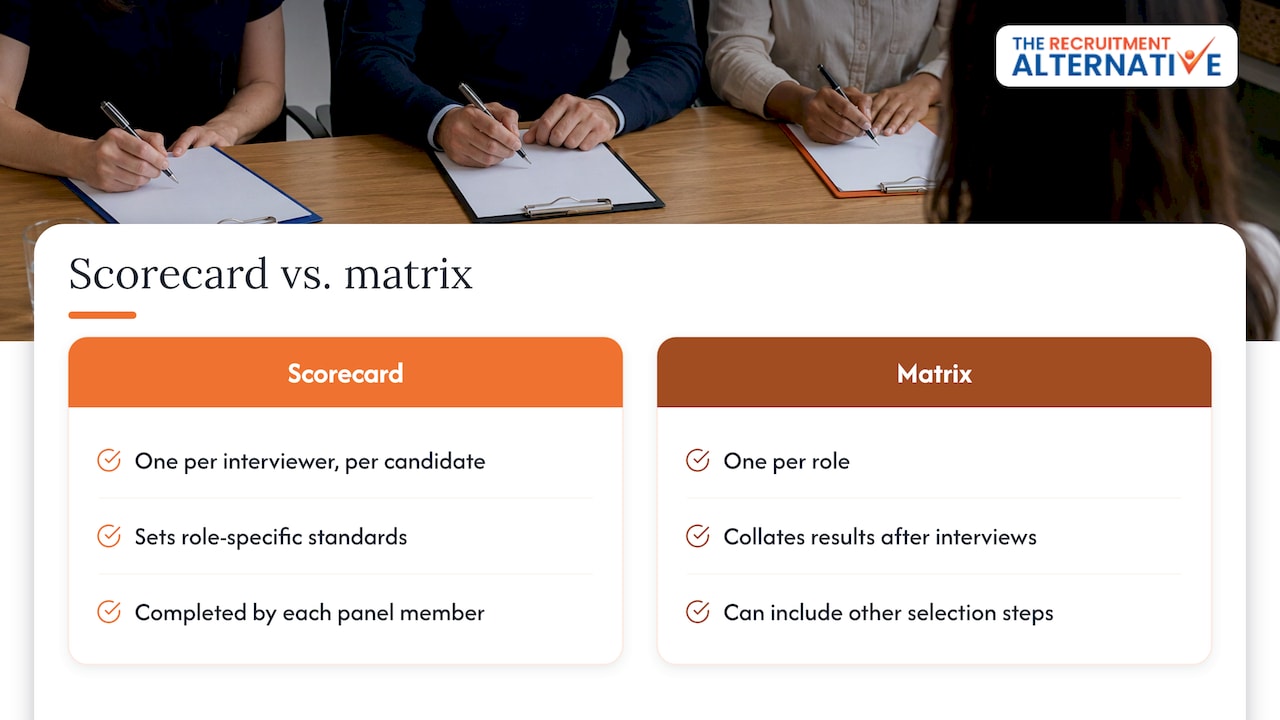
A scorecard is the form each interviewer fills in for one candidate. It sets out what “good” looks like for the role before anyone is interviewed, so every candidate is judged against the same standard rather than against the last person who walked out of the room.
An interview scoring matrix is the collation step. The Australian Industry Group provides a sample interview assessment form for each panel member to complete per candidate, and a matrix form for collating the results after the interviews. In practice: one scorecard per interviewer per candidate, then one matrix per role.
The matrix can also carry results from other selection steps. The Australian Industry Group notes that its summary scoring matrix can be adapted for psychometric testing, a second interview or work sample tests. That suits small businesses that use more than one step before making an offer.
Why use one at all
The case is consistency. The Australian Industry Group says a structured interview means every applicant is interviewed the same way with the same questions, which allows effective comparisons and reduces the possibility of bias or discrimination.
The Behavioural Insights Team makes a similar point in its guide to structured interviewing: structured interviews help hiring managers make better decisions and can help stop women and minority groups being disadvantaged. For a small business with no HR department, a scorecard is the cheapest piece of structure you can add to hiring.
If bias is your main concern, our guide to interview bias reduction covers the habits that sit around the scorecard.
What to include on the scorecard
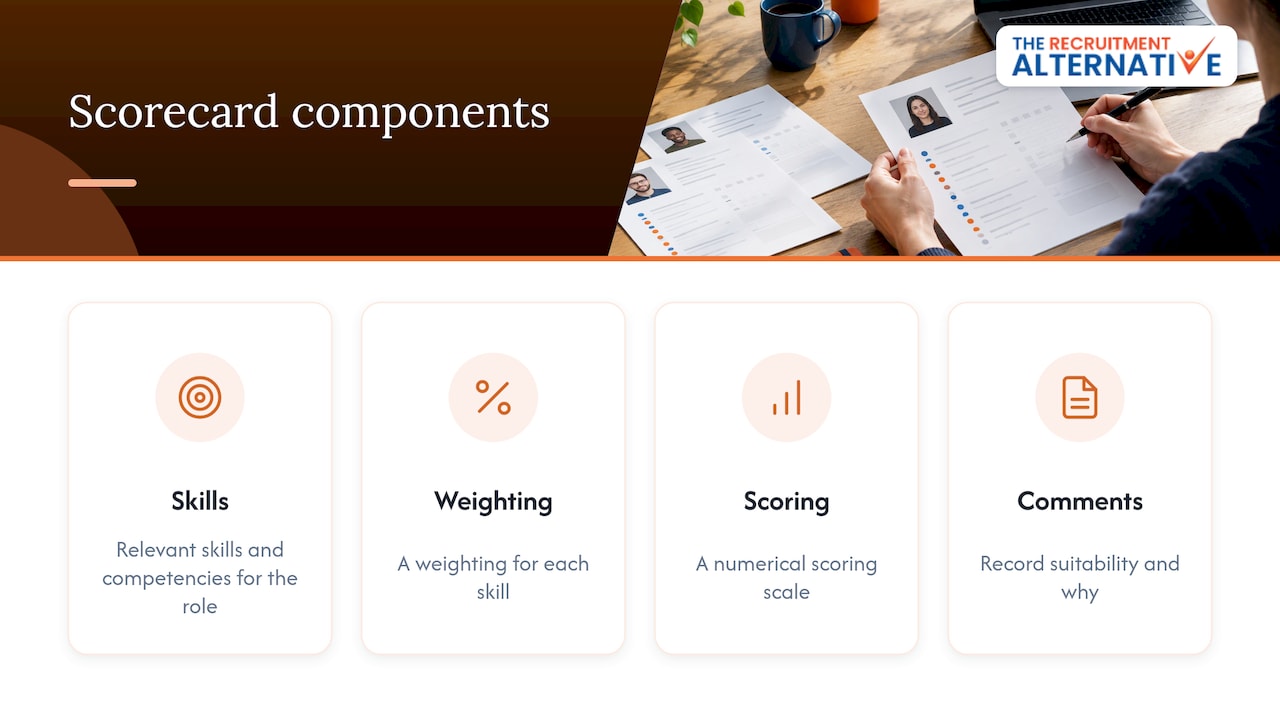
The core elements are well established. AIHR lists them as skills and competencies relevant to the role, a weighting for each, a numerical scoring scale and a comments section where the interviewer records suitability and why.
Split the criteria into three groups
Yardstick suggests three parts: competencies, skills and role outcomes. Competencies are the behaviours the role demands. Skills are abilities a candidate must arrive with because they cannot be taught quickly. Outcomes are the results that would make you call the hire a success. It recommends three or four items in each part.
For a sales role that might look like this:
| Group | Example criteria | Weight |
|---|---|---|
| Skills | Consultative selling, CRM discipline, pipeline forecasting | 35% |
| Competencies | Resilience, coachability, communication | 35% |
| Role outcomes | Reaches target within the first two quarters, builds own pipeline | 30% |
The weights are yours to set. They should reflect what the job really needs, and they should total 100%.
Write criteria you can actually score
Vague words fail at the interview table. Otter.ai gives a useful test: a criterion such as providing technical direction to two or three junior engineers can be scored, while “teamwork” means something different to each interviewer. If you cannot draft questions that would surface evidence of a criterion, it is too abstract.
Yardstick applies the same idea to outcomes: write them so that at six or twelve months you could settle the verdict without an argument. “Build a strong pipeline” fails. “Hold 30 active qualified opportunities by month four” passes.
Keep it short
The Behavioural Insights Team warns that scoring criteria should not be too complex or long, or interviewers will struggle to judge responses. It also advises leaving room for good answers you did not anticipate, because candidates from diverse backgrounds may approach problems in new ways. A comments box and an “other evidence” line handle that.
Choosing a rating scale
The two common choices are 4 points and 5 points. Otter.ai explains the trade-off: a 4-point scale has no neutral midpoint, so interviewers must lean positive or negative, while a 5-point scale gives more gradation and a neutral middle. It recommends picking one of the two and not going much wider.
The Victorian Government’s toolkit shows a sample 5-point scale (does not meet, basic, proficient, excellent, outstanding) and notes that most Victorian public sector organisations use a 5-point scale. That makes it familiar to many Australian candidates and hiring managers.
Anchor every number to a description
A bare 1 to 5 means different things to different people. The Victorian Public Sector Commission recommends a descriptively anchored rating scale, where descriptors define each number and help align interviewers’ scores. Its example runs from 1, where the applicant did not at all demonstrate the criterion, to 5, where they demonstrated it significantly and in great detail, with 3 as acceptable, meaning sufficient evidence.
A simple version you can copy:
| Score | Meaning |
|---|---|
| 5 | Specific, detailed examples that clearly exceed the standard |
| 4 | Strong, relevant examples with minor gaps |
| 3 | Sufficient evidence that the standard is met |
| 2 | Some evidence, but general or partial |
| 1 | No relevant example, or an example that does not show the criterion |
Write the anchors for each criterion where you can. “Meets the standard” for forecasting accuracy is not the same as for written communication.
How to score consistently
Consistency comes from process more than from the form itself. The Behavioural Insights Team recommends that interviewers record and mark responses independently against pre-determined criteria, and do not discuss their opinions until they have scored all questions. Discussing first makes interviewers more likely to be swayed by one another.
A workable routine:
- Agree the scorecard before interviews start. Everyone on the panel reads the criteria, weights and anchors.
- Ask every candidate the same core questions, in the same order. Follow-up probes are fine; new topics are not.
- Note evidence during the answer, score straight after. Write what the candidate said or did, then the number.
- Submit scores before any discussion. Greenhouse gives the same advice: complete the scorecard as soon as possible and hold off discussing assessments until everyone has submitted.
- Calibrate once. Have two people score the same recorded or role-played answer and compare. Where they differ by two points or more, the anchor needs rewriting.
One line of caution for Australian employers. Keep questions on the job. Do not ask about age, pregnancy or family plans, relationship status, religion, sexuality, or disability beyond the ability to perform the inherent requirements of the role. The scorecard is a good guard here, because each question maps to a criterion you wrote down.
Need ready-made questions? Our structured interview prompts and 5-step rubric pair neatly with a scorecard, and the candidate screening script helps you decide who reaches the interview stage.
Reading the scores and making the decision
The Behavioural Insights Team’s method is simple: each interviewer adds up their scores across all questions, the totals are collated and averaged, and the candidate with the best overall score is a strong indicator of the best candidate. Its reasoning is the wisdom of crowds: several viewpoints tend to produce a fairer and more accurate result on average.
A worked example
Three interviewers score two candidates on a weighted five-criterion card. The matrix looks like this:
| Criterion (weight) | Candidate A: avg | Candidate B: avg |
|---|---|---|
| Technical skill (30%) | 4.3 | 3.0 |
| Customer handling (25%) | 3.7 | 4.3 |
| Problem solving (20%) | 4.0 | 3.3 |
| Teamwork (15%) | 3.0 | 4.7 |
| Learning agility (10%) | 3.7 | 4.0 |
| Weighted score | 3.8 | 3.7 |
The weighted totals are close. That is the signal to discuss evidence, not to let the arithmetic decide. Read the comments on the criteria where scores diverge, and check whether any single interviewer is an outlier on every line.
Set minimums for the criteria that matter most
Averages can hide a weakness. One Australian guide to scorecards describes declining a candidate who scores 2 out of 5 on a critical competency even when the total is high, because averages can hide a weakness that will cost the business later. Decide in advance which two or three criteria carry a minimum score, and write it on the card.
Limits worth planning for
A scorecard supports judgement; it does not replace it. SmartRecruiters notes that interviewers focused on filling in a form can limit eye contact and personal engagement, restrict the organic feel of the conversation, and that scorecards take time to establish.
The practical fixes are straightforward. Keep the form short, take brief notes during the interview and complete the scoring in the five minutes afterwards. Build the template once per role family and reuse it. The Behavioural Insights Team also suggests combining structured interviews with other assessment methods, such as work samples, since every method has strengths and weaknesses.
For values and culture fit, score observable behaviours rather than impressions. Our guide to values-based recruiting shows how to turn values into questions you can score.
A copyable scorecard layout
Use this as a starting structure and adapt the criteria to the role.
- Role mission: one sentence on why the role exists.
- Outcomes: three or four results you would expect by month six or twelve.
- Criteria table: 5 to 6 rows, each with a one-line definition, a weight, an anchored 1 to 5 score, the question that tests it and a comments field for evidence.
- Minimum scores: the two or three criteria where a low score rules a candidate out.
- Overall recommendation: strong yes, yes, no, strong no, with one line of reasoning.
- Interviewer name and date: so the record is complete.
For a tradeable starting point, the Australian Industry Group forms linked above are free, and the Victorian sources show how public sector panels word their anchors. If you are hiring for technology roles, our technology hiring checklist helps you choose the skills to weight. Track whether your scorecards are working with a few core recruitment metrics, such as how many scored-highly hires are still in the role after the probation period.
Our perspective
We see the same pattern across small businesses. The hiring decision is rarely lost at the offer stage. It is lost in the interview, when three people leave the room with three different impressions and nothing written down.
A scorecard is the fix, and it costs nothing but an hour of preparation. We encourage employers to write it before the job goes live, because the exercise forces a decision on what the role really needs. That clarity improves the advertisement, the shortlist and the interview all at once.
It is also why we built our service around a fixed price. When you are not paying a percentage of salary, the conversation with your recruiter is about fit, evidence and the scorecard, not about the size of the fee. We designed our approach to give small businesses a structured, transparent process that is usually reserved for large employers.
Josh Townsend
Get a structured shortlist without a percentage fee
If you would rather arrive at interview with a vetted shortlist, The Recruitment Alternative recruits permanent staff across Australia and New Zealand on a flat fee instead of a percentage of salary. Our Recruit service has a $895 engagement fee and a placement fee of $3,900 to $5,000, while Recruit+ has a $2,495 engagement fee and a placement fee of $5,000 to $6,000. A psychometric evaluation is available at $199 per candidate if you want another input for your scoring matrix.
See the full flat-fee pricing structure or learn how our replacement guarantee works if a hire does not work out in the first two to three months.
FAQ
How many criteria should an interview scorecard have?
Aim for five or six. Yardstick suggests three or four items in each of its sections, and the Behavioural Insights Team warns that long, complex criteria make responses hard to judge. If interviewers cannot hold the list in their heads, trim it.
Should I use a 4-point or 5-point scale?
Either works if every number has a written anchor. A 4-point scale forces a lean positive or negative, while a 5-point scale offers a neutral midpoint and finer gradation. Most Victorian public sector bodies use 5 points, so many panels will find it familiar.
Can one person use a scorecard?
Yes. Scoring each answer straight after the interview still gives you a record and a consistent standard. Where you can, add a second scorer who is not the hiring manager, since multiple viewpoints tend to produce a fairer result on average.
What is the difference between an interview scorecard and a scoring matrix?
The scorecard is the individual form each interviewer completes for one candidate. The scoring matrix is the summary that collates every panel member’s scores for all candidates, so you can compare them on one page.
Sources
- Sample: Interview Assessment Form, Australian Industry Group
- Sample: Summary Interview Scoring Matrix Form, Australian Industry Group
- How to run structured interviews, Behavioural Insights Team
- Best practice recruitment selection methodology and tools, Victorian Public Sector Commission
- Recruitment, interviews and selection, Victorian Government
- What Is an Interview Scorecard? AIHR
- How to Build an Interview Scorecard, Yardstick
- Turning Interviews into Scorecards, Otter.ai
- What is an interview scorecard? Greenhouse
- Interview scorecard, SmartRecruiters
- The Shopify Hiring Scorecard playbook

