
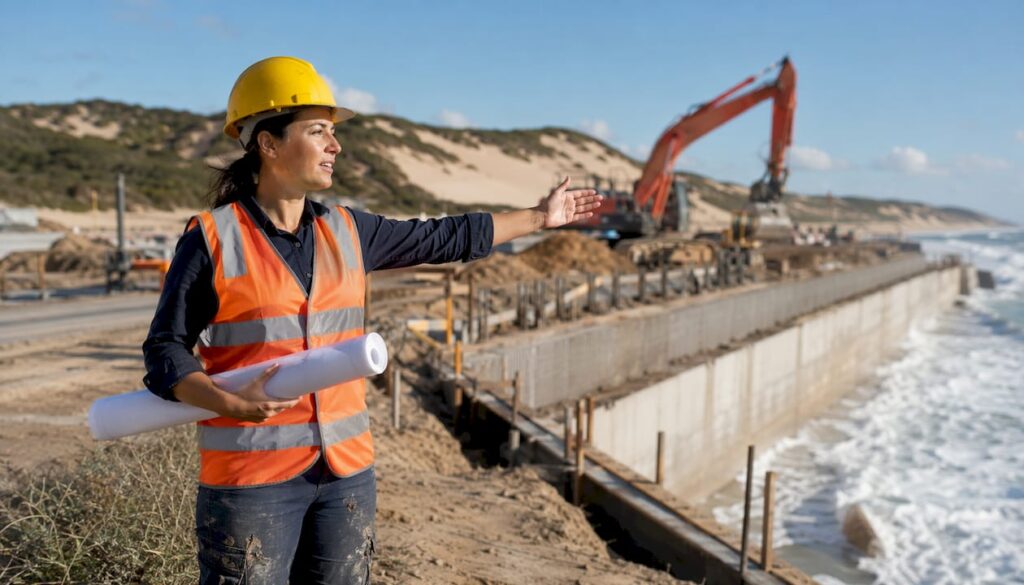
Is civil engineering difficult? What employers need to know
Yes, civil engineering is genuinely demanding, and that difficulty directly shapes how hard it is to attract and keep qualified people. The role combines physical site work, technical complexity, strict regulatory compliance, and high-stakes project management. According to the Civil Contractors Federation, 64% of construction workers exceed 50 hours per week, which affects both retention and candidate expectations from the outset.
The challenges shift significantly with career stage:
- Entry-level roles involve physical site work, exposure to harsh conditions, and steep learning curves around safety and compliance.
- Mid-career engineers (5–15 years) face peak demand and intense market competition, with volatile material costs and construction-phase pressures adding to workload.
- Senior roles centre on project management, stakeholder communication, regulatory navigation, and strategic planning, requiring a very different kind of endurance.
For employers, this progression means retention strategies must evolve at each stage. A graduate retention approach will not work for a principal engineer.
Table of Contents
- What qualifications does a civil engineer need in Australia?
- What project challenges do civil engineers face in Australia?
- Mental and emotional stress in civil engineering roles
- Salary expectations vs. the reality of the job
- Key takeaways
What qualifications does a civil engineer need in Australia?
Candidates must hold a Bachelor’s degree in civil engineering or a closely related field. Engineers Australia accreditation is the recognised professional benchmark, with Chartered Professional Engineer (CPEng) status marking the highest level of credibility for career advancement.
Key requirements to understand when assessing candidates:
- Washington Accord degrees are recognised directly by Engineers Australia.
- Overseas-qualified engineers typically complete a Competency Demonstration Report (CDR), referencing tools like AutoCAD Civil 3D and standards such as AS/NZS 1170. Reviewing a candidate’s skills assessment checklist can help employers verify documentation completeness.
- Technical software proficiency, particularly AutoCAD and Civil 3D, is critical for candidate suitability alongside formal registration.
- Continuing Professional Development (CPD) is expected throughout a career, not just at entry level.
Notably, more than 50% of overseas-born engineers work outside core engineering fields in Australia, pointing to a structural retention problem rather than a simple supply shortage.
What project challenges do civil engineers face in Australia?
Australia’s infrastructure pipeline is substantial, and that scale creates real pressure on practitioners. Projects like Sydney Metro, Cross River Rail in Queensland, and Western Australia’s Metronet expansion demand engineers who can manage cost volatility, environmental disruptions, and shifting delivery timelines simultaneously.
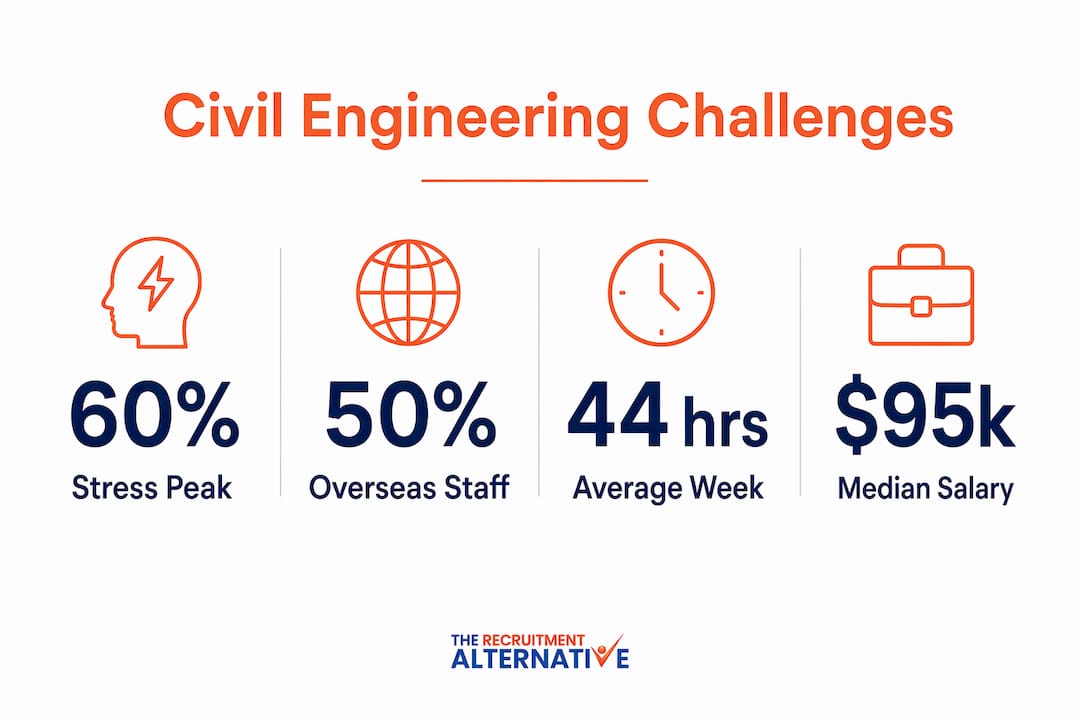
The 2024 Infrastructure Market Capacity Report identifies construction-phase work as the highest-stress period, particularly for engineers with 5–15 years of experience managing these complexities. Remote and mining-related projects add further difficulty through geographic isolation and compressed schedules. These conditions are not theoretical, they are the day-to-day reality your candidates have navigated.
Mental and emotional stress in civil engineering roles
The psychological load of civil engineering is often underestimated in job descriptions. Missed deadlines carry financial and legal consequences. Site safety incidents, even near-misses, carry personal weight. Senior engineers routinely manage conflicting stakeholder expectations while maintaining compliance with Australian standards.
Consult Australia’s Skills Survey found firms are losing mid-career talent not primarily over salary, but over inadequate career progression and poor work-life balance. Burnout is a genuine attrition driver. Employers who build structured wellbeing and progression support into their offer retain engineers longer.
Pro Tip: Addressing career development and workload transparency in your job advertisement, not just salary, will attract stronger civil engineering candidates.
Salary expectations vs. the reality of the job
Civil engineers in Australia typically work 40–44 hour weeks in standard roles, though project demands and site visits regularly extend that. Salary must reflect the full scope of difficulty: physical exposure, compliance responsibility, and the mental load of complex project delivery.
Staff retention strategies that combine competitive pay with genuine career development, CPD support, and reasonable hours consistently outperform salary-only approaches. Engineers weigh the whole package, and so should your hiring offer.
When you’re ready to find qualified civil engineers without the cost of percentage-based agency fees, The Recruitment Alternative’s flat-fee recruitment gives you access to a proven process at a transparent fixed price.

Key takeaways
Civil engineering roles in Australia are demanding across every career stage, and employers who understand that complexity will recruit and retain engineers more effectively.
| Point | Details |
|---|---|
| Difficulty shifts by career stage | Physical demands peak early; organisational and compliance complexity grows at senior levels. |
| 64% of construction workers exceed 50 hours per week in construction roles, directly affecting retention and candidate expectations. | |
| CPEng is the credibility benchmark | Engineers Australia’s Chartered status signals the highest professional standard for employers assessing candidates. |
| Overseas engineers face CDR requirements | More than 50% of overseas-born engineers work outside core engineering fields, signalling a structural retention gap. |
| Non-salary factors drive attrition | Career progression and work-life balance matter more than pay for retaining mid-career civil engineers. |

