

A hiring strategy for a growing business is a structured, forward-looking plan that connects every recruitment decision to a specific business outcome. Done well, it means you are never scrambling to fill a critical role at the worst possible moment. Companies with formal hiring plans fill roles 35% faster and reduce cost-per-hire by 20%, showing the real benefit versus reactive recruitment.
The foundational elements of an effective hiring strategy are:
- Business alignment: every role traces back to a revenue target, a capacity gap, or a strategic objective
- Headcount forecasting: projecting needs 6–12 months ahead, factoring in growth and expected attrition
- Role prioritisation: ranking open positions by business impact before sourcing begins
- Budget planning: building realistic cost estimates per role, not just an aggregate number
- Flexibility: separating committed hires from contingent ones so the plan can adapt without collapsing
The goal is not a document that sits in a folder. It is a working plan that your team actually uses when a new role opens, a key person resigns, or the business pivots.
Table of Contents
- How to plan recruitment beyond your immediate vacancies
- How to build a talent pipeline and use internal mobility well
- When and whom should you hire during a growth phase?
- How to manage hiring costs and integrate new staff effectively
- Compliance, risk management, and adapting your hiring strategy for 2026
- How The Recruitment Alternative supports Australian businesses with scalable hiring
- A smarter way to hire as your business grows
- Key takeaways
How to plan recruitment beyond your immediate vacancies
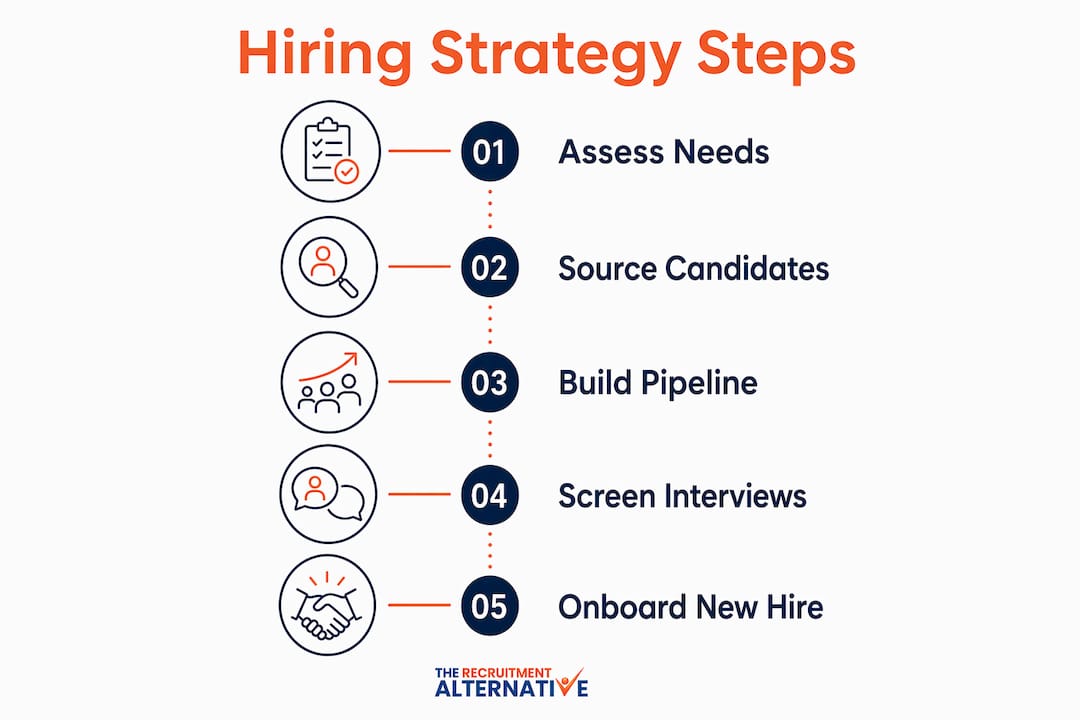
Reactive hiring is expensive in ways that rarely show up on a single invoice. When you fill roles under pressure, you compromise on candidate quality, pay premium agency fees, and absorb the productivity cost of a prolonged vacancy. A 12-month rolling hiring plan, updated every quarter, is the most practical way to stay ahead of demand rather than chasing it.
The mechanics are straightforward. Start with your business goals for the next four quarters: revenue targets, product launches, market expansion, or operational capacity milestones. Then work backwards to identify which roles are needed to hit those goals. Factor in your expected attrition rate. Most industries see significant annual turnover, which means if you have 20 people, you should plan for a few departures before the year is out.
Key principles for a rolling recruitment plan:
- Separate “committed” hires (approved, budgeted, certain) from “projected” hires (likely but contingent on milestones)
- Sequence roles by business priority, not by which hiring manager is loudest
- Build a recruitment calendar that maps each role to a target start date and works backwards to set sourcing milestones
- Review the plan quarterly with both department heads and finance, not just HR
- Adjust sequencing when pipeline velocity or business conditions shift
Pro Tip: Keep your plan in two tiers. Tier one covers roles you are actively sourcing now. Tier two covers roles you are building early pipelines for, so when a milestone is hit, you are not starting from scratch.
The quarterly review cadence matters more than most business owners realise. Experienced managers recommend formal quarterly reviews precisely because business conditions shift faster than annual planning cycles can accommodate. A plan that was right in January may need significant adjustment by April.
How to build a talent pipeline and use internal mobility well
A talent pipeline is a pool of candidates you have already identified and engaged before a role officially opens. This can significantly reduce the time-to-fill when a critical position becomes vacant. Building one takes consistent effort, but the payoff compounds over time.
Proactive sourcing tactics that work for Australian SMEs:
- Attend industry events and professional association meetups to build relationships with passive candidates
- Run a structured employee referral programme with clear incentives
- Maintain a talent pool in your applicant tracking system (ATS) from previous applications
- Use LinkedIn and industry-specific job boards to engage candidates before roles open
- Partner with universities and TAFE providers for entry-level and graduate pipelines
Internal mobility deserves equal attention. Filling roles with existing employees reduces hiring costs, accelerates time-to-productivity, and strengthens retention because internal candidates already understand your culture and processes. Before posting any role externally, run a structured internal expression of interest. You may already have the right person.
Employer branding supports both pipelines. A well-maintained careers page, genuine employee testimonials on LinkedIn, and a reputation for treating candidates professionally all reduce the effort required to attract quality applicants. For practical guidance on showcasing your employer brand online, there are proven approaches that translate directly to recruitment marketing.

Pro Tip: Aim for a balanced ratio of external hires to internal promotions or transfers. Too many external hires can erode culture; too few can stunt development and signal a ceiling to your best people.
Diversity and inclusion belong in pipeline strategy, not as an afterthought. Posting roles on platforms that reach underrepresented communities, removing unnecessary credential requirements, and using structured interviews with consistent scoring criteria all reduce bias and widen your candidate pool.
When and whom should you hire during a growth phase?
Timing a hire wrong costs more than not hiring at all. Bring someone on too early and you burn cash before they are productive. Wait too long and your existing team hits a capacity ceiling that slows revenue. The decision framework that works best ties hiring timing directly to financial runway and business milestones.
A practical runway threshold model:
- 18+ months of runway: hire ahead of growth. Capacity constraints will cost more than the burn.
- 12–18 months of runway: fill confirmed capacity gaps only. No speculative roles.
- Under 12 months: limit hires to backfills and roles with direct, near-term revenue attribution.
Force-ranking every open role by business impact is the most reliable way to allocate recruiting resources. The question to ask for each role: if this position stays vacant for another 60 days, what is the revenue impact, the project delay, or the customer risk? Roles where the answer is “significant” go to the top of the sourcing queue.
Criteria for prioritising hires in a growing business:
- Revenue-generating roles with a quantified business case (e.g., each new account manager adds $X in pipeline)
- Critical backfills where the team is currently understaffed and delivery is at risk
- Roles with long ramp times, which need to be filled early to minimise the productivity gap
- Growth roles that are approved but not immediately critical (begin sourcing in 30 days)
- Contingent roles that depend on a funding round, product launch, or contract win (build a warm pipeline in the background)
| Role tier | Sourcing action | Timing |
|---|---|---|
| Revenue-critical or critical backfill | Source immediately | Now |
| Approved growth role | Begin active sourcing | Within 30 days |
| Milestone-contingent role | Build passive pipeline | 60–90 days out |
Prioritising hires by business impact prevents the common mistake of trying to fill 10 roles simultaneously and doing all of them poorly. Concentrated effort on the highest-impact positions produces better candidates, faster decisions, and stronger outcomes.
How to manage hiring costs and integrate new staff effectively
The cost of a single hire varies widely, influenced by advertising, agency fees, recruiter time, and lost productivity during the vacancy; senior positions generally cost significantly more than entry-level roles. Building your budget bottom-up, role by role, gives you a far more accurate picture than working from a single aggregate number.
Cost components to account for per hire:
- Job advertising (job boards, sponsored posts, LinkedIn)
- Internal recruiter or hiring manager time (often underestimated, with several hours per hire for interviews alone)
- Agency fees where applicable
- ATS and assessment tool subscriptions
- Onboarding and training costs in the first 90 days
- Signing bonuses or relocation packages for specialist roles
Technology can meaningfully reduce per-hire costs at scale. AI sourcing tools significantly increase recruiter capacity by automating sourcing and initial screening, enabling a small internal team to manage a higher volume of roles without proportional headcount growth. For growing businesses that cannot justify a large internal talent acquisition team, this changes the cost equation considerably.
Onboarding quality directly affects whether a hire sticks. A defined hiring process with clear role ownership accelerates decision-making and improves the candidate experience, but the same clarity needs to extend into the first 90 days of employment. New starters who receive structured onboarding, clear early milestones, and regular check-ins are more likely to reach full productivity and stay longer-term.

Pro Tip: Never optimise purely for the lowest cost-per-hire. A cheaper process that produces a poor fit costs far more in turnover, retraining, and team disruption than a slightly more expensive hire who performs well and stays.
For businesses managing variable growth, flexible scheduling tools can also help coordinate interview panels and onboarding schedules without the administrative overhead that typically slows down the process.
Compliance, risk management, and adapting your hiring strategy for 2026
Australian employment law creates specific obligations that every growing business must embed into its recruitment process from the outset. Embedding compliance early prevents costly legal exposure and supports fair hiring practices, which matters both for risk management and for your employer brand.
Key compliance checkpoints for Australian businesses:
- Advertise roles with accurate salary ranges where required under state-based pay transparency obligations
- Apply consistent, documented selection criteria to every candidate to support defensible hiring decisions
- Conduct right-to-work checks before any offer is made, in line with the Migration Act 1958
- Comply with the Fair Work Act 2009 on employment contracts, probationary periods, and termination procedures
- Follow the Australian Human Rights Commission Act 1986 to avoid discriminatory screening or interview practices
- Store candidate data in accordance with the Privacy Act 1988 and the Australian Privacy Principles
- Conduct structured reference checks with documented outcomes
Technology plays a practical role in compliance. An ATS standardises the hiring process, creates an audit trail for every decision, and reduces the risk of inconsistent application of selection criteria. As hiring volume grows, manual coordination becomes a compliance liability.
The regulatory environment is not static. The Closing Loopholes Act amendments, updates to casual conversion rules, and evolving pay secrecy provisions all affect how Australian businesses recruit and contract staff. Build a formal review of your hiring policies into your annual planning cycle, not just when something goes wrong. Proactive compliance is significantly cheaper than reactive remediation.
How The Recruitment Alternative supports Australian businesses with scalable hiring
The Recruitment Alternative works with growing Australian businesses across a broad range of industries, including sales, administration, finance, engineering, healthcare, technology, trades, and executive leadership. The flat-fee model means clients pay a fixed price per placement rather than a percentage of salary, which produces material cost savings on mid-to-senior roles where traditional agency commissions can reach tens of thousands of dollars.
What sets the approach apart for SMEs:
- Fixed, transparent pricing with no commission surprises at offer stage
- Personalised service from experienced consultants who understand the specific demands of growing businesses
- Extensive candidate sourcing across active and passive talent pools nationally
- A proven recruitment process that covers briefing, sourcing, screening, shortlisting, and offer management
- Coverage across diverse Australian industries without the specialist agency premium
- Support for both permanent placements and roles requiring urgent turnaround
For businesses navigating a growth phase, the recruitment tips for hiring managers published by The Recruitment Alternative also provide practical guidance on running efficient processes internally, which complements the agency’s work rather than duplicating it.
The Recruitment Alternative’s track record spans businesses of all sizes throughout Australia, from early-stage companies making their first hires to established SMEs scaling across multiple states. The consistent feedback is that the fixed-fee model removes the financial uncertainty that makes growing businesses hesitant to engage professional recruitment support.
A smarter way to hire as your business grows
Growing businesses that need to hire well, hire consistently, and hire without blowing the budget have a clear alternative to traditional commission-based agencies. The Recruitment Alternative delivers full-service permanent recruitment at a fixed, affordable fee, covering everything from candidate sourcing and screening through to offer management, across virtually every industry and profession in Australia.
The practical difference is straightforward. Where a traditional agency charges a percentage of a candidate’s annual salary, The Recruitment Alternative charges a flat fee, regardless of the role’s salary level, resulting in significant cost savings on a single placement. Multiply that across a year of growth hiring and the savings fund additional headcount. For small and medium businesses that need to make every dollar count, this model changes what professional recruitment looks like in practice.
Get in touch with The Recruitment Alternative today to discuss your hiring plan and find out how the flat-fee model works for your specific growth stage.
Key takeaways
A structured hiring strategy aligned to business outcomes is the single most effective way for a growing Australian business to reduce cost-per-hire, accelerate time-to-fill, and avoid the disruption of reactive recruitment.
| Point | Details |
|---|---|
| Plan 12 months ahead | A rolling hiring plan updated quarterly keeps recruitment aligned with shifting business priorities and attrition. |
| Prioritise by business impact | Force-rank open roles by revenue risk and project delay; source the highest-impact positions first. |
| Budget role by role | Hiring costs vary widely—from $1,500 for entry-level roles up to $15,000 for senior positions, including agency fees and lost productivity—so budgeting should be per role, not as a single aggregate figure. |
| Embed compliance early | Australian employment law obligations, including right-to-work checks and fair selection criteria, must be built into the process from the start, not added later. |
| The Recruitment Alternative | Offers flat-fee permanent recruitment across all Australian industries, delivering professional hiring without commission-based pricing. |

