

A sourcing strategy in recruitment is the proactive plan and repeatable process for identifying, engaging, and warming candidates before they ever submit an application. It sits at the top of the talent acquisition funnel and rests on four core components: candidate personas, channel selection, personalised outreach, and measurable data. Done well, it compresses time-to-fill, raises the quality of candidates who reach interview, and removes the cost premium that comes with reactive, urgent hiring.
If you are starting from scratch or trying to fix a pipeline that keeps running dry, this guide gives you a clear definition, a practical 30/60/90 plan, Australia-relevant channel guidance, and the metrics to know whether it is working.
Table of Contents
- What sourcing strategy covers and where it fits in talent acquisition
- Why a formal sourcing strategy matters for your business
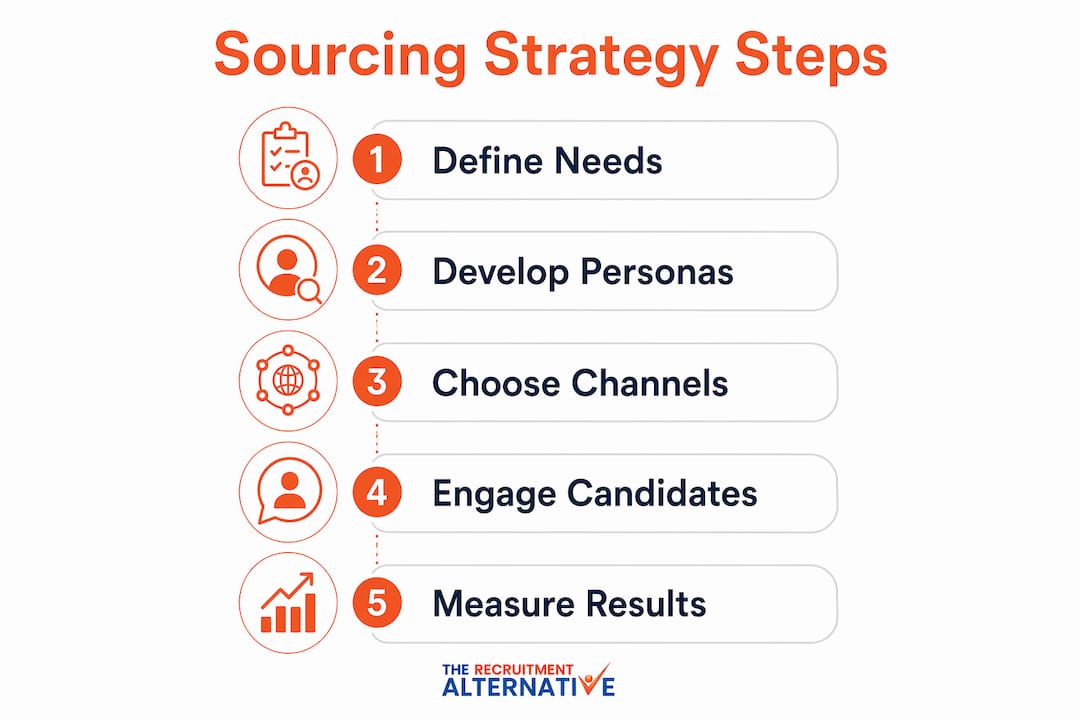
- The four core components every sourcing strategy needs
- Proven sourcing tactics and the right channels for each role type
- How to build your sourcing plan: a 30/60/90 timeline
- Which metrics tell you whether your sourcing is working
- Outreach templates and the rules that raise reply rates
- Common mistakes that derail sourcing efforts
- How Australian SMEs can apply sourcing strategy without overcomplicating it
- Key takeaways
- A perspective on sourcing strategy that most guides miss
- Flat-fee recruitment for Australian SMEs that want sourcing done for them
- Useful sources for Australian recruiters
What sourcing strategy covers and where it fits in talent acquisition
Sourcing in talent acquisition is the active, outbound effort to find and connect with potential candidates, particularly those who are not actively looking. Recruiting, by contrast, is the inbound and conversion work: reviewing applications, conducting interviews, and closing offers. The two functions are complementary but distinct, and confusing them leads to ownership gaps.
Sourcing owns:
- Pipeline volume (number of qualified prospects identified)
- Response rate to outreach
- Engagement rate (prospects who agree to a conversation)
- Source-of-hire attribution
Recruiting owns:
- Screening-to-interview conversion
- Offer acceptance rate
- Time-to-fill from role opening
- Cost-per-hire
The handoff point is the moment a candidate agrees to be considered for a specific role. At that point, the sourcer should pass a concise brief: outreach history, the candidate’s stated motivations, timeline availability, and any sensitivities noted during early conversations. Without that brief, the recruiter starts cold and the candidate notices.
Workforce and skills planning should precede sourcing activity. Hiring without clarity on what the organisation actually needs risks filling seats rather than solving problems.
Why a formal sourcing strategy matters for your business
Reactive hiring is expensive in ways that rarely appear on a single invoice. When a role sits vacant for weeks, productivity drops, remaining staff absorb extra load, and the pressure to fill quickly pushes teams toward the first available candidate rather than the right one.
A formal sourcing programme addresses this directly:
- Faster fills. Building candidate relationships before roles open means you have a warm pipeline to draw from the moment a position is approved, compressing time-to-fill by weeks.
- Better quality of hire. Sourced candidates are chosen from a curated pool rather than whoever happened to apply on a given Tuesday. You control the criteria from the start.
- Predictable pipeline. A maintained talent pool reduces the feast-or-famine cycle that plagues teams relying solely on job board postings.
- Lower urgent-hire premium. Rushed hires often cost more in agency fees, onboarding time, and early attrition. Sourcing reduces the frequency of those situations.
For SMEs, the gains are disproportionate. Even a simple, repeatable sourcing approach reduces rushed hires and protects brand and culture in smaller communities where reputation travels fast. A small business does not need an enterprise sourcing programme; it needs a few focused steps done consistently.
The four core components every sourcing strategy needs
A well-structured sourcing strategy includes four components. Each one needs to be locked down before execution begins.

1. Candidate personas
Define who you are looking for before you go looking. A persona captures the skills, experience level, career motivations, and preferred channels of your ideal candidate for each role type.
- Identify the must-have skills versus the nice-to-haves
- Note where this person currently works and what their career trajectory looks like
- Understand what would motivate them to move (growth, flexibility, mission, compensation)
2. Channel strategy
Map which sourcing channels suit each role type. Not every channel works for every hire.
- List the two or three primary channels per role type
- Assign a budget or time allocation to each
- Review channel performance quarterly and reallocate accordingly
3. Personalised outreach framework
Generic messages get ignored. Build templates that allow personalisation at scale.
- Draft a base message for each role category
- Identify the three personalisation variables: role-specific hook, mutual connection or shared context, and a clear reason for reaching out now
- Set a follow-up cadence before you send the first message
4. Measurement and data
Define what success looks like before the campaign starts.
- Set baseline targets for pipeline volume, response rate, and source-of-hire
- Use your ATS or CRM to tag candidates by source
- Review data monthly and adjust channel spend or outreach copy based on what the numbers show
Pro Tip: Define the handoff trigger before sourcing begins. Agree with your recruiting team on exactly what information must accompany every candidate who moves from sourced to active. A shared template with fields for outreach history, candidate interest level, and timeline prevents candidates from falling into a black hole between functions.
Proven sourcing tactics and the right channels for each role type
Choosing the right channel for the role type is where most sourcing plans either gain traction or stall. Here is how the major tactics map to different hire categories in Australia.

Employee referrals are the highest-ROI channel for most small businesses. Structured referral programmes materially improve retention and reduce cost-per-hire compared with general job boards. A modest referral bonus, adjusted according to role seniority and a clear process for submitting referrals are all that is needed to make this channel work consistently.
LinkedIn suits professional, technical, and management roles well. Boolean search strings let you filter by title, location, skills, and current employer. For Australian searches, add state-level location filters and industry-specific keywords to narrow results quickly.
SEEK remains the dominant general job board in Australia and works across most role types, particularly for volume hiring and roles where candidates are actively looking. Supplement it with industry-specific boards for niche searches: CareersInConstruction for trades, Ethical Jobs for not-for-profit, and Hatch for early-career tech roles.
Boolean and X-ray search extends your reach beyond LinkedIn to GitHub (for developers), ResearchGate (for scientists and researchers), and Google itself. A basic X-ray string such as site:linkedin.com/in "software engineer" "Melbourne" "Python" surfaces profiles that standard platform searches miss.
ATS and past candidates are an underused asset. Silver medallists — candidates who performed well but were not selected — are warm, pre-screened, and often still open to the right opportunity. Tag them in your ATS and re-engage before opening a new search.
Niche communities and events work well for technical and specialist roles. Meetup groups, industry conferences, Slack communities, and professional associations (Engineers Australia, CPA Australia, the Australian HR Institute) give you access to engaged professionals who are not actively job hunting.
Alumni networks are particularly effective for roles requiring specific institutional knowledge or cultural fit. University alumni portals and LinkedIn alumni filters are practical starting points.
| Channel | Best for | Australia-specific note |
|---|---|---|
| Employee referrals | All levels | Highest retention outcomes; incentivise formally |
| Professional, technical, management | Use state + industry filters | |
| SEEK | Volume, active candidates | Dominant Australian board |
| Boolean / X-ray | Technical, specialist | GitHub, ResearchGate, Google |
| ATS / past candidates | All levels | Tag silver medallists on exit |
| Niche boards | Specialist roles | CareersInConstruction, Ethical Jobs, Hatch |
| Events / communities | Technical, senior | Engineers Australia, AHRI, Meetup |
Pro Tip: Referral programmes work best when the process is frictionless. Give employees a single-page brief on the open role and a direct email address to submit names. The harder it is to refer, the fewer referrals you receive.
How to build your sourcing plan: a 30/60/90 timeline
Building a sourcing programme does not require months of preparation. A small talent team can be operational within 30 days if the steps are sequenced correctly.
- Audit current state. Review your last six months of hires: which channels produced them, how long each took, and what each cost.
- Define priority roles. Identify the two or three role types you hire most frequently or that cause the most disruption when vacant.
- Build candidate personas for each priority role using the framework above.
- Select two or three channels per role type and set a realistic budget.
- Draft outreach templates with personalisation variables built in.
- Set up ATS tagging so every sourced candidate is tracked by channel from day one.
- Define your metrics and create a simple dashboard (a spreadsheet works at small scale).
- Launch and track. Send the first outreach batch, record responses, and schedule a four-week review.
| Milestone | Priority actions | Expected outputs |
|---|---|---|
| 30 days | Audit, personas, channel selection, templates drafted | Sourcing plan documented; first outreach sent |
| 60 days | First pipeline review, channel performance data, ATS tags live | — |
| 90 days | Refine channels based on data, adjust outreach copy, referral programme launched | Warm pipeline for each priority role; source-of-hire data available |
Cost checkpoints for SMEs:
- LinkedIn Recruiter Lite costs vary monthly
- SEEK job postings costs vary depending on classification
- Referral bonuses vary depending on seniority
- ATS tools have varying monthly costs depending on the provider and package
- The total monthly outlay for a focused two-channel programme typically falls within a moderate range for most SMEs
Which metrics tell you whether your sourcing is working
Track fewer metrics well rather than many metrics poorly. For a new sourcing programme, start with five.
| Metric | Why it matters | Example benchmark |
|---|---|---|
| Pipeline volume | Shows whether you are reaching enough prospects | 15 qualified prospects per open role |
| Response rate | Measures outreach quality and message relevance | 15% for personalised outreach |
| Engagement-to-screen conversion | Tracks how many prospects agree to a conversation | — |
| Source-of-hire | Identifies which channels produce actual hires | Review monthly; shift budget to top two |
| Time-to-fill | Measures overall speed from role approval to offer accepted | Varies by role; track trend, not absolute |
Worked example — cost-per-hire calculation:
Total sourcing spend for a quarter (ads + tools + referral bonus): $3,200. Hires made from sourced candidates: 4. Cost-per-hire from sourcing: $800. Compare this against your previous reactive cost-per-hire to quantify the programme’s value.
According to Greenhouse, typical cost per hire and time to fill can be significant, and a maintained sourcing pipeline helps reduce both. A maintained sourcing pipeline reduces both figures by giving you pre-warmed candidates to draw from when a role opens.
Response rate is the metric to watch earliest. If personalised outreach is returning less than 15%, the message, the persona, or the channel is wrong. Fix one variable at a time and retest before drawing conclusions.
Outreach templates and the rules that raise reply rates
Most sourcing outreach fails at the subject line. Candidates receive generic messages daily; the ones that get replies are specific, brief, and clearly written for them rather than copied from a template.
A three-step outreach sequence:
-
Initial contact (Day 1). One short paragraph: who you are, why you are reaching out to this specific person, and a single low-friction ask (a 15-minute call, not a full application). Subject line: reference their role or a specific piece of their work.
-
Follow-up (Day 5–7). Two sentences. Acknowledge you know they are busy, restate the opportunity in one line, and offer an alternative format (a brief email exchange if a call does not suit). Do not apologise for following up.
-
Re-engage (Day 14–21). A final short note that leaves the door open without pressure. Mention you will keep them in mind for future roles and invite them to reach out when the timing is right.
Personalisation rules that matter:
- Reference something specific: a project, a publication, a mutual connection, or a career milestone
- State clearly why this role suits their background, not just why the company is great
- Keep the initial message under 100 words; longer messages signal the sender values their own time more than the recipient’s
Subject line guidance:
- Use their name and a specific reference: “Your work at [Company] — quick question”
- Avoid: “Exciting opportunity,” “Are you open to new roles?” or anything that reads as a mass send
Compliance note: Under Australian privacy law and the Spam Act 2003, commercial electronic messages require the sender’s identity to be clear, must include an opt-out mechanism, and must honour opt-out requests promptly. For recruitment outreach, this means including your name, agency or company, and a simple way for the candidate to ask not to be contacted again.
Pro Tip: Write the follow-up message before you send the first one. Having it ready removes the temptation to skip it when the first message goes unanswered, and a disciplined cadence is what separates sourcers who build pipelines from those who send one message and move on.
Common mistakes that derail sourcing efforts
Most sourcing programmes do not fail because of the wrong channel. They fail because of process gaps that compound over time.
- No handoff protocol. Candidates who move from sourced to active without a proper brief feel the discontinuity immediately. Define the handoff trigger and the information that must travel with every candidate.
- Starting too late. Sourcing that begins the day a role is approved is recruiting, not sourcing. The pipeline needs to exist before the vacancy does. Remediation: set a quarterly sourcing calendar for your most frequently hired roles.
- Over-indexing on one channel. A programme that relies entirely on LinkedIn is one algorithm change away from a dry pipeline. Maintain at least two active channels per role type.
- Neglecting nurture. Candidates who expressed interest six months ago are not lost; they are warm. A quarterly check-in email or a relevant article share keeps the relationship alive without pressure. Remediation: set a CRM reminder for every warm prospect at 90-day intervals.
- Poor screening criteria. Sourcing volume without quality filters wastes recruiter time and damages candidate experience. Define the minimum criteria for a prospect to enter the pipeline before outreach begins.
Red flag to watch: A high pipeline volume combined with a low engagement-to-screen conversion rate signals that the persona definition is off. You are reaching people, but not the right people. Revisit the persona before scaling outreach.
How Australian SMEs can apply sourcing strategy without overcomplicating it
SMEs have real advantages in sourcing that larger organisations do not: speed of decision-making, direct access to founders and leaders, and the ability to offer candidates genuine visibility and impact. The mistake is trying to replicate an enterprise sourcing stack with a team of one or two.
What to prioritise:
- Referrals first. Your existing team knows people. A structured referral programme with a clear bonus and a simple submission process costs little and produces high-retention hires.
- Pick one or two channels and work them well. SEEK plus LinkedIn covers most Australian role types. Add a niche board only when those two are producing consistent results.
- Use a simple CRM. Even a tagged spreadsheet or a free tier of a tool like Zoho Recruit or HubSpot CRM is enough to track outreach history and set follow-up reminders.
- Track 90-day retention as your quality-of-hire proxy. If sourced hires are staying, the programme is working.
SMEs that treat workforce decisions as part of an integrated system — auditing internal capability before external sourcing — reduce long-term recruitment spend and hire with more confidence. Before opening a search, ask whether the role could be filled through internal mobility or a restructure.
When to outsource sourcing versus build in-house:
| Scenario | Recommendation |
|---|---|
| Role is critical and time-to-fill risk is high | Outsource to a specialist or flat-fee recruiter |
| Role is complex or senior (management, executive) | Outsource; the network and screening expertise justify the cost |
| Internal capacity exists and role type is familiar | Build in-house with the framework above |
| Budget is constrained and role is volume/entry-level | In-house referrals and SEEK; consider outsourcing recruitment when time cost exceeds service cost |
For SMEs weighing the economics, the hidden costs of traditional recruitment — management time, productivity loss, and early attrition — often exceed the visible fee. A flat-fee model makes the comparison straightforward.
Key takeaways
A sourcing strategy in recruitment is the proactive, repeatable process of building candidate pipelines before roles open, and it consistently produces faster fills, better hires, and lower cost-per-hire than reactive approaches.
| Point | Details |
|---|---|
| Define before you source | Lock in candidate personas and channel selection before sending a single message. |
| Sourcing and recruiting are distinct | Sourcers own pipeline volume and response rate; recruiters own conversion and time-to-fill. |
| Referrals deliver the highest ROI | Structured referral programmes reduce cost-per-hire and improve retention, especially for SMEs. |
| Measure response rate first | Below 15% on personalised outreach signals a persona, message, or channel problem — fix one variable at a time. |
| The Recruitment Alternative | Offers flat-fee recruitment across Australia, giving SMEs a predictable-cost alternative to building sourcing in-house. |
A perspective on sourcing strategy that most guides miss
The conventional framing of sourcing strategy treats it as a volume problem: reach more people, fill more pipelines, send more messages. That framing is wrong, and it is why so many sourcing programmes produce activity without results.
The real value of a sourcing strategy is not speed. It is selection. When you build a pipeline before a role opens, you get to choose who you approach based on fit, not desperation. That shift in posture changes everything: the quality of conversations, the calibre of candidates who reach interview, and the retention outcomes after hire.
What most guides also understate is the maintenance burden. A sourcing pipeline is not a one-time build; it is an ongoing commitment. Candidates go cold, circumstances change, and a pipeline that was warm six months ago needs tending. Teams that treat sourcing as a project rather than a practice find themselves starting from scratch every time a role opens.
For SMEs specifically, the temptation is to skip sourcing entirely and rely on job boards when the need arises. That works until it does not: until the role is urgent, the board produces thin results, and the pressure to hire someone, anyone, overrides the discipline to hire the right person. The cost of that moment is rarely captured in a single invoice, but it shows up in turnover, culture, and the time managers spend managing a poor fit.
The teams that get sourcing right treat it like a fish farm rather than a fishing trip. Low-intensity, consistent engagement keeps pipelines warm and response rates higher when roles open. That discipline is available to any team, regardless of size, and it does not require expensive tooling to start.
Flat-fee recruitment for Australian SMEs that want sourcing done for them
Building a sourcing programme in-house takes time, tools, and consistent execution. For many Australian SMEs, the more practical option is a flat-fee recruitment service that delivers interview-ready candidates at a fixed, predictable cost — without the percentage-of-salary fee that makes traditional agencies expensive.
The Recruitment Alternative provides proactive candidate sourcing, screening, and a clear handoff to hiring managers across a broad range of industries and role types throughout Australia. The fixed-price model means you know the cost before the search begins, which makes budgeting straightforward and removes the financial risk of a prolonged search. For SMEs weighing the build-versus-buy decision, the simple flat-fee structure is worth reviewing against your current cost-per-hire. Get in touch with The Recruitment Alternative to discuss your next hire and see whether a fixed-fee search fits your situation.
Useful sources for Australian recruiters
- Greenhouse: what is sourcing strategy in recruitment — clear definition, KPI guidance, and practical pipeline-building steps from a leading ATS provider.
- Talentprise: talent sourcing strategy — current framing of proactive sourcing with channel and persona guidance.
- Paraform: strategic sourcing in recruitment — practical notes on how strategic sourcing compresses time-to-fill and raises quality.
- Recruitee: recruitment strategy — covers the four core components of a sourcing strategy with checklist-style guidance.
- FirstHR: recruitment strategies for small business — referral programme guidance and cost-per-hire benchmarks relevant to small teams.
- SEEK Employer — Australia’s dominant job board; essential for active-candidate sourcing across most role types.
- Australian HR Institute (AHRI) — professional body for HR practitioners in Australia; publishes workforce research and policy updates relevant to sourcing and talent strategy.
- The Recruitment Alternative — flat-fee recruitment for Australian SMEs; practical starting point for businesses that want sourcing support without a percentage-based fee.

