

To hire a network engineer in Australia, first decide whether you need someone to design your network or someone to run it day to day. Then write a specific job description, set pay against current market ranges, assess candidates on real troubleshooting, and complete screening before you make a formal offer. This guide takes you through each step. It also covers what a fixed-fee agency costs when you would rather not spend weeks sourcing candidates yourself.
TL;DR
- A network engineer designs and plans the network. A network administrator keeps it running and secure. Many small businesses need an administrator first, or one person who covers both.
- Name the platforms, certifications and years of experience you need. Vague briefs attract vague applications.
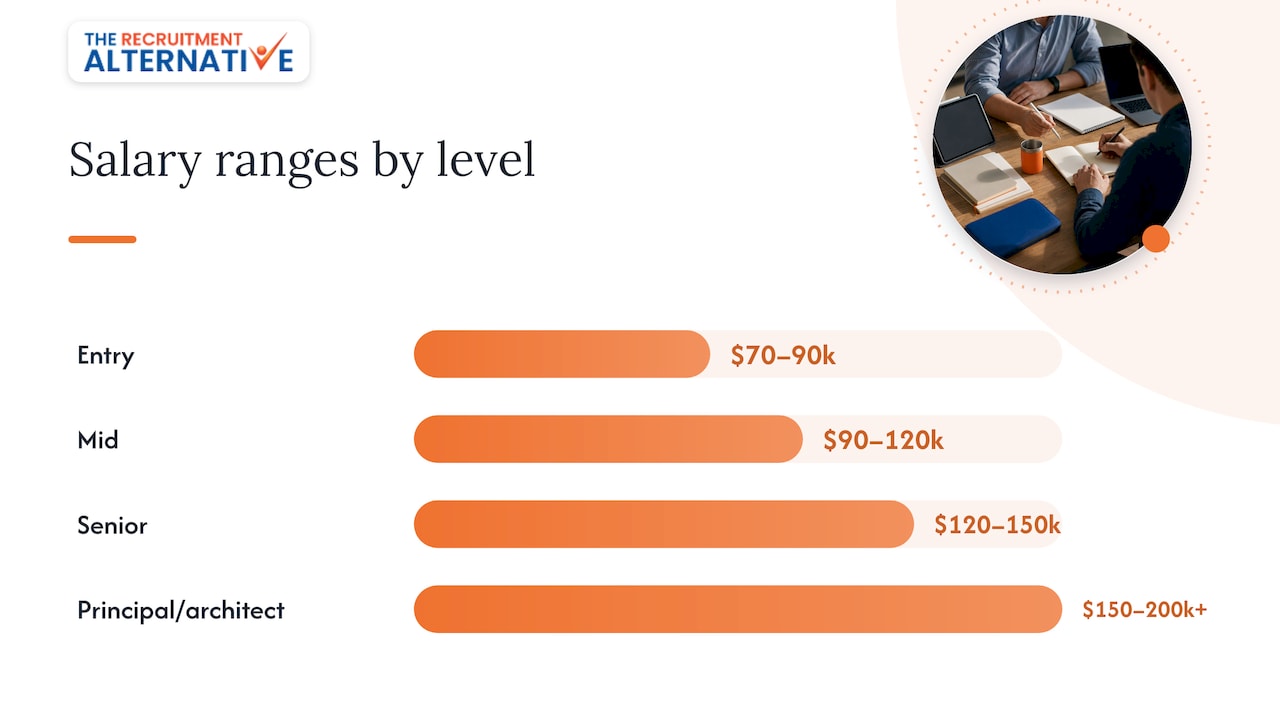
- Published benchmarks put mid-level pay at roughly $90,000 to $120,000 and senior pay at $120,000 to $150,000. Location and hands-on experience move those numbers.
- Assess candidates with live troubleshooting and design questions, then check references, credentials and work rights before the offer.
- With us, you pay a fixed engagement fee and a fixed placement fee, not a percentage of salary.
Table of Contents
- Network engineer or network administrator: which role do you need?
- What to put in the job description
- What to expect to pay
- Where to find network candidates
- How to assess network skills, problem-solving and communication
- Checks to complete before you make an offer
- Our perspective
- What fixed-fee recruitment costs with us
- Offer, onboarding and the cost of getting it wrong
- FAQ
- Sources
Network engineer or network administrator: which role do you need?
The two titles overlap, and job ads often mix them up. The distinction is worth getting right, because it changes the candidate pool and the salary.
According to SolarWinds’ IT glossary, a network administrator handles the day-to-day management and maintenance of a network. A network engineer focuses on the lifecycle of the network: its design and strategic implementation. In a larger enterprise, the engineer may oversee a team of administrators and work with them to resolve problems and improve efficiency.
The Australian Bureau of Statistics describes the Network Administrator occupation as installing and maintaining hardware and software, monitoring and optimising network environments, documenting the diagnosis and resolution of incidents, managing network security, and handling operational tasks such as help desk support and user training.
| Network engineer | Network administrator | |
|---|---|---|
| Main focus | Designing, building and improving the network | Running, monitoring and securing it day to day |
| Typical work | Architecture, wired and wireless rollouts, equipment strategy, performance planning | Incident response, user access, security policies, utilisation monitoring |
| Best fit | Growing businesses, new sites, migrations, cloud connectivity | Stable environments that need reliable support |
| Seniority | Often mid to senior | Entry to mid level, sometimes senior |
If you have one office, a handful of switches and a firewall, an administrator with solid troubleshooting skills is usually the practical hire. If you are opening sites, moving workloads to the cloud or redesigning your network, you need an engineer. Some small businesses hire one experienced person to do both, which is fine as long as the job description says so openly.
What to put in the job description
The most common hiring mistake is a vague brief. A guide from RefHub for Australian employers recommends specific wording, such as asking for an administrator with experience managing firewalls, VPNs and cloud services, rather than a general request for IT help. It also suggests listing responsibilities, required skills and preferred qualifications, and being honest about what is negotiable.
Australian government position descriptions are a useful model for what a thorough brief contains:
- The ANSTO Network Engineer specification asks for an IT degree, CCNA/CCNP or five years of equivalent experience. It also asks for experience configuring switches, routers and enterprise network systems, working with Cisco and Palo Alto technologies, diagnosing faults across layers 1 to 7, and designing and administering software-defined networking.
- The ASIS selection document for L4-L6 network roles lists support of Cisco or Juniper routers, switches and firewalls, monitoring and performance optimisation, troubleshooting outages, and exposure to cloud and virtualised networks. It treats CCNA as beneficial but not essential.
You do not need that level of detail for every role, but the structure carries over. Split your list into three groups.
Must-haves
Pick the few things the person cannot do without: the vendors you run (for example Cisco, Fortinet, Aruba or Juniper), the environment (on-premises, hybrid or cloud) and the level of independence you expect. A candidate who has only worked in a large team with a dedicated security group will behave differently from one who has been the sole IT person.
Nice-to-haves
Certifications such as CCNA, CCNP or vendor-specific credentials belong here unless a compliance requirement makes them mandatory. Allowing equivalent experience widens your pool without lowering the bar.
Working conditions
State the location, the on-site expectation, any after-hours or on-call duties, and the salary range. Candidates compare listings quickly, and a missing range often means a missing application.
If you are hiring across the wider technology function, our guide on how to recruit technology staff in Australia covers the wider picture.
What to expect to pay
Salary sources disagree at the edges, so treat any figure as a range and test it against live job ads in your city. These are the benchmarks we found, all in Australian dollars.
| Level | Experience | Range |
|---|---|---|
| Entry | 0 to 2 years | $70,000 to $90,000 |
| Mid | 3 to 5 years | $90,000 to $120,000 |
| Senior | 6 to 10 years | $120,000 to $150,000 |
| Principal or architect | 10+ years | $150,000 to $200,000+ |
Those bands come from Asanify’s 2025 guide to hiring network engineers in Australia.
Certification gives another reference point. Red Education’s 2026 Cisco salary guide puts CCNA holders at $85,000 to $110,000, CCNP holders at $115,000 to $145,000 and CCIE holders at $150,000 to $190,000+. The same guide says Sydney and Melbourne roles tend to sit at the top of the range, while regional and remote roles sit towards the bottom. It also notes that years of hands-on production experience matter more than how recently someone passed an exam.
For the broader IT market, ARN reported in June 2026 that only 40% of IT professionals in Australia and New Zealand are satisfied with their pay, and that 82% of organisations report skills shortages. For you, that means strong candidates are often open to a move but will compare offers, so a clear range and a prompt process matter.
A practical rule: set your range from the level of independence you need, not from the job title. A “network administrator” who must also design a site-to-site VPN and manage firewall policy is doing mid-level engineering work and should be paid like it.
Where to find network candidates
The channels that work for network roles are well established. Asanify’s guide lists specialised IT recruitment agencies, LinkedIn and Seek, IT job boards and communities, university and technical college career centres, vendor communities and certification directories, and industry events and professional associations.
Here is how to use them with a small team and limited time:
- Post on the major job boards first. Seek and LinkedIn give reach, but expect a high share of unsuitable applicants. A tight brief and a salary range reduce that.
- Use your own network. Ask your IT vendor, managed service provider or current staff who they would recommend. Good network people tend to know each other.
- Look to graduates for junior roles. University and TAFE career centres can supply entry-level administrators who you can develop on your own environment.
- Make applying simple. If you are advertising at events or on printed material, QR codes for hiring can send candidates straight to your application page.
- Consider a recruitment agency when the role is urgent or hard to fill. The right agency screens for you and presents a shortlist, which is worth the most when nobody on your team can judge technical depth.
If you are weighing local hires against offshore options, our page on hiring IT professionals locally or offshore sets out the trade-offs.
How to assess network skills, problem-solving and communication
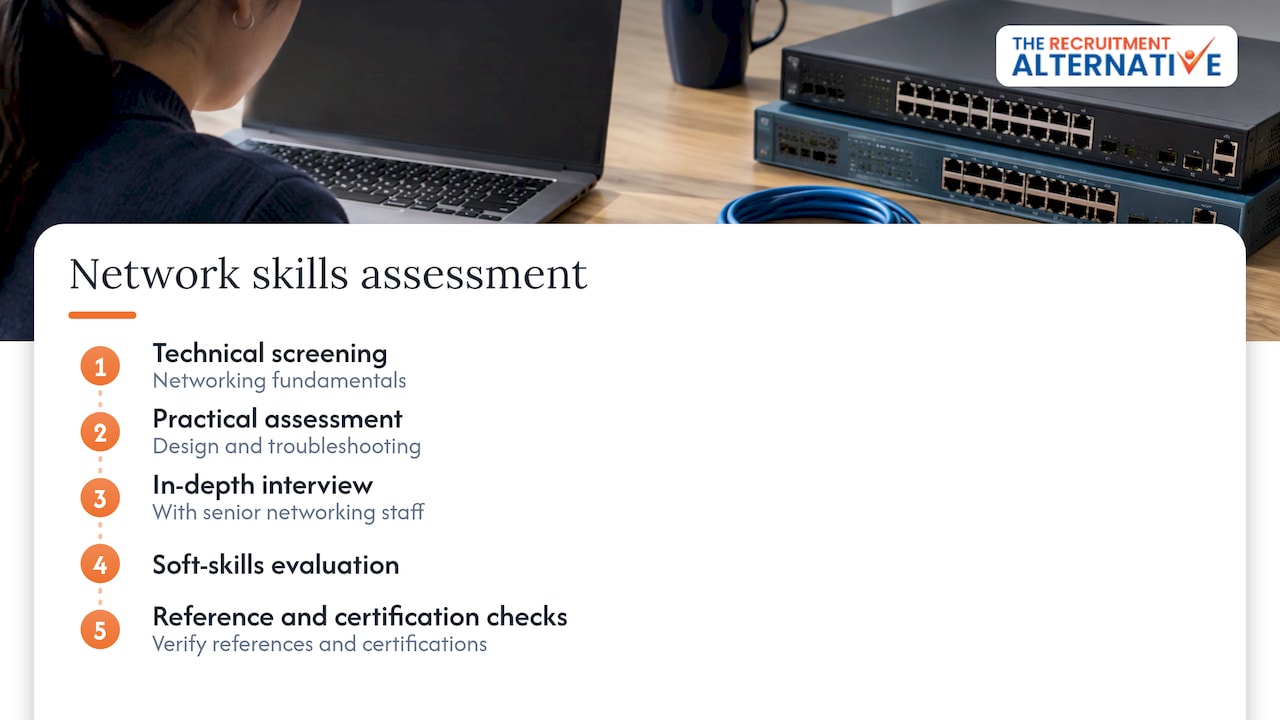
Asanify’s guide suggests a combination of technical screening interviews on networking fundamentals, practical design and troubleshooting assessments, in-depth interviews with senior networking staff, soft-skills evaluation, and reference and certification verification. That is a sound sequence, and you can scale it to your size.
Start with a short phone screen
A 20-minute call confirms experience, availability, salary expectations and communication style before anyone spends an hour on a technical interview. A guide to phone screen questions can help you prepare a consistent set so every candidate is treated the same way.
Test with scenarios, not trivia
Memorised answers prove little. Give candidates a realistic problem and ask them to talk through their approach:
- Users at one site can reach the internet but not a cloud application. Where do you start, and why?
- You are adding a second office. How would you design connectivity, addressing and failover?
- A switch stack is dropping packets intermittently. What do you check, in what order?
Listen for method. Strong candidates ask clarifying questions, work through layers logically and explain trade-offs. If you do not have an in-house expert, ask your managed service provider to sit in on the technical round.
Judge communication as seriously as configuration
Network staff explain outages to non-technical colleagues. Ask the candidate to describe a past incident as if speaking to your finance manager. Clear, calm and honest answers are a good sign.
Our engineer interview questions guide covers fair, structured interviewing for technical roles.
Checks to complete before you make an offer
A network engineer or administrator typically holds privileged access to your systems, so screening matters. The NSW Public Service Commission’s guidance is a useful public-sector reference. It says screening should be completed before a formal offer. If that is not possible, the offer can be conditional on satisfactory checks, but the person must not start work until they are complete. Employers decide which checks suit the role, which may include identity, work entitlement, qualifications, employment history, criminal history and licence checks. It also says candidate consent should be obtained.
For a policy framework that applies to organisations of any size, AS 4811:2022 sets out requirements and guidance for developing workforce screening principles, policies and processes.
For a network role, a sensible set is:
- Identity and right to work. Sight photo ID and confirm work entitlement.
- Qualifications and certifications. Verify them with the issuing body. One screening guide cites around 6% of applicants giving materially false information on their resumes, and gives the cost of a bad hire as between 30% and 200% of annual salary.
- Referees. Speak to at least two professional referees, ideally including a former manager.
- Criminal history check. Get written consent first. We offer this as an optional add-on at $129.
- Conditional offer. Make the offer subject to satisfactory results, not after the person has started.
The higher the access, the more thorough the checks should be. A careers-focused screening guide from CareerOne treats system administrator roles as high risk in the access category, with police and bankruptcy checks possible for senior roles.
Our perspective
Most small businesses we work with do not struggle to find a network engineer because there are none. They struggle because the hiring costs more than they planned for. A traditional agency fee calculated as a percentage of a $130,000 salary is a large bill, and the owner is often paying it while also covering the cost of an empty seat.
We built our model on the opposite idea. The fee should be known before the search starts, and it should not rise because the candidate is good. Our tiers depend on the salary band of the role, and every amount is published, so you can budget with confidence.
For technical roles, we recommend a short brief with clear must-haves, a realistic salary range and a structured assessment. Those three things do more for hire quality than any amount of advertising. Where you want a deeper assessment, our optional psychometric evaluation is $199 per candidate, and our replacement guarantee gives you cover if the hire does not work out in the first two to three months.
We would rather you spend your budget on the right person than on a percentage.
Josh Townsend
What fixed-fee recruitment costs with us
If you want help with shortlisting, our pricing is published and based on the candidate’s salary, not a percentage of it. There are two service levels, each with an engagement fee and a placement fee.
| Engagement fee | Placement fee | |
|---|---|---|
| Recruit | $895 | $3,900 to $5,000 |
| Recruit+ | $2,495 | $5,000 to $6,000 |
Optional extras are a criminal check at $129 and a psychometric evaluation at $199 per candidate. If a placement does not work out, a Replacement Campaign costs $1,000. We claim savings of over 70% compared with commission-based agencies, and the full detail is on our flat-fee pricing page.

We recruit permanent staff across Australia and New Zealand, including technology and engineering roles. To see how the fees compare with commission models, read our page on engineering recruitment fees in Australia, or start from our fixed-fee recruitment service.
Offer, onboarding and the cost of getting it wrong
A bad hire is expensive in time as well as money. A 2017 survey reported by Travel Weekly found nearly three in four employers had hired the wrong person, with an average loss of almost AU$20,000 per bad hire. The most common reasons were assuming the candidate could learn quickly, qualifications that were not true, and taking a chance on a likeable person. Each of those is addressed by the steps above: a clear brief, verified credentials and a structured assessment.
Once you have chosen your candidate, move quickly. Capable network people are rarely unemployed for long. Confirm the offer in writing, make it conditional on checks, and plan the first week: system access, a walkthrough of your network diagram, documentation, and a named person to ask questions. Clear expectations at the start make the probation period more useful for both sides.
FAQ
How long does it take to hire a network engineer in Australia?
It depends on seniority, location and how specific your brief is. Senior and specialised roles usually take longer because fewer candidates are looking. A precise job description, a published salary range and a short, fast interview process are the factors you control.
Should I hire a network engineer or a network administrator?
Hire an administrator if the main need is keeping an existing network running and secure. Hire an engineer if you are designing, expanding or migrating a network. In a small business, one experienced person can cover both if the job description says so.
Do I need to pay for a criminal check on a network role?
No law requires one for every role, and employers choose checks to suit the position. Because network staff hold privileged access, many employers include one, with the candidate’s written consent. We offer an optional criminal check at $129.
What happens if the hire does not work out?
Our candidate replacement cover applies if a hire does not work out in the first two to three months, and a Replacement Campaign costs $1,000. Details are on our replacement page.
Sources
- What Is Network Administration? SolarWinds IT Glossary
- Occupation 272132 Network Administrator, Australian Bureau of Statistics
- PD-2075 Network Engineer, ANSTO
- ICT Infrastructure Engineer selection document, ASIS
- A Guide to How to Hire an IT Professional, RefHub
- Hire Network Engineers in Australia, Asanify
- Cisco Certification Salary Guide 2026, Red Education
- IT and tech workforce face pay gaps, skills pressure and AI uncertainty, ARN
- Pre-employment screening checks, NSW Public Service Commission
- AS 4811:2022, Standards Australia Store
- Pre-Employment Screening Checklist for Australian Employers, RefChecks
- The 5 Ps of a successful employment screening framework, CareerOne
- 74% of employers have made bad hires, Travel Weekly
- QR Codes for Hiring, QRlytics
- Phone Screen Questions, ResumeMatch

