

A candidate database is a searchable, governed repository of candidate profiles, metadata, activity logs, and consent records. It is the first place you should check when a new vacancy lands on your desk. Before you post to a job board or brief a sourcer, open your database, run a saved search for your most-hired role type, and filter for profiles updated recently. That single habit separates teams that reduce sourcing cost from those that repeat the same external spend on every requisition.
- Check recency first. Filter for profiles last updated recently before running any Boolean query.
- Run a saved search. If you have a master query for the role, use it. If you do not, build one today from the search that found your last successful hire.
- Treat it as a signal layer. A well-maintained database reduces repeat external sourcing and shortens time-to-hire when it is used proactively, not as passive storage.
Pro Tip: Set a recurring calendar reminder every Monday to check your saved searches before opening any job board. The discipline of checking internally first compounds over months into measurable sourcing cost savings.
Table of Contents
- What does a candidate database actually contain?
- How do candidate databases work under the hood?
- How do you build and maintain a working candidate database?
- What search and retrieval habits should recruiters use every day?
- What are the Australian privacy and governance requirements for candidate data?
- Which integrations and automation features add the most value?
- What KPIs tell you whether your candidate database is healthy?
- What does the research say about database-driven sourcing gains?
- Key takeaways
- The database is only as good as the discipline behind it
- Prefer to outsource the database work entirely?
- Useful sources and further reading
What does a candidate database actually contain?
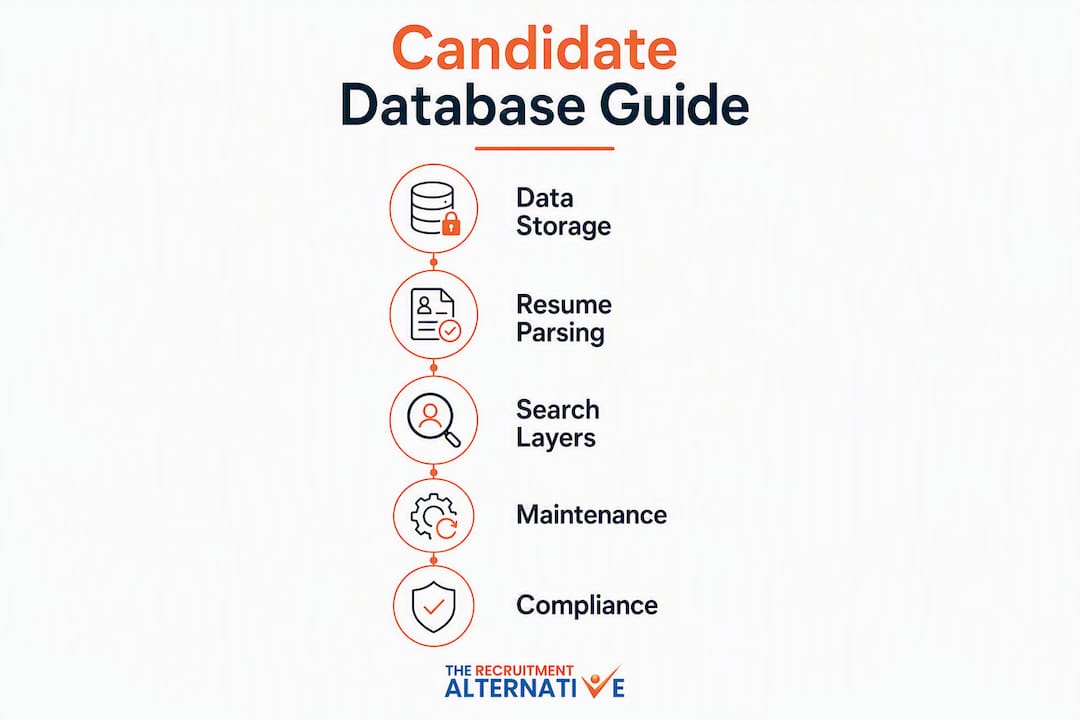
At its core, a candidate database holds structured records about people who have applied for, been sourced for, or expressed interest in roles at your organisation. Each record typically contains a candidate profile (name, contact details, location, work rights), parsed CV fields (job titles, employers, dates, skills, qualifications), tags and labels applied by recruiters, an activity history (emails sent, calls logged, interview outcomes), uploaded documents, and consent or privacy logs.
The distinction from a job board is fundamental. Job boards are reactive: candidates come to you when they are actively looking. A candidate database is proactive. You hold the records and you initiate contact. That shift in posture is what makes the database a sourcing asset rather than an inbox.
A candidate database is not a filing cabinet. It is a living signal layer that encodes your team’s institutional knowledge about people: who interviewed well, who relocated, who is available in six months. The moment you stop treating it as storage and start treating it as intelligence, your sourcing economics change.
Inside a recruitment team, different roles interact with the database differently. Sourcers add new records and enrich existing ones. Recruiters run searches, apply tags, and log activity after every touchpoint. Hiring managers may have read-only access to shortlists. Sourcer-analysts build and maintain saved queries and monitor data quality metrics. Compliance officers oversee consent logs, retention schedules, and subject access requests. Each role depends on the others: a sourcer who skips tagging makes the recruiter’s search harder; a recruiter who never logs call outcomes removes signal that a sourcer needs for re-engagement.
How do candidate databases work under the hood?
Understanding the technical architecture helps you diagnose search failures, set realistic expectations about latency, and have informed conversations with your ATS vendor.
The typical data architecture
Most modern candidate databases pair a relational database with a search index. The relational store, commonly PostgreSQL or a similar SQL engine, holds structured records: one row per candidate, with columns for each field. This is where data integrity lives. The search index, typically Elasticsearch or OpenSearch, is a separate layer that indexes those records for fast, flexible full-text queries. When you type a keyword or run a Boolean string, you are querying the index, not the relational store directly. The index trades some write-speed for dramatically faster reads across millions of records.

This architecture explains a common recruiter frustration: you update a candidate’s record and the change does not appear in search results immediately. That delay is index replication lag, usually seconds to minutes depending on configuration. It is not a bug; it is the cost of fast search at scale.
Resume parsing and why it matters
Resume parsing converts unstructured PDFs, DOCX files, and scanned documents into structured fields that filters and Boolean queries can actually use. A parser reads a CV and extracts job titles, employers, employment dates, skills, education, and location into discrete database columns. The quality of that extraction determines whether your filters work. A parser that misreads a job title or conflates two roles into one will cause candidates to disappear from searches they should appear in.
Modern parsers use natural language processing to handle formatting variation: different CV layouts, abbreviations, and date formats. The practical implication is that you should test your parser against a sample of real CVs from your market before trusting filter results at scale.
Search layers compared
| Search type | How it works | Best used for | Limitation |
|---|---|---|---|
| Filter-based | Matches exact field values (location, experience band, work rights) | Narrowing a large pool quickly | Misses synonyms and non-standard field entries |
| Boolean | Logical operators (AND, OR, NOT) on keyword fields | Precise skill combinations | Brittle with >5–6 clauses; misses semantic variants |
| Semantic / AI matching | Embeds query and profiles as vectors; ranks by conceptual similarity | Surfacing non-obvious matches | Less transparent; requires human validation |
| Saved search | Stored query replayed on demand | Recurring roles; institutional knowledge retention | Degrades if underlying data quality drops |
How do you build and maintain a working candidate database?
Building a database that your team actually uses requires deliberate design upfront and consistent operational habits afterwards. The following six steps apply whether you are starting from scratch or overhauling an existing system.
-
Design a minimal, consistent schema. Decide on mandatory fields before the first record enters the system: full name, primary email, phone, location, current or most recent job title, work rights status, and source. Mandatory fields reduce noise at intake and make filters reliable. Resist the temptation to capture everything; a lean schema with high completion rates outperforms a rich schema with patchy data.
-
Bulk import, parse, and dedupe. When migrating existing records, run a deduplication pass before and after import. Match on email address first, then on name plus phone. Set up validation rules at every entry point so duplicates cannot re-enter through web forms or ATS integrations. AI parsers can process a CV in roughly 90 seconds compared to approximately 12 minutes for manual entry, which makes bulk parsing the only practical approach for volumes above a few hundred records.
-
Build a controlled tagging taxonomy. Tags encode the subjective judgements that parsed fields cannot capture: ‘silver-medalist’, ‘strong-culture-fit’, ‘relocating-2026’, ‘available-Q3’. Create a governed list of approved tags, assign one owner for tag governance, and retire unused tags quarterly. Automated tagging from application behaviour (pipeline stage reached, response time, assessment score) prevents manual backlogs in databases with more than 1,000 profiles.
-
Implement retention policies and consent capture. Every record must have a lawful basis for storage and outreach. Capture consent at the point of application or sourcing, log it with a timestamp, and set automated expiry at 24–36 months unless the candidate renews consent or there is a documented business reason to retain the record longer. This is not optional under Australian privacy law; the section on governance below covers the specifics.
-
Automate enrichment and re-engagement. Contact data goes stale quickly without proactive validation. Schedule enrichment jobs to verify email addresses and phone numbers, and build re-engagement sequences that trigger when a candidate’s record approaches its expiry date or when a relevant role opens. Personalised outreach to recent high-value segments consistently outperforms cold sourcing.
-
Save master queries and document governance. Saved searches convert one-off query work into reusable assets that compound value over time. Build your master query from the search that found your last successful hire for that role type, then validate it by confirming the query would have returned that hire. Document who owns each saved search, when it was last reviewed, and what role it serves.
Pro Tip: Before saving any master query, run it against your current database and review the top 10 results. If fewer than 7 of those 10 are genuinely relevant, refine the query before saving it as canonical.
What search and retrieval habits should recruiters use every day?
Efficient search discipline is what separates a recruiter who trusts their database from one who defaults to LinkedIn for every role. The recommended three-step pattern is straightforward and reproducible under deadline pressure.
- Step 1: Apply 2–3 broad filters. Start with location, experience band (years in role or seniority level), and a key tag or work rights status. This narrows the pool without over-constraining it.
- Step 2: Add one Boolean skill clause. A single, well-constructed Boolean string on the skills or job title field adds precision without brittleness. Keep it to 3–4 terms connected by OR within a group, then AND to the filters. Queries with more than 5–6 Boolean clauses become fragile and return inconsistent results as data quality varies.
- Step 3: Sort by recency. Once the filtered results are returned, sort by last-updated date and prioritise profiles touched within the last 30–90 days. A technically qualified candidate whose record has not been updated in 18 months is a lower-probability contact than one who responded to an email last month.
On tagging versus keywords: use tags for subjective judgements and parsed fields for measurable skills. Searching for ‘strong-culture-fit’ as a keyword will return nothing; searching for it as a tag returns every record where a recruiter made that call. The distinction matters because machines cannot infer interview outcomes or fit nuances from CV text alone.
Pro Tip: Name your saved searches with a consistent convention: [Role Type] + [Location] + [Date saved]. For example: “Senior Accountant Sydney 2026-03”. This makes it easy to identify stale queries during quarterly reviews.

What are the Australian privacy and governance requirements for candidate data?
Governance is not a compliance checkbox. It is the operational foundation that keeps the database trustworthy and legally defensible. For Australian recruiters, the primary framework is the Privacy Act 1988 and the Australian Privacy Principles (APPs) administered by the Office of the Australian Information Commissioner (OAIC).
Retention, consent, and deletion
- Retain records for no longer than necessary. Practitioner guidance recommends a default window of 24–36 months, after which records should be deleted or anonymised unless the candidate has provided renewed consent or a documented business reason exists.
- Capture consent at intake: a clear, specific statement of how the candidate’s data will be used, stored, and shared. Timestamp every consent event and log it against the candidate record.
- Provide a mechanism for candidates to request access to their data, correct inaccuracies, or request deletion. Under the Privacy Act, individuals have the right to access personal information held about them, and organisations must respond within a reasonable timeframe (the OAIC guidance references 30 days as a practical standard).
- Log every subject access request, its outcome, and the date of resolution.
Operational controls
- Deduplication: run scheduled deduplication jobs, not just at import. Duplicate records create compliance risk because deletion requests may only remove one copy.
- Contact refresh: validate email and phone data on a scheduled basis and at first outreach. Stale contact data is both a sourcing failure and a data quality risk.
- Role-based access: restrict access to candidate records by role. Sourcers need read/write on profiles; hiring managers typically need read-only on shortlists; only compliance officers and senior administrators should access consent logs and deletion queues.
- Encryption: candidate data should be encrypted at rest and in transit. This is a baseline expectation for any ATS or database handling personal information under Australian law.
- Backup and disaster recovery: maintain regular backups with tested restoration procedures. A database that cannot be restored after a failure is a liability, not an asset. Document recovery time objectives (RTO) and recovery point objectives (RPO) and test them at least annually.
Compliance-first design, including consent capture, automated expiry, and subject access logging, is now a core operational requirement for sustainable talent acquisition practice in Australia, not an optional layer to add later.
Which integrations and automation features add the most value?
A candidate database in isolation is less useful than one connected to the tools your team uses every day. The highest-value integrations are those that reduce manual data entry, keep records current, and surface the right candidates at the right moment.
- ATS pipelines: — bidirectional sync between your ATS and candidate database means that every application, stage change, and outcome is logged against the candidate record automatically. This is the foundation of activity history.
On AI and semantic search: semantic matching ranks candidates by conceptual similarity to a role description rather than exact keyword overlap. This surfaces candidates who use different terminology for the same skills, which Boolean search misses. The caveat is transparency: AI match scores should be treated as a starting point for human review, not a final ranking. Over-reliance on AI scoring without human validation introduces bias risk and reduces the recruiter’s ability to explain a shortlist decision. The risks of AI in recruitment are worth understanding before automating shortlisting decisions.
Pro Tip: When evaluating enrichment providers, test accuracy on Australian mobile numbers and email domains specifically. Many enrichment tools are calibrated on US data and perform poorly on Australian contact records.
What KPIs tell you whether your candidate database is healthy?
Measuring database health gives you the evidence to justify investment in tooling, governance, and headcount. These five metrics form a practical monthly dashboard.
| KPI | Definition | Target range | Measurement cadence |
|---|---|---|---|
| Internal fill rate | Hires sourced from the database ÷ total hires | 30% for mature databases | Monthly |
| Time-to-shortlist | Days from role open to first shortlist sent | Trending down over 6 months | Per role; monthly average |
| Contact accuracy rate | Valid email + phone records ÷ total active records | >80% | Monthly |
| Re-engagement response rate | Replies to re-engagement outreach ÷ messages sent | 15–25% for warm segments | Per campaign |
| Duplicate rate | Duplicate records identified ÷ total records | <3% | Monthly |
Beyond the table, a few additional signals are worth tracking:
- Tag coverage rate: the percentage of records with at least one recruiter-applied tag. Low tag coverage means the database is storing CVs, not intelligence.
- Saved search utilisation: how often saved searches are run versus new ad hoc queries. High ad hoc query rates suggest saved searches are not being maintained or trusted.
- Record age distribution: the proportion of records last updated within 30 days, 31–90 days, 91–180 days, and over 180 days. A healthy database has a high proportion in the 0–90 day band.
What does the research say about database-driven sourcing gains?
The evidence for treating a candidate database as a primary sourcing channel rather than a backup is consistent across practitioner research. Teams that activate their database through tagging, saved queries, and re-engagement sequences reduce their dependence on external sourcing spend and shorten time-to-hire for repeat role types.
The parsing speed differential is concrete: manual CV entry takes approximately 12 minutes per candidate, while AI parsing completes the same task in roughly 90 seconds. Across a bulk import of 500 records, that difference is roughly 95 hours of manual work versus under 13 hours of automated processing. At scale, the argument for investing in parsing quality is straightforward.
The highest-performing recruitment teams do not use their database as a last resort after job boards have failed. They use it as the first port of call for every requisition, and they build saved queries that make that first check take minutes, not hours.
The practical illustration of this is the master query. A recruiter who has built and validated a saved search for a recurring role type, say a mid-level accountant in Sydney, can open a new requisition, run the query, and have a shortlist of warm, recently-contacted candidates within 30 minutes. The same search conducted from scratch on external platforms typically takes two to three days. That time difference compounds across every repeat role in a financial year.
The re-engagement response rate benchmark of 15–25% for warm segments reflects the value of maintaining relationship continuity. A candidate who interviewed six months ago and received a personalised follow-up is far more likely to respond than a cold-sourced contact. Strong candidate-recruiter relationships are built through consistent, relevant communication, and the database is the infrastructure that makes that communication possible at scale.
Key takeaways
A well-governed candidate database, used as a proactive signal layer rather than passive storage, reduces external sourcing cost and shortens time-to-hire for every repeat role type.
| Point | Details |
|---|---|
| Schema and recency first | Design mandatory fields before intake and filter for profiles updated within 30–90 days before any external search. |
| Build and save master queries | Validate each saved search against your last successful hire for that role, then save it as the canonical query. |
| Govern tags with one owner | Assign a single owner for tag taxonomy, retire unused tags quarterly, and automate tags from application behaviour at scale. |
| Embed Australian privacy compliance | Default retention to a couple of years, capture timestamped consent at intake, and log every subject access request. |
| Measure five core KPIs monthly | Track internal fill rate, time-to-shortlist, contact accuracy, re-engagement response rate, and duplicate rate on a monthly dashboard. |
| The Recruitment Alternative approach | The Recruitment Alternative uses specialist candidate databases to shorten time-to-fill for Australian employers, with flat-fee pricing that removes the cost barrier to professional recruitment. |
The database is only as good as the discipline behind it
Most of the candidate database problems I see in Australian recruitment come down to one thing: the system was set up, and then the habits were not. A well-configured ATS with clean parsing and a sensible schema will degrade within six months if nobody owns the tag taxonomy, nobody runs the deduplication job, and nobody validates contact data before a re-engagement campaign goes out.
The ‘signal layer’ framing matters here. A database that stores CVs is passive. A database that encodes recruiter judgements, tracks relationship history, and surfaces warm candidates through saved queries is active intelligence. The difference is not the software. It is the operational discipline: who owns each saved search, who retires stale tags, who checks the contact accuracy rate each month.
There is also a tendency in Australian TA teams to over-invest in AI matching features before the underlying data quality justifies it. Semantic search and AI scoring are genuinely useful, but they amplify whatever is already in the database. Feed them stale, untagged, poorly-parsed records and you get confident-looking results that are wrong. Fix the data first. The AI features become valuable once the foundation is solid.
The compliance piece deserves the same seriousness. The OAIC’s guidance on the Privacy Act is not ambiguous about the obligations around personal data retention and consent. Treating compliance as an afterthought, or assuming the ATS vendor handles it automatically, is a risk that Australian recruitment teams cannot afford. Build the consent capture, the retention schedule, and the subject access request process into the database from day one.
Prefer to outsource the database work entirely?
Not every recruitment team has the capacity to build and maintain a candidate database at the standard this guide describes. For businesses that need to fill roles quickly, lack the internal TA infrastructure, or are hiring in specialist areas where database depth takes years to build, outsourcing to a specialist agency is a practical alternative.
The Recruitment Alternative gives Australian employers access to specialist candidate databases built and maintained by experienced recruiters across sales, administration, finance, engineering, healthcare, technology, trades, and executive leadership. The flat-fee model means you pay a fixed price per placement, not a percentage of salary, so the cost of a well-resourced database search does not scale with the seniority of the role. There is no retainer, no lock-in, and no commission structure inflating the final invoice.
For employers who want the sourcing depth of a mature candidate database without the overhead of running one, the next step is straightforward: view the flat-fee recruitment offer or start a recruitment brief to discuss your current vacancy.
Useful sources and further reading
- Office of the Australian Information Commissioner (OAIC) — Privacy Act guidance: The primary source for Australian privacy obligations relevant to candidate data, including the Australian Privacy Principles and individual rights of access and correction.
- How to Build a Candidate Database That Your Team Will Actually Use (Tree Garden): Practitioner-focused guide covering data hygiene, retention policies, re-engagement cadences, and the signal-layer framing used throughout this article.
- Searchable Candidate Database: Tags, Filters and Smart Search (Hirium): Detailed operational guide on Boolean search discipline, tagging governance, saved searches, and automated tagging for larger databases.
- How Applicant Tracking Systems Work: Technical Guide to ATS Architecture and Resume Parsing (CrawlJobs): Technical explanation of relational database and search index architecture, useful for understanding why search latency and parsing accuracy matter.
- Candidate Database Guide: How to build and manage an effective talent pool (SimpleOne): Accessible overview of candidate database components and their role in the hiring process, suitable for teams new to structured database management.
- Resume Database Search: Complete Guide for Recruiters (Talentprise): Covers master query construction and calibration techniques, including the validation step of confirming a saved search would have returned your last successful hire.

