

Recruitment is the strategic process of acquiring talent that directly fuels business growth by aligning hiring decisions with organisational goals and market realities. For Australian SME owners, understanding how recruitment supports business growth is the difference between scaling with confidence and stalling under the weight of the wrong hires. The right talent acquisition approach lifts productivity, reduces costly turnover, and builds the workforce capacity your business needs to compete. This article covers the frameworks, evidence, and practical steps that turn hiring from an administrative task into a genuine growth engine.
How strategic recruitment frameworks reduce costs and accelerate growth
Tactical hiring and strategic talent acquisition are not the same thing. Tactical hiring fills a vacancy. Strategic talent acquisition builds a workforce that compounds in value over time. The distinction matters because companies with mature talent acquisition systems pay 25–40% less per hire than those using reactive recruiting methods. That cost gap widens significantly over a three to five year period, making early investment in a structured approach one of the highest-return decisions an SME can make.
A seven-pillar strategic framework elevates recruitment from operational to strategic. The seven pillars are:
- Workforce planning — forecasting headcount needs before vacancies arise
- Employer branding — shaping how candidates perceive your business
- Multi-channel sourcing — reaching talent across job boards, referrals, and social platforms
- Candidate experience — treating applicants with the same care as customers
- Assessment design — using structured interviews and skills testing to reduce bias
- Technology integration — deploying applicant tracking systems and recruitment analytics
- Analytics and reporting — measuring outcomes and refining the process continuously
Each pillar reinforces the others. A business with strong employer branding attracts better candidates. Better candidates improve assessment quality. Improved assessment quality reduces mis-hires. Fewer mis-hires lower turnover costs. The compounding effect is real, and it starts from the first pillar you build.
Pro Tip: Start with workforce planning before you post a single role. Map your growth targets for the next 12 months and work backwards to identify which roles you need to fill and when. This one step prevents the reactive scramble that inflates hiring costs.

What measurable business outcomes result from effective recruitment?
The clearest proof of recruitment’s impact on growth comes from organisations that have measured it rigorously. Pandora, the global jewellery retailer, is the most cited example in recent recruitment literature. Pandora’s strategic recruitment overhaul cut administration by 64%, reduced time-to-hire from 38 days to 15 days, and generated $35 million in added sales value. That is not a marginal improvement. It is a structural shift in how the business operates.
The metrics behind that result are worth examining closely.
| Metric | Before | After |
|---|---|---|
| Time-to-hire | 38 days | 15 days |
| Q4 hiring turnaround | Weeks | Under 5 days |
| Attrition rate | Baseline | Down 25% |
| Candidate satisfaction | Not measured | 9.7 out of 10 |
| Administrative burden | High | Reduced by 64% |
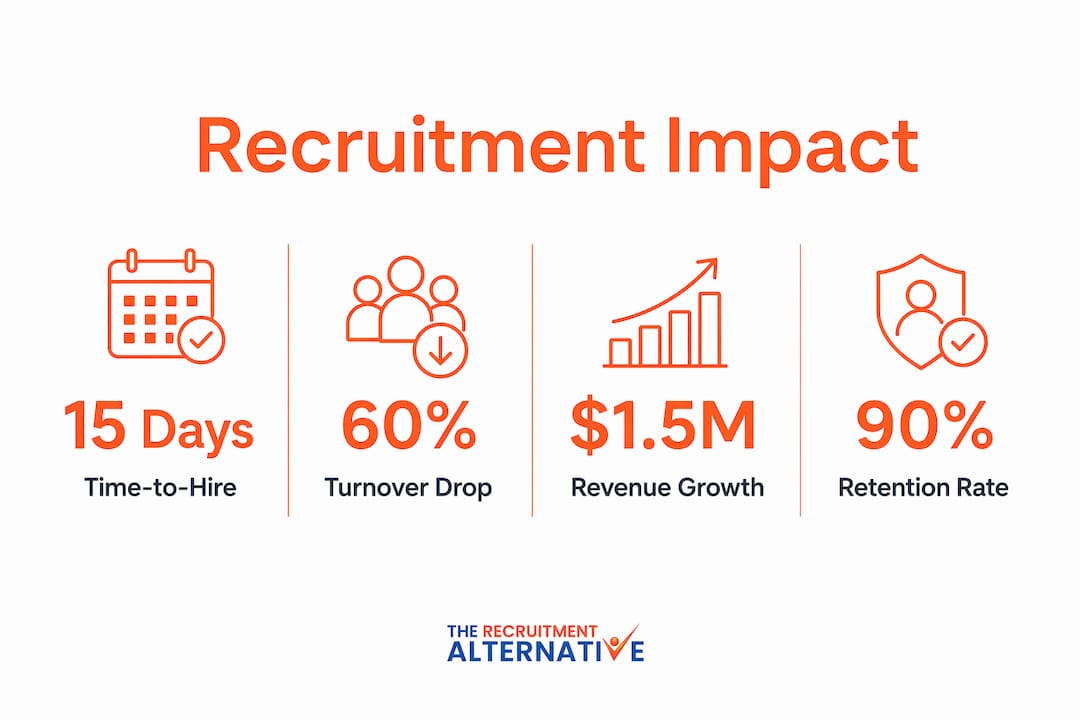
Each of these numbers connects to a business outcome. Faster hiring means fewer days of lost productivity from unfilled roles. Lower attrition means less money spent replacing staff who leave. Higher candidate satisfaction signals a stronger employer brand, which attracts better applicants in future hiring rounds.
Recruitment ROI links talent acquisition directly to revenue growth, productivity, and retention. Talent leaders who connect hiring metrics to business impact also secure greater influence and larger budgets from leadership. For SME owners, this means tracking more than just cost-per-hire. Measure time-to-productivity, 90-day retention rates, and the revenue contribution of new hires in their first year. Those figures tell a far more complete story.
Pro Tip: Use hiring metrics for small business to build a simple dashboard tracking time-to-hire, 90-day attrition, and hiring manager satisfaction. Review it quarterly and adjust your process based on what the data shows.
Does hiring for culture beat hiring for skillset?
Culture-first hiring is not about finding people who are similar to your existing team. It is about hiring people who align with a clear organisational blueprint that defines how your business operates and what it values. Culture hiring models are not about similarity but about adhering to clear organisational blueprints that provide stability and value preservation.
The evidence for this approach is compelling. Startups that prioritise culture-first hiring are 2.5 times more likely to reach IPO than those focusing solely on skills or star hires. That finding comes from a Stanford study tracking 800 startups over 15 years. The implication for SMEs is direct: the way you hire shapes the long-term trajectory of your business, not just your headcount.
Culture-first hiring delivers three specific advantages for growing businesses:
- Lower turnover. Employees who align with organisational values stay longer. Replacing a mid-level employee typically costs between 50% and 200% of their annual salary, so retention has a direct dollar value.
- Preserved institutional knowledge. Long-tenured employees carry process knowledge, client relationships, and operational context that cannot be documented or transferred quickly. Losing them is expensive in ways that rarely appear on a balance sheet.
- Faster onboarding. Cultural alignment accelerates the time it takes a new hire to become productive. They understand the environment and adapt more quickly than someone hired purely on technical credentials.
Balancing culture and skills is the practical challenge. The answer is not to ignore skills but to treat culture fit as a threshold requirement rather than a secondary consideration. A candidate who scores highly on technical skills but poorly on cultural alignment is a retention risk from day one. You can read more about this approach in The Recruitment Alternative’s guide to hiring for culture.
How does technology drive smarter, faster hiring decisions?
Recruitment technology works when it removes administrative burden and frees hiring managers to focus on decisions. Pandora’s experience illustrates this precisely. Pandora’s AI recruitment assistant reduced manager administrative time by 12 hours per week. That time was redirected to candidate evaluation and hiring quality, not paperwork.
For SMEs, the practical starting point is not AI. It is an applicant tracking system (ATS) and a basic analytics layer. The key tools to consider are:
- Applicant tracking systems such as Greenhouse, Workable, or JobAdder, which centralise candidate data and remove the chaos of spreadsheet-based hiring
- Predictive assessments that score candidates on role-relevant competencies before the interview stage, reducing time spent on poor-fit applicants
- Recruitment analytics dashboards that track source-of-hire, time-to-fill, and offer acceptance rates across roles
“Simply adding technology tools doesn’t guarantee hiring success. They must reduce administrative burden to enable focus on hiring decisions.” — Pandora case study insight
The shift from operational to outcome-based metrics is where technology pays off most. Operational metrics count activity: applications received, interviews scheduled, offers made. Outcome metrics measure impact: revenue per new hire, 90-day retention, productivity ramp time. Technology makes outcome metrics trackable. Trackable metrics make the case for recruitment investment to your leadership team or board.
For SMEs exploring recruitment software options, the priority is fit over features. A system your hiring managers actually use delivers more value than a feature-rich platform that sits unused.
Key takeaways
Effective recruitment is a direct driver of business growth, not a support function, and SMEs that treat it as a strategic investment consistently outperform those that treat it as a cost.
| Point | Details |
|---|---|
| Strategic frameworks cut costs | Mature talent acquisition systems reduce cost-per-hire by 25–40% compared to reactive hiring. |
| Measurable outcomes are real | Pandora reduced time-to-hire from 38 to 15 days and generated $35 million in added sales value. |
| Culture-first hiring compounds | Startups prioritising cultural alignment are 2.5 times more likely to reach IPO than skills-only hirers. |
| Technology must reduce burden | Recruitment tools deliver value only when they free managers to focus on decisions, not administration. |
| Early planning prevents overcommitment | Involving talent acquisition in growth planning before finalising headcount targets reduces strategic risk. |
The uncomfortable truth about how most smes hire
I have worked with enough Australian businesses to recognise a pattern. Most SMEs hire reactively. A resignation lands, pressure builds, and the hiring process compresses into two weeks of rushed interviews and a decision made under duress. The result is a hire that fits the urgency, not the role.
The uncomfortable truth is that treating recruitment spend as a cost rather than a performance investment leads directly to settling for subpar candidates and high turnover. That cycle is expensive. It is also entirely avoidable.
What I have seen work consistently is treating recruitment as infrastructure. The businesses that grow well do not wait for a vacancy to think about hiring. They maintain a warm candidate pipeline, they know their employer brand, and they have a clear picture of the roles they will need to fill six months from now. When a vacancy does arise, they move quickly and confidently because the groundwork is already done.
The other mistake I see regularly is failing to involve talent acquisition early in growth planning. A business commits to a new contract or a market expansion without first confirming that the workforce capacity exists to deliver it. That misalignment creates operational strain that no amount of reactive hiring can fix quickly enough.
My advice to SME owners is straightforward. Build your recruitment process before you need it. Define your culture blueprint before you write a job ad. Measure your hiring outcomes the same way you measure your sales pipeline. The compounding returns on that investment are significant, and they show up in retention, productivity, and revenue in ways that are entirely measurable.
— Josh Townsend
Grow your business with the recruitment alternative
Building a strategic recruitment process takes time, expertise, and the right partner. The Recruitment Alternative helps Australian SMEs hire exceptional permanent staff without the cost burden of traditional commission-based agencies.
The Recruitment Alternative’s flat-fee recruitment model gives you access to professional candidate sourcing, structured assessment, and personalised service at a fixed price. Whether you are filling a sales role, an executive position, or a specialist technical vacancy, the process is designed to move quickly and deliver quality. Explore affordable recruitment solutions built for Australian businesses, or contact The Recruitment Alternative directly to discuss your hiring needs and get a tailored approach that matches your growth plans.
FAQ
How does recruitment directly support business growth?
Recruitment supports business growth by placing the right people in roles that drive productivity, reduce turnover costs, and build the workforce capacity needed to deliver on growth targets. Businesses with strategic talent acquisition systems pay 25–40% less per hire and see measurable improvements in revenue and retention.
What is the difference between tactical hiring and strategic talent acquisition?
Tactical hiring fills an immediate vacancy. Strategic talent acquisition is a planned, ongoing process that aligns workforce capacity with business goals using workforce planning, employer branding, structured assessment, and recruitment analytics.
How do you measure the ROI of recruitment?
Recruitment ROI is measured through metrics including time-to-hire, 90-day retention rates, cost-per-hire, and revenue contribution of new hires. Linking these figures to business outcomes such as productivity and revenue growth demonstrates the true value of effective hiring.
Does culture fit matter more than skills when hiring?
Cultural alignment and skills both matter, but culture fit should be treated as a threshold requirement. Startups that prioritise culture-first hiring are 2.5 times more likely to reach IPO than those hiring purely on skills, according to a Stanford study of 800 startups over 15 years.
How can small businesses improve their recruitment processes?
Small businesses can improve their recruitment processes by implementing an applicant tracking system, defining a clear cultural blueprint before hiring, tracking outcome-based metrics, and involving recruitment planning in broader business growth discussions before vacancies arise.

