

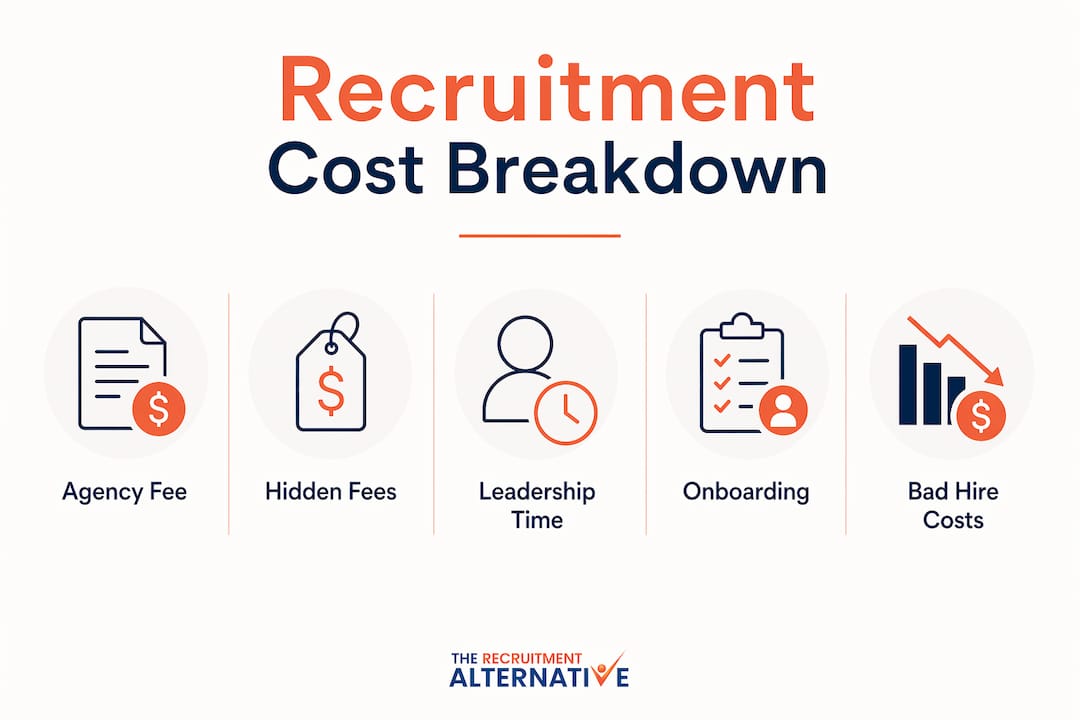
Traditional recruitment fees account for only a portion of your true hiring cost. A significant share accumulates quietly across internal time, vacancy losses, add-on fees, and the financial fallout from poor hires. Most Australian employers approve an agency invoice and move on, never accounting for what sits beneath it.
The hidden costs of traditional recruitment typically fall into these categories:
- Internal leadership time spent on intake calls, interview scheduling, and agency coordination
- Vacancy costs from lost productivity while a role sits open
- Add-on fees such as background checks, drug screens, and skills assessments
- Bad hire risk, including retraining, team disruption, and full replacement cycles
- Legal and compliance exposure from poorly negotiated agency contracts
- Onboarding and ramp-up delays before a new hire reaches full productivity
A single engineering placement on a $180,000 salary, with a standard agency fee of $39,600, can result in a true cost of about $105,000 once every hidden line item is included. That is nearly three times the invoice amount. Understanding where those costs come from is the first step to controlling them.
How manual recruitment processes quietly drain leadership time
The hours your hiring managers spend on recruitment rarely appear on any invoice, yet they represent one of the most consistent hidden costs employers face. Managing intake calls, coordinating interview schedules, debriefing panels, and chasing agency updates can consume many hours per week per open role. At a conservative internal valuation of hourly leadership time, a two-month search can represent a substantial cost before a single offer is made.

This drain is sometimes called the “Recruitment Productivity Tax.” It describes the cumulative cost of pulling senior people away from revenue-generating work to handle tasks that are largely administrative. An operations manager spending three hours a week on recruiter follow-ups is not just losing three hours. Those are hours not spent on client delivery, team performance, or business growth.
Running multiple agencies compounds the problem. Each additional agency on your panel means another briefing call, another candidate format to reconcile, and another feedback loop to manage. The operational burden of coordinating several providers can consume additional hours weekly in internal team time, a cost that never appears on any agency’s invoice.
Common manual tasks that contribute to this inefficiency include:
- Writing and rewriting job briefs for each agency
- Reviewing duplicate candidate submissions across providers
- Scheduling and rescheduling interview rounds
- Providing structured feedback to multiple recruiters
- Reconciling conflicting candidate assessments
Pro Tip: Track the hours your hiring managers spend on each recruitment process for one month. Assign a dollar value based on their loaded hourly rate. Most employers are surprised by the total.
What are the real monetary costs hiding behind the agency fee?
The percentage fee on an agency invoice is the most visible recruitment expense, but it accounts for a minority of total hiring spend. Traditional contingency agencies in Australia typically charge a percentage fee based on a candidate’s first-year salary, yet the true cost per hire runs well above that figure once every cost element is included.

Add-on fees are a common source of budget overruns. Background checks, drug screens, and skills assessments are frequently charged separately from the placement fee, and many agencies do not disclose these costs upfront. For roles requiring thorough pre-employment screening, these extras add up quickly across a shortlist of candidates.
Vacancy costs are equally significant. According to SHRM data, the average time to fill an open role is over a month. For revenue-generating positions, the lost output during that period can exceed the agency fee itself. Vacancy cost estimates vary widely depending on role seniority and function.
Hidden monetary costs beyond the base fee typically include:
- Background check and verification fees charged per candidate
- Skills assessment and psychometric testing costs
- Job board advertising fees on premium platforms
- Candidate travel expenses passed through to the client
- Ramp-up delays reducing output for weeks after a hire starts
A placement for an engineer on a high salary generates a sizeable agency fee. When combined with vacancy costs, internal hiring manager time, pre-screen failures, and bad-hire risk, the true cost can be several times higher than the invoice alone.
Why bad hires cost far more than the replacement guarantee covers
Poor hiring decisions carry a financial impact that extends well beyond the original placement fee. Industry research indicates that 31% of contingency-placed hires leave within 12 months, and replacing an employee typically costs six to nine months of their salary once lost productivity, retraining, and rehiring are factored in. A standard 60–90 day replacement guarantee from an agency does not come close to covering those losses.
Replacement guarantees cover the agency’s effort to find another candidate, but do not compensate for productivity gaps, team management time, or morale impact after a bad hire. Second searches by the same agency often face similar risks if initial vetting failed.
The financial and operational damage from a bad hire compounds quickly:
- Lost revenue from delayed projects or missed targets
- Management time spent performance-managing and exiting the hire
- Retraining costs for the replacement candidate
- Team morale and retention risk from instability
- Full recruitment cycle costs incurred a second time
Contingency recruiters are paid on placement, not on retention. That incentive structure favours speed over depth, which is why replacement guarantees rarely cover the true business losses from an early exit.
Practical ways to reduce unforeseen recruitment costs
Controlling recruitment expenses starts with visibility. Most employers cannot reduce costs they have never measured, so the first step is tracking both external spend and internal time across every hire. Once you have a baseline, the opportunities to cut waste become clear.
Thorough role scoping before engaging any agency reduces churn significantly. Vague briefs produce mismatched candidates, which means more screening rounds, more internal time, and a higher risk of a poor hire. Spending an extra hour on a detailed role brief at the start saves multiples of that time later.
Consolidating your agency panel is another practical lever. Managing fewer providers reduces coordination overhead, eliminates duplicate submissions, and gives your preferred agency a stronger incentive to prioritise your roles. A single well-briefed agency with a clear brief outperforms three agencies working from a vague one.
Other cost-reduction steps worth implementing:
- Assign a dollar value to internal hiring manager time and include it in your cost-per-hire calculation
- Negotiate add-on fees upfront and request a full cost disclosure before signing any agreement
- Review exclusivity and candidate ownership clauses carefully; negotiate these windows down to 90 days maximum
- Use structured interview scorecards to reduce repeat interview rounds
- Set clear timelines and decision points to prevent searches from dragging on
Tracking what unfilled roles cost your business in real terms also sharpens decision-making. When hiring managers can see the daily cost of a vacancy, they tend to move faster through the process.
How The Recruitment Alternative offers a smarter, fixed-cost model
The Recruitment Alternative was built specifically to address the cost unpredictability that defines traditional percentage-based hiring. Rather than charging a commission tied to salary, The Recruitment Alternative offers a flat-fee recruitment model that gives Australian employers a fixed, transparent price from the outset. There are no percentage calculations, no surprise add-ons, and no invoice that scales with the seniority of the role.
That pricing certainty matters most when you are managing multiple hires or working within a defined budget. With a flat-fee recruitment service, you know your cost before the search begins, which makes forecasting straightforward and eliminates the budget overruns that percentage-based fees routinely produce.
The service covers a broad range of industries and professions across Australia, including sales, management, administration, finance, engineering, healthcare, technology, and executive leadership. Personalised candidate sourcing and a proven recruitment process are built into every engagement, so quality is not traded away for affordability.
Key advantages of The Recruitment Alternative’s model include:
- Fixed pricing with no percentage of salary calculations
- Full transparency on costs before any search begins
- Broad national coverage across industries and role types
- Personalised service with dedicated recruitment consultants
- Proven sourcing process designed to identify the right candidates efficiently
For small and medium businesses in particular, affordable recruitment solutions that remove the financial risk of percentage-based fees make a material difference to hiring budgets.
Legal and compliance costs that traditional recruitment often overlooks
Agency contracts carry legal and financial risks that many employers do not discover until they are already exposed. Exclusivity clauses and candidate ownership provisions are among the most common. Some agency agreements stipulate that if you hire a candidate the agency presented, through any channel, within several months of introduction, you owe the full placement fee. That means even direct applications shortly after introduction could still trigger an invoice.
The practical advice from employment law specialists is to negotiate these clauses down to a 90-day window and require the agency to provide a specific, named list of candidates presented rather than a blanket claim over anyone they contacted. Without that specificity, the exposure is open-ended.
Beyond contract terms, employers also carry compliance obligations around pre-employment screening. Background checks, right-to-work verification, and reference processes all require consistent application to avoid discrimination claims. When these steps are managed inconsistently across multiple agencies, the risk of a compliance gap increases. Centralising your recruitment process with a single provider reduces that exposure and makes your screening practices easier to document and defend.
Onboarding and training costs that follow every new hire
The recruitment process does not end when an offer is accepted. Onboarding and training represent a substantial cost that most employers undercount when assessing their total hiring spend. A new employee typically takes several weeks to reach full productivity, and during that ramp-up period, the business absorbs both the cost of their salary and the cost of reduced output.
Onboarding involves more than paperwork. Hiring managers and team members spend time on inductions, system training, process walkthroughs, and ongoing check-ins. For technical or specialist roles, the ramp-up period can extend to three months or longer before the hire is genuinely contributing at the level the role requires. That delay has a direct cost in deferred output and continued pressure on the existing team.
When a hire does not work out within the first six months, the full onboarding investment is lost and the cycle begins again. This is why holding on to good staff after a successful hire is as financially important as getting the hire right in the first place. Reducing early turnover through better role scoping, realistic job previews, and structured onboarding programmes protects the investment made during recruitment and keeps total hiring costs from compounding.
Key takeaways
The visible agency fee typically represents only 60 to 70% of the true hiring cost; the remainder arises from internal time, vacancy losses, add-on fees, and the risks associated with bad hires.
| Point | Details |
|---|---|
| True cost exceeds the invoice | A $39,600 agency fee on a $180,000 salary can actually incur about $105,000 in total true cost when including hidden line items. |
| Internal time is a major cost | Managing recruitment consumes many hours per week per open role, costing substantial amounts in leadership time over a two-month search. |
| Bad hires trigger a second cycle | 31% of contingency-placed hires leave within 12 months; replacing them costs six to nine months of salary, well beyond any guarantee. |
| Contract clauses carry financial risk | Exclusivity windows can obligate payment for hires sourced through other channels; negotiate these down to 90 days. |
| Fixed-fee models remove cost uncertainty | Flat-fee recruitment provides a known price before the search begins, eliminating percentage-based budget overruns entirely. |

