

New Zealand’s recruitment landscape is defined by a dual-speed labour market where employers hold the advantage but face persistent structural challenges. As of 2026, the NZ employment landscape sits at 5.3% unemployment with job ads rising 13.1% year-on-year, yet candidate activity is cooling. For business leaders and HR professionals, understanding what the NZ recruitment landscape looks like right now is the difference between filling roles efficiently and losing top talent to Australia or overseas. This guide breaks down the regional divides, skill shortages, AI adoption trends, and hiring strategies shaping the market in 2026.
What is the NZ recruitment landscape in 2026?
The NZ recruitment landscape, also referred to in industry circles as the New Zealand employment market, is currently employer-favoured but structurally complex. Job ad volumes are climbing, yet applications per ad have fallen for seven consecutive months since August 2025. That combination tells a clear story: more roles are being advertised, but fewer candidates are actively applying. Employers who treat this as a straightforward buyer’s market will be caught off guard.
Economic and geopolitical pressures, including global uncertainty from conflicts overseas, have introduced caution into hiring volumes despite an optimistic start to 2026. Business confidence is fragile. Hiring decisions are taking longer. At the same time, AI-related skills references in NZ job advertisements have more than doubled year-on-year, signalling a structural shift in what employers actually need from candidates. The market is not stagnant. It is evolving rapidly, and your hiring strategy needs to keep pace.
What are the current labour market conditions and regional differences?
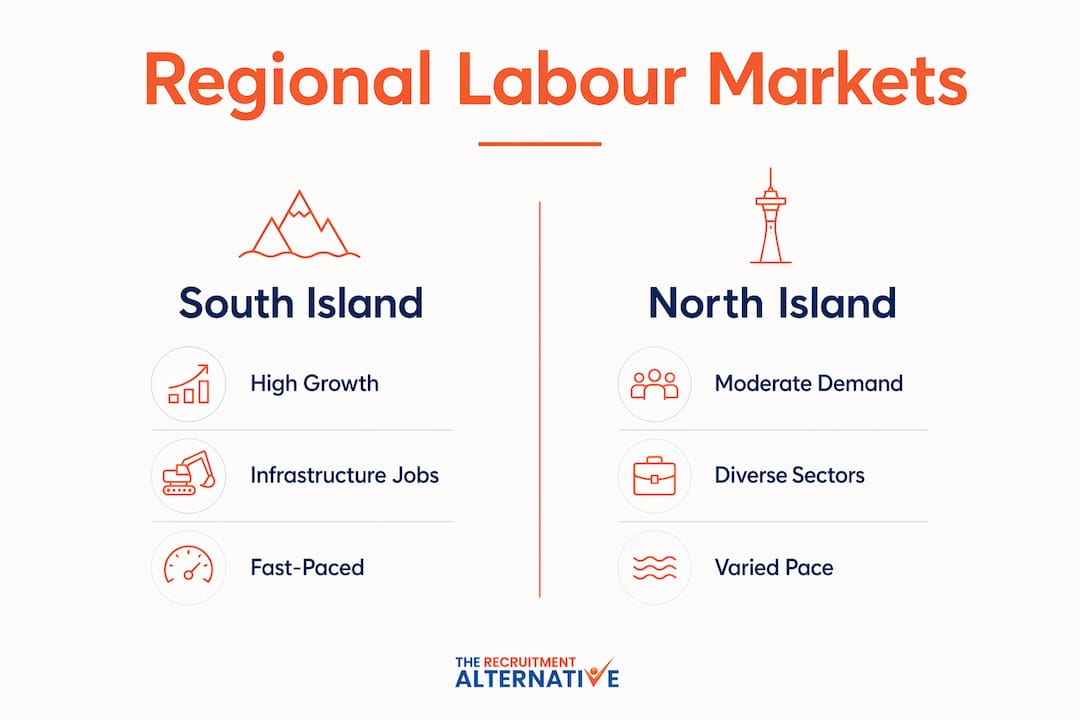
New Zealand’s labour market is not one market. It is several, operating at different speeds depending on geography and sector.
| Region | Job ad growth (year-on-year) | Market character |
|---|---|---|
| Otago | 23% | High demand, fast-moving |
| Southland | 21.3% | Infrastructure-driven growth |
| Auckland | Minimal growth | Measured, more candidate supply |
| Wellington | Minimal growth | Cautious, public sector influence |
South Island regions like Otago and Southland are experiencing hiring intensity driven by infrastructure expansion and agriculture. Employers in these regions need to move fast. A slow recruitment process in Southland means losing candidates to the next employer who calls. Auckland and Wellington, by contrast, allow a more measured approach, with greater candidate supply and a slower hiring rebound.
Sector-specific demand reinforces these regional patterns. Healthcare, construction, engineering, and agriculture are the most active hiring sectors across the country. These are also the sectors with the deepest skill shortages, which means competition for qualified candidates is fierce regardless of location.
Pro Tip: If you are hiring in Otago or Southland, compress your recruitment timeline. Aim to move from shortlist to offer within five business days. Candidates in high-demand regions are fielding multiple offers simultaneously.
Which skill shortages most influence hiring in NZ?
Skill shortages in New Zealand are not a temporary market condition. They are structurally entrenched due to long-term demographic and migration factors that persist across economic cycles.
The most critical shortages sit in:
- Healthcare: Nurses, allied health professionals, and aged care workers are in chronic short supply as the population ages.
- Construction and trades: Electricians, plumbers, and civil engineers are scarce across both islands, with demand accelerating in South Island infrastructure projects.
- Engineering: Mechanical and structural engineers are consistently hard to place, particularly outside Auckland.
- Agriculture: Seasonal and permanent roles in primary industries face ongoing shortfalls, compounded by visa and immigration constraints.
- Education: Teacher shortages, particularly in secondary and specialist subjects, show no sign of easing.
An ageing population is the primary structural driver. As experienced workers retire, replacement pipelines are thin. Net migration has not filled the gap at the pace required. The result is a talent pool that simply does not match the volume of open roles in critical sectors.
Skills-based hiring is the most effective response to this reality. Rather than filtering candidates by job title or years in a specific role, skills-based hiring maps requirements to core competencies and demonstrated potential. This approach opens your candidate pool significantly, particularly for roles being reshaped by AI and automation.
Pro Tip: Audit your current job descriptions and remove any credential requirements that are not genuinely necessary. Requiring a specific degree for a role that can be performed by someone with demonstrated skills immediately narrows your pool without improving hire quality.
How is technology changing NZ recruitment practices?
Technology, particularly AI, is reshaping how New Zealand employers source, screen, and engage candidates. The shift is early but accelerating.
| Recruitment activity | Traditional approach | AI-assisted approach |
|---|---|---|
| Candidate sourcing | Job boards and referrals | Algorithmic sourcing across multiple platforms |
| Resume screening | Manual review | Automated shortlisting by competency match |
| Interview scheduling | Phone and email coordination | Automated scheduling tools |
| Candidate engagement | Recruiter-led communication | AI-driven messaging with human escalation |
| Skills assessment | Reference checks and interviews | Digital assessment platforms |
AI-related skills references in NZ job ads grew 4.1% month-on-month in April 2026, with the strongest growth in consulting and media sectors. That figure represents demand from employers who want candidates who can work alongside AI tools, not just awareness that AI exists. The expectation is shifting from familiarity to fluency.
For HR professionals, the practical implication is twofold. First, your recruitment process itself should incorporate AI tools to reduce time-to-hire and improve candidate matching. Second, your job briefs need to reflect AI fluency as a genuine competency, not an afterthought. Understanding how AI changes recruitment workflows helps you build processes that are faster without sacrificing the human judgement that determines cultural fit.
Demand for niche technical skills like software development and data engineering is also driving a rise in contract and fixed-term roles, with project-based IT and digital positions typically running 12–18 months. This flexibility suits both employers managing uncertain budgets and candidates who prefer varied project work.
What hiring strategies should NZ business leaders adopt now?
Reactive hiring is the single most expensive mistake NZ employers make in this market. When a role becomes vacant and you begin sourcing from scratch, you are already behind. The most effective NZ hiring practices in 2026 are built on proactive pipeline management and a compelling employer value proposition.
Here is a practical framework for adapting your recruitment strategy to current NZ workforce dynamics:
-
Build a talent pipeline before you need it. Engage with passive candidates through LinkedIn, industry events, and referral programmes. Proactive pipeline engagement is the most reliable defence against losing candidates to Australian employers who are actively targeting NZ talent.
-
Offer a value proposition beyond salary. Top candidates are weighing flexible hours, remote work options, professional development budgets, and clear career pathways. Employers who lead with salary alone are losing to those who offer holistic employment packages that address lifestyle and long-term growth.
-
Adjust your speed by region. Auckland and Wellington allow a more deliberate process. South Island regions require urgency. Calibrate your recruitment timeline to the local market, not a national template.
-
Adopt skills-based hiring across all roles. Map every open position to the competencies required, not the titles previously held. This is particularly important for roles being reshaped by AI, where the skills needed today may not match the skills that defined the role three years ago.
-
Invest in candidate experience. A slow, opaque recruitment process signals poor organisational culture. Candidates talk. Poor experiences spread quickly in tight professional networks. Strong candidate and recruiter relationships directly influence whether your best applicants accept your offer or walk away.
-
Use data to guide decisions. Track time-to-hire, offer acceptance rates, and source-of-hire by region. These metrics reveal where your process is losing candidates and where your sourcing channels are underperforming.
Recruiting in a candidate-driven market requires a mindset shift. Even in an employer-favoured environment, the best candidates still have options. Treat every interaction as a chance to demonstrate why your organisation is worth choosing.
Key takeaways
The NZ employment landscape in 2026 rewards employers who hire proactively, adapt to regional conditions, and build value propositions that go beyond salary.
| Point | Details |
|---|---|
| Employer-favoured but complex | Unemployment sits at 5.3%, yet candidate applications per ad have fallen for seven consecutive months. |
| Regional hiring speeds vary | Otago and Southland require fast offers; Auckland and Wellington allow more measured timelines. |
| Skill shortages are structural | Healthcare, construction, engineering, and agriculture face entrenched shortfalls that economic cycles alone will not fix. |
| AI fluency is now a hiring factor | AI-related skills in NZ job ads have more than doubled year-on-year, reshaping what employers need from candidates. |
| Skills-based hiring opens talent pools | Mapping roles to competencies rather than titles significantly expands the candidate pool in constrained sectors. |
What I have learned about hiring in NZ’s current market
After working across recruitment markets on both sides of the Tasman, the thing that strikes me most about New Zealand in 2026 is how many employers are still treating it as a single, uniform market. It is not. The difference between hiring in Queenstown and hiring in Wellington is not just geographic. It is a fundamentally different competitive environment, a different candidate mindset, and a different pace of decision-making.
The employers I see succeeding right now are the ones who have stopped waiting for the perfect candidate to appear on a job board. They are building relationships with talent before roles open. They are calling candidates who are not actively looking. They are offering genuine flexibility, not just listing it as a bullet point in a job ad.
The AI conversation is real but often misframed. The question is not whether to use AI in recruitment. The question is whether you are using it to free up recruiter time for genuine human connection, or whether you are using it as a shortcut that filters out candidates who do not fit a rigid template. The best outcomes I have seen come from teams that use AI to handle volume and use human judgement to handle nuance.
One more thing worth saying directly: if your employer brand is weak, your recruitment results will be weak regardless of your process. Candidates researching your organisation before applying are looking at Glassdoor reviews, your LinkedIn presence, and how your current staff talk about working there. That is the real competition for talent, and it starts long before a job ad goes live.
— Josh Townsend
How The Recruitment Alternative can help you hire smarter in NZ
Navigating the NZ job market overview requires more than posting a job ad and waiting. The Recruitment Alternative delivers affordable recruitment solutions built specifically for business leaders who need quality hires without the cost of traditional percentage-based agency fees.
The Recruitment Alternative works across healthcare, engineering, technology, administration, finance, and executive leadership. The flat-fee model means you know the cost upfront, whether you are hiring one person or building a team. For NZ employers dealing with regional skill shortages and a shifting candidate market, that transparency matters. If you are ready to build a smarter hiring strategy, contact The Recruitment Alternative today and find out how the fixed-fee model delivers results without the premium price tag.
FAQ
What is the current unemployment rate in New Zealand?
New Zealand’s unemployment rate sits at 5.3% as of 2026. This places the market in employer-favoured territory, though falling candidate applications per ad signal a more complex picture beneath the headline figure.
Why are skill shortages so persistent in NZ?
Skill shortages in healthcare, construction, engineering, and agriculture are structurally entrenched due to an ageing workforce and insufficient migration to replace retiring workers. These shortfalls persist across economic cycles and are not resolved by short-term hiring volume changes.
How do NZ recruitment trends differ by region?
South Island regions like Otago and Southland are experiencing job ad growth of 20% or more year-on-year, driven by infrastructure and agriculture. Auckland and Wellington are seeing minimal growth, allowing employers there to take a more measured approach to hiring.
What role does AI play in NZ hiring practices?
AI-related skills references in NZ job ads have more than doubled year-on-year and grew 4.1% month-on-month in April 2026. Employers are increasingly expecting candidates to demonstrate AI fluency, particularly in consulting, media, and technology sectors.
What is skills-based hiring and why does it matter in NZ?
Skills-based hiring means assessing candidates on demonstrated competencies and potential rather than job titles or specific credentials. In a constrained NZ talent market, this approach expands the available candidate pool and is particularly effective for roles being reshaped by AI and automation.

