

Volume recruitment is the process of filling large numbers of similar roles simultaneously within a compressed timeframe, using standardised workflows, applicant tracking systems (ATS), and AI-powered screening to maintain quality at scale. It differs from standard recruitment in one fundamental way: the challenge shifts from evaluating a handful of candidates in depth to efficiently processing hundreds or thousands of applicants while still delivering quality hires.
Known also as bulk hiring or mass hiring, volume recruitment typically begins when an organisation needs to fill dozens of positions or more at once, though enterprise campaigns often involve numerous roles across multiple business units.
What is volume recruitment and what defines it?
Volume recruitment treats the hiring funnel as a production system rather than a series of individual decisions. The goal is speed, consistency, and throughput, without sacrificing the quality of each hire.
Core elements that define volume recruitment:
- Scale: Filling dozens or more similar roles within a defined window
- Standardised workflows: Consistent screening criteria, structured interviews, and templated communications applied across all candidates
- Automation: ATS platforms, AI-assisted resume screening, scheduling bots, and recruitment analytics dashboards
- Wide sourcing: Advertising across job boards, social media, and recruitment agencies to generate large candidate pools
- Asynchronous assessments: Digital tools that allow candidates to complete evaluations on their own schedule, removing scheduling bottlenecks
- Coordination: Cross-functional alignment between recruiters, hiring managers, and business unit leaders
Industries where volume recruitment is most common include retail, hospitality, agriculture, call centres, logistics, healthcare, and manufacturing. In Australia, these sectors regularly face peak-season surges or rapid expansion that make a one-by-one hiring approach unworkable.
How does volume recruitment differ from standard recruitment?
Standard recruitment focuses on filling individual, often specialised roles with deep candidate evaluation. Volume hiring flips that logic entirely.
Key differences between the two models:
- Hiring volume: Standard recruitment handles a small number of open roles; volume hiring addresses hundreds or thousands simultaneously
- Recruitment focus: Standard hiring prioritises depth of evaluation and individual fit; volume hiring prioritises speed and scalability
- Screening process: Standard recruitment uses manual, detailed review; volume hiring relies on structured, automated screening
- Interview approach: Standard hiring involves extensive deliberation; volume hiring uses standardised, high-throughput evaluation methods
- Coordination needs: Standard recruitment requires minimal cross-team coordination; volume hiring demands complex alignment across recruiters, hiring managers, and business units
- Candidate experience risk: Standard recruitment makes personalisation straightforward; maintaining a consistent experience at scale requires deliberate effort in volume hiring
- Metrics: Standard recruitment measures time-to-hire in weeks; volume hiring measures time-to-fill in days
The operating model is fundamentally different. When filling 100+ roles per quarter, every manual step becomes a bottleneck and every inefficiency multiplies across dozens of requisitions at once.

Volume recruitment strategies and processes that work
Effective volume recruitment requires planning before a single job ad goes live. Organisations that skip workforce planning and jump straight to advertising typically end up with chaotic scaling and poor hire quality. Clarity on exact numbers, roles, and deadlines underpins every successful campaign.
Key strategies and processes:
- Workforce planning: Define exact headcount targets, role profiles, start dates, and location requirements before sourcing begins
- Multi-channel sourcing: Advertise across job boards (Seek, Indeed), LinkedIn, social media, and industry-specific platforms to maximise candidate reach
- ATS implementation: A central applicant tracking system manages applications, automates communications, and tracks candidates through each stage
- AI-assisted screening: Automated resume parsing and matching tools filter applicants against defined criteria, reducing screening time to as little as three minutes per applicant
- Structured assessments: Asynchronous digital assessments and standardised interview scorecards maintain consistency across all evaluators
- Recruiter coordination: Assign clear ownership of each stage across the recruitment team to prevent duplication and missed follow-ups
- Real-time analytics: Recruitment dashboards surface bottlenecks in sourcing or screening before they compound, allowing teams to adjust mid-campaign
- Fraud detection: Dedicated layers in recruitment technology identify bot-driven or fraudulent applications and protect pipeline integrity
The production-line mindset is what separates high-performing volume campaigns from chaotic ones. Continuous monitoring and real-time diagnosis replace retrospective fixes.
Benefits and challenges of volume recruitment
Volume recruitment delivers clear advantages when the process is well-designed, but it also carries risks that can undermine results if left unmanaged.
Benefits:
- Speed: Filling dozens of roles in days rather than weeks keeps operations running during peak periods
- Cost efficiency: Standardised processes and automation reduce the cost per hire compared to individually managed searches
- Consistency: Structured screening and scoring criteria produce more uniform quality outcomes across large cohorts
- Scalability: The model adapts to seasonal surges, new site openings, or rapid business expansion without rebuilding the process each time
- Talent pipeline: High-volume sourcing builds a pool of pre-screened candidates available for future roles
Challenges:
- Candidate experience: Maintaining a positive, responsive experience across hundreds of applicants requires deliberate communication planning
- Recruiter overload: Without proper workload distribution and automation, recruiters burn out quickly under high application volumes
- Quality risk: Speed pressure can lead to shortcuts in screening, resulting in poor-fit hires and higher turnover
- Fraud: At scale, fraudulent or bot-generated applications can contaminate the pipeline if detection tools are absent
- Alignment gaps: Misalignment between HR, hiring managers, and business units produces delays and inconsistent hiring standards
Pro Tip: Use the time saved by automation to give high-potential candidates more personal attention. Smart volume sourcing frees recruiters to engage meaningfully with top applicants rather than spending every hour on initial screening.

Volume recruitment in Australia: insights from The Recruitment Alternative
The Recruitment Alternative brings a practical, cost-conscious approach to volume recruitment that suits the Australian market particularly well. Rather than charging a percentage of salary, The Recruitment Alternative operates on a flat-fee recruitment model, which makes bulk hiring campaigns far more predictable in cost, regardless of the number of roles being filled.
Key Australian market insights:
- Flat-fee advantage: Fixed pricing removes the cost blowout that typically accompanies high-volume percentage-based agency fees, giving HR teams a clear budget from the outset
- Personalised service at scale: The Recruitment Alternative combines technology-assisted sourcing with hands-on consultant support, so candidates receive genuine engagement rather than automated silence
- Broad industry coverage: The agency recruits across sales, administration, finance, engineering, healthcare, trades, technology, and management, covering the sectors most likely to require volume hiring in Australia
- National reach: With the ability to source candidates across all Australian states and territories, The Recruitment Alternative supports multi-site volume campaigns without geographic constraints
- Compliance awareness: Australian volume campaigns must account for Fair Work Act obligations, equal opportunity requirements, and privacy law, all of which The Recruitment Alternative factors into its recruitment process
Pro Tip: Australian HR teams running volume campaigns should confirm that their ATS and screening tools comply with the Privacy Act 1988, particularly around the collection and storage of candidate data. Non-compliance at scale carries proportionally greater risk.
Tips and best practices for successful volume recruitment
Getting volume hiring right comes down to preparation, process discipline, and communication.
- Define role profiles tightly: Vague job descriptions generate irrelevant applications and slow screening. Specific criteria speed up every downstream step.
- Automate early-stage screening: Use ATS and AI tools to handle resume filtering and initial scheduling, freeing recruiters for higher-value tasks. The role of AI in recruitment has expanded rapidly and the tools available to Australian teams in 2026 are considerably more capable than even three years ago.
- Communicate proactively: Candidates in volume pipelines expect fast responses. Automated status updates at each stage reduce drop-off and protect your employer brand.
- Standardise interview scoring: Use structured scorecards so every interviewer evaluates candidates against the same criteria, reducing bias and improving consistency.
- Monitor your funnel daily: Track application-to-screen, screen-to-interview, and offer-to-acceptance ratios in real time. Drop-offs at any stage signal a problem worth fixing immediately.
- Plan onboarding in parallel: Volume hiring that ends at the offer stage creates a bottleneck at onboarding. Build induction processes that can handle cohort arrivals.
- Review and iterate: After each campaign, analyse what worked and what slowed you down. Volume recruitment improves with each cycle when teams document lessons systematically.
Legal and compliance considerations for volume recruitment in Australia
Australian employment law applies equally to volume hiring campaigns, and the scale of these campaigns amplifies the consequences of any compliance failure.
The Fair Work Act 2009 sets minimum standards for employment contracts, pay rates, and working conditions. Every role filled through a volume campaign must meet the applicable Modern Award or enterprise agreement, regardless of how quickly the hire was made.
Equal opportunity obligations under the Age Discrimination Act 2004, Disability Discrimination Act 1992, Racial Discrimination Act 1975, and Sex Discrimination Act 1984 require that screening criteria and interview questions are free from discriminatory intent. Automated screening tools must be audited regularly to confirm they do not inadvertently filter out protected groups.
The Privacy Act 1988 governs how candidate data is collected, stored, and used. At volume scale, this means your ATS and any third-party screening tools must have compliant data handling practices, and candidates must be informed of how their information will be used.
Right to work verification is a legal requirement for every hire. Volume campaigns must build identity and visa status checks into the workflow, not treat them as an afterthought after offers are made.
Working with an experienced recruitment agency that understands Australian compliance requirements reduces the risk of costly errors across large candidate cohorts.
Metrics and KPIs to measure volume recruitment success
Measuring volume recruitment requires different metrics from standard hiring. The focus shifts to throughput, efficiency, and quality at scale.
| KPI | What it measures |
|---|---|
| Time-to-fill | Days from role approval to accepted offer; volume hiring targets days, not weeks |
| Cost per hire | Total campaign cost divided by number of successful hires |
| Application-to-screen ratio | Proportion of applicants who pass initial screening criteria |
| Offer acceptance rate | Percentage of offers accepted; a low rate signals issues with compensation or candidate experience |
| Quality of hire | Post-hire performance ratings and retention rates |
| Candidate drop-off rate | Where in the funnel candidates disengage; identifies communication or process gaps |
| Recruiter workload ratio | Applications managed per recruiter; flags overload before it affects quality |
| Sourcing channel effectiveness | Which platforms generate the highest proportion of qualified applicants |
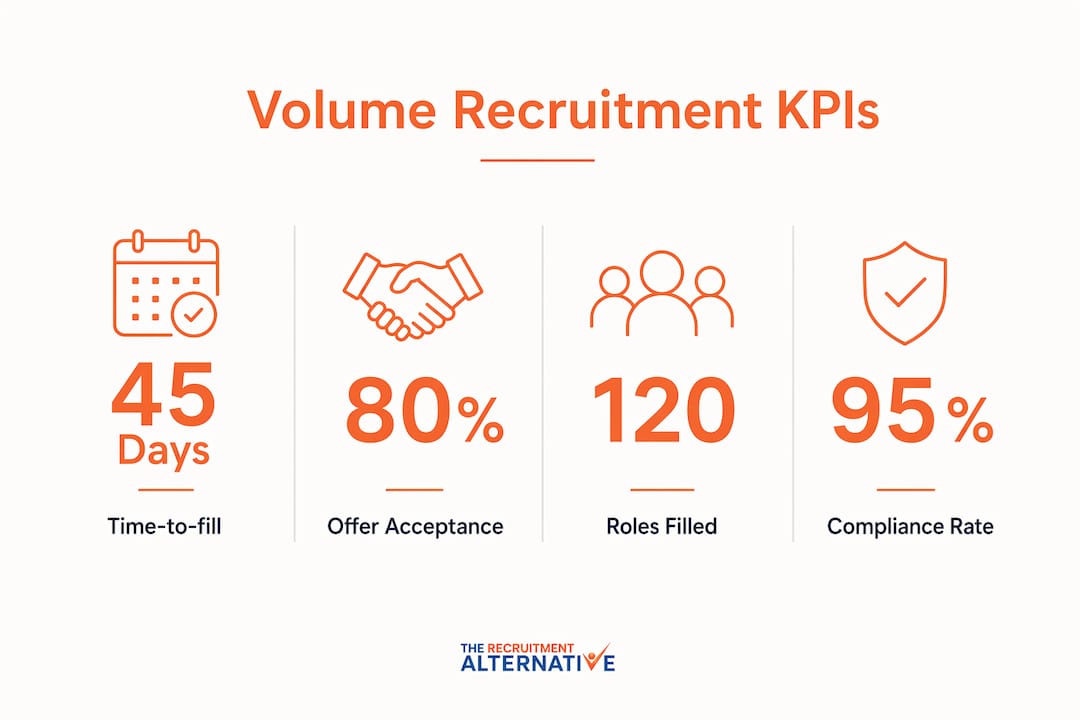
Tracking these KPIs across every campaign builds the data foundation needed to improve each subsequent volume hiring effort. Teams that review these figures after each campaign consistently outperform those that treat each campaign as a standalone event.
Key takeaways
Volume recruitment succeeds when automation handles throughput, structured processes maintain quality, and recruiters focus their attention on high-potential candidates rather than administrative screening.
| Point | Details |
|---|---|
| Definition and scale | Volume recruitment fills dozens or more similar roles simultaneously using standardised, automated workflows. |
| Automation is foundational | ATS, AI screening, and analytics dashboards are not optional extras; they are what make volume hiring viable. |
| Compliance is non-negotiable at scale | Fair Work Act, Privacy Act 1988, and anti-discrimination laws apply to every hire in a volume campaign. |
| Measure throughput and quality | Track time-to-fill in days, cost per hire, offer acceptance rate, and retention to assess campaign performance. |
| Flat-fee models suit volume campaigns | Fixed-price recruitment removes cost uncertainty and makes large-scale hiring budgets predictable from the start. |

