
Full cycle recruiting is a hiring model where one recruiter or a unified team manages every stage of the talent acquisition process, from the initial role brief through to the new hire’s first day. Also known as end-to-end recruiting or full life cycle recruiting, it places single-point ownership at the centre of the entire hiring journey. Rather than handing candidates between a sourcer, a coordinator, and a closing recruiter, one person holds accountability for the outcome.
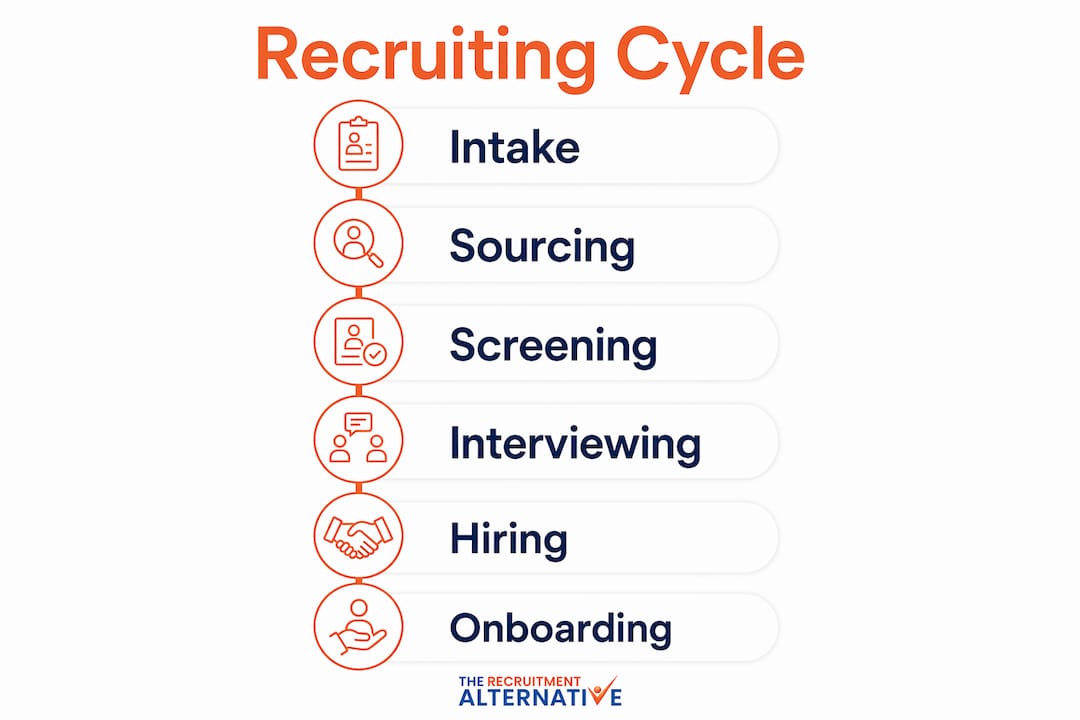
The full cycle recruitment process covers six core stages:
- Preparation — defining the role, ideal candidate profile, and evaluation criteria
- Sourcing — building a candidate pipeline through job boards, outreach, and referrals
- Screening — reviewing applications and conducting initial qualification calls
- Selection — coordinating and conducting structured interviews with hiring managers
- Hiring — extending the offer, negotiating terms, and managing background checks
- Onboarding — integrating the new hire into the team and relevant systems
This model suits growing Australian businesses where HR teams are not heavily segmented. Large enterprises sometimes assign specialist teams to each phase, but for most small and medium organisations, a single recruiter owning the full process is both practical and effective.
What does the full cycle recruiting process look like in practice?
Understanding each stage in sequence makes the model far easier to implement. Here is how the six phases connect in a real hiring workflow.
-
Preparation. The recruiter meets with the hiring manager to define the role requirements, must-have qualifications, compensation range, and evaluation criteria. This intake meeting is the most consequential step in the entire process. A thorough brief here prevents misaligned candidate expectations and drawn-out searches later.
-
Sourcing. With a clear brief, the recruiter builds a candidate pipeline through inbound job postings, outbound search on platforms like LinkedIn, employee referrals, and talent communities. The full cycle recruiting process connects sourcing directly to workforce planning, so the recruiter is not just filling a vacancy but anticipating future needs.
-
Screening. The recruiter reviews applications, conducts phone screens, and shortlists candidates. Because the same person who wrote the brief is now evaluating candidates, they develop genuine pattern recognition about which traits predict hiring manager satisfaction and eventual offer acceptance.
-
Selection. The recruiter coordinates interview scheduling, prepares interviewers with candidate context, and manages all candidate communication. This stage tends to consume the most calendar time, particularly when multiple stakeholders are involved.
-
Hiring. Once a preferred candidate is identified, the recruiter manages reference and background checks, crafts the offer, presents it to the candidate, and negotiates terms through to acceptance. Having built a relationship across every prior stage, the recruiter is well placed to handle objections and close confidently.
-
Onboarding. The recruiter facilitates a smooth handoff to the HR team and the hiring manager, covering day-one logistics, system access, and the employee handbook. Some organisations extend the recruiter’s involvement to include early retention check-ins, treating onboarding as part of the same closed-loop system rather than a separate HR function.
Why organisations choose full cycle recruiting
The case for this model comes down to accountability, candidate experience, and cost. Each advantage reinforces the others.
- Single point of contact. Candidates interact with one consistent person throughout the process. There is no re-explaining preferences to a new coordinator at each stage, and candidate experience improves measurably when trust builds with a single recruiter.
- Faster feedback loops. When the recruiter who sourced the candidate also sees the interview feedback and hiring decision, they calibrate their sourcing immediately. This learning loop breaks down when sourcing and coordination sit with different people.
- Clear accountability. One person owns the outcome. There is no ambiguity about where a process broke down, which drives higher-quality decisions at every stage.
- Cost efficiency. A single experienced full cycle recruiter typically costs less than a sourcer, coordinator, and closing recruiter operating separately, and often delivers stronger results for individual roles.
- Closer hiring manager relationships. When one recruiter manages the entire process, they develop a nuanced understanding of what the hiring manager actually wants, which often differs from what is written in the job description.
For Australian businesses navigating competitive talent markets, these advantages translate directly into faster time-to-hire and lower cost-per-hire.
Where full cycle recruiting creates pressure
A balanced view of this model requires acknowledging its real limitations. None of them are disqualifying, but they do require deliberate management.
- Administrative overload. Interview scheduling, compliance documentation, and candidate communication can consume a disproportionate share of a recruiter’s time, leaving less capacity for high-value relationship work. Standardised scorecards and automation help redirect that time toward candidate engagement.
- Capacity ceiling. A full cycle recruiter can manage multiple open roles simultaneously before quality drops. Beyond a manageable number of roles, sourcing and screening may suffer due to workload priorities.
- Skill breadth demands. The model requires competence across sourcing, evaluation, negotiation, project management, and relationship building. Not every recruiter excels across all of these, and identifying skill gaps early is important.
- Scalability at volume. At high hiring volumes, specialisation becomes necessary. Five full cycle recruiters independently building sourcing strategies cannot match the output of a dedicated sourcing team building shared pipelines.
- Hybrid models as a solution. Blending full cycle for senior roles with specialised models for high-volume positions lets organisations manage varied hiring demands without forcing one model across every role type.
How do you measure full cycle recruiting success?
Tracking the right metrics turns a qualitative process into a manageable, improvable system. The KPIs below give HR teams a clear picture of where the process is performing and where it needs attention.

Time to fill measures the number of days from a role being approved to an offer being accepted. A shorter time to fill generally reflects a well-run intake meeting and an active candidate pipeline.
Quality of hire is the most telling long-term indicator. It typically combines a new hire’s performance rating at the 90-day or six-month mark with their retention rate. A full cycle recruiter who owns the entire process tends to produce stronger quality-of-hire scores because they understand the hiring manager’s actual expectations, not just the job description.
Offer acceptance rate reflects how well the recruiter has managed candidate relationships and set expectations throughout the process. A low acceptance rate often signals a disconnect between the offer stage and earlier conversations.
Candidate satisfaction scores, gathered through post-process surveys, measure the experience directly. Organisations using a single point of contact consistently report higher candidate satisfaction than those using segmented models.
Recruiter capacity tracks how many active roles a recruiter is managing at any point. Monitoring this against the 8–15 role benchmark helps managers identify burnout risk before it affects output.
Source of hire shows which channels are producing the strongest candidates, allowing the recruiter to concentrate sourcing effort where it delivers the best return.
Modern tools and best practices for full cycle recruiting in Australia
Technology does not replace the recruiter’s judgement, but it does extend their capacity considerably. Here is what works in practice for Australian HR teams.
- Integrated ATS and HRMS platforms. Without a connected applicant tracking system and HR management system, full cycle recruiting becomes unscalable quickly. Platforms like Workday, Employment Hero, and PageUp (all available in Australia) centralise candidate data, compliance records, and workflow tracking in one place.
- AI-powered sourcing. AI sourcing tools dramatically expand what a single recruiter can handle. With With AI sourcing and scheduling automation, a full cycle recruiter can handle a greater number of roles without the usual sourcing bottleneck.
- Standardised scorecards. Consistent evaluation criteria across every interview reduce bias and make debrief conversations faster and more productive. Scorecards also create a defensible record for Australian Fair Work compliance purposes.
- Automated scheduling. Delegating interview scheduling to automation tools frees recruiter time for candidate relationship work, which is where the model’s real value lies.
- Australian compliance integration. Every stage of the process must account for obligations under the Fair Work Act 2009, the Privacy Act 1988, and anti-discrimination legislation across federal and state jurisdictions. Building compliance checkpoints directly into the ATS workflow, rather than treating them as a separate step, reduces risk and administrative duplication. For guidance on screening job applicants efficiently within these frameworks, structured evaluation tools are worth reviewing.
- Small business hiring considerations. Australian small and medium businesses benefit from reviewing small business hiring best practices before committing to a full cycle model, particularly around recruiter capacity and technology investment.
Pro Tip: Master the intake meeting before anything else. A thorough brief with the hiring manager, covering must-haves, compensation, timeline, and deal-breakers, prevents the majority of downstream hiring problems including misaligned candidate expectations and prolonged searches.

Key takeaways
Full cycle recruiting delivers the strongest results when one accountable recruiter owns every stage, supported by integrated technology and a thorough intake process.
| Point | Details |
|---|---|
| Single ownership drives accountability | One recruiter managing all six stages eliminates handoff gaps and improves hiring outcomes. |
| Capacity has a real ceiling | Full cycle recruiters typically handle 8–15 roles; AI tools can help increase that capacity. |
| Technology is not optional | Without an integrated ATS and HRMS, administrative overload will limit the model’s effectiveness. |
| Intake meetings determine success | A thorough role brief with the hiring manager prevents misaligned searches and wasted sourcing effort. |
| Hybrid models suit high-volume hiring | Full cycle works best for senior and specialist roles; high-volume pipelines benefit from specialised support. |
How The Recruitment Alternative can support your hiring
For Australian businesses that want the accountability of full cycle recruiting without building an in-house function from scratch, The Recruitment Alternative offers a flat-fee recruitment service that covers the entire hiring process at a transparent fixed price. There are no percentage-of-salary commissions and no hidden costs. The team recruits across sales, management, administration, finance, engineering, healthcare, technology, and executive leadership, working with businesses of all sizes throughout Australia. If you are ready to hire with confidence and cost certainty, The Recruitment Alternative is worth a conversation.