

To hire a product manager well, hire someone who has already done product management, brief the role around outcomes rather than a wish list, and judge candidates with the same structured assessment. A fixed-fee recruiter keeps the cost of that search predictable: with The Recruitment Alternative you pay an engagement fee of $895 plus a placement fee of $3,900 to $5,000 on the Recruit option, instead of a percentage of a salary that, for a product manager, can run well into six figures.
This guide is written for small and mid-sized businesses in Australia and New Zealand hiring a permanent product manager, often for the first time.
TL;DR
- Hire your first product manager when product complexity outgrows the founders, not on a fixed date. Guidance from product leaders points to roughly 12 to 25 employees, or once you have product/market fit and an engineering team of more than seven.
- Choose proven product management experience over deep subject expertise. Three to seven years suits most first hires.
- Budget for salary first. One 2026 Australian report puts product managers in asset and wealth management at $140,000 to $160,000 before super and bonus.
- Write the ad around skills, outcomes and a salary range, and assess every candidate against the same criteria.
- Our flat fees, with an engagement fee and a placement fee, replace percentage-of-salary charges. A replacement campaign is $1,000 if a hire does not work out.
Table of Contents
- What a product manager does, and what they are not
- When to hire your first product manager
- Experience level: who to target
- What a product manager costs in Australia
- Writing a brief and job ad that attracts product managers
- Screening and interviewing product manager candidates
- Before the offer: the employment basics
- Why a fixed-fee search suits this hire
- Hiring a product manager with The Recruitment Alternative
- FAQ
- Sources
What a product manager does, and what they are not
A product manager sets the direction of a product: who it is for, what problem it solves and what gets built next. The Project Management Institute describes product management as strategic work focused on long-term product vision and market trends, while product owners are more tactical and work with delivery teams to build the right functionality on time.
The confusion most employers run into is with project managers. Atlassian’s explanation is that product managers own the vision and decide on features from user needs and market opportunities, while project managers make sure work is completed on time, on budget and to specification.
In practice:
- Product manager: decides what to build and why. Owns the roadmap, priorities and the link between customers, sales and engineering.
- Product owner: manages the backlog for a delivery team. In a small company the product manager often does this job too.
- Project manager: delivers an agreed scope on schedule. If that is the person you need, see our project manager hiring guide.
Spending ten minutes on this distinction before you write the ad saves weeks. Many failed hires start with a job description that asks for a product manager but describes a project coordinator.
When to hire your first product manager
There is no single trigger, but the guidance from experienced product leaders is consistent. Rich Mironov suggests the time is between about 12 and 20 employees, perhaps 25 at most, when complexity outgrows the founders’ memory of customer promises and sales pressure makes it hard to say no. A stage-by-stage guide notes that many B2B software companies hire their first product manager between 15 and 40 employees, often after early revenue traction.
Jonathan Golden, the first product manager at Airbnb, gave three conditions, reported in Lenny Rachitsky’s newsletter: you have product/market fit and need to scale, your engineering team is larger than seven, and you are ready to let someone else own part of the roadmap.
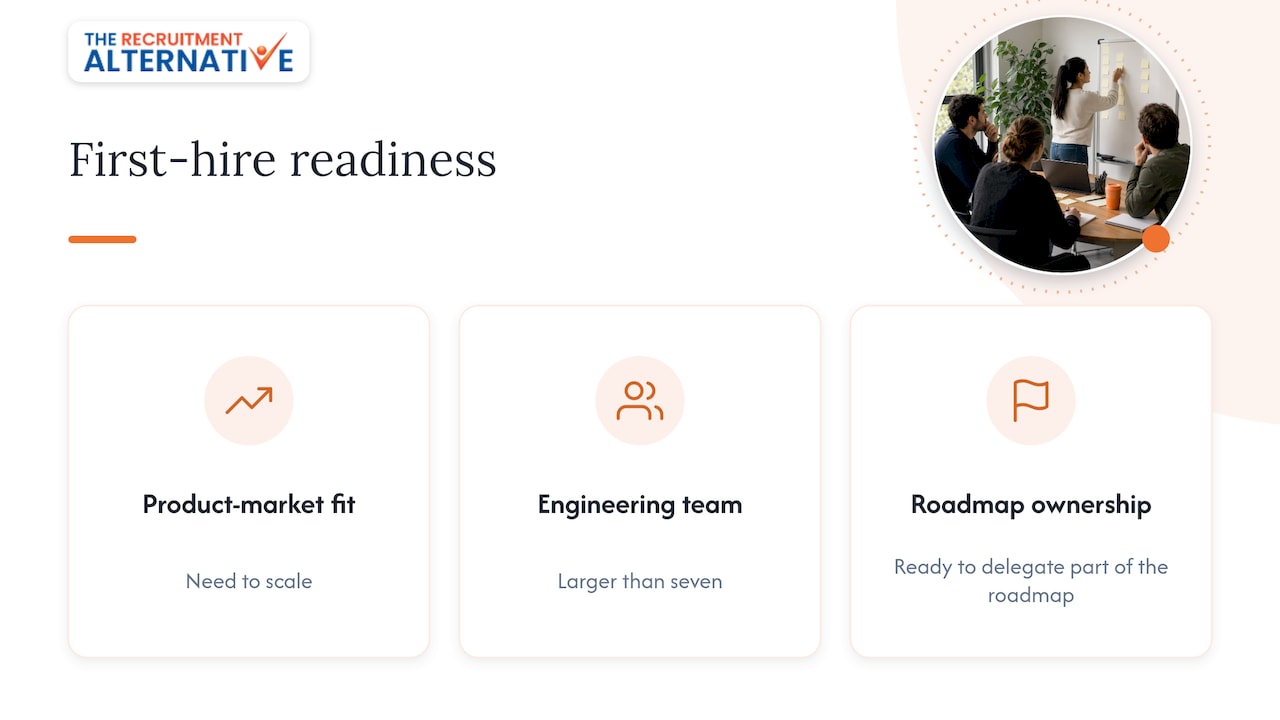
That last condition is the one owners underestimate. A product manager who cannot change priorities will leave, or will quietly stop trying.
Signs the role is due
- Founders or the managing director still decide every feature, and the decisions are slowing the team down.
- Sales, support and engineering each hold a different idea of what comes next.
- Customer feedback arrives constantly but nobody turns it into a ranked list.
- Your developers spend time guessing what the business wants.
Experience level: who to target
The same stage-by-stage guide recommends three to seven years of experience for most first hires. Its reasoning: a very senior product manager may be bored by the ambiguity of a first-hire role, while a junior one may lack the influence to steer people who have run the business for years.
The second decision is between a product specialist and a subject expert. Mironov’s advice is to hire somebody who has actually done product management before and to be wary of subject matter experts with no product experience, because experts tend to tell users what they need rather than listen to them. A former engineer, support lead or industry specialist can become a fine product manager, but make that a deliberate choice, not an accident of the shortlist.
Skills worth testing
- Prioritisation: can they explain why one feature beats another, with the trade-offs?
- Customer discovery: how do they find out what users need, and how often?
- Communication across teams: can they say no to sales and engineering and keep both on side?
- Commercial sense: do they connect product decisions to revenue, retention or cost?
- Evidence of shipping: what did they launch, and what happened after?
If the product is software, our technology role hiring checklist and guide to recruiting technology staff cover the wider team around the role.
What a product manager costs in Australia
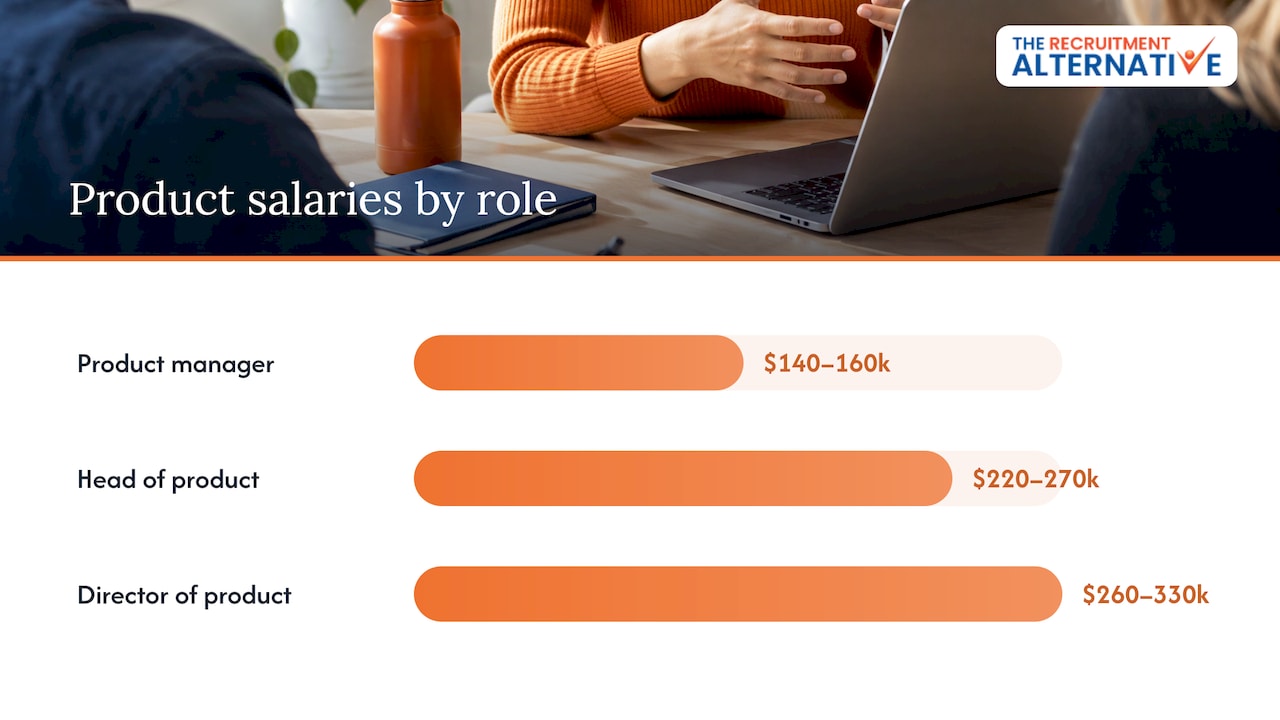
Salary is the largest cost, and it varies by industry, city and seniority. A Parity Consulting report covered by Money Management in August 2026 found that a product manager in Australian asset or wealth management earns $140,000 to $160,000 excluding superannuation and bonus. The same report puts a head of product at $220,000 to $270,000 and a director of product at $260,000 to $330,000. Those are figures for one sector. Software, retail and health businesses will differ, so use them as a sense of scale and not a quote.
On top of salary, budget for:
- Superannuation: the guarantee rate is 12% of ordinary time earnings, and from 1 July 2026 super is paid each payday under Payday Super rather than quarterly. Check the Australian Taxation Office for your obligations.
- Leave and standards: the Fair Work Act 2009 sets the National Employment Standards, covering hours, leave, notice and redundancy pay, and the Fair Work Information Statement.
- Recruitment: this is where the model you choose matters.
The recruitment fee: percentage versus flat
Traditional agencies charge a percentage of first-year salary. On a $150,000 salary, a percentage fee grows with every dollar you offer. A flat fee does not. That is why small businesses, which hire rarely and cannot absorb a large unexpected invoice, tend to prefer fixed pricing: you know the cost before the search starts, and a better candidate who asks for more does not make the fee higher.
At The Recruitment Alternative the fees are published and tiered by candidate salary:
| Option | Engagement fee | Placement fee |
|---|---|---|
| Recruit | $895 | $3,900 to $5,000 |
| Recruit+ | $2,495 | $5,000 to $6,000 |
Optional extras are a criminal check at $129 and a psychometric evaluation at $199 per candidate. The full schedule is on our flat-fee pricing page, and what the engagement fee covers is explained separately.
Writing a brief and job ad that attracts product managers
A clear brief is the cheapest improvement you can make to any search. Before the ad goes anywhere, write down:
- The problem the role solves. For example: “turn customer feedback into a ranked roadmap for the next two quarters”.
- Reporting line and decision rights. Who does the product manager answer to, and what can they decide alone?
- Must-haves and nice-to-haves. Keep the must-have list short.
- Salary range, location and work arrangements. Hybrid or remote expectations matter to this candidate group.
- How you will assess candidates, and the timeline.
The Australian Human Rights Commission advises that job ads should focus on the skills and abilities genuinely needed for the job, avoid discriminatory wording and encourage suitable people to apply. It also recommends advertising through broad mainstream, specialist, industry and community channels and including an inclusive diversity statement. Its recruitment and selection guidelines add that employers should separate essential from desirable criteria, avoid arbitrary years-of-experience requirements and decide in advance how each criterion will be assessed.
Use a standard title such as “Product Manager” or “Senior Product Manager”, not an internal label. Candidates search by the common title, and your listing will not be found under a made-up one.
Screening and interviewing product manager candidates
Product management is hard to judge from a CV, because titles vary widely between companies. A “product manager” in one business may do the work of a product owner in another.
A workable structure:
- Screen against the written criteria. Score each applicant on the essential criteria only.
- A structured first interview. Ask every candidate the same questions about a product they shipped: the problem, the evidence, the trade-offs, the result.
- A short case exercise. Give a realistic problem from your business and judge how they think, not whether they land on your preferred answer.
- Stakeholder conversations. Let the engineering lead and a sales or support lead meet the finalists. A product manager works through them.
- References and checks. Confirm what they actually owned.
Use one scoring rubric for all candidates so that the interviewers compare like with like. Optional psychometric evaluations are available through us at $199 per candidate if you want more data on working style, and a criminal check at $129 where the role calls for it.
Before the offer: the employment basics
Once you have chosen a candidate, the paperwork has to be right. Employers covered by the Fair Work Act must meet the National Employment Standards, which include a 38-hour maximum week for full-time employees unless additional hours are reasonable. Product managers often work long cycles around launches, so write the hours clause carefully.
A written contract should name the position and reporting line, employment type, start date, hours, location, remuneration and notice. Our guide to creating an employment contract in Australia walks through it. Confirm whether a Modern Award or enterprise agreement applies to the role with the Fair Work Ombudsman, because that decides minimum conditions, and ask an employment lawyer for anything unusual such as intellectual property or equity terms.
Why a fixed-fee search suits this hire
Product manager searches have three features that make flat pricing sensible for a small business.
- The salary is high. Percentage fees scale with it. A flat fee does not.
- The hire is infrequent. You may fill the role once every few years, so you cannot spread the cost across a steady stream of placements.
- A mismatch is expensive. A first product manager who does not fit can cost months of direction. Our replacement cover applies if a hire does not work out in the first two to three months, and a replacement campaign is $1,000.
Our stated position is that fixed fees deliver savings of over 70% compared with traditional commission-based agencies. You can see how the model works on our page on flat fee recruitment benefits, and how it compares to a percentage fee in our management recruitment strategies guide.
We recruit permanent staff across sales, management, technology, finance, engineering, healthcare, trades and executive leadership, for businesses of all sizes across Australia and New Zealand. Product management sits between several of those worlds, which is why the brief matters so much.
Our view is simple. A small business should not have to hand over a percentage of a product manager’s salary to find the right person. A fixed, published fee lets you decide on the hire for the right reasons: fit, experience and what the role will add to the business. It also means you can afford to run a proper search instead of settling for the first acceptable applicant.
Whatever route you take, write the problem the role solves before you write the job title. Most good product manager hires begin with that sentence.
Josh Townsend
Hiring a product manager with The Recruitment Alternative
Our permanent recruitment service is priced as a fixed fee: an engagement fee up front and a placement fee when you hire. The Recruit option has an $895 engagement fee and a $3,900 to $5,000 placement fee; Recruit+ has a $2,495 engagement fee and a $5,000 to $6,000 placement fee. The fee tier depends on the candidate’s salary, and the pricing page sets out the detail.
If you are planning a product manager search, start with our fixed fee recruitment service, or read how a flat fee recruitment model works for HR teams. If a hire leaves in the first two to three months, the replacement campaign is $1,000.
FAQ
Should I hire a product manager or a product owner?
Hire a product manager if you need someone to decide what to build and why. Hire a product owner if the direction is set and you need someone to manage the backlog for a delivery team. In a small business, one person often does both, so write the job ad to reflect which half matters most.
How many years of experience should a first product manager have?
Three to seven years suits most first hires, according to a stage-by-stage hiring guide. Look for direct product management experience, not only expertise in your industry. Avoid setting an arbitrary minimum number of years as an essential criterion without a reason.
What should I put in a product manager job ad?
Include the problem the role solves, the reporting line, essential and desirable skills, the salary range, the location and work arrangements. Keep the focus on the skills and abilities genuinely needed for the job, as the Australian Human Rights Commission advises, and avoid wording that could discourage suitable applicants.
How much does a recruiter cost for a product manager?
A percentage-based agency charges a share of the salary, so the fee rises with the package. With us, the fee is fixed: an engagement fee of $895 plus a placement fee of $3,900 to $5,000 on Recruit, or $2,495 plus $5,000 to $6,000 on Recruit+. See the pricing page for the full schedule.
Sources
- Product Management Roles and Responsibilities, Project Management Institute
- Product manager vs. project manager, Atlassian
- Rich Mironov on Hiring Your First Product Manager, Leading the Product
- When to Hire Your First Product Manager, Product Management Review
- Joining as the first product manager, Lenny’s Newsletter
- Asset managers return to office but salaries outpace rival industries, Money Management
- A step-by-step guide to preventing discrimination in recruitment, Australian Human Rights Commission
- Guidelines for recruitment and selection, Australian Human Rights Commission
- Fair Work Act 2009, Federal Register of Legislation
- Australian Taxation Office
- Fair Work Ombudsman

