
Offering genuine flexibility materially increases applicant interest. CIPD research finds that 87% of people want flexible work, yet only around 11% of roles are advertised as flexible — a gap that hands employers who advertise flexibility a significant competitive edge. The Australian Department of Employment and Workplace Relations (DEWR) confirms that advertising and normalising flexible work supports more diverse talent pipelines and signals an inclusive employer. Three actions you can take this week:
- Advertise flexibility explicitly in every job ad, not just on a careers page.
- Brief hiring managers on how to discuss flexible arrangements in interviews.
- Run an A/B test on two versions of your next job ad — one with flexibility language, one without — and compare application volumes over two weeks.
Key takeaways
Flexible work attracts candidates because it signals trust, improves work–life balance, and widens the talent pool — and advertising it explicitly is the single fastest way to capture that advantage.
| Point | Details |
|---|---|
| Advertising flexibility works | CIPD finds 87% of people want flexible work but only ~11% of roles advertise it — closing that gap gives employers a direct competitive edge. |
| Research backs the business case | A 2026 meta-analysis of 83,951 participants found flexible working has a significant positive relationship with work–life balance (r = .39) and organisational commitment (r = .29). |
| Pilot before you scale | Run a 90-day pilot on two to three output-measurable roles with defined success metrics before expanding flexibility organisation-wide. |
| Manage the risks actively | Without clear norms and manager support, flexibility can increase work–family conflict and create career progression inequity among team members. |
| The Recruitment Alternative | Fixed-fee recruitment with explicit flexibility briefing, targeted candidate sourcing, and cost-predictable pricing for employers hiring flexible roles across Australia. |
Table of Contents
- Why flexible work attracts candidates: what drives candidate demand
- How flexible work helps your business attract and keep people
- What the research and Australian data actually show
- What specific arrangements candidates are actually looking for
- How to design, pilot and scale flexible roles
- How to advertise flexibility to attract more applicants
- Common risks of flexible work and how to manage them
- Which metrics tell you whether flexibility is working
- What The Recruitment Alternative sees in Australian hiring markets
- Your action plan for this week and the next 90 days
- The conventional wisdom on flexible work gets one thing consistently wrong
- Hire for flexible roles without the percentage-fee cost
- Sources
Why flexible work attracts candidates: what drives candidate demand
Candidates do not value flexibility as a perk. They value it as a structural feature of how work fits their life. Autonomy over when and where work happens reduces commuting time, lowers daily stress, and gives people genuine control over their schedules. A 2026 meta-analysis of 83,951 participants across 19 countries found that flexible working arrangements have a significantly positive relationship with work–life balance (r = .39) and organisational commitment (r = .29). Those are not marginal effects.
The motivations differ by life stage, though the direction is consistent across groups.
- Parents and carers prioritise flexibility to manage school pickups, medical appointments, and caring responsibilities without burning leave.
- Early-career workers often cite flexibility as a signal that an employer trusts them — and trust is a strong predictor of engagement for this cohort.
- Older workers and those approaching retirement frequently want reduced hours or compressed weeks to manage health or transition gradually.
- Workers with long commutes respond strongly to remote or hybrid options because the time and cost savings are immediate and tangible.
There is also a signal effect worth noting. When an employer advertises flexibility, candidates read it as evidence of a supportive culture. That perception can outweigh modest pay differentials for many applicants, particularly in roles where the talent pool is tight.
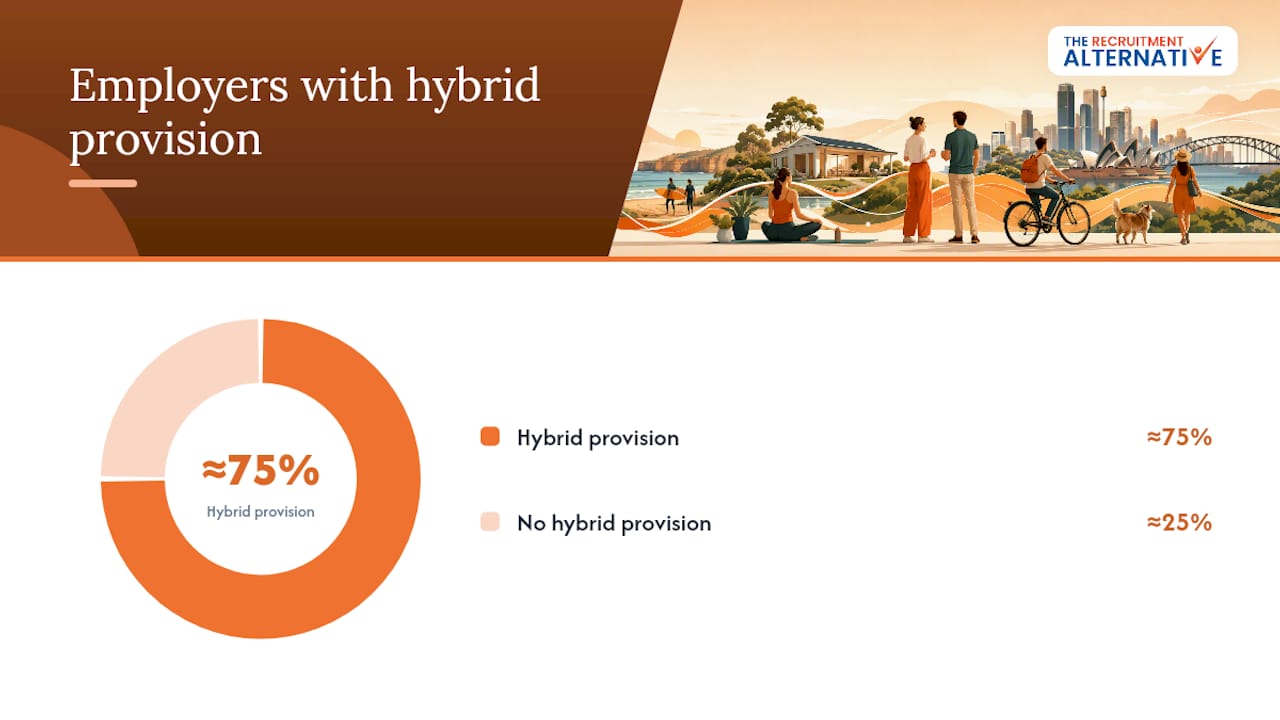
Statistic: CIPD’s employer survey (2025) found that around three-quarters of organisations now have some hybrid provision, with attraction and retention cited as the top reasons employers offer flexible working.
Pro Tip: When writing job ads, name the specific flexible arrangement on offer rather than using vague language like “we support work–life balance.” Candidates respond to concrete offers: “three days from home per week” or “flexible start between 7:30 and 9:30 AM” converts better than abstract promises.
How flexible work helps your business attract and keep people
The business case for flexible work and employee attraction is well-documented by the Workplace Gender Equality Agency (WGEA). The benefits operate across three dimensions: attraction, retention, and cost.
Attraction. Advertising flexibility widens the applicant pool by reaching candidates who have self-selected out of traditional roles. Parents returning from parental leave, workers with disabilities, carers, and people in regional areas all become accessible. A randomised controlled trial published by CEPR confirmed that highlighting flexibility in job ads increases applications from both women and men.

Retention and engagement. The systematic review published on PMC reports a significant positive relationship between flexible working arrangements and organisational commitment (r = .29). Employees who feel trusted to manage their own time tend to stay longer and report higher engagement scores.
Cost. Turnover is expensive. A rough estimate: replacing a mid-level employee typically costs between 50% and 200% of their annual salary when you factor in advertising, agency fees, onboarding, and lost productivity—but keep in mind that published estimates of replacement cost vary widely by industry and study design, and specific benchmarks should be validated against your internal data where possible. Additional savings can come from reduced absenteeism and, for some organisations, reduced office footprint.
- Larger and more diverse applicant pools per role
- Reduced time-to-hire when flexibility removes geographic constraints
- Lower voluntary turnover among flexible workers
- Reduced absenteeism linked to improved work–life balance
- Potential office-space savings for hybrid-first organisations
Pro Tip: Build a simple internal business case by tracking your current cost-per-hire and average tenure for roles you are struggling to fill. Then compare those figures after introducing flexibility to the same role type. The before-and-after comparison is more persuasive to senior leaders than any external benchmark.
What the research and Australian data actually show
The evidence base for flexible working and job satisfaction is now substantial. Here are the headline findings HR teams can cite internally.
- The 2026 meta-analysis (Springer) covering 83,951 participants found positive relationships between flexible working and both work–life balance and organisational commitment, while flagging that poorly managed flexibility can increase work–family conflict and psychological isolation.
- The PMC systematic review reports effect sizes of r = .39 for work–life balance and r = .29 for organisational commitment — statistically significant across a large body of primary studies.
- CIPD’s 2025 employer survey found hybrid working is now common across sectors, with employers consistently naming attraction and retention as the primary drivers for offering flexibility.
- DEWR guidance highlights that advertising flexible work is an Australian best-practice signal, particularly for employers seeking to improve gender diversity and attract underrepresented groups.
- WGEA’s business case resource summarises Australian employer benefits and provides practical steps for embedding flexibility into organisational practice.
One important caveat. The research consistently notes a “flexibility paradox”: autonomy improves outcomes, but without clear norms and active manager support, the same arrangements can increase work–family conflict and feelings of isolation. The benefit is real; it is not automatic.
Australian reports worth keeping on hand: DEWR’s workplace flexibility guidance, WGEA’s business case for flexibility, CIPD’s 2025 hybrid working survey, and the Fair Work Ombudsman’s flexibility in the workplace resources.
What specific arrangements candidates are actually looking for
Not all flexibility is equal in candidates’ eyes. Different arrangements attract different people, and the right mix depends on the role and the candidate segment you are trying to reach.
| Arrangement | Who it typically attracts | Best suited to |
|---|---|---|
| Fully remote | Candidates in regional areas, those with long commutes, carers | Knowledge work, tech, administration, finance |
| Hybrid (2–3 days in office) | Early-career workers who want connection plus autonomy | Most professional roles |
| Flexible start/finish times | Parents, carers, those managing health conditions | Any role without fixed client-facing hours |
| Compressed week (4 x 10 hrs) | Workers seeking longer weekends, those with long commutes | Operations, project-based roles |
| Part-time | Carers, students, semi-retired workers | Administration, customer service, specialist roles |
| Job-share | Experienced workers wanting reduced hours without leaving | Senior and specialist roles |
| Sabbaticals | High-tenure employees, those seeking development | Senior, long-service roles |
A 2017 meta-analysis found that different flexible work practices vary in their impact on organisational attractiveness, with flexible schedules often showing stronger effects on commitment than telecommuting alone. Offering a combination tends to outperform a single option.
Pro Tip: Structure your flexibility offer as tiers rather than a single policy. For example: Tier 1 is fully remote with quarterly in-person days; Tier 2 is hybrid with two days in the office; Tier 3 is flexible core hours with full in-office presence. Publishing these tiers in job ads sets clear expectations and reduces mismatched applications.
How to design, pilot and scale flexible roles
A flexible work policy that lives only in an HR document rarely delivers results. The operational steps below give you a practical path from design to scale.
Design checklist
- Define outputs, not hours. For each role, write two to four measurable deliverables that define success in a given period. This shifts the conversation from presence to performance.
- Audit technology needs. Confirm the role has the tools for asynchronous collaboration: a project management platform (Asana, Monday.com, or similar), reliable video conferencing, and documented communication norms.
- Set core hours. Identify the minimum overlap window when all team members need to be available. Two to three hours per day is usually sufficient for most professional roles.
- Draft a flexibility agreement. Cover: arrangement type, core hours, communication response times, equipment responsibilities, and a scheduled review date.
Pilot plan
- Select two to three roles that are output-measurable and do not require constant physical presence.
- Run the pilot for 90 days with defined success metrics agreed upfront (see Section 9 for metrics).
- Hold a manager calibration session at the 30-day mark to catch inconsistencies early.
- Report results to leadership at 90 days before expanding.
Under the Fair Work Act, employees have a right to request flexible work from day one of employment in certain circumstances. Employers must respond in writing within 21 days and can only refuse on reasonable business grounds. Building this into your process from the start avoids compliance issues later.
Pro Tip: Use a short manager conversation script for flexibility negotiations: “Tell me what arrangement would work best for you, and let’s look at how we can make that work within the team’s needs.” This framing signals openness without creating an unconditional commitment, and it surfaces candidate preferences early in the hiring process.
How to advertise flexibility to attract more applicants
Where and how you mention flexibility in a job ad changes who applies. Candidates scan ads quickly, so placement matters as much as wording.
Where to place flexibility language:
- Headline or job title line: “Senior Accountant | Hybrid, 3 days from home” outperforms a title with no flexibility signal.
- First paragraph of the role description: Candidates decide within seconds whether to read further. Mentioning flexibility early keeps them reading.
- Benefits section: List the specific arrangement, not a generic phrase.
Three ready-to-use ad copy variations:
- Remote role: “This role is fully remote. You will work from anywhere in Australia, with quarterly team days in [city]. We provide all equipment and a home-office allowance.”
- Hybrid role: “We work on a hybrid model: two days in our [city] office, three days from wherever you work best. Core hours are 10 AM to 3 PM.”
- Flexible hours: “Start between 7:30 and 9:30 AM and finish accordingly. We care about what you deliver, not when you log on.”
Microcopy for careers pages: “We advertise every role with flexibility in mind. If a standard arrangement does not suit you, tell us what does — we will always consider it.”
The CEPR randomised trial found that highlighting flexibility increases applications from both women and men, though highlighting career advancement attracted more highly qualified applicants in entry-level STEM roles. For senior or specialist roles, pairing flexibility messaging with clear career progression language captures both effects.
Pro Tip: Run an A/B test on your next two identical roles: post one ad with explicit flexibility language in the headline and first paragraph, and one without. Track total applications, female applicant share, and offer acceptance rate. Even a two-week test gives you directional data to justify a policy change.
Common risks of flexible work and how to manage them
Poorly implemented flexibility creates problems that undermine the very benefits you are trying to capture. These are the risks that appear most consistently in the research and in practice.
Boundary blurring. When work and home share the same space, employees can struggle to switch off. The 2026 meta-analysis specifically flags that without clear norms, flexible arrangements can increase work–family conflict rather than reduce it.
Career progression gaps. Employees who work remotely or part-time can become less visible to decision-makers, reducing their access to stretch assignments and promotion opportunities.
Reduced informal learning. Junior staff in particular lose incidental learning that happens in shared physical spaces. This is a real cost that hybrid designs need to account for.
Perceived inequity. When flexibility is granted informally and inconsistently, team members who cannot access it feel disadvantaged. This erodes trust and engagement.
Mitigations
- Publish explicit norms. Document expected response times, meeting protocols, and “off” hours. Make these visible to the whole team, not just flexible workers.
- Apply hybrid meeting rules. If one person is remote, everyone joins on video. This prevents a two-tier meeting experience.
- Rotate in-person development days. Schedule regular in-office days specifically for mentoring, project kick-offs, and informal learning — not just for meetings that could be emails.
- Standardise approval processes. Use a written flexibility agreement for every arrangement, approved through a consistent process, to prevent ad-hoc decisions that create inequity.
Manager script for perceived unfairness: “I understand it can feel uneven when different team members have different arrangements. Every arrangement is based on role requirements and individual circumstances. If you would like to discuss what might work for your role, let’s set up a time.”
Pro Tip: Conduct a brief quarterly check-in specifically on flexibility equity: ask managers to review whether all team members have had the opportunity to discuss flexible arrangements, and whether any informal approvals have been made outside the standard process.
Which metrics tell you whether flexibility is working
Tracking the right numbers turns flexibility from a feel-good policy into a measurable business strategy. Below are the metrics worth building into your HR reporting.
Recruitment metrics
- Applications per role (track before and after introducing flexibility language)
- Offer acceptance rate
- Time-to-hire
- Applicant diversity (gender, age, location)
Retention and performance metrics
- Voluntary turnover rate by cohort (flexible vs non-flexible workers)
- Engagement scores from pulse surveys
- Internal mobility rate (promotions and lateral moves among flexible workers)
- Absenteeism rate
Sample dashboard elements to request from your analytics team:
| Metric | Frequency | Benchmark target |
|---|---|---|
| Applications per flexible role | Per hiring cycle | Compare to same role pre-flexibility |
| Offer acceptance rate | Per hiring cycle | Track trend over 6 months |
| Voluntary turnover (flexible cohort) | Quarterly | Compare to non-flexible cohort |
| Engagement score (flexible workers) | Bi-annual pulse | Compare to organisation average |
| Time-to-hire (flexible roles) | Per hiring cycle | Track trend over 6 months |
Report these metrics together rather than in isolation. A rise in applications means little if offer acceptance is falling, which may signal that candidates are attracted by the ad but disappointed by what they find in the interview process.
What The Recruitment Alternative sees in Australian hiring markets
Employers who approach The Recruitment Alternative about flexible roles often share a common hesitation: “We are open to flexibility, but we do not know how to brief a recruiter on it.” The answer is straightforward. A well-structured brief for a flexible role includes the arrangement type, core hours, output expectations, and any in-person requirements. That information goes directly into sourcing and screening criteria.
A few patterns stand out in the Australian market right now. Roles advertised with explicit hybrid or remote arrangements consistently attract more applicants per posting. Candidates are also asking about flexibility earlier in the process — often in the first screening call rather than at offer stage. Employers who cannot answer those questions confidently lose candidates to competitors who can.
Fixed-fee recruitment handles flexible-role briefs without the cost blowout that percentage-based models create when a role takes longer to fill or requires broader sourcing. The fee is fixed regardless of how many candidates need to be screened or how many ad variants are tested. For employers piloting flexibility across several roles simultaneously, that cost predictability matters.
The flexible recruitment approach The Recruitment Alternative uses with clients reflects what the research supports: advertise the arrangement explicitly, screen for fit with the arrangement, and measure applicant quality alongside volume.
Your action plan for this week and the next 90 days
Three steps to take this week
- Update your next job ad. Add the specific flexible arrangement to the headline and first paragraph. Use concrete language: days in office, core hours, remote equipment provision.
- Brief your hiring managers. Share the three ad copy variations from Section 7 and the manager conversation script from Section 6. Fifteen minutes in a team meeting is enough.
- Choose one role to pilot. Select a role that is output-measurable and does not require constant physical presence. Define two to four success metrics before the pilot starts.
90-day checklist
- Week 1: Update job ads and brief hiring managers
- Week 2: Launch pilot role with documented flexibility agreement
- Week 4: First manager check-in on pilot progress
- Week 8: Pulse survey with pilot participants on work–life balance and engagement
- Week 12: Report pilot results to leadership using the metrics from Section 9
- Week 13: Decide whether to expand, adjust, or pause based on data
Measure before you scale. A 90-day pilot with defined success criteria gives you the internal evidence to expand flexibility confidently, rather than rolling it out organisation-wide and discovering problems at scale.
The conventional wisdom on flexible work gets one thing consistently wrong
Most employer guides treat flexible work as a policy question: write the policy, publish it, done. The research tells a different story. The 2026 meta-analysis is clear that the benefit of flexibility depends heavily on how it is managed, not just whether it exists. An organisation can have a generous flexibility policy and still see higher work–family conflict among flexible workers if managers do not actively set norms, protect boundaries, and ensure visibility for remote staff.
The other thing most guides understate is the advertising gap. CIPD’s finding that 87% of people want flexible work but only around 11% of roles advertise it is not just a statistic about candidate preferences. It is a description of a market inefficiency that employers can exploit right now, without changing a single internal policy. Simply advertising what you already offer — or what you would consider on request — puts you ahead of the majority of employers competing for the same candidates.
Where I think the conventional advice falls short is in treating flexibility as a single lever. The CEPR trial shows that flexibility messaging and career advancement messaging attract different applicant profiles. For senior or specialist roles, leading with flexibility alone may not attract the highest-calibre candidates. The smarter approach is to pair flexibility with a clear articulation of growth, responsibility, and impact — so the ad speaks to both what candidates want from their life and what they want from their career.
The employers who will win on flexibility are not the ones with the most generous policies. They are the ones who advertise clearly, manage intentionally, and measure consistently.
Hire for flexible roles without the percentage-fee cost
Filling a flexible role through a traditional percentage-based agency can cost a significant portion of the annual salary — and that cost does not change whether the role took two weeks or two months to fill. The Recruitment Alternative offers a fixed-fee model for permanent recruitment across Australia, with pricing tiered by role salary rather than charged as a percentage. For employers hiring multiple flexible roles or running a pilot across several teams, the cost predictability is a practical advantage.
The service covers sourcing, screening, and shortlisting candidates who are briefed on the specific flexible arrangement from the first contact. Candidate replacement insurance is included if a placement does not work out within the first two to three months. Whether you are hiring remote staff, filling a hybrid role, or testing a compressed-week arrangement for the first time, The Recruitment Alternative structures the brief around the arrangement you are offering.
To discuss a flexible-role brief or get a fixed-fee quote, visit Therecruitmentalternative or get in touch directly to talk through your hiring needs.
Sources
These are the primary Australian and international resources HR teams should keep on hand for internal citations and policy development.
- The relationship of flexible working arrangements on work-family conflict, work-life balance and organizational commitment (Springer, 2026)
- The relationship of flexible working arrangements on WLB and OC (BMC Psychology / PMC)
- The case for flexible work (Australian Government, DEWR)
- RCT on job ad messaging and applicant pools (CEPR, 2025)
- Business case for flexibility (WGEA)
- Flexibility in the workplace (Fair Work Ombudsman)