

The right recruitment agency for a small business is one that knows your type of role, quotes you a fee you can calculate before you sign, and puts the replacement terms in writing. Most of the cost and risk in an agency relationship sits in the fee structure and the guarantee, not in the agency’s brand name. A fixed-fee agency such as The Recruitment Alternative lets you see the full cost of a permanent hire up front, instead of discovering it when the candidate’s salary is agreed.
This guide walks through what to settle before you call anyone, what to look for in a recruiter, how to read fee terms, and a short list of questions to ask every agency you speak to.
TL;DR
- Define the role, salary range and must-have skills first. A recruiter can only be as good as the brief you give them.
- Look for specialisation in your field, consultants who have stayed in the job, and a candidate network that reaches beyond your city.
- Compare agencies on total cost for one placement, not on the headline rate. Ask whether the fee is a percentage of salary or a fixed amount.
- Get the replacement guarantee, its length and its exclusions in writing before you engage.
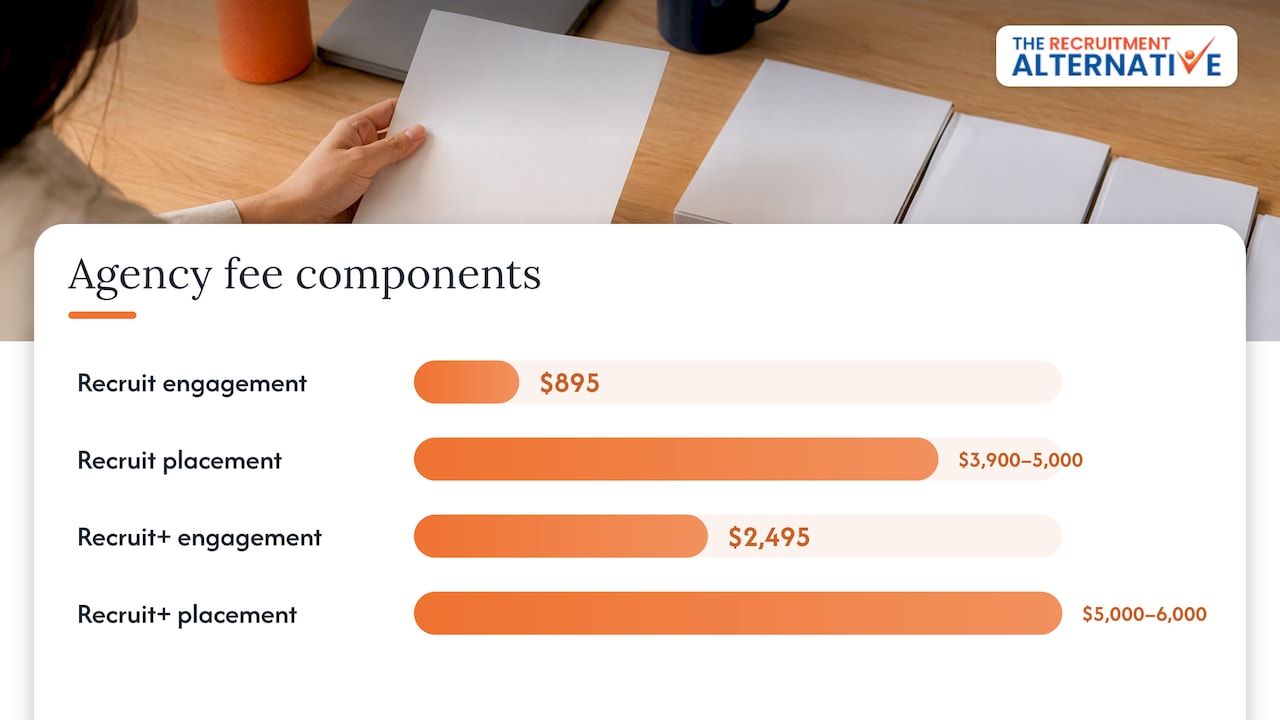
- Our flat-fee model publishes its prices: for example, $895 to engage and $3,900 to $5,000 on placement for Recruit.
Table of Contents
- Start with the role, not the agency
- What to look for in a recruiter
- How agency fees work, and why the model matters
- The replacement guarantee
- Communication, timeline and measures of quality
- Rules and licensing: what to know in Australia
- Fair hiring is part of the choice
- Our flat-fee service
- Our perspective
- A short list to take into every agency meeting
- FAQ
- Sources
Start with the role, not the agency
Agencies are quick to ask for a brief. If yours is vague, you will receive a long list of loosely matched candidates and pay for the time it takes to sort them. Before you contact anyone, settle five things.
- The essential requirements of the job. The Australian Human Rights Commission advises employers to focus on the essential requirements of the job, assess applicants consistently against selection criteria and document decisions. A good agency will work to this standard. A brief built on essentials also keeps your shortlist fair and defensible.
- Employment type and pay range. Permanent full-time, part-time or fixed term, and the salary band you can genuinely support. Check the award or agreement that covers the role and confirm the classification matches the real duties.
- Approval and budget. Confirm the headcount is signed off and the budget includes the recruitment fee, any checks and the likely start date.
- A current position description. One page of duties, reporting lines and outcomes in the first six months.
- Who decides. Name the person who will interview and the person who will sign off the offer, so the agency is not waiting on you when a good candidate is on the market.
If you are writing the advertisement yourself or want to know what a job ad must and must not say, our guide to job ad requirements in Australia covers it.
What to look for in a recruiter
The agencies that rank for this search are mostly lists. A list tells you who is big. It does not tell you who suits a ten-person business hiring one office manager or one estimator. These are the points that separate a useful recruiter from an expensive one.
Specialisation in your field
CPA Australia’s INTHEBLACK, in its guidance on when to engage recruiters and what to look for, quotes recruiters advising employers to look for specialisation and industry knowledge. It also points to due diligence on candidates’ qualifications and employment history. In practice, ask the agency to describe the last three roles of your type it filled: the job title, the sourcing approach and how long it took.
Reputation and consultant tenure
The same guidance recommends checking online reviews and how long consultants have stayed with their firm. A consultant who has been in the same seat for years has built a network and has a record you can ask about. A high-turnover desk means your brief may change hands mid-search.
Reach into the candidate pool
A small business rarely has access to candidates beyond the people who see its own job ad. Ask where the agency finds people: its own database, direct approaches to people not actively looking, industry associations, interstate contacts. For regional employers and for roles where talent is scarce, this reach is much of what you are paying for.
Willingness to learn your business
Talk to two or three agencies before choosing. Notice which one asks about your team, your growth plans and the person the new hire will report to. The one that asks is the one that will screen for fit, not only for a matching CV.
Candidate screening you can see
Ask what happens between sourcing and shortlist. Typical steps are a screening interview, reference checks and verification of qualifications. Optional extras such as criminal history checks or psychometric assessments are common, and they are usually charged separately. With us, an optional criminal check is $129 and a psychometric evaluation is $199 per candidate, so you know the cost before you choose to add either.
If you want a printable version of these criteria, our recruitment agency evaluation checklist for small businesses puts them in one place.
How agency fees work, and why the model matters
There are two broad ways an agency can price a permanent placement.
- Percentage of salary. The fee is calculated on the candidate’s annual package once the offer is accepted. The higher the salary, the higher the fee. As an illustration only, a 20% fee on a $90,000 salary would be $18,000.
- Flat fee. The fee is a set amount, tiered by the salary band of the role, and it is known before the search starts.
The difference matters most to small businesses because a single hire is a large share of the annual budget. A percentage fee rises with the salary you offer, so a better candidate costs the agency’s client more. A flat fee separates the cost of the recruiter’s work from the size of the salary.
Our own claim is that this model delivers over 70% savings against traditional commission-based agencies. To test any claim like that for your own role, work out the total cost under each model, including checks and the cost of a replacement search if the hire does not work out.
What our flat fees are
We publish our fees on our simple flat-fee structure page. Each service has two payments: an engagement fee when the search begins and a placement fee when a candidate is successfully placed.
| Service | Engagement fee | Placement fee | Total for one placement |
|---|---|---|---|
| Recruit | $895 | $3,900 to $5,000 | $4,795 to $5,895 |
| Recruit+ | $2,495 | $5,000 to $6,000 | $7,495 to $8,495 |
The placement fee sits within a range because it depends on the candidate’s salary. Optional extras are listed separately: a criminal check at $129 and a psychometric evaluation at $199 per candidate. These are our prices as published on our site, and the page is the place to confirm the current figures for your role.
Totals are the engagement and placement fees added together, so you can compare them with a quote from any other agency on the same basis: one placement, everything included, no surprises.
If you want to see the model explained further, read our guide to flat fee recruitment benefits for Australian employers. For payment timing, see placement fee payment terms and the four payment structures.
Fee terms to read before you sign
Whatever the model, check these points in the agency’s terms of business.
- When each payment falls due. On engagement, on shortlist, on offer acceptance or on start date.
- What triggers the placement fee. Does it apply if you hire a candidate the agency introduced months later, or someone you were already talking to?
- What is included and what is extra. Reference checks, criminal checks, psychometric testing, advertising costs.
- Whether the fee is confirmed in writing before the work starts. The RCSA’s August 2024 submission describes South Australia’s proposed framework, under which an employment agent could not recover a fee unless it notified the employer of the amount and confirmed it in writing before providing the service. Whatever your state requires, written confirmation of the fee before you start is sound practice.
The replacement guarantee
A permanent hire can leave in the first weeks. A replacement guarantee is the agency’s commitment to deal with that. The details decide its value, so ask for these in writing:
- How long the guarantee runs, and from which date.
- What counts as the hire not working out, and who has to notify whom, and when.
- What the agency does: a new search, a credit, or a refund.
- What cancels the guarantee, such as a change to the role, redundancy or a late payment.
Our candidate replacement insurance covers hires that do not work out in the first two to three months. If you need a replacement search, a Replacement Campaign costs $1,000. That is a known figure you can plan for before you hire.
Communication, timeline and measures of quality
These are the questions that tend to be left out of agency comparisons, and they decide whether the process feels well run.
- Who is your contact? One named consultant, or a rotating team.
- How often will you hear from them? Agree a rhythm at the start, such as a weekly update with the number of candidates approached, screened and shortlisted.
- What is a realistic timeline? Ask for stages: brief, advertising and approach, first shortlist, interviews, offer. A recruiter who promises a short timeline for a scarce skill without explaining how deserves a follow-up question.
- How is candidate quality measured? Ask how many of the agency’s recent placements are still in the role after 12 months, and how it follows up after the start date.
- Is there support beyond the introduction? Recruitment involves more than introducing a candidate. Onboarding support and feedback between all parties help a new hire settle in.
Rules and licensing: what to know in Australia
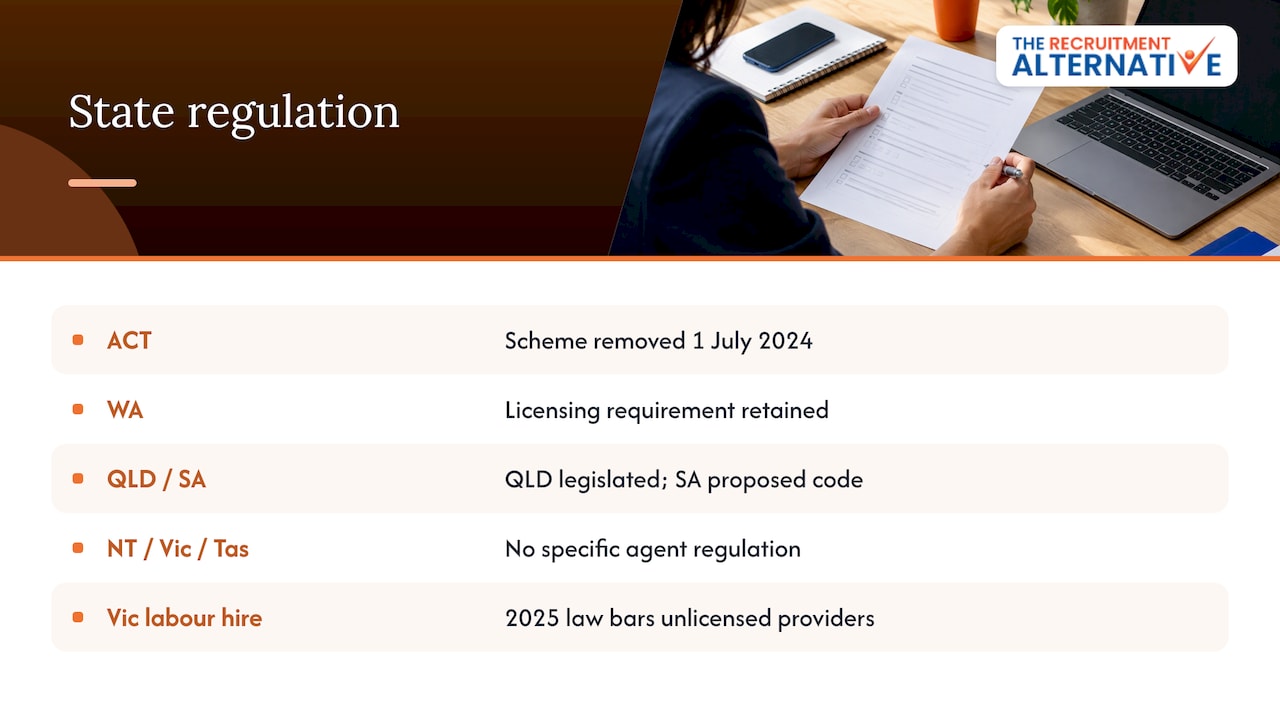
Recruitment regulation differs by state, and it has been changing. The RCSA’s August 2024 submission records that the ACT removed its employment agents licensing scheme on 1 July 2024. It also notes that Western Australia kept its licensing requirement, that Queensland replaced licensing with a legislated code of conduct, and that South Australia was proposing a code of conduct in place of its licence. According to the same submission, the Northern Territory, Victoria and Tasmania had never introduced specific employment-agent regulation. Check the current position in your state with the relevant state regulator before you engage an agency.
Labour hire is a separate matter from permanent recruitment, but it matters if you are also considering temporary or contract workers. In Victoria, the Labour Hire Legislation Amendment (Licensing) Act 2025 amends the Labour Hire Licensing Act 2018. It includes a prohibition on entering into an arrangement for labour hire services with an unlicensed provider. If you use labour hire in Victoria, confirm the provider holds a licence first.
Fair hiring is part of the choice
Your agency is acting for you in a hiring process, and discrimination law applies to that process. The Australian Human Rights Commission recommends planning recruitment to give equal opportunity, including adjustments for applicants who need them, casting the net widely and avoiding requests for irrelevant personal information. Ask any agency how it screens and what it asks candidates. Our article on diversity hiring in Australia sets out three actions employers can take today.
Our flat-fee service
We recruit permanent staff for businesses across Australia and New Zealand, in sales, management, administration, finance, engineering, healthcare, trades, technology and executive roles. Our fixed-fee recruitment service is a one-off $4,795, and the engagement and placement structure above sets out how that fee is paid. You can see the whole structure on our flat-fee pricing page or start from our fixed fee recruitment service.
For engineering roles, where fees are often a concern, see engineering recruitment fees in Australia. If you want to understand how agencies work before you decide, our guide on how recruitment agencies work is a good start.
Our perspective
Small businesses usually come to us after a hire has gone wrong or a quote has come back larger than the budget. In both cases the problem is the same: the cost was not clear until it was too late to change the decision.
That is why we built our service around a fixed fee. The employer knows the engagement fee and the placement range before the search starts. Salary is the employer’s decision, and it does not change what we charge in the way a commission would.
We also think an agency should stand behind its work. Our replacement insurance covers a hire who does not work out in the first two to three months, and a Replacement Campaign has a published price of $1,000.
Our advice is to choose the agency whose terms you can explain to your accountant in two minutes. If the fee, the checks and the guarantee are simple to describe, the relationship usually is too.
Josh Townsend
A short list to take into every agency meeting
- Which roles like mine have you filled recently, and how?
- How do you find candidates who are not applying for jobs?
- What is the total cost for one placement, including checks?
- When is each payment due, and what triggers it?
- How long is the replacement guarantee, what does it cover and what voids it?
- Who will be my contact, and how often will I hear from them?
- How do you check qualifications, employment history and references?
An agency that answers these plainly and in writing is one you can work with.
FAQ
How much does a recruitment agency cost in Australia?
It depends on the model. Many agencies charge a percentage of the candidate’s annual salary, so the fee rises with the package. A flat-fee agency charges a set amount by salary band. Our Recruit service is $895 to engage plus a placement fee of $3,900 to $5,000, and Recruit+ is $2,495 plus $5,000 to $6,000.
Should a small business use a recruitment agency or hire directly?
An agency suits roles that are hard to fill, urgent, or outside your usual network, and it saves the time of screening many applicants. A fixed fee makes the cost predictable, so you can set it against the time and risk of a poor hire before you decide.
What is a replacement guarantee?
It is an agency’s promise to run a new search or otherwise make good if a placed candidate leaves within a set period. Ask for the length, the start date, what voids it and the remedy in writing. Ours covers hires who do not work out in the first two to three months.
Do recruitment agencies need a licence in Australia?
It depends on the state. Western Australia has maintained a licensing requirement, while other states and territories have removed licensing or never introduced it, according to the RCSA’s August 2024 submission. Labour hire providers in Victoria must be licensed. Check your state regulator for the current rules.
What should I look for in a recruiter?
Look for experience in your field, consultants with long tenure, a candidate network that reaches beyond your city, clear fee terms and a written replacement guarantee. Speak to two or three recruiters and choose the one that asks most about your business.

