

Hiring a project engineer goes well when you define the discipline first, budget to the state and sector pay range, and judge candidates on the project work they have delivered rather than on a title. Fixed-fee recruitment then keeps the cost of the search predictable. Our Recruit service has an engagement fee of $895 and a placement fee of $3900-5000, so the agency cost does not climb with the salary you offer. This guide covers what the role involves, what to look for, what to pay, how to screen and interview, and what to check before you make an offer.
TL;DR
- A project engineer sits between the project manager and the technical disciplines. Decide whether you need civil, mechanical, electrical or another specialty before you write the advertisement.
- Budget from discipline and state. Published 2026 indicative ranges run from about $90,000 for mechanical engineers to $125,000 for electrical engineers, with Western Australia paying the most.
- Screen against written criteria, then interview on delivered project work: scope, cost, schedule, contracts and safety.
- Complete screening checks before a formal offer, or make the offer conditional on them.
- With us, the Recruit engagement fee is $895 and the placement fee is $3900-5000. Recruit+ is $2495 engagement and $5000-6000 placement. Both are flat fees, not a percentage of salary.
Table of Contents
- What a project engineer actually does
- Choose the discipline before the title
- Qualifications, experience and skills to look for
- Write the role so the right people apply
- What to budget: salary and conditions
- Source and screen candidates
- Interview for evidence, not impressions
- Checks to complete before the offer
- What it costs to recruit a project engineer with us
- Our view: why a fixed fee suits engineering hires
- FAQ
- Sources
What a project engineer actually does
The title covers a wide range of jobs, so the first task is to pin down yours. A project engineer delivers the technical side of a project while the project manager looks after the overall plan. ANSTO’s position description for its project engineer/manager describes engineering and management of multi-disciplinary projects from concept to completion. That covers scope, cost, time, quality, safety, environmental and contract management, plus specifications, drawings and reports to stakeholders.
The mix of technical and coordination work shifts with the employer. A Hitachi Energy project engineering advertisement from Brisbane lists discipline engineering and design, planning and risk assessment, and coordination of personnel and equipment. It says the person may act as design authority for one discipline, prepare work plans and cost estimates, and review scope, budget and schedule. A mining construction role advertised by SIMPEC is more about procurement and construction coordination, work packs, installation scheduling, RFIs (requests for information) and compliance with Australian Standards.
In practice you are usually hiring one of three profiles:
- Design-side project engineer. Coordinates design reviews across disciplines, checks drawings and manages technical queries.
- Construction or site project engineer. Runs work packs, subcontractors, installation sequencing and site queries.
- Contract and commercial-leaning project engineer. Spends more time on cost control, variations, procurement and client reporting.
Most small businesses need a blend of two. Decide which one carries more weight, because it decides the qualifications, the pay range and the questions you ask at interview.
Choose the discipline before the title
“Project engineer” on its own attracts a flood of applications from every branch of engineering. A water treatment contractor needs someone who understands process and civil works. A fabrication business needs mechanical. An electrical contractor needs someone who can review protection and switchgear documentation.
A useful test is to list the three technical decisions this person will have to review or approve in their first six months. If you cannot name them, the role is probably closer to a project coordinator or a project manager. If it is closer to the latter, our guide to project manager hiring covers that role.
If you are mapping what the role needs against skills already in your team, a project resourcing and skills mapping approach can help you see which capabilities you are short of before you advertise.
Qualifications, experience and skills to look for
Most Australian project engineer roles ask for an engineering degree. ANSTO’s position description, for example, asks for a degree or master’s in engineering, science or project management, proven problem-solving, the ability to lead projects independently using project management methods, stakeholder management, and work that meets Australian Standards, quality procedures and statutory requirements.
Qualifications are only part of the picture. A 2021 study of project engineers in Western Australian mining found three competency areas behind high performance: expertise, people management and interpersonal skills, and actions and approach to work. The authors describe the project engineer as a hybrid of technical expert and project manager, with broad rather than narrow technical expertise, and note that high performers keep learning on the job.
For an employer, that translates into a short list of what to weigh:
- Relevant technical grounding in the discipline your projects use, shown by what they have designed, reviewed or commissioned.
- Commercial awareness: tracking cost against budget, handling variations and understanding contract obligations.
- Communication: writing a clear RFI, running a progress meeting, explaining a delay to a client without drama.
- Safety and compliance habits: working to Australian Standards and site safety systems.
- Learning appetite: a willingness to pick up a new system, tender process or software.
Engineers Australia’s construction engineer learning and development guide, written with the Australian Constructors Association, is a useful checklist if you are in construction. It names competencies such as developing project methods, contract management, managing project cost and schedule, applying digital tools, working safely, controlling quality and managing stakeholders.
A graduate with strong fundamentals suits a business that has a senior engineer to mentor them. A business with no senior engineer in-house usually needs someone who has already carried a package of work from start to finish.
Write the role so the right people apply
A clear advertisement saves screening time. Include:
- The discipline and the type of projects: for example, water infrastructure, commercial fit-out or plant upgrades, with typical project value and duration.
- Who they report to and who they coordinate with (subcontractors, designers, clients).
- Three to five outcomes for the first year, not a long task list.
- Must-have versus nice-to-have qualifications and experience. Keep must-haves to what you will genuinely reject someone for.
- Location and work arrangements, including site time, travel or FIFO if relevant.
- The salary range. Advertisements with a range draw better-matched applicants than those that say “negotiable”.
Write the scope before you read any applications. Then every candidate is measured against the same page rather than against whoever applied first.
What to budget: salary and conditions
Pay varies by discipline, state and whether the work is site-based or FIFO. A June 2026 salary guide drawing on SEEK’s engineering data gives these indicative 2026 ranges:
| Discipline | Indicative range |
|---|---|
| Mechanical engineer | $90,000-$110,000 |
| Civil engineer | $95,000-$115,000 |
| Electrical engineer | $105,000-$125,000 |
| Structural engineer | about $110,000 average |
| Engineering manager | $170,000-$190,000 |
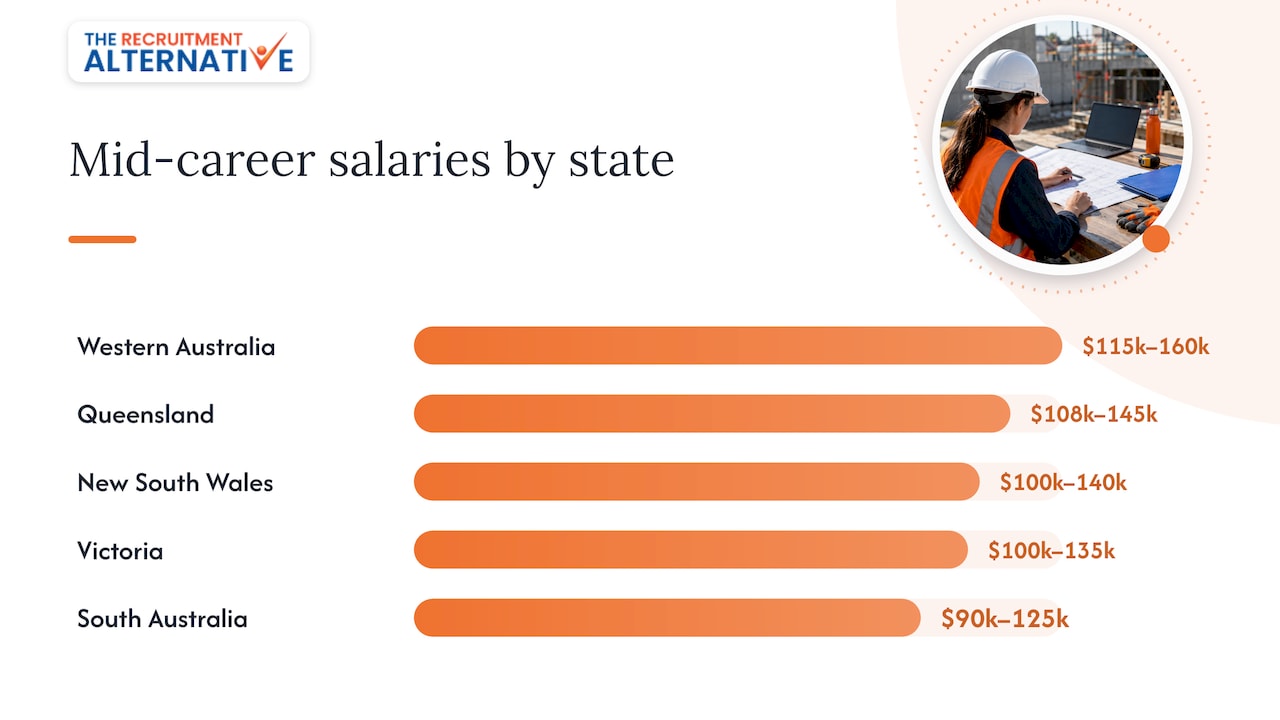
The same guide reports mid-career base salary ranges by state: Western Australia $115,000-$160,000, Queensland $108,000-$145,000, New South Wales $100,000-$140,000, Victoria $100,000-$135,000 and South Australia $90,000-$125,000. It also says FIFO allowances often add $20,000-$50,000 above base. These are indicative figures for engineers in general, not project engineers specifically, so treat them as a starting range and test it against current advertisements in your city.
For senior roles, PayScale’s 2026 Australian data for senior engineering project managers shows an average base of $147,797, with base pay from $117,000 to $217,000 across the 10th to 90th percentile. That data was based on 54 profiles last updated in August 2024, so use it as a ceiling check rather than a quote.
The salary also sets the cost of the hire in other ways. Superannuation, leave, vehicle or tool allowances and any site allowances all sit on top. A realistic offer is one you can sustain through the first year, not just the one that wins the candidate.
Source and screen candidates
A project engineer search has two usual problems: too few suitable people see your advertisement, and too many unsuitable ones apply. A structured process deals with both.
- Fix the scope and criteria first. Turn your must-haves into a scoring sheet. business.gov.au suggests rating candidates against the role requirements on a 1-5 matrix, then shortlisting those with the right qualifications, cultural fit, matching goals and the right to work in Australia.
- Reach beyond job boards. The strongest engineers are often employed and not browsing. Direct approaches, industry contacts and a recruiter’s candidate network reach them. This is the step where our extensive candidate sourcing does the heavy lifting for a small business with no time to chase.
- Screen on delivered work. Ask for a short summary of two projects: the scope, their role, the value, the programme, and what went wrong. Check that the equipment, processes and standards are comparable to yours.
- Check technical accountability. Which calculations, reviews or approvals did the person actually sign off, and which did a senior engineer handle? This separates someone who coordinated a project from someone who engineered it.
- Use a consistent first conversation. A 20-minute phone screen on availability, salary expectations and two or three technical points removes weak matches cheaply.
If your team does a lot of first-round screening, a recruitment workflow automation approach with recorded video responses can cut scheduling time, since candidates answer the same questions in their own time and your team reviews them together.
Where our service fits
When we run a search for you, we recruit permanent staff across engineering and many other fields, using personalised service and extensive candidate sourcing. Our process is built for small and mid-sized businesses that do not have an in-house recruiter. If you want to see how our approach works for technical roles, read about engineering recruitment in Australia with flat fees.
Interview for evidence, not impressions
Use the same open-ended questions for every candidate and write notes straight after, as business.gov.au recommends. For a project engineer, build questions around the work:
- “Walk me through a project you delivered from design to handover. What was your part?”
- “Tell me about a time the budget or programme slipped. What did you do, and what would you change?”
- “How do you manage a subcontractor who is behind on a work package?”
- “Describe an RFI or design clash you resolved. Who did you involve?”
- “How do you make sure work meets the relevant Australian Standards?”
- “How do you handle a client or senior manager who wants a scope change with no extra cost or time?”
Score each answer against the same 1-5 scale you used for screening. Pay attention to specifics: names of systems, quantities, who made which decision. Vague answers about “the team” rarely describe the candidate’s own contribution.
Our guide to engineer interview questions and fair hiring checks covers more questions and how to keep the process consistent.
If you want an objective read on working style, we offer a psychometric evaluation at $199 per candidate, which you can add for your final shortlist.
Checks to complete before the offer
Good engineers move fast, so employers are tempted to make an offer first and check later. The NSW Public Service Commission’s guidance is written for the public sector, but the principle works for any employer. Complete screening checks before a formal offer. If you cannot, make the offer conditional on satisfactory checks. Do not let the person start until they are complete, and state the condition clearly in any verbal offer.
For a project engineer, a sensible set of checks includes:
- Right to work in Australia (or New Zealand).
- Verification of the engineering degree and any professional registration or membership they claim.
- Two referee conversations with former managers, focused on delivery and reliability.
- Licences and tickets the role needs, such as a driver licence or site inductions.
- A criminal history check where the role involves client sites, money or sensitive information. We offer this as an optional add-on at $129.
Put the conditions and the probation period in the written offer. Then confirm the notice period, start date and any relocation or allowance details so that there are no surprises on day one.
What it costs to recruit a project engineer with us
The agency fee is a separate cost from the salary, and it is the one you can control. We charge a fixed fee, not a percentage of the salary, and the fee depends on the salary band of the candidate.
| Recruit | Recruit+ | |
|---|---|---|
| Engagement fee | $895 | $2495 |
| Placement fee | $3900-5000 | $5000-6000 |
Optional extras are a criminal check at $129 and a psychometric evaluation at $199 per candidate. If a hire does not work out in the first two to three months, our candidate replacement insurance applies, and a replacement campaign costs $1000. You can see the full structure on our flat-fee pricing page, and the replacement campaign page explains the cover. For a wider comparison of what engineering search costs across the market, see our guide to engineering recruitment fees in Australia.
We say our flat-fee model delivers savings of over 70% compared with traditional commission-based agencies. You can check that against your own salary and a percentage quote.
If you want to start a search for a project engineer, the quickest route is our fixed fee recruitment service, priced at $4795 one-off.

We work with businesses of all sizes throughout Australia and New Zealand, so a regional builder and a metropolitan engineering firm get the same fixed-fee structure.
Our view: why a fixed fee suits engineering hires
We started The Recruitment Alternative because professional recruitment should not be a privilege for businesses that can absorb a fee tied to salary. Project engineers are a good example. The better the engineer, the higher the salary, and under a percentage model the agency fee climbs with it. Under ours, the fee is known on day one.
Hiring a project engineer is a decision about delivery. This person will touch your budgets, your programme and your client relationships. We think the effort belongs in finding people with real delivered project experience and in asking them the right questions, not in negotiating a fee.
That is why we offer two flat-fee tiers, Recruit and Recruit+, with fees set by the salary of the candidate, and why we back placements with candidate replacement insurance for the first two to three months. A small business should be able to hire an engineer with a clear budget and a safety net.
Josh Townsend
FAQ
How long does it take to hire a project engineer?
It depends on the discipline, your location and how specific the brief is. Clear criteria, a salary range that matches the market and quick interview decisions shorten it the most. Strong engineers are often employed, so delays between interview and offer cost you candidates.
What is the difference between a project engineer and a project manager?
A project engineer is typically closer to the technical work, coordinating design, drawings, RFIs and technical review across disciplines. A project manager is responsible for the overall plan, budget, client and team. Smaller businesses sometimes combine the two, which is why the role description matters. Our guide to project manager hiring sets out the other side.
Should I hire a graduate or an experienced project engineer?
Hire a graduate if you have a senior engineer who can mentor them and your projects have room for learning. Hire an experienced engineer if you have no technical lead in-house or your projects carry high cost or safety exposure. Whichever you choose, write the first-year outcomes down before you advertise.
How much does an agency charge to recruit a project engineer?
Our Recruit service has an $895 engagement fee and a $3900-5000 placement fee. Recruit+ has a $2495 engagement fee and a $5000-6000 placement fee. Both are fixed amounts, set by the candidate’s salary, not a percentage of it.
What if the engineer leaves in the first few months?
Our candidate replacement insurance covers hires that do not work out in the first two to three months. A replacement campaign is $1000.
Sources
- ANSTO Project Engineer / Manager position description
- Hitachi Energy project technical engineering role, Brisbane
- SIMPEC senior project engineer / project engineer role
- Competencies that lead to high performance as a project engineer, AAEE 2021
- Engineers Australia construction engineer learning and development guide
- Highest paying engineering jobs, real salaries 2026
- PayScale: Senior Project Manager, Engineering salary in Australia
- business.gov.au: Interview and recruit employees
- NSW Public Service Commission: Pre-employment screening checks
- Recruitment workflow automation: a practical guide
- Project and programme resourcing

