

The fastest way to hire a good QA tester is to define the role tightly, test real testing skill rather than tool names, and recruit for a fixed fee so the cost does not grow with the salary. A tester at mid level can easily carry a salary of $85,000 or more, so a percentage-based agency fee climbs with every pay band. Our Recruit service is priced at an $895 engagement fee plus a $3,900 to $5,000 placement fee, with the placement fee set by the candidate’s salary.
This guide is for owners and managers of small and midsize businesses in Australia and New Zealand who need to hire a permanent software tester, test analyst or automation engineer. It covers what the role involves, what testers earn, how to assess them and how to run the process from brief to offer.
TL;DR
- Decide first whether you need a manual tester, an automation engineer or a quality engineer. Job titles overlap, so write the job around the work, not the title.
- Budget by level: published guides put junior testers at roughly $60,000 to $80,000 and senior automation roles well above $110,000, before superannuation.
- Assess with a short practical exercise and a structured interview. Resumes full of tool names tell you little about how someone finds and reports bugs.
- Move quickly once you have a strong candidate. Slow offers lose good testers.
- Our flat fee for permanent hires is $895 plus a $3,900 to $5,000 placement fee on Recruit, or $2,495 plus $5,000 to $6,000 on Recruit+, with a replacement guarantee in the first 2 to 3 months.
Table of Contents
- What a QA tester actually does
- Define the role before you advertise
- What QA testers earn in Australia
- Where to find QA testers
- How to assess a QA tester
- How AI is changing what you should assess
- Run the process quickly
- What it costs to recruit a tester for a flat fee
- Our view: why flat fees suit tester hiring
- Hire your QA tester with us
- FAQ
- Sources
What a QA tester actually does
The Australian Bureau of Statistics describes the ICT Test Analyst occupation as specifying, developing and executing test plans and scripts, producing test cases, testing software behaviour, functionality and integrity, and documenting results in defect reports. The same entry lists specialisations including Automation Test Engineer, Software Tester and Systems Test Engineer, and notes that the work can include performance, load and stress testing.
In plain terms, a tester checks that your software does what it should before your customers find out that it does not. That covers a few distinct jobs:
- Manual and exploratory testing: working through the product by hand, following test cases and probing for unexpected behaviour.
- Test automation: writing code that runs the same checks on every release.
- Non-functional testing: performance, security, usability and compatibility.
- Reporting: writing defects so a developer can reproduce and fix them without a follow-up call.
QA tester or quality engineer?
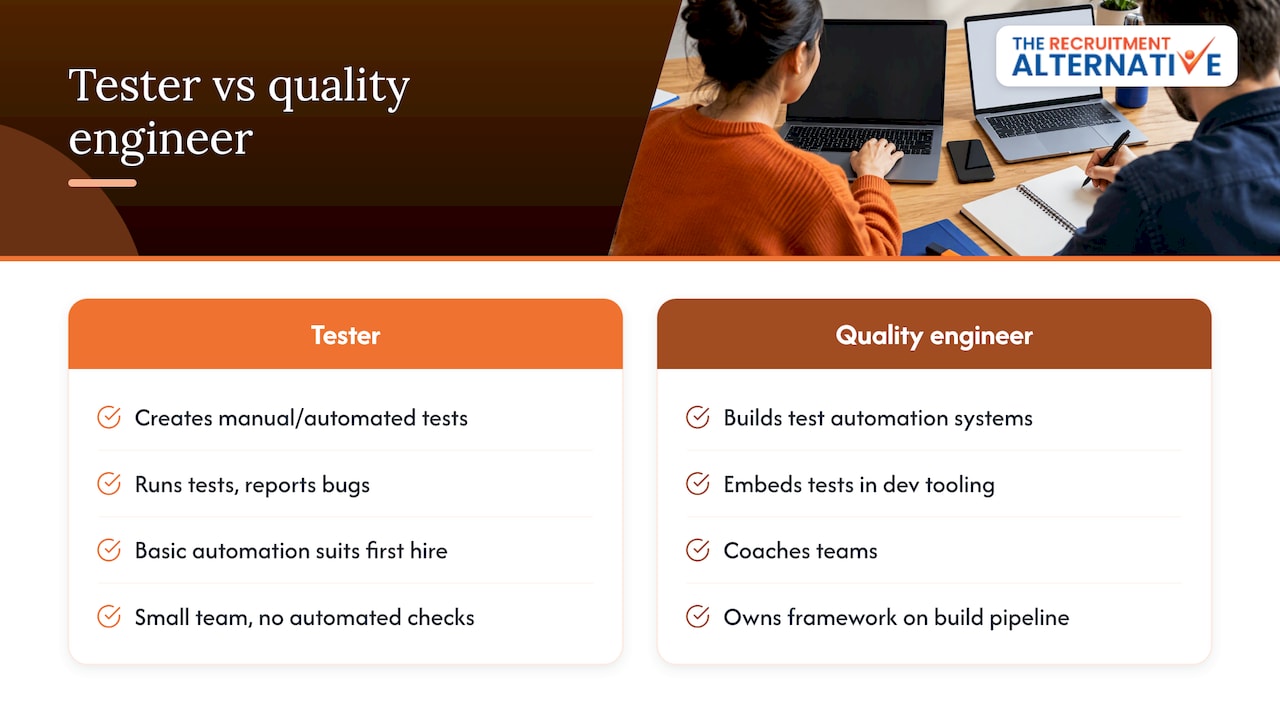
You will see both titles in job ads. One comparison of testers and quality engineers draws the line this way: testers create and run manual or automated tests and report bugs, while quality engineers build test automation systems, embed tests in development tooling and coach teams. In practice the titles are used loosely, and a tester at one company may do more automation than a quality engineer at another.
For a small business, this matters because you rarely need the full engineering role. If you have one product, a small development team and no automated checks, a capable tester who can also write basic automation is often the right first hire. If you already run a build pipeline and want someone to own the test framework, you are hiring a quality engineer or SDET (software development engineer in test), and you should price and screen accordingly.
Define the role before you advertise
Most failed hires trace back to a vague brief. Before you write the job description, answer five questions with whoever will manage the hire:
- What will this person own in their first 90 days?
- How much autonomy do they need?
- What technical constraints are fixed (your stack, your tools, your release cycle)?
- What would failure look like at six months?
- What would great look like at twelve months?
These questions come from a software hiring playbook that links poor role definition to most failed hires. Written down, they become your scorecard.
Then choose three to five must-have skills and separate them from nice-to-haves. For a QA role, the must-haves usually come from this list:
- Writing clear test cases and defect reports
- Understanding of agile delivery and how your team ships
- API testing (for example with Postman)
- Basic SQL for checking data
- One automation framework such as Playwright, Cypress or Selenium, if automation is part of the job
- Familiarity with a bug tracker such as Jira
This mirrors the skills an Australian QA hiring guide lists, including API testing, CI/CD knowledge, Jira, SQL and methods such as boundary value analysis and risk-based testing. A large employer will ask for more. A Qantas Group senior quality engineer posting from 2026 asks for six or more years of experience, scalable automation frameworks in CI/CD and API contract testing. That is a senior engineering role, not the profile most small businesses need first.
If your team has no written character or behaviour expectations for new hires, our guide to a character profile in job descriptions shows how to add them. For wider technology hiring, the technology role hiring checklist covers the steps around the brief.
What QA testers earn in Australia
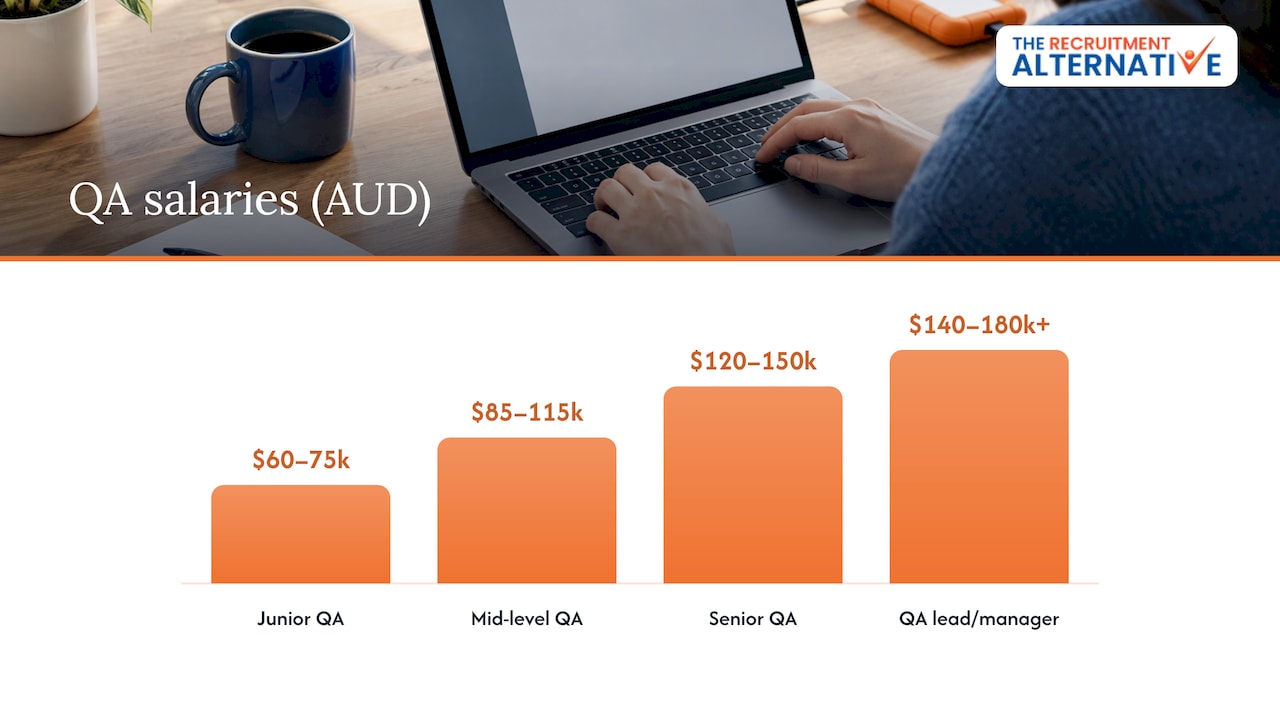
Salary data for testers varies by source, city and the way each source defines the role. Treat the ranges below as budgeting guides and check them against live job ads and salary tables for your city before you set a figure.
One Australian QA hiring guide published in November 2025 gives these benchmarks:
| Level | Typical experience | Budget range (AUD, base salary) |
|---|---|---|
| Junior QA | 0 to 2 years | $60,000 to $75,000 |
| Mid-level QA | 3 to 5 years | $85,000 to $115,000 |
| Senior QA | 6 to 10 years | $120,000 to $150,000 |
| QA lead or manager | 10+ years | $140,000 to $180,000+ |
A separate Australian software testing jobs guide for 2026 shows a similar pattern, with junior testers at $60,000 to $80,000 and senior automation engineers at $110,000 to $135,000. Automation skill is what moves the number: SDET roles sit well above manual-only roles in both sources.
Three things affect what you will actually pay:
- Automation skill. Candidates who can build and maintain automated suites are in shorter supply than manual testers, so they cost more and move faster.
- Location and industry. Sydney and Melbourne roles, and finance or government work that needs clearances, tend to carry higher salaries.
- Superannuation and extras. Base salary is not the full cost. Add superannuation and any bonus or tooling costs to your budget.
Where to find QA testers
Testers are found through the usual channels: job boards such as SEEK and Indeed, LinkedIn, referrals, QA and testing meetups, and university placement programs. The Australian hiring guide lists these as the main sources.
The difficulty for a small business is not finding applicants. A search for tester roles in Australia returns thousands of listings on the large job boards, which means your advertisement competes with many others, and the applicants you receive are a mix of strong testers, career changers and people applying to everything. The time cost sits in sorting them. That is where a recruiter earns their fee, provided the fee is not a percentage of a growing salary.
How to assess a QA tester
A tester’s value shows in how they think, not in the tools on their resume. A good process uses the same steps for every candidate and scores them against the same criteria.
Step 1: Screen the resume for evidence
Look for ownership of releases, regression work and examples of defects they found, not only a list of tools. Ask for concrete numbers where possible: how many releases they supported, how large the product was, what the test suite covered.
Step 2: Use a short practical exercise
A QA assessment guide suggests scoring four things rather than the final fix: reproduction (did they make the failure happen deliberately first), isolation (did they narrow down a cause), risk judgement (can they say what a test protects) and communication (could a developer act on their bug report without asking questions). Strong candidates reproduce first. Weak ones apply a retry or a delay and declare the problem solved.
A practical, low-cost version for a small business:
- Give them a real or sample feature, such as a search page or a login form.
- Allow 30 to 60 minutes.
- Ask them to explore it and write up what they find.
- Read the write-up the way a developer would.
One hiring guide for QA and SDET roles suggests asking candidates to talk through how they would test a login form for a banking app, covering test design, risk analysis and reporting. The answer shows process thinking and communication in a few minutes.
Step 3: Check automation with real code
For roles with automation, ask the candidate to write or review a small automated test. An automation hiring checklist says to read it like application code, looking at naming, structure and stability, and to ask how they diagnose and prevent flaky tests. It lists clean test code and a clear view of what to automate and what to leave manual as strengths. Reliance on record-and-playback tools alone and no pipeline experience are flags.
Step 4: Structure the interview
Ask every candidate the same questions and score each answer on a 1 to 5 scale before the team compares notes. The same QA and SDET hiring guide recommends behavioural questions that probe for specific past examples rather than hypotheticals. Our engineer interview questions guide sets out five checks for fair hiring in Australia, and the same approach applies to testers.
In Australia, keep the questions to the role. Anything unrelated to the inherent requirements of the job risks a discrimination complaint, which is why a written scorecard helps you as well as the candidate.
Step 5: Check references
Ask former managers about the tester’s reporting, reliability and how developers responded to their bug reports. A useful closing question is whether they would hire the person again.
How AI is changing what you should assess
Testers now use AI tools to draft test cases, summarise failures, generate test data and improve bug reports. One 2026 overview of AI in QA describes manual-only tester listings declining while roles that combine test design, automation and responsible use of AI tools grow, and says communication of risk in business language matters more as delivery speeds up.
For an employer, the practical conclusion is simple. Ask candidates how they use AI tools in their work and how they check what those tools produce. A tester who accepts generated tests without review is a risk. A tester who uses them to move faster and still checks the output is an asset. This is also a reason to prefer candidates with sound testing fundamentals: tools change, and judgement carries over.
Run the process quickly
Good testers are rarely on the market long. The software hiring playbook notes that offer acceptance falls significantly when time from final interview to offer exceeds ten business days, and suggests aiming to give a verbal offer within 48 hours. For a small business, that means deciding in advance who signs off the offer and what the salary ceiling is.
A realistic sequence looks like this:
- Agree the role, scorecard and salary range.
- Advertise and approach candidates directly.
- Screen resumes against the scorecard.
- Run the practical exercise.
- Hold one structured interview round, plus a second with a developer or product owner.
- Check references and make a verbal offer quickly, then confirm in writing.
For a broader walk-through of tech hiring, see how to recruit technology staff in Australia.
What it costs to recruit a tester for a flat fee
A percentage-based fee rises with the salary you offer. A flat fee does not. Our published pricing for permanent hires:
| Service | Engagement fee | Placement fee | Total |
|---|---|---|---|
| Recruit | $895 | $3,900 to $5,000 | $4,795 to $5,895 |
| Recruit+ | $2,495 | $5,000 to $6,000 | $7,495 to $8,495 |
The placement fee depends on the candidate’s salary, and you pay it only on a successful permanent placement. Optional extras are a criminal check at $129 and a psychometric evaluation at $199 per candidate. Full details are on our flat fee pricing page.
If the hire does not work out in the first two to three months, our candidate replacement insurance covers it, with a Replacement Campaign priced at $1,000. For a mid-level tester at $100,000, a flat fee in this range is a fixed, known cost from the start. Our flat fee recruitment benefits page explains how the model compares with percentage fees.
Our view: why flat fees suit tester hiring
Testers are a good example of a role where the percentage model works against the employer. The market has split between manual testers and automation engineers, and the automation end commands a higher salary. Under a percentage fee, the harder you need to look, the more you pay, even though the work of finding the candidate has not changed.
We built our model on the opposite idea. You know the cost before you start, and it does not move with the salary you offer. We claim savings of over 70% compared with traditional commission-based agencies, and we back the hire with a replacement guarantee for the first two to three months.
Our advice to small businesses is to write the scorecard first, keep the process short, and give a decision within days of the final interview. A clear brief and a fixed price remove most of the friction from hiring a tester.
Josh Townsend
Hire your QA tester with us
We recruit permanent staff across Australia and New Zealand, including technology and engineering roles, for a fixed fee. If you are hiring a tester or automation engineer, you can start with our fixed fee recruitment service, priced at $4,795 one-off, or compare Recruit and Recruit+ on the pricing page.
If the role sits within a wider engineering team, our engineering recruitment page explains how flat fees apply there.
FAQ
Should I hire a manual tester or an automation tester?
It depends on your product and release pace. If you ship often and run the same checks repeatedly, automation skills save time and are worth the higher salary. If your product is early stage and changing quickly, a strong manual and exploratory tester who can write some basic automation is often enough.
How long does it take to hire a QA tester?
The time varies with the role and market, but the stages you control are the screening, the practical exercise and the offer. Keeping the process to a short series of scheduled steps and giving an offer within days of the final interview helps you keep good candidates, as the hiring playbook notes about offer delays.
What is the difference between a QA tester and a quality engineer?
A tester finds problems in software that already exists by creating and running tests. A quality engineer builds the systems and processes that stop problems arising, including automation inside the development pipeline. Titles overlap between companies, so judge the role by its duties, not its name.
Can a small business afford a recruiter for a tester role?
Yes, with a fixed-fee model. Our Recruit service costs an $895 engagement fee plus a $3,900 to $5,000 placement fee, so the total is known before you start and does not rise with the salary.
Sources
- ABS: Unit Group 2722 ICT Quality Engineers and Test Analysts
- Tester vs Quality Engineer: what’s the difference?
- Hire Quality Assurance Engineers in Australia
- Senior Quality Engineer at Qantas Group
- How to Hire Software Engineers: A Practical Playbook
- Top Software Testing Jobs in Australia 2026
- QA Engineer Assessment
- Hiring for QA and SDET Roles
- How to Hire QA Automation Engineers
- How AI is Changing QA in 2026

